Homestead Purple verbena
Glandularia canadensis 'Homestead Purple'. Family Verbenaceae. Perennial.
Also called Homestead Purple rose verbena, Verbena canadensis 'Homestead Purple'.
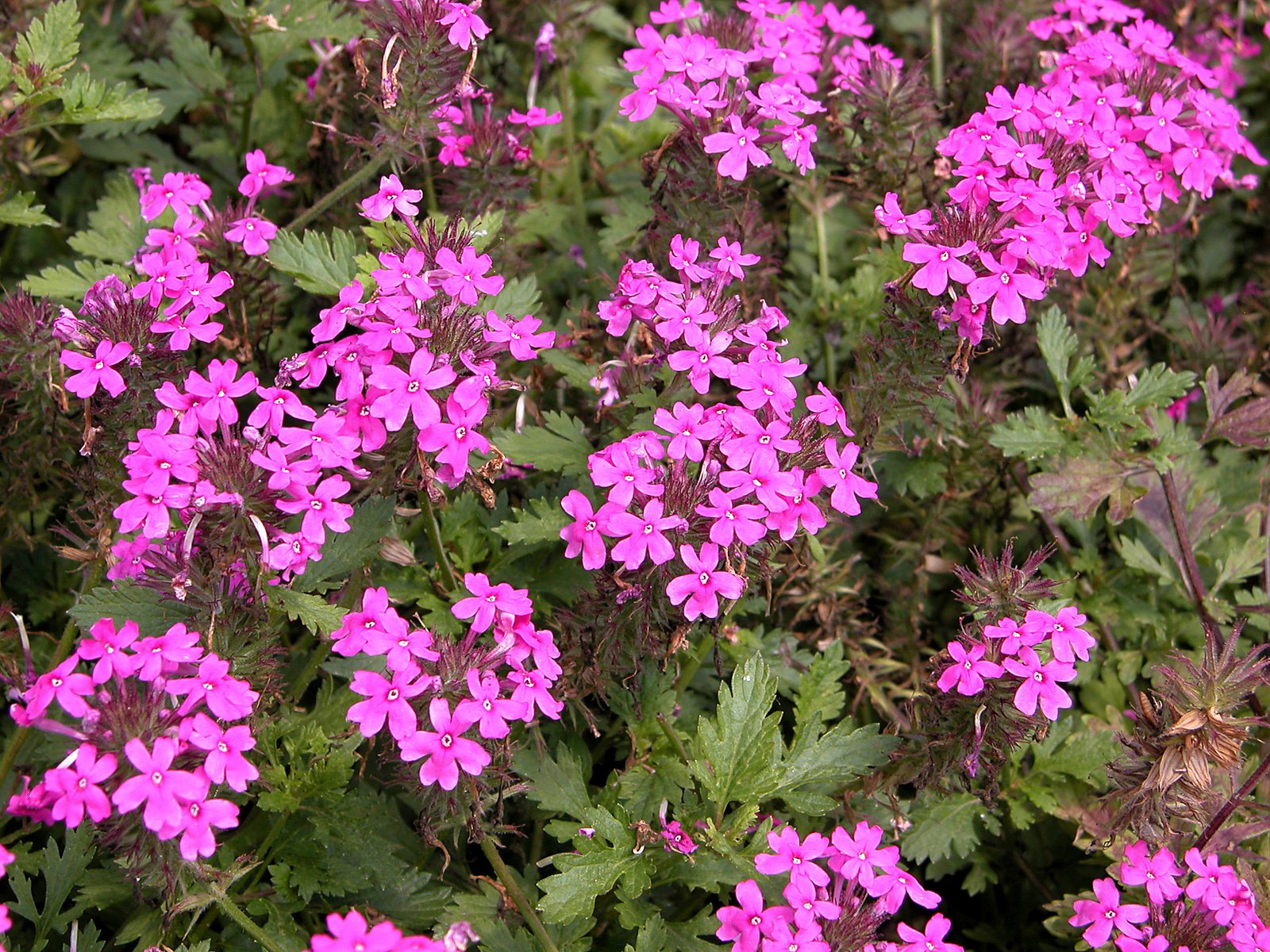
A low, spreading perennial grown for clusters of rich purple flowers from late spring until frost. Its trailing stems fill sunny border edges and spill over walls or containers, attracting butterflies. It is often grown as an annual in colder areas; winter survival is less dependable at the cold end of its range, especially in wet soil.
At a glance
- Sun
- Full sun; flowering becomes sparse and stems looser in shade.
- Water
- Water regularly while establishing, then deeply during prolonged dry spells. Container plants need more frequent watering.
- Soil
- Well-drained soil of average fertility; tolerates sandy or gravelly soil but dislikes heavy, persistently wet ground.
- Height
- 0.5-1 ft (0.15-0.3 m)
- Spread
- 1.5-3 ft (0.45-0.9 m)
- Flowers
- Rich purple flower clusters from late spring through autumn, often continuing until frost.
- Foliage
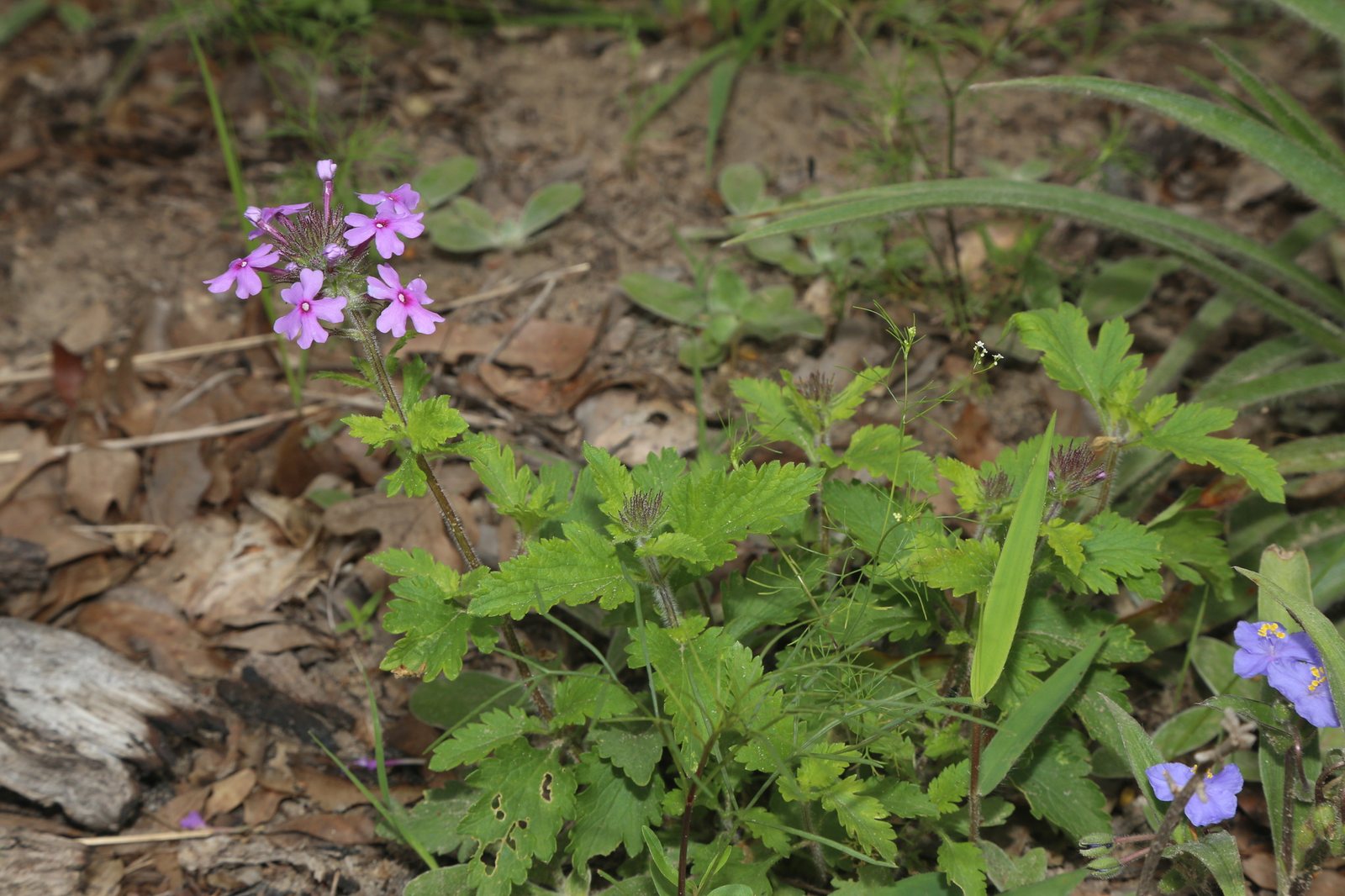
- Green, rough-textured, toothed to lobed leaves on branching, trailing stems; may retain foliage in mild winters.
- Growth
- Fast during warm weather.
- Care needed
- Low
The year at a glance
- Pollinators
- Deer resistant
- Drought tolerant
- Heat tolerant
- Low allergen
| J | F | M | A | M | J | J | A | S | O | N | D | |
|---|---|---|---|---|---|---|---|---|---|---|---|---|
| Flowers | ||||||||||||
| Plant |
Northern hemisphere months. In Australia, shift them by six.
- Difficulty
- Easy
- Toughness
- Fairly tough
Will it suit your garden?
Pick your zone, country, light and whether you have pets.
Full sun is 6 or more hours of direct sun a day, part shade 3 to 6 hours, shade under 3.
How it grows
Planting day
0.7 ft (0.22 m)
full size
About 2 years to full size.
From a typical nursery size, at an average rate for this kind of plant. A rule of thumb, not a forecast.
Good to know
- Cats and dogs
- Safe
- Native to
- the US
- In the garden
- Spreads vigorously: plan to contain it.
- Growth rate
- Fast
Care
Jobs through the year
- WaterApr–May, Sep–Oct, every 14 days
- Water established plants when upper soil dries; new plants and containers need more frequent watering.
- WaterJun–Aug, every 7 days
- Water established plants deeply during prolonged dry spells, skipping when soil is moist.
- FeedApr
- Feed lightly only if growth is weak; avoid excess nitrogen.
- PruneApr
- Remove dead stems once new shoots reveal which growth survived winter.
- PruneJun–Jul
- After the first main flush, trim flowering stems back by about one-third.
- ProtectJan–Feb, Oct–Dec
- Keep crowns clear of wet mulch and fallen leaves, and maintain free drainage.
- ProtectOct
- Move spare rooted cuttings into bright, frost-free shelter as insurance against winter loss.
- Plant after severe frost has passed, allowing room for stems to spread.
- Water at soil level when the upper soil dries; avoid keeping the crown wet.
- Feed lightly in spring if growth is weak; excess fertiliser encourages leafy growth rather than flowers.
- Keep mulch away from the crown, especially where winters are wet.
- In containers, use a free-draining potting mix and keep drainage holes clear.
Pruning. After the first main flush, trim flowering stems back by about one-third to encourage fresh growth and more flowers. Remove dead stems in spring once new growth shows which parts survived winter.
Through the year
- Early spring
- Check for surviving shoots and remove dead stems without cutting into fresh growth.
- Spring
- Plant once severe frost has passed; water well and leave space for outward growth.
- Early summer
- Take non-flowering stem cuttings to keep replacement plants.
- Summer
- Trim after the first heavy flowering flush and water during extended dry weather.
- Autumn
- Keep fallen leaves from smothering the crown and check that water drains freely.
- Winter
- In cold regions, keep rooted cuttings in a bright, frost-free place as insurance against outdoor losses.
In the garden
- Edge sunny paths and borders with a low ribbon of purple flowers.
- Let stems trail over retaining walls, raised beds or container rims.
- Plant beside ornamental grasses and upright salvias for contrasting shapes.
- Use between widely spaced, sun-loving perennials to cover bare soil without hiding taller flowers.
Garden styles it suits: Cottage garden, Pollinator garden, Dry gravel garden, Mediterranean, Blues and silvers and Small-space.
Plant it with: Catmint, Yarrow, Coreopsis, Salvia, Lavender and Little bluestem.
Wildlife: Flowers provide nectar for butterflies and other pollinating insects, including bees.
Problems to watch for
- Powdery mildew: provide full sun and good airflow, avoid crowding, and remove badly affected growth.
- Root or crown rot: improve drainage, keep mulch clear of the crown and avoid frequent watering of already moist soil.
- Spider mites in hot, dry conditions: inspect stippled leaves and rinse leaf undersides thoroughly; use insecticidal soap if needed, following the label.
- Winter loss: cold combined with wet soil can kill plants; use a freely draining site and overwinter spare cuttings under cover.
Safety
Not known to be toxic to people, cats, dogs or horses. No particular plant part is recognised as a serious poisoning hazard, but specific information for this cultivar is limited; it is not an edible plant.
Easily confused with
Tall verbena (Verbena bonariensis)
Has tall, stiff, upright stems carrying small purple flower clusters well above the foliage, rather than a low, spreading carpet.
Slender vervain (Verbena rigida)
Usually has more upright growth, narrow, stiff, sharply toothed leaves and smaller lilac-purple flower heads.
Garden verbena (Glandularia × hybrida)
Bedding hybrids can look very similar but come in many colours, often with contrasting eyes; a uniformly purple trailing plant cannot always be identified as 'Homestead Purple' without a reliable label.
The name
The cultivar name refers to the old Georgia homestead where this purple-flowered selection was found.
Propagation. Root softwood or non-flowering stem cuttings in spring or summer. Stems may also root where they touch moist soil and can be separated once well rooted. Seed does not reliably reproduce the cultivar.
Checked against open data
- Accepted botanical name
- Verbena canadensis Glandularia canadensis 'Homestead Purple' is an older name for Verbena canadensis.
- In the US and Canada
- Native in the lower 48 states.
Sources: GBIF (CC BY 4.0) and USDA PLANTS. The care and design notes are LandscapeGPT's own.
See it in your own yard.
Upload a photo of your yard and see it redesigned with plants that suit your climate, each checked against your zone.