Horseradish
Armoracia rusticana. Family Brassicaceae. Perennial.
Also called Horse radish.
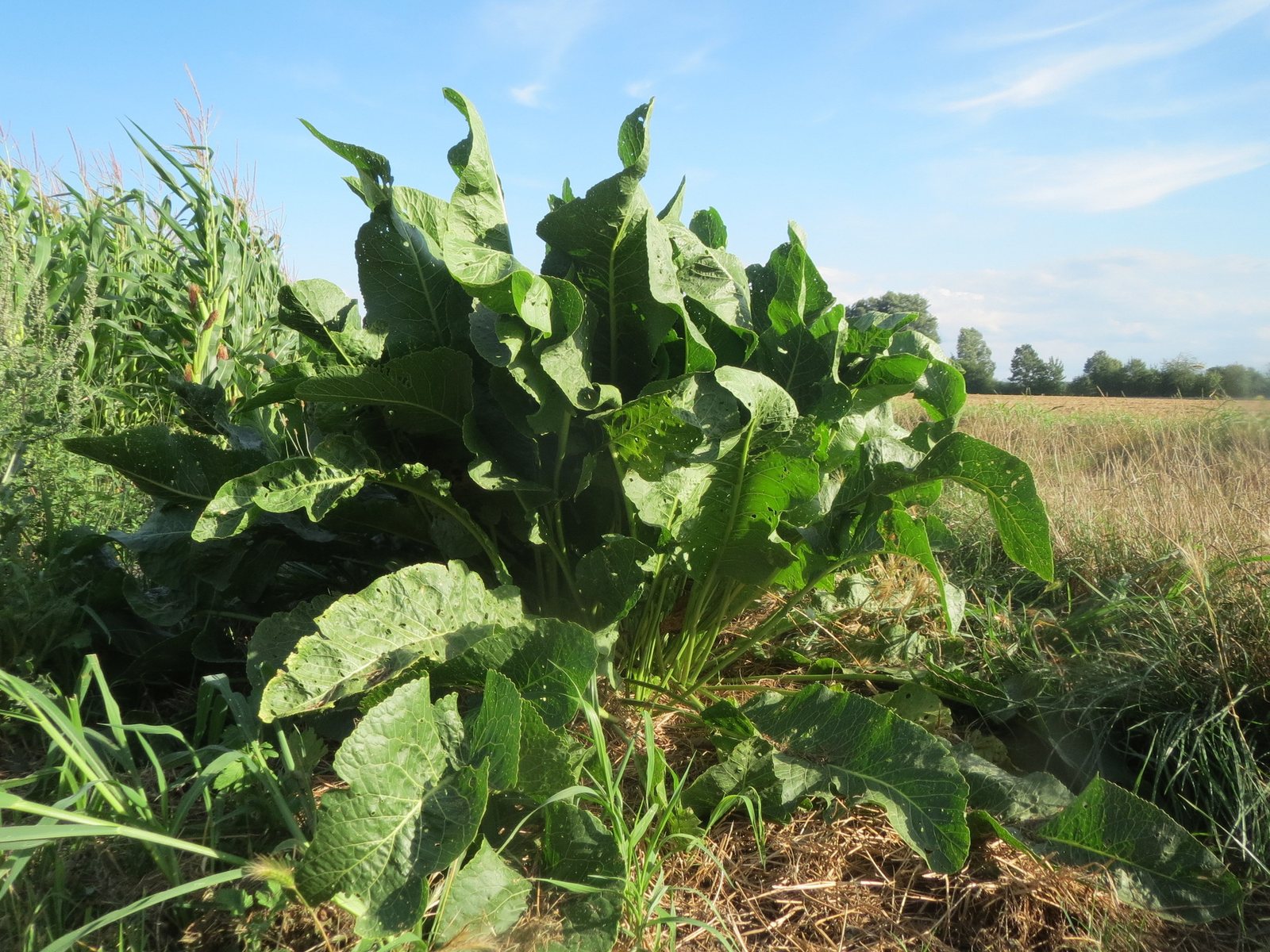
Horseradish is a hardy, clump-forming perennial grown for its thick roots, which become sharply pungent when grated. Its large leaves make a bold patch in the kitchen garden, but leftover root fragments readily regrow, so give it a permanent, contained position.
At a glance
- Sun
- Full sun to partial shade; full sun usually produces the best roots.
- Water
- Water deeply during dry spells, keeping the root zone evenly moist but never waterlogged.
- Soil
- Deep, fertile, well-drained soil, preferably a loose loam. Stony or compacted soil produces forked roots.
- Height
- 2-3 ft (0.6-0.9 m), with flower stems sometimes reaching 4 ft (1.2 m)
- Spread
- 2-3 ft (0.6-0.9 m) per clump; roots can spread farther over time
- Flowers
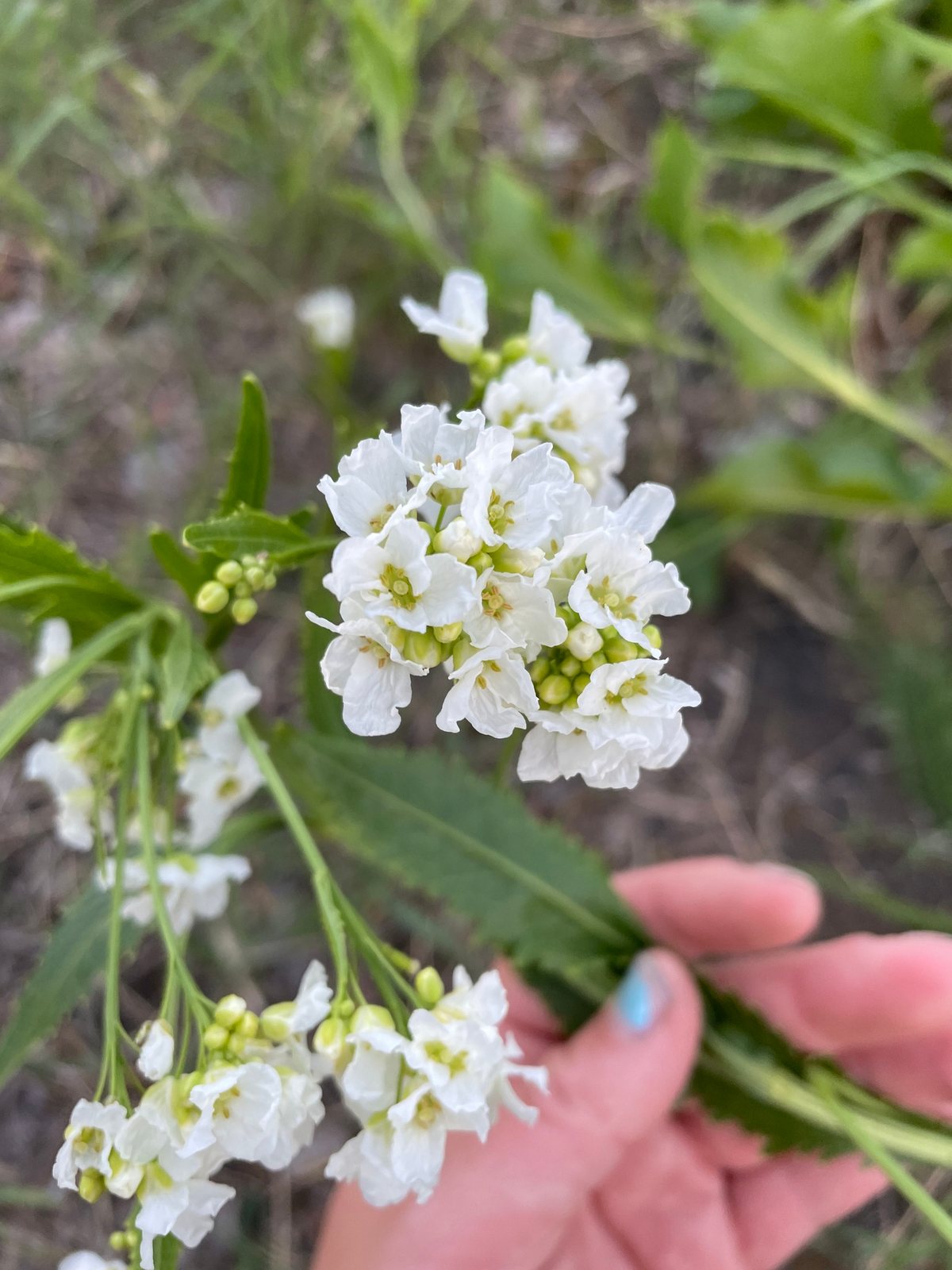
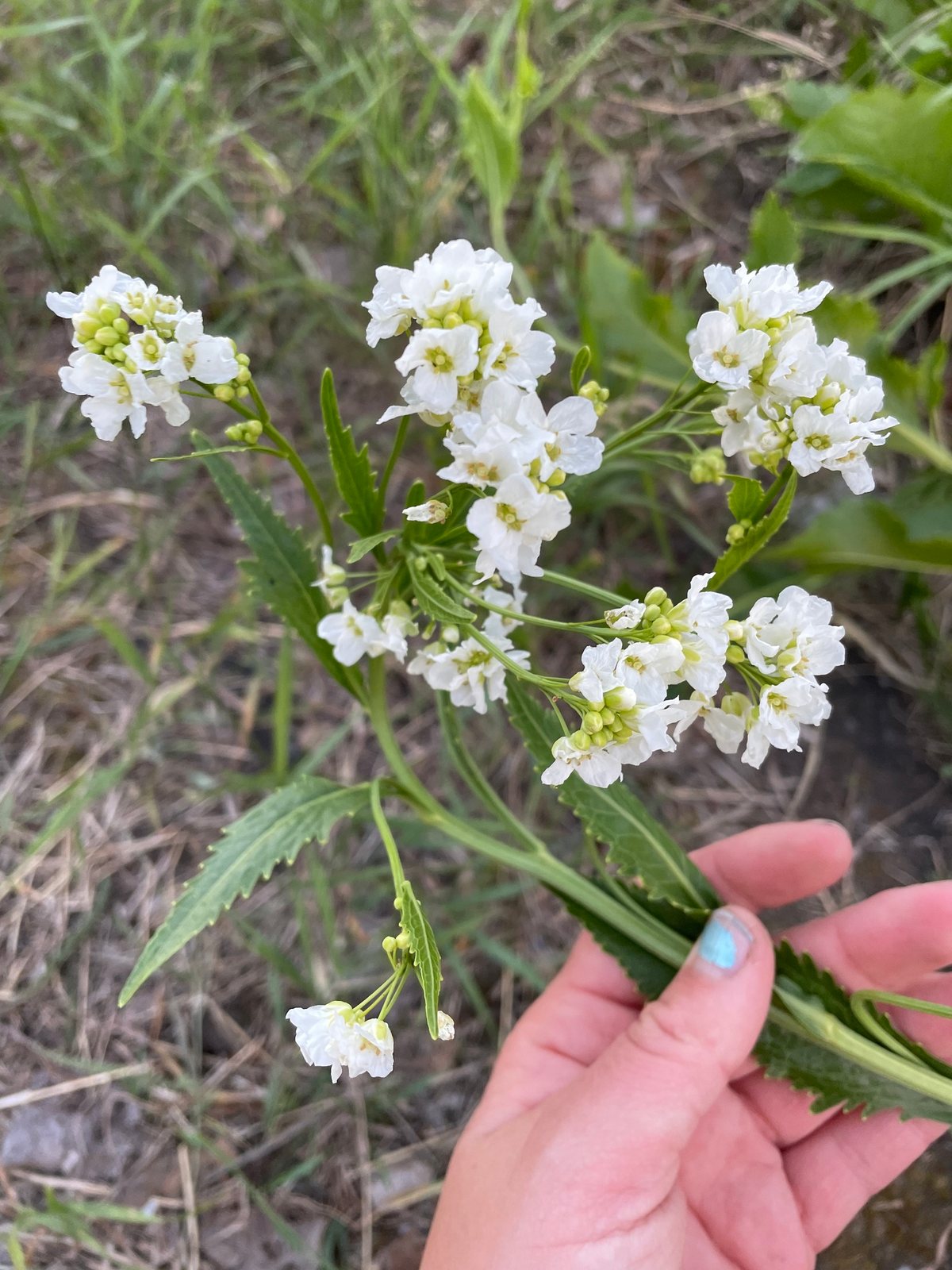
- Small white flowers in loose clusters in late spring to early summer; flowering can be sparse.
- Foliage
- Large, upright, glossy green leaves with prominent veins, wavy edges and coarse teeth; dies back in cold winters.
- Growth
- Fast
- Care needed
- Medium
The year at a glance
- Pollinators
- Cold hardy
- Low allergen
- Edible
| J | F | M | A | M | J | J | A | S | O | N | D | |
|---|---|---|---|---|---|---|---|---|---|---|---|---|
| Flowers | ||||||||||||
| Fruit | ||||||||||||
| Plant |
Northern hemisphere months. In Australia, shift them by six.
- Difficulty
- Easy
- Toughness
- Very tough
Will it suit your garden?
Pick your zone, country, light and whether you have pets.
Full sun is 6 or more hours of direct sun a day, part shade 3 to 6 hours, shade under 3.
How it grows
Planting day
1 ft (0.3 m)
After 1 year
1.7 ft (0.53 m)
After 2 years
2.5 ft (0.75 m)
full size
About 2 years to full size.
From a typical nursery size, at an average rate for this kind of plant. A rule of thumb, not a forecast.
Good to know
- Cats and dogs
- Mildly toxic: may upset a stomach
- In the garden
- Spreads vigorously: plan to contain it.
- Growth rate
- Fast
Care
Jobs through the year
- WaterApr–May, Sep–Oct, every 14 days
- Deep-water established plants during dry spells; new root cuttings need closer attention.
- WaterJun–Aug, every 7 days
- Water deeply when rain is insufficient to prevent tough roots.
- MulchMar–Apr
- Add mature compost before planting; avoid heavy nitrogen feeding.
- MulchMay
- Mulch around established plants to conserve moisture and suppress weeds.
- PruneMay–Jun
- Remove flower stems if root production is the priority; leave them for insects otherwise.
- PruneNov
- Cut dead foliage to ground level after autumn dieback.
- HarvestJan–Feb, Nov–Dec
- Lift useful roots after dieback when soil is workable; collect fragments to prevent spread.
- DivideMar
- If renewing the patch, lift selected roots and replant a few cuttings in a contained bed.
- Plant root cuttings in early spring in deeply loosened soil.
- Mix in mature compost before planting; avoid heavy nitrogen feeding, which encourages leaves rather than roots.
- Water during dry weather to support root growth and reduce toughness.
- Mulch around plants to conserve moisture and suppress weeds.
- Use a large container or a dedicated bed, and remove unwanted shoots with their roots.
Pruning. Remove flower stems as they appear if root production is your priority. Cut dead foliage to ground level after autumn dieback, and remove badly damaged leaves during the growing season.
Harvest
Lift thick roots in late autumn or winter once the leaves die back, usually after one full growing season; roots about a finger's thickness or larger are useful for grating. Loosen the soil deeply with a fork and lift carefully, collecting fragments to prevent unwanted regrowth.
Through the year
- Early spring
- Prepare a contained bed or large container with compost and plant root cuttings.
- Late spring
- Weed around young plants, mulch the soil and remove unwanted shoots.
- Early summer
- Remove flower stems if you want to concentrate growth on the roots.
- Summer
- Water deeply in dry spells and check leaves for flea beetles and caterpillars.
- Late autumn
- After foliage dies back, cut it down and lift roots for the kitchen.
- Winter
- Harvest when soil is workable, and store spare roots cool and moist without allowing them to freeze.
In the garden
- Place in a dedicated corner of a kitchen garden where persistent roots will not disturb crop rotations.
- Grow in a large, deep container near the kitchen for accessible harvesting and easier control.
- Use its bold leaves behind lower herbs such as chives and thyme in an edible border.
- Include in a spacious homestead or perennial food garden, separated from delicate, slow-growing crops.
Garden styles it suits: Potager (kitchen garden), Cottage garden, Farmhouse, Edible landscape, Homestead and Sensory garden.
Plant it with: Chives, Thyme, Calendula and Nasturtium.
Wildlife: Flowers provide nectar and pollen for visiting insects. As a cabbage-family plant, it can also feed cabbage white butterfly caterpillars.
Problems to watch for
- Flea beetles make small holes in young leaves: protect new growth with fine insect mesh and keep plants watered.
- Cabbage caterpillars chew leaves: inspect leaf undersides and hand-pick caterpillars, or protect plants with insect mesh.
- Waterlogged soil causes root decay: improve drainage or grow in a raised bed or container.
- Unwanted regrowth follows harvesting or digging: remove root fragments carefully and repeatedly dig out new shoots; do not cultivate through an established patch.
Safety
The roots are edible for people in small condiment quantities, but their mustard oils can irritate skin, eyes and the digestive tract; large amounts can cause significant stomach upset. Roots and leaves should not be fed to cats, dogs or horses, as chewing releases irritating compounds that can cause digestive upset, particularly in quantity.
Where it spreads. Spreads aggressively from persistent roots and discarded root fragments. It escapes cultivation in parts of the northern United States and southern Canada and can become a persistent garden escape in the United Kingdom and temperate southeastern Australia; keep it away from natural areas and do not dump roots with garden waste.
Easily confused with
Broad-leaved dock (Rumex obtusifolius)
Dock usually has broader, heart-based leaves and produces tall spikes of small green flowers followed by brown seeds. Horseradish has elongated, coarsely toothed leaves and white, four-petalled flowers.
Comfrey (Symphytum officinale)
Comfrey leaves and stems are conspicuously rough and hairy, and its flowers are hanging bells. Horseradish leaves are mostly hairless, with small white flowers in open clusters.
The name
The botanical epithet rusticana means 'of the countryside' or 'rustic'.
Propagation. Propagate by pencil-thick root cuttings in early spring. Set cuttings about 8-12 in (20-30 cm) long at an angle, with the upper end roughly 2 in (5 cm) below the soil surface; space plants 18-24 in (45-60 cm) apart.
Checked against open data
- Accepted botanical name
- Armoracia rusticana
- In the US and Canada
- Introduced in Canada and the lower 48 states.
- Native range
- South European Russi and Ukraine.
- Measured
- Soil pH 5.5 to 6.5. Average height 100 cm.
Sources: GBIF (CC BY 4.0), USDA PLANTS and Trefle (CC BY 4.0). The care and design notes are LandscapeGPT's own.
See it in your own yard.
Upload a photo of your yard and see it redesigned with plants that suit your climate, each checked against your zone.