Indian bean tree
Catalpa bignonioides. Family Bignoniaceae. Tree.
Also called Southern catalpa, Cigar tree.
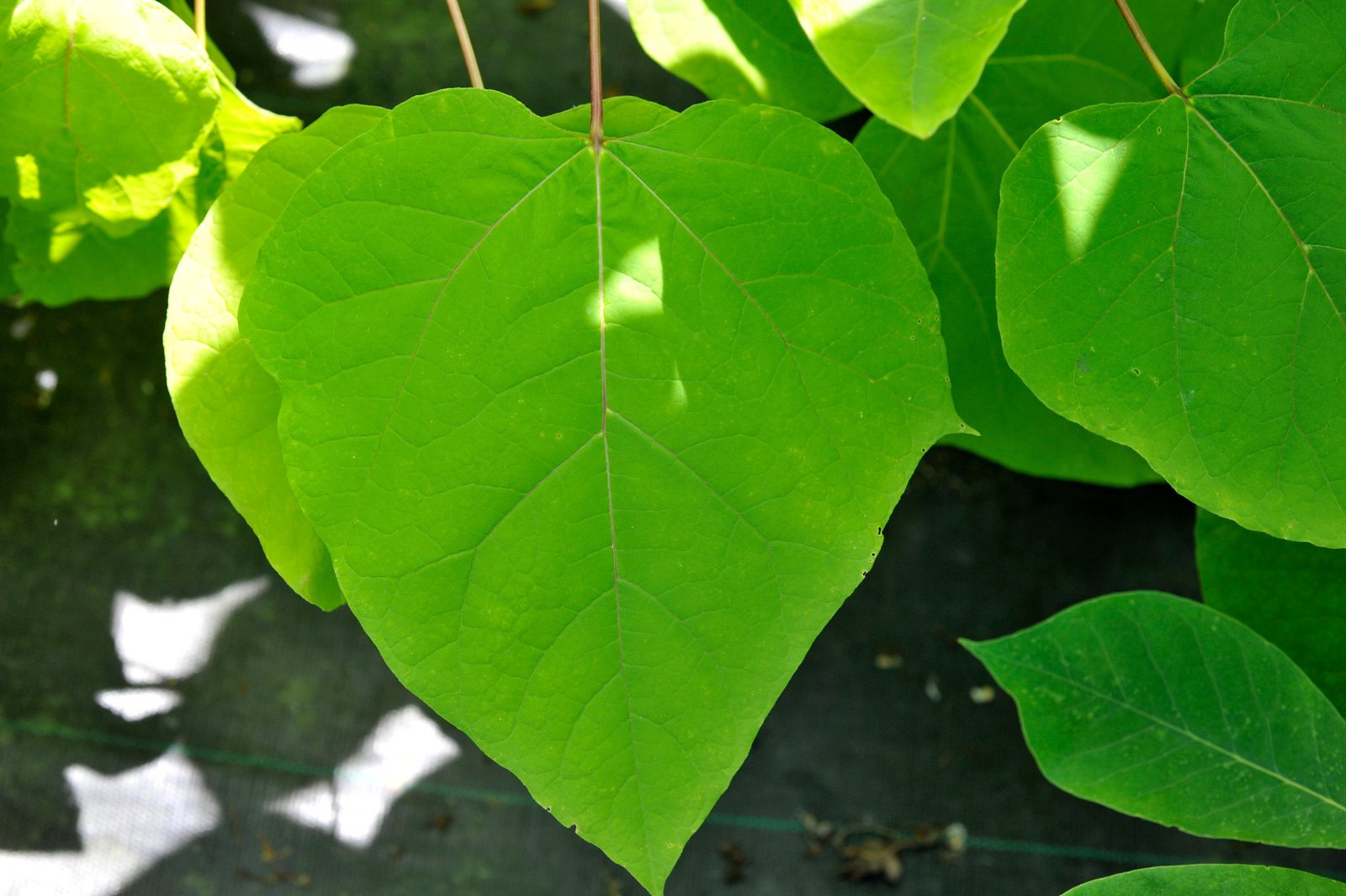
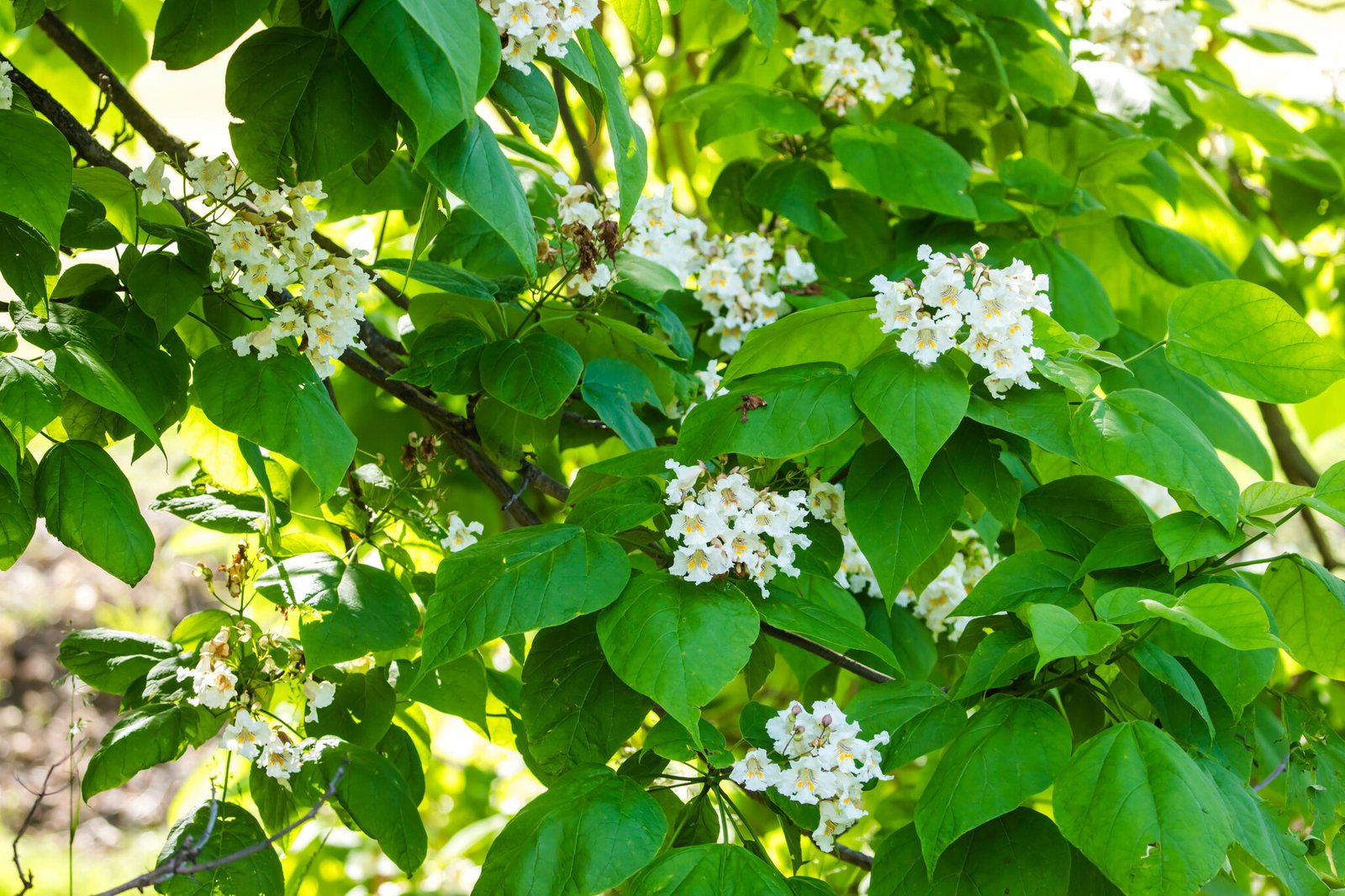
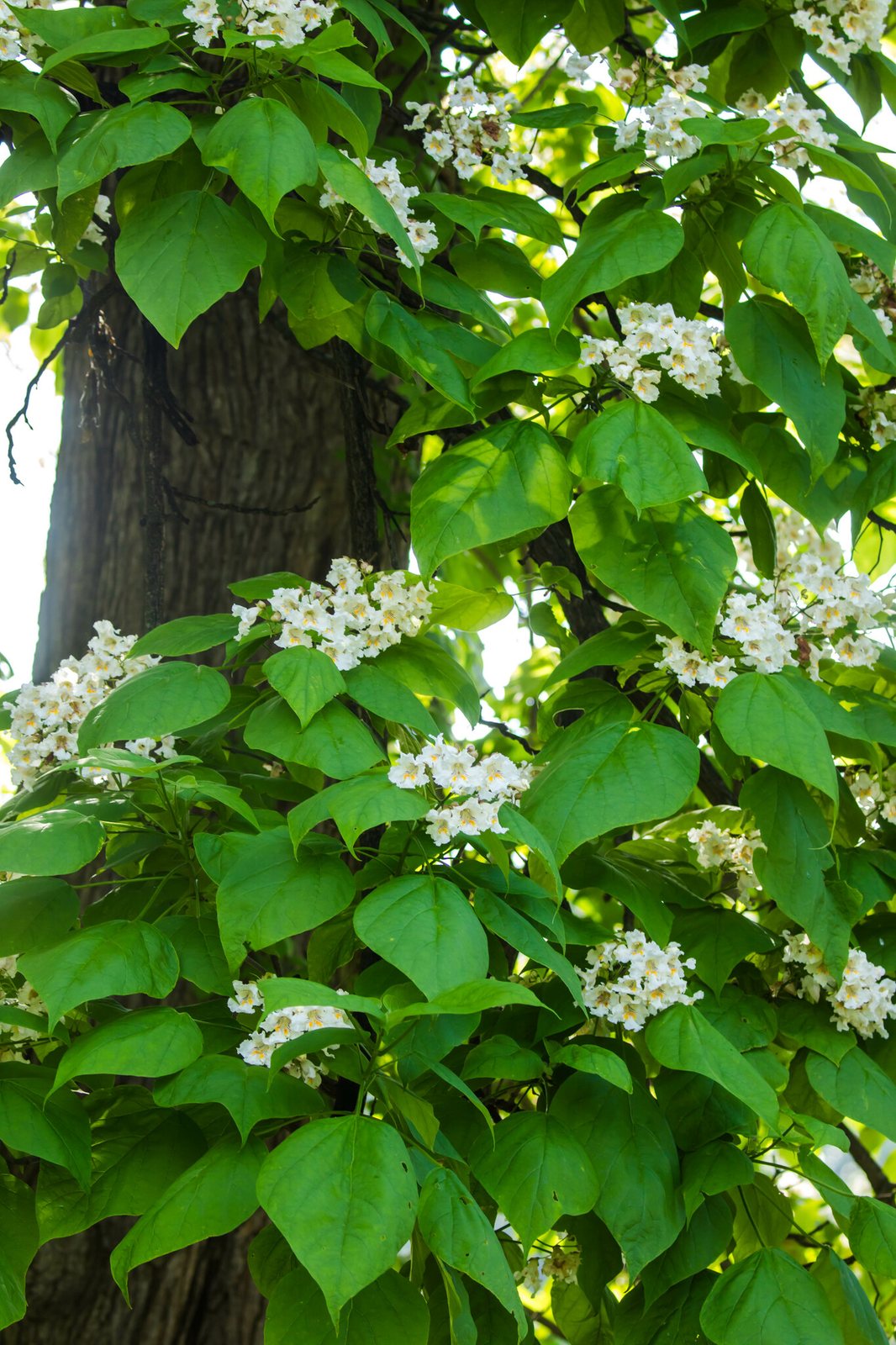
A deciduous tree native to the southeastern United States, grown for its large, heart-shaped leaves, upright clusters of white flowers and long, hanging seed pods. Its broad crown provides summer shade, but falling flowers, leaves and pods make it better suited to lawns than beside pools or busy paving.
At a glance
- Sun
- Full sun for the best flowering; tolerates partial shade.
- Water
- Water regularly while establishing. Established trees tolerate short dry spells, but grow best with moderate moisture.
- Soil
- Adaptable to clay, loam or sandy soil, including alkaline soil; prefers fertile, moist but well-drained ground.
- Height
- 30-50 ft (9-15 m)
- Spread
- 20-40 ft (6-12 m)
- Flowers
- Early to midsummer; upright clusters of white, trumpet-shaped flowers marked with yellow and purple inside.
- Foliage
- Large, soft, heart-shaped green leaves, usually opposite or in whorls of three; emerge late in spring and turn yellowish before falling in autumn.
- Growth
- Fast when young, slowing with maturity.
- Care needed
- Medium
The year at a glance
- Pollinators
- Heat tolerant
- Wildlife
- Low allergen
| J | F | M | A | M | J | J | A | S | O | N | D | |
|---|---|---|---|---|---|---|---|---|---|---|---|---|
| Flowers | ||||||||||||
| Fruit | ||||||||||||
| Plant |
Northern hemisphere months. In Australia, shift them by six.
- Difficulty
- Easy
- Toughness
- Very tough
Will it suit your garden?
Pick your zone, country, light and whether you have pets.
Full sun is 6 or more hours of direct sun a day, part shade 3 to 6 hours, shade under 3.
How it grows
Planting day
7 ft (2 m)
After 1 year
8 ft (2.5 m)
After 2 years
10 ft (3 m)
After 3 years
11 ft (3.5 m)
After 5 years
15 ft (4.5 m)
About 20 years to full size.
From a typical nursery size, at an average rate for this kind of plant. A rule of thumb, not a forecast.
Good to know
- Cats and dogs
- Safe
- Native to
- the US
- Growth rate
- Moderate
Care
Jobs through the year
- WaterApr–May, Sep–Oct, every 14 days
- Deep-water established trees only if soil is drying; water young trees more often.
- WaterJun–Aug, every 10 days
- Water deeply in extended dry spells, especially during the first two growing seasons.
- MulchMar–Apr
- Maintain 5–8 cm of organic mulch over roots, clear of the trunk.
- FeedMar–Apr
- Feed only for weak growth or a soil-test deficiency; avoid routine high-nitrogen feeding.
- PruneFeb–Mar
- Lightly train young trees and remove damaged or crossing wood; hard cutting sacrifices flowers and pods.
- ProtectNov–Dec
- Inspect weak forks and storm damage; have split or hanging limbs assessed professionally.
- Plant where the mature crown has room to spread, away from exposed, windy positions.
- Water deeply during dry spells for the first two growing seasons, moistening the root zone rather than sprinkling the surface.
- Apply 2-3 in (5-8 cm) of organic mulch over the root area, keeping it clear of the trunk.
- Feed only if growth is weak or a soil test shows a deficiency; avoid routine high-nitrogen feeding.
- Stake only if the root ball moves in the wind, and remove supports once the tree is firmly rooted.
- Collect fallen pods where tidiness matters and pull unwanted seedlings while small.
Pruning. In late winter or early spring, remove dead, damaged or crossing branches and establish a well-spaced framework while the tree is young. Hard annual cutting produces larger leaves but sacrifices flowers and pods; avoid this treatment on a mature, untrained tree.
Through the year
- Late winter
- Check the branch structure and prune young trees before growth starts; leave large limbs to a qualified arborist.
- Spring
- Plant in cold regions once the ground is workable, renew mulch and check that ties are not cutting into the bark.
- Late spring
- Allow for naturally late leaf emergence before deciding that bare branches are dead.
- Summer
- Water establishing trees deeply during dry weather and check leaves for mildew or caterpillar feeding.
- Autumn
- Rake fallen leaves and pods from paths, and remove unwanted seedlings.
- Winter
- Inspect for storm damage and enjoy the persistent hanging pods; arrange professional assessment of split or hanging limbs.
In the garden
- Use as a specimen tree in a generous lawn, where its spreading crown and summer flowers can be seen clearly.
- Place behind shrub borders to provide a bold, large-leaved canopy above finer foliage.
- Combine with ferns and shade-tolerant perennials beneath the outer crown for a woodland-edge planting.
- Use its broad leaves as a cool-climate contrast to grasses and other fine-textured planting.
Garden styles it suits: Architectural minimal, Traditional, Southern, Grand estate, Woodland and English country.
Plant it with: Oakleaf hydrangea, Hosta, Epimedium, Japanese painted fern, Siberian bugloss and Virginia sweetspire.
Wildlife: Flowers attract bees and other pollinating insects. In North America, the leaves feed catalpa sphinx caterpillars, which in turn support birds and parasitic wasps.
Problems to watch for
- Powdery mildew: white coating develops on leaves, especially late in the season. Improve airflow, avoid drought stress and collect fallen foliage; established trees rarely need treatment.
- Verticillium wilt: individual branches wilt or die back. Have the cause confirmed, remove dead wood, maintain even moisture and avoid replanting susceptible trees in affected soil.
- Catalpa sphinx caterpillars in North America: heavy feeding can strip leaves. Healthy established trees usually recover; hand-pick caterpillars on small trees if necessary and avoid broad-spectrum sprays.
- Wind or storm breakage: brittle branches and weak forks can fail. Choose a sheltered site, train young trees and have suspect mature limbs assessed by an arborist.
Safety
Not known to be toxic to cats, dogs or horses. Human toxicity information is limited; the long pods are not edible beans, and seeds, bark and roots should not be eaten.
Easily confused with
Northern catalpa (Catalpa speciosa)
Usually a taller, more upright tree, with larger flowers in fewer-flowered clusters and generally thicker pods. Leaf and tree size overlap, so compare flowers and mature pods rather than habit alone.
Foxglove tree (Paulownia tomentosa)
Has similarly large leaves, but bears purple flowers before the leaves and oval, woody seed capsules rather than long, slender pods.
Yellow catalpa (Catalpa ovata)
Has smaller, pale yellow flowers and leaves that are often shallowly three-lobed, rather than the mostly unlobed leaves and white flowers of Indian bean tree.
The name
Catalpa derives from a Muscogee name for the tree, bignonioides means resembling Bignonia, and Indian bean tree refers to its long, bean-like seed pods.
Propagation. Sow ripe seed in spring in pots or a nursery bed, lightly covering it and keeping it moist. Named cultivars do not reliably come true from seed and are usually propagated by grafting.
Checked against open data
- Accepted botanical name
- Catalpa bignonioides
- In the US and Canada
- Native in the lower 48 states. Introduced in Canada.
- Native range
- Alabama, Florida, Georgia, Louisiana, Mississippi and Texas.
- Measured
- Soil pH 5.5 to 7.5. Average height 1750 cm.
Sources: GBIF (CC BY 4.0), USDA PLANTS and Trefle (CC BY 4.0). The care and design notes are LandscapeGPT's own.
See it in your own yard.
Upload a photo of your yard and see it redesigned with plants that suit your climate, each checked against your zone.