Indian hawthorn
Rhaphiolepis indica. Family Rosaceae. Shrub.
Also called India hawthorn.
Indian hawthorn is a rounded evergreen shrub grown for glossy leaves, clusters of spring flowers and blue-black fruits. It makes a compact hedge or foundation shrub in mild climates and tolerates coastal exposure, but cold winters and leaf spot limit its usefulness elsewhere.
At a glance
- Sun
- Full sun to light partial shade; flowering and leaf health are usually best in sun. Choose shelter from cold, drying winds near its cold limit.
- Water
- Water regularly while establishing. Once established, water deeply during prolonged dry spells; avoid frequent shallow watering and wetting the leaves.
- Soil
- Well-drained soil, preferably slightly acidic to neutral. Tolerates sandy and clay soils if drainage is good; avoid waterlogged ground.
- Height
- 4-6 ft (1.2-1.8 m), occasionally taller
- Spread
- 4-6 ft (1.2-1.8 m)
- Flowers
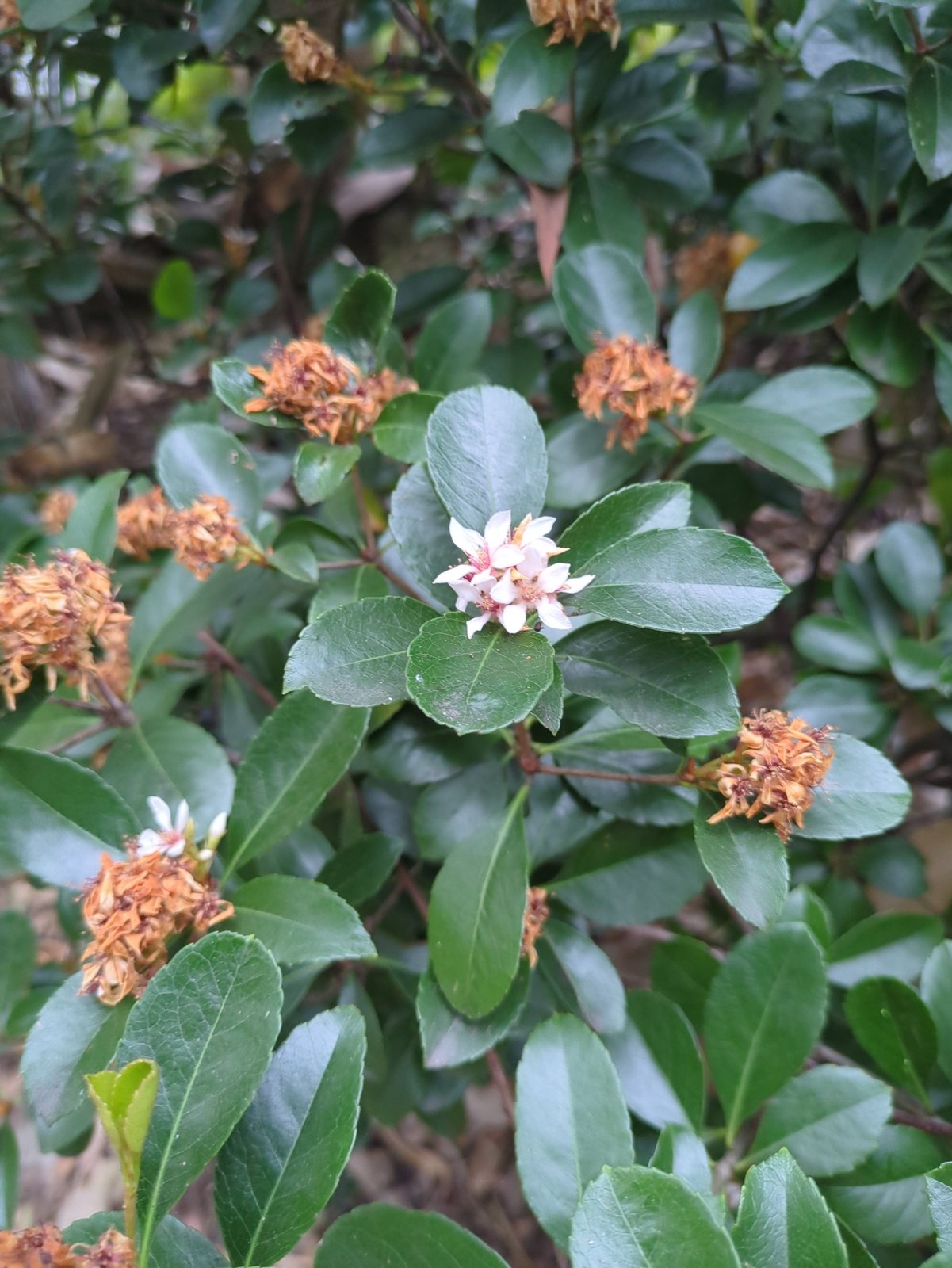
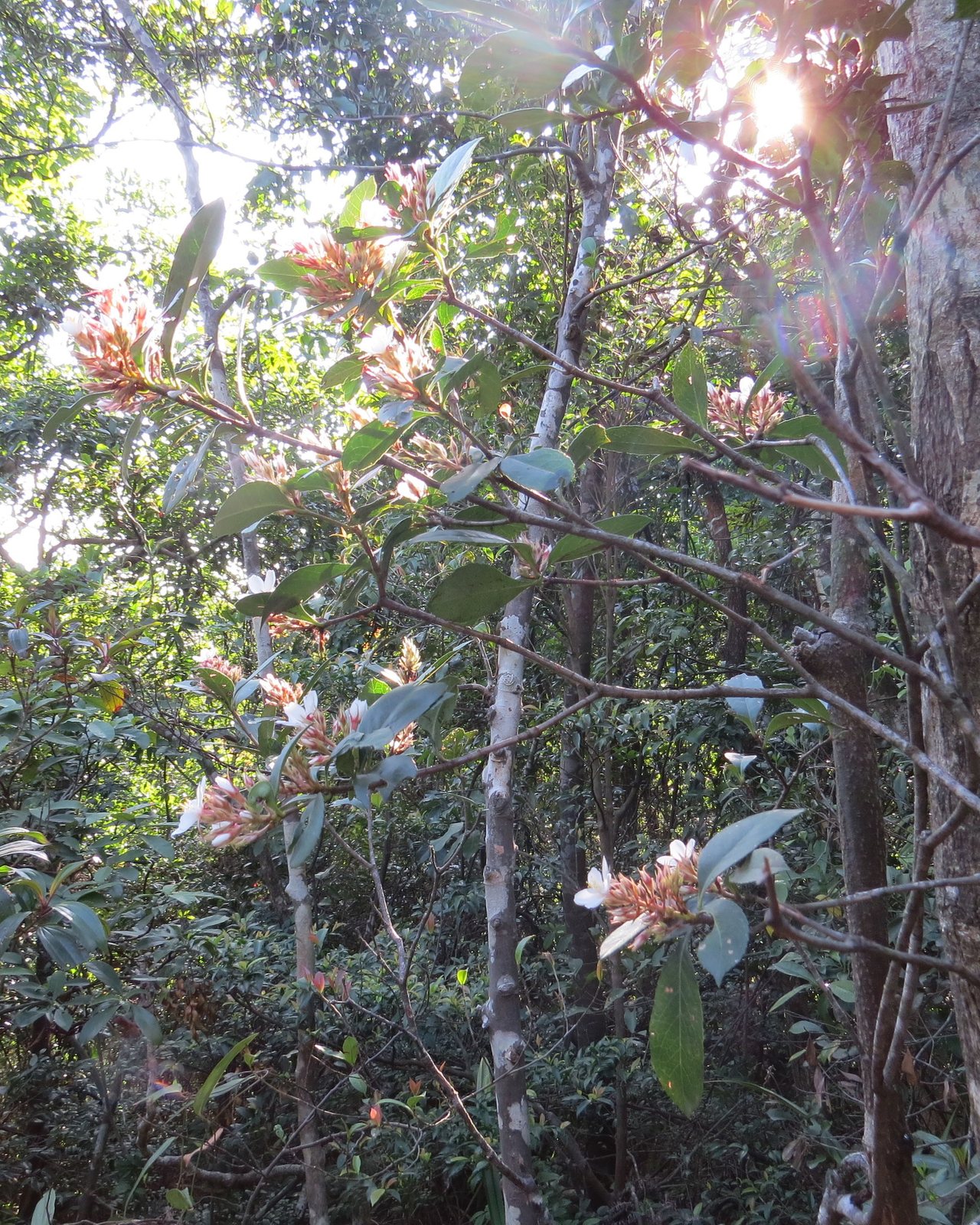
- White to pale pink, sometimes deeper pink in named selections, in spring; occasional scattered flowers later.
- Foliage
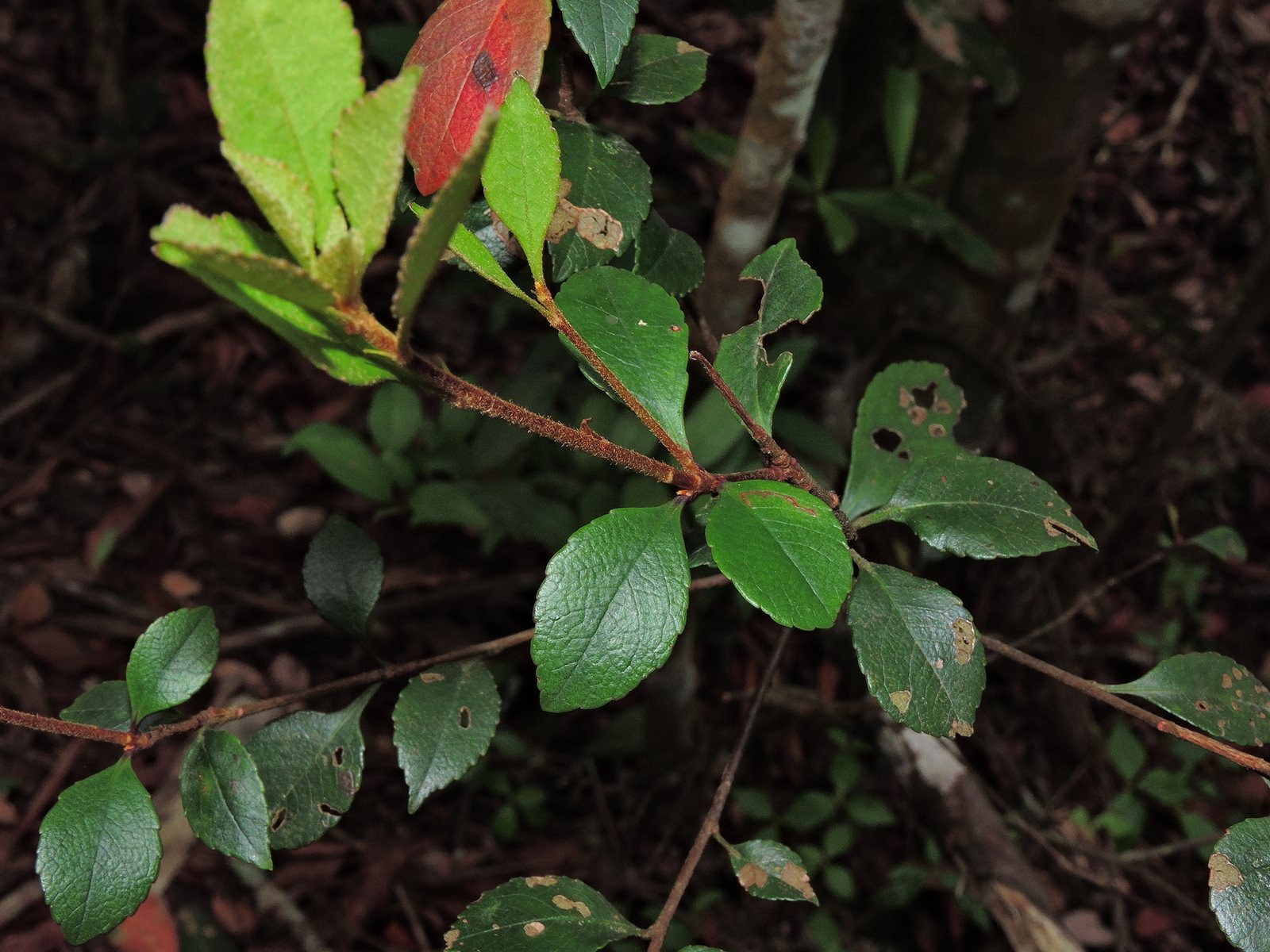
- Evergreen. Leathery, glossy dark green leaves with toothed margins; new growth is often bronze or reddish. Older leaves may turn red before falling.
- Growth
- Slow to moderate
- Care needed
- Medium
The year at a glance
- Pollinators
- Drought tolerant
- Heat tolerant
- Wildlife
- Low allergen
- Fragrant
| J | F | M | A | M | J | J | A | S | O | N | D | |
|---|---|---|---|---|---|---|---|---|---|---|---|---|
| Flowers | ||||||||||||
| Fruit | ||||||||||||
| Plant |
Northern hemisphere months. In Australia, shift them by six.
- Difficulty
- Hard
- Toughness
- Needs looking after
Will it suit your garden?
Pick your zone, country, light and whether you have pets.
Full sun is 6 or more hours of direct sun a day, part shade 3 to 6 hours, shade under 3.
How it grows
Planting day
1.6 ft (0.5 m)
After 1 year
2.1 ft (0.65 m)
After 2 years
2.7 ft (0.81 m)
After 3 years
3 ft (0.96 m)
After 5 years
4 ft (1.3 m)
About 7 years to full size.
From a typical nursery size, at an average rate for this kind of plant. A rule of thumb, not a forecast.
Good to know
- Cats and dogs
- Safe
- Invasive in
- Australia
- Growth rate
- Slow
Care
Jobs through the year
- WaterApr–May, Sep–Oct, every 14 days
- Water established shrubs only when soil is drying; new plants and containers need more frequent checks.
- WaterJun–Aug, every 10 days
- Water deeply during prolonged dry spells, keeping foliage dry and allowing drainage.
- MulchApr–May
- Refresh a 5–8 cm organic mulch layer, keeping it clear of stems.
- FeedApr–May
- Feed lightly with shrub fertilizer only if growth is weak.
- PruneJun
- Lightly shape just after flowering and remove dead wood; avoid repeated shearing.
- ProtectJan–Apr, Oct–Dec
- In zones 6–7, overwinter containers in bright, frost-free shelter; remove spotted fallen leaves promptly.
- Water deeply during the first growing season whenever the root zone begins to dry.
- Apply 2-3 in (5-8 cm) of organic mulch, keeping it clear of the stems.
- Feed lightly in spring with a general-purpose shrub fertilizer if growth is weak; avoid heavy feeding.
- Allow space between plants for air circulation, and use drip irrigation rather than overhead sprinklers.
- Remove fallen spotted leaves promptly to reduce disease carryover.
Pruning. Prune lightly just after flowering, shortening stray shoots and removing dead or damaged wood. Avoid repeated shearing, which removes flower buds and creates dense growth that encourages leaf spot.
Through the year
- Early spring
- Check for winter damage and remove clearly dead wood once new growth reveals what has survived.
- Spring
- Refresh mulch and feed lightly if needed.
- Late spring
- After flowering, lightly shape the shrub if necessary.
- Summer
- Water young plants during dry weather and check leaves for spotting.
- Autumn
- Collect diseased fallen leaves; avoid pruning that would remove next spring's flowers.
- Winter
- Protect young plants from severe frost near the cold limit, and keep containers from becoming waterlogged.
In the garden
- Use as a low, informal hedge along a sunny path, allowing room for its natural rounded outline.
- Plant beneath windows where a compact evergreen shrub is needed without frequent clipping.
- Combine with lavender, rockrose and ornamental grasses in a sunny, well-drained coastal border.
- Grow a compact selection in a large, freely draining container in a sheltered courtyard.
Garden styles it suits: Coastal, Traditional, Southern, Mediterranean, Modern courtyard and Formal.
Plant it with: Lavender, Rockrose, Lilyturf, Society garlic and Dwarf pittosporum.
Wildlife: Flowers provide pollen and nectar for visiting insects, and birds eat the fruits and disperse the seeds. Deer may browse the foliage.
Problems to watch for
- Entomosporium leaf spot causes red-purple spots and premature leaf drop, especially in humid weather. Remove infected debris, keep foliage dry and improve spacing; choose a resistant selection when replacing badly affected plants.
- Root rot can follow prolonged waterlogging. Improve drainage or move the shrub to a raised planting area; do not keep the root zone constantly wet.
- Scale insects can cause sticky honeydew and sooty mould. Prune heavily infested shoots and use a labelled horticultural oil when conditions are suitable.
- Hard frost can scorch leaves and kill shoots. Choose a sheltered site and wait until spring growth starts before cutting back damaged stems.
Safety
Not known to be toxic to people, cats, dogs or horses. No part is generally recognised as a serious poisoning hazard, but the fruits are not recommended as food; eating plant material may cause digestive upset.
Where it spreads. An environmental weed in parts of eastern Australia, including coastal New South Wales and south-eastern Queensland, where bird-dispersed seeds can establish in bushland. Check local guidance before planting near native vegetation.
Easily confused with
Yeddo hawthorn (Rhaphiolepis umbellata)
Usually has broader, rounder-tipped leaves with smoother margins. Indian hawthorn generally has more pointed leaves with clearer teeth; hybrids can be difficult to distinguish.
Red-tip photinia (Photinia × fraseri)
Usually grows much larger, with bigger leaves and conspicuous bright red new growth. Its fruits are red rather than blue-black.
Common hawthorn (Crataegus monogyna)
Has deciduous, deeply lobed leaves, thorny branches and red fruits, unlike Indian hawthorn's evergreen, unlobed leaves and blue-black fruits.
The name
Rhaphiolepis comes from Greek words meaning needle and scale, referring to slender bracts, while indica means 'of India'.
Propagation. Take semi-ripe cuttings in summer, using a freely draining propagation mix. Seed can also be sown, but seedlings may differ from the parent; use cuttings to preserve a named selection.
Checked against open data
- Accepted botanical name
- Rhaphiolepis indica
- Native range
- Cambodia, China South-Central, China Southeast, Hainan, Japan, Jawa, Laos, Nansei-shoto, Ogasawara-shoto, Taiwan, Thailand and Vietnam.
- Measured
- Average height 490 cm.
Sources: GBIF (CC BY 4.0) and Trefle (CC BY 4.0). The care and design notes are LandscapeGPT's own.
See it in your own yard.
Upload a photo of your yard and see it redesigned with plants that suit your climate, each checked against your zone.