Irish moss
Sagina subulata. Family Caryophyllaceae. Groundcover.
Also called Heath pearlwort, Awl-leaved pearlwort.
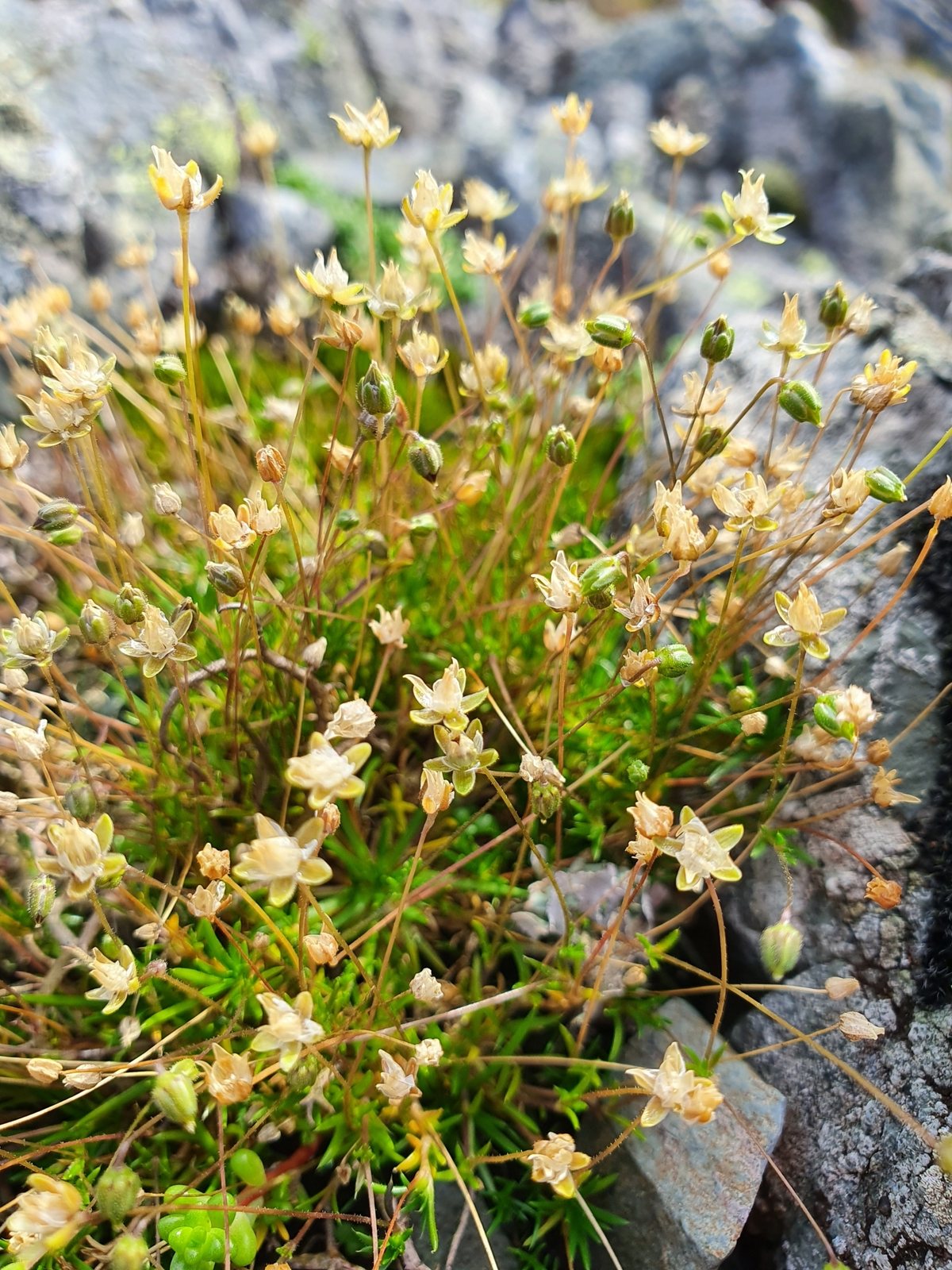
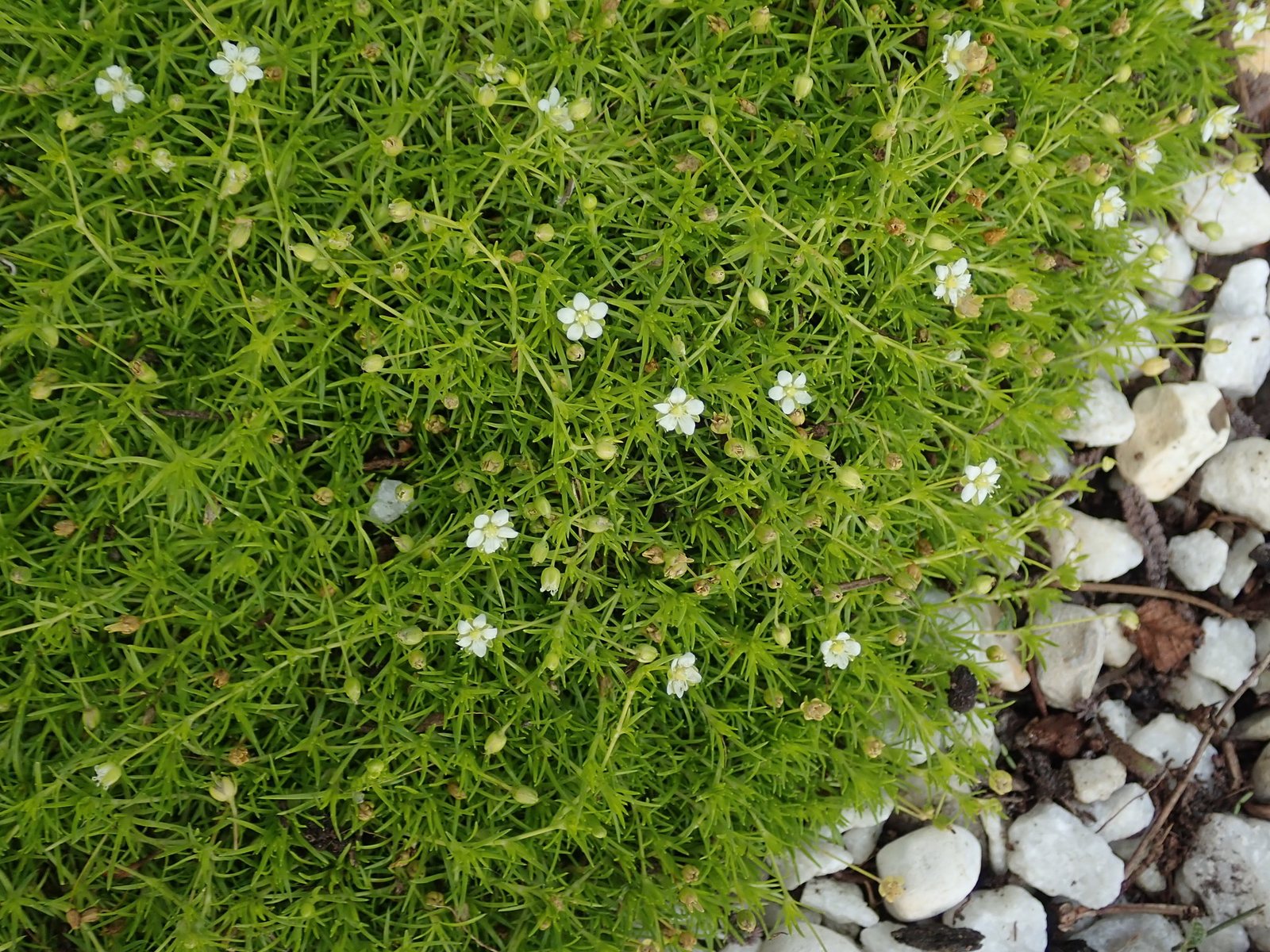
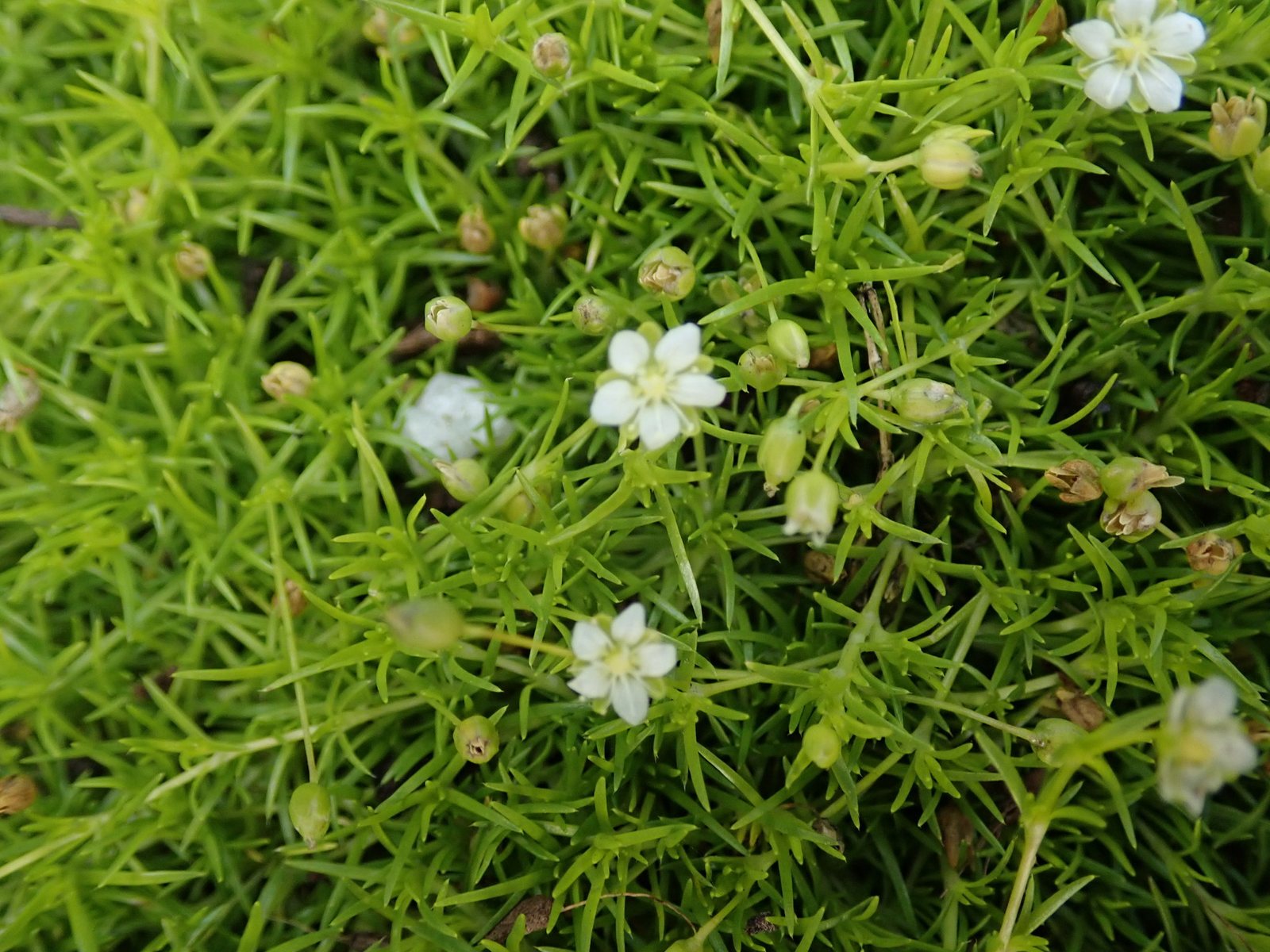
Irish moss is a creeping evergreen perennial that forms low, moss-like cushions dotted with tiny white flowers. It is a flowering plant, not a true moss, and is grown between stepping stones, in rock gardens and as a small groundcover in cool, moist conditions. It tolerates occasional light footsteps, but not regular foot traffic.
At a glance
- Sun
- Full sun to partial shade; provide afternoon shade where summers are hot.
- Water
- Keep evenly moist but not waterlogged. Its shallow roots dry out quickly, especially beside paving.
- Soil
- Humus-rich, moisture-retentive soil with good drainage; avoid compacted clay and sites that stay wet in winter.
- Height
- 0.1-0.2 ft (0.03-0.06 m)
- Spread
- 0.5-1 ft (0.15-0.3 m)
- Flowers
- Tiny white, five-petalled flowers in late spring and summer.
- Foliage
- Evergreen. Fine, narrow, bright to deep green leaves form dense cushions; foliage may brown during severe cold, drought or summer heat.
- Growth
- Moderate in cool, moist conditions.
- Care needed
- Medium
The year at a glance
- Cold hardy
- Low allergen
| J | F | M | A | M | J | J | A | S | O | N | D | |
|---|---|---|---|---|---|---|---|---|---|---|---|---|
| Flowers | ||||||||||||
| Plant |
Northern hemisphere months. In Australia, shift them by six.
- Difficulty
- Moderate
- Toughness
- Needs looking after
Will it suit your garden?
Pick your zone, country, light and whether you have pets.
Full sun is 6 or more hours of direct sun a day, part shade 3 to 6 hours, shade under 3.
How it grows
Planting day
0 ft (0.01 m)
After 1 year
0.1 ft (0.02 m)
After 2 years
0.1 ft (0.04 m)
After 3 years
0.1 ft (0.05 m)
full size
About 3 years to full size.
From a typical nursery size, at an average rate for this kind of plant. A rule of thumb, not a forecast.
Good to know
- Cats and dogs
- Safe
- Growth rate
- Moderate
Care
Jobs through the year
- WaterApr–May, Sep–Oct, every 7 days
- Water established cushions when the surface begins drying; water new divisions more often.
- WaterJun–Aug, every 3 days
- Check shallow roots and water before drying out; skip if soil remains moist.
- PruneMar–Apr
- Trim dead foliage and remove dead patches without mowing healthy cushions.
- PruneMay–Sep, every 30 days
- Trim encroaching edges only where needed.
- DivideMar–Apr, Sep
- Divide crowded cushions or replant healthy pieces into bare patches.
- ProtectJan–Feb, Oct–Dec
- Remove fallen leaves, keep crowns drained and avoid traffic on frozen cushions.
- Water when the soil surface begins to dry; do not let newly planted cushions dry out.
- Work a little compost into the soil before planting; avoid heavy feeding, which encourages loose growth.
- Keep mulch off the foliage and crowns.
- Remove weeds by hand while they are small, before their roots become tangled in the mat.
- Divide crowded or uneven cushions in spring and replant healthy pieces to fill bare patches.
Pruning. No routine pruning or mowing is needed. In spring, trim away dead foliage and lift out dead patches; cut back edges whenever they spread beyond their allotted space.
Through the year
- Spring
- Plant or divide cushions once the soil is workable, and water them in thoroughly.
- Late spring
- Hand-weed between cushions before surrounding growth closes over.
- Summer
- Check moisture regularly, particularly along paving, and water before the mat dries out.
- Early autumn
- Repair bare patches with rooted divisions where there is enough mild weather for establishment.
- Late autumn
- Clear fallen leaves from the mat and check that water drains away freely.
- Winter
- Avoid walking on frozen or saturated cushions.
In the garden
- Plant in wide joints between stepping stones on lightly used paths for a soft green contrast to stone.
- Use around small rocks in a cool rock garden, keeping it away from plants that need dry soil.
- Create a small moss-like carpet in a sheltered courtyard with morning sun.
- Edge a moist border beneath dwarf conifers or alongside compact shade-tolerant perennials.
Garden styles it suits: Moss and fern garden, Japanese, Zen dry garden, Alpine rock garden, Cottage garden and Small-space.
Plant it with: Dwarf hostas, Japanese painted fern, Primroses, Dwarf astilbes and Dwarf conifers.
Wildlife: The small flowers may attract small visiting insects, but this is not a major nectar plant. Dense cushions provide shelter for small ground-dwelling invertebrates.
Problems to watch for
- Summer browning or dieback: check for dry soil and heat reflected from paving; water thoroughly and provide afternoon shade.
- Rot and winter losses: improve drainage and keep crowns out of standing water rather than watering on a fixed schedule.
- Slugs and snails: inspect damp cushions and remove pests; use a labelled iron-phosphate bait if necessary.
- Weeds invading the mat: pull seedlings promptly and remove established weed roots carefully to avoid tearing up the groundcover.
Safety
Not known to be toxic to cats, dogs, horses or people; no poisonous parts are established. Species-specific safety information is limited, and it should not be treated as an edible plant.
Easily confused with
Scotch moss (Sagina subulata 'Aurea')
This is a golden-leaved cultivar of the same species, with yellow-green rather than deep green foliage; its flowers and cushion-forming habit are similar.
Procumbent pearlwort (Sagina procumbens)
Usually forms flatter, less cushion-like patches. Its tiny flowers normally have four sepals and absent or very short petals, rather than the conspicuous five white petals of Irish moss.
The name
The species name subulata means awl-shaped, referring to the narrow, pointed leaves, while Irish moss describes its moss-like appearance.
Propagation. Divide rooted cushions in spring or early autumn and keep the pieces moist until established. Seed can be surface-sown in spring; do not bury it deeply.
Checked against open data
- Accepted botanical name
- Sagina subulata
- In the US and Canada
- Introduced in Hawaii and the lower 48 states.
Sources: GBIF (CC BY 4.0) and USDA PLANTS. The care and design notes are LandscapeGPT's own.
See it in your own yard.
Upload a photo of your yard and see it redesigned with plants that suit your climate, each checked against your zone.