Japanese aralia
Fatsia japonica. Family Araliaceae. Shrub.
Also called Japanese fatsia, Paperplant.
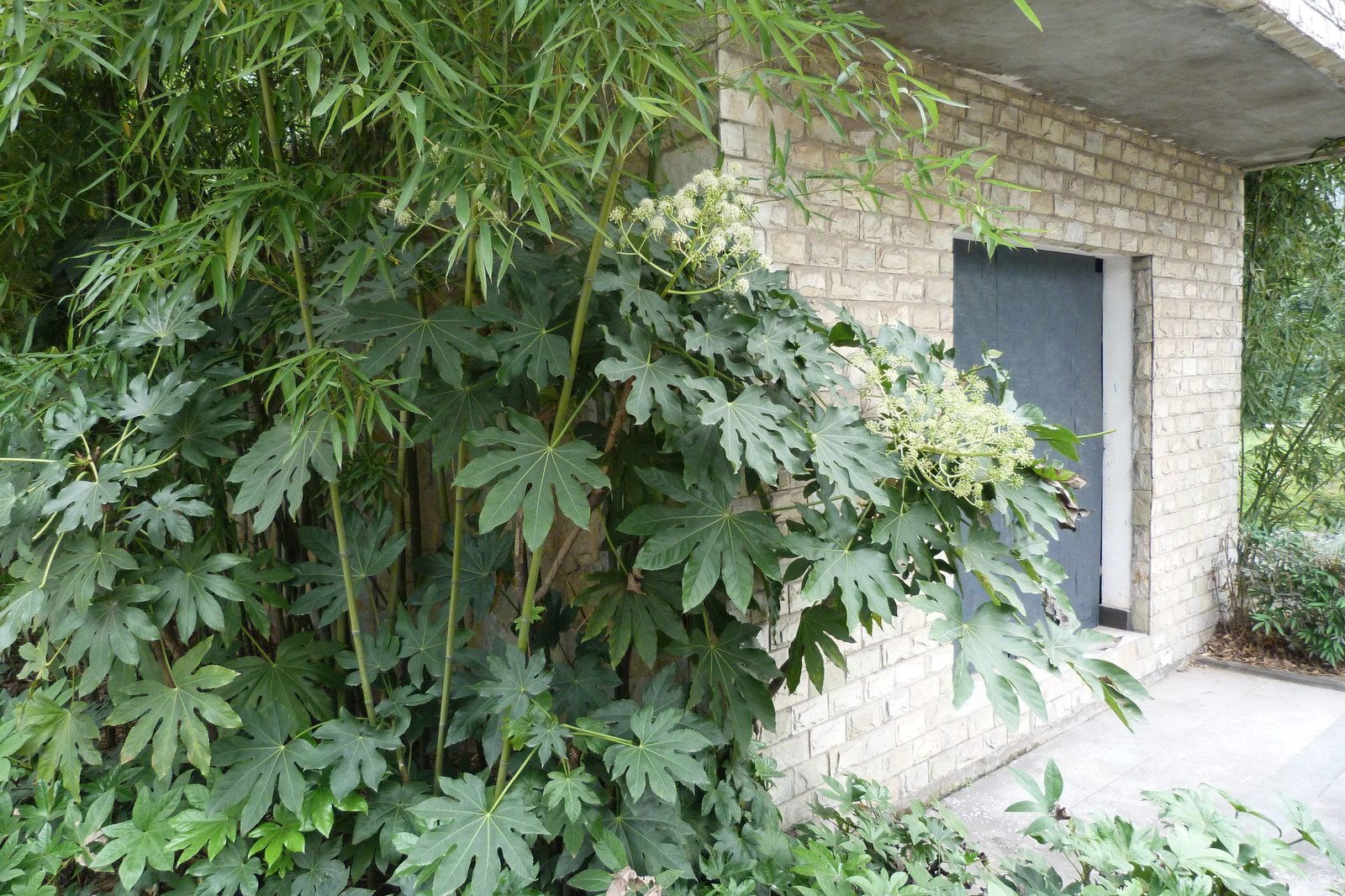
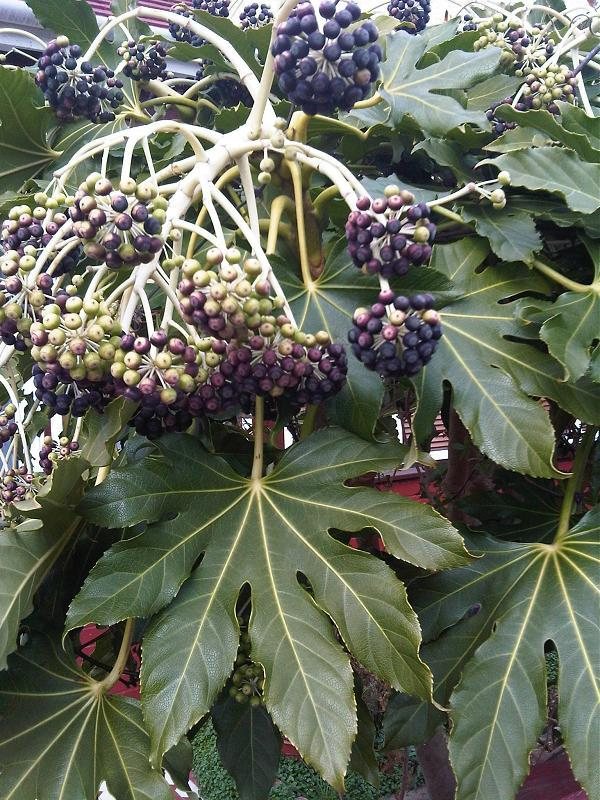
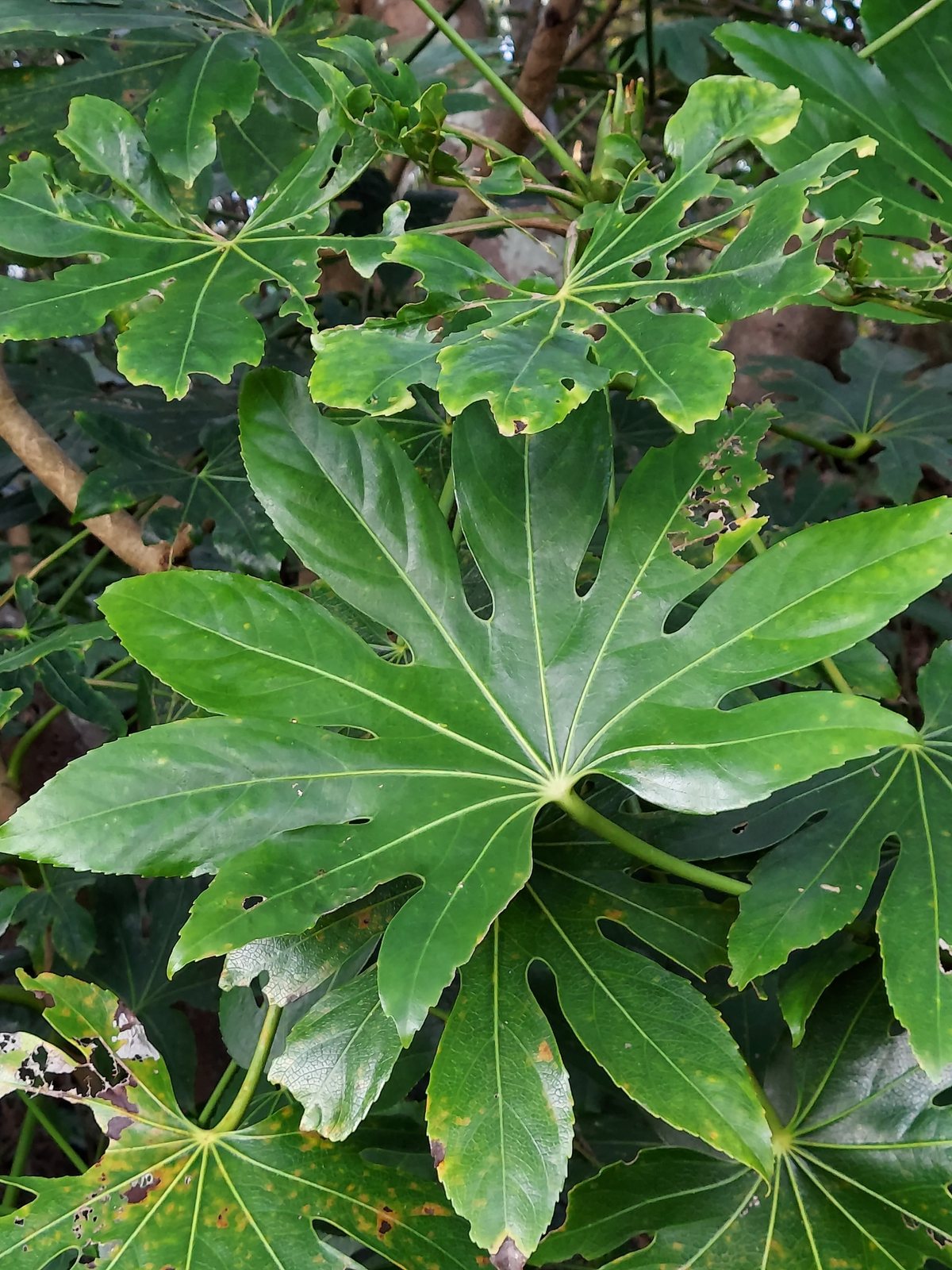
Japanese aralia (Fatsia japonica) is an evergreen shrub grown for its large, glossy, hand-shaped leaves and bold outline in shade. It brings year-round structure to sheltered borders and courtyards, with rounded clusters of creamy-white flowers in autumn followed by black berries.
At a glance
- Sun
- Partial to full shade; gentle morning sun is suitable, but hot afternoon sun can scorch the leaves.
- Water
- Moderate; keep the root zone evenly moist but not waterlogged. Established plants tolerate brief dry spells in shade.
- Soil
- Humus-rich, well-drained soil that retains some moisture; tolerates acidic, neutral and mildly alkaline conditions.
- Height
- 6-12 ft (1.8-3.7 m)
- Spread
- 6-12 ft (1.8-3.7 m)
- Flowers
- Creamy-white flowers in rounded clusters in autumn to early winter; flowering is less reliable in cold climates.
- Foliage
- Evergreen. Large, glossy, dark-green leaves with usually seven to nine broad, pointed lobes.
- Growth
- Moderate, becoming faster in moist soil and mild conditions.
- Care needed
- Low
The year at a glance
- Pollinators
- Heat tolerant
- Wildlife
- Low allergen
| J | F | M | A | M | J | J | A | S | O | N | D | |
|---|---|---|---|---|---|---|---|---|---|---|---|---|
| Flowers | ||||||||||||
| Fruit | ||||||||||||
| Plant |
Northern hemisphere months. In Australia, shift them by six.
- Difficulty
- Hard
- Toughness
- Needs looking after
Will it suit your garden?
Pick your zone, country, light and whether you have pets.
Full sun is 6 or more hours of direct sun a day, part shade 3 to 6 hours, shade under 3.
How it grows
Planting day
1.6 ft (0.5 m)
After 1 year
3 ft (1.1 m)
After 2 years
5 ft (1.6 m)
After 3 years
7 ft (2.2 m)
After 5 years
9 ft (2.8 m)
full size
About 4 years to full size.
From a typical nursery size, at an average rate for this kind of plant. A rule of thumb, not a forecast.
Good to know
- Cats and dogs
- Safe
- Growth rate
- Fast
Care
Jobs through the year
- WaterApr–May, Sep–Oct, every 14 days
- For established ground plants, water when soil begins drying; young plants and pots need more frequent checks.
- WaterJun–Aug, every 7 days
- Water established ground plants deeply if soil is drying; keep young plants evenly moist without waterlogging.
- MulchApr–May
- Apply compost or leaf mould around the roots, keeping stems clear.
- FeedMay
- Feed lightly only if growth is weak; avoid late-season feeding.
- PruneMay
- After severe frosts, remove damaged growth and selected old stems if renewal is needed.
- ProtectJan–Apr, Oct–Dec
- Not reliably hardy in zones 6–7; preferably grow in a movable pot and overwinter bright and frost-free.
- Plant out of cold, drying winds, preferably beneath light tree cover or beside a sheltered wall.
- Water deeply during dry weather for the first two growing seasons; thereafter, water during prolonged drought.
- Apply leaf mould or compost mulch each spring, keeping it clear of the stems.
- Feed lightly in spring if growth is weak; avoid heavy feeding late in the growing season.
- Water container plants when the surface begins to dry, and protect their roots from hard frost.
Pruning. In spring, once severe frost has passed, remove damaged leaves and dead stems. To reduce size or renew a leggy shrub, cut selected old stems near ground level, or shorten an overgrown plant hard in spring.
Through the year
- Spring
- Plant in a sheltered, shaded position once the soil is workable and severe frost has passed.
- Spring
- Remove frost-damaged growth, thin old stems if needed, and mulch with compost or leaf mould.
- Summer
- Water new plants during dry spells and check container plants regularly.
- Summer
- Take semi-ripe cuttings from healthy shoots.
- Autumn
- Leave flower clusters for insects, or remove spent clusters before berries ripen where unwanted seedlings are a concern.
- Winter
- Shelter containers from freezing winds and brush heavy snow gently off the broad leaves.
In the garden
- Use as an evergreen focal point in a shaded courtyard, giving the leaves room to spread.
- Combine with ferns and hostas in woodland borders for contrasting leaf shapes.
- Plant against a plain wall to show off its bold silhouette.
- Grow in a large, well-drained container beside a sheltered entrance.
- Use beneath open-canopied trees where smaller shrubs would lack visual weight.
Garden styles it suits: Architectural minimal, Modern courtyard, Modern tropical, Japanese, Woodland and Winter interest.
Plant it with: Japanese painted fern, Hart's-tongue fern, Hosta, Hellebore, Japanese forest grass and Lilyturf.
Wildlife: Late flowers provide nectar and pollen for bees, hoverflies and other insects when few shrubs are flowering. Birds may eat the berries and disperse the seeds.
Problems to watch for
- Scorched or bleached leaves: move container plants out of hot afternoon sun, or provide shade and maintain soil moisture.
- Frost and wind damage: choose a sheltered position and remove damaged growth in spring rather than during winter.
- Scale insects or spider mites, especially under cover: inspect leaf undersides, wipe off small infestations and use a labelled insecticidal soap when needed.
- Yellowing and root rot in wet soil: improve drainage, reduce watering and never leave containers standing in water.
Safety
Not known to be toxic to people, cats, dogs or horses. No parts are recognised as poisonous, but the leaves and berries are not intended as food; eating substantial amounts of ornamental plant material may cause stomach upset.
Where it spreads. An environmental weed in parts of New Zealand, where bird-dispersed seed can establish in native forest. Remove berries and seedlings where escape into nearby vegetation is a concern.
Easily confused with
Rice-paper plant (Tetrapanax papyrifer)
Has much larger, usually duller leaves with pale, felted undersides, and commonly spreads by suckers.
Tree ivy (× Fatshedera lizei)
Has smaller leaves, usually with five lobes, and long, lax stems that need support rather than forming a sturdy, self-supporting shrub.
Castor bean (Ricinus communis)
Has more sharply toothed, often reddish leaves and conspicuous spiny seed capsules. Its seeds are highly poisonous.
The name
Fatsia comes from an old rendering of the Japanese word for eight, referring to the leaf lobes, while japonica means 'from Japan'.
Propagation. Take semi-ripe stem cuttings in summer and root them in a moist, free-draining medium under cover. Fresh seed can also be sown after removing the berry pulp; named cultivars may not come true from seed.
Checked against open data
- Accepted botanical name
- Fatsia japonica
- Native range
- Japan, Korea and Nansei-shoto.
- Measured
- Average height 370 cm.
Sources: GBIF (CC BY 4.0) and Trefle (CC BY 4.0). The care and design notes are LandscapeGPT's own.
See it in your own yard.
Upload a photo of your yard and see it redesigned with plants that suit your climate, each checked against your zone.