Japanese cedar
Cryptomeria japonica. Family Cupressaceae. Tree.
Also called Sugi, Japanese cryptomeria.
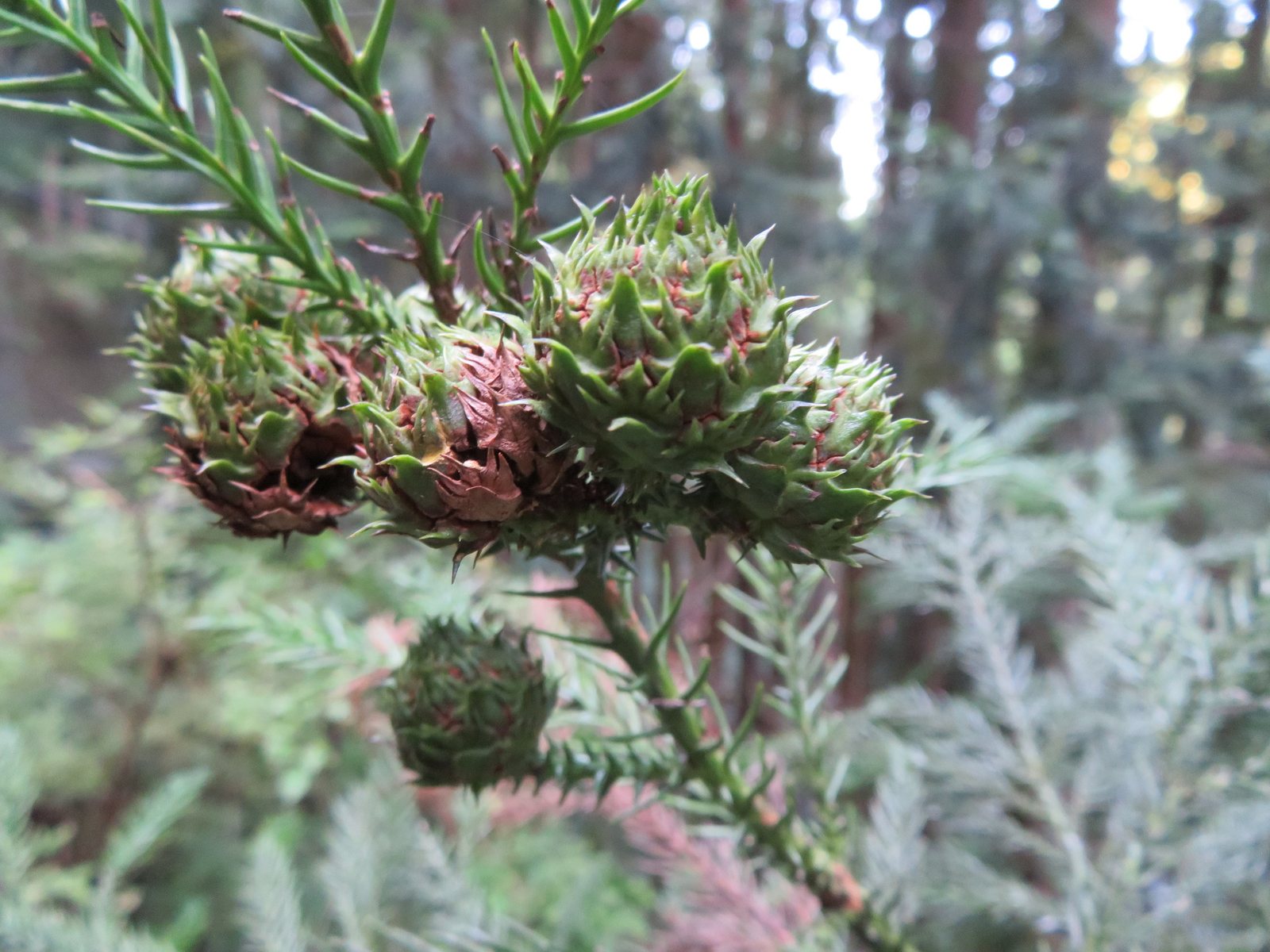
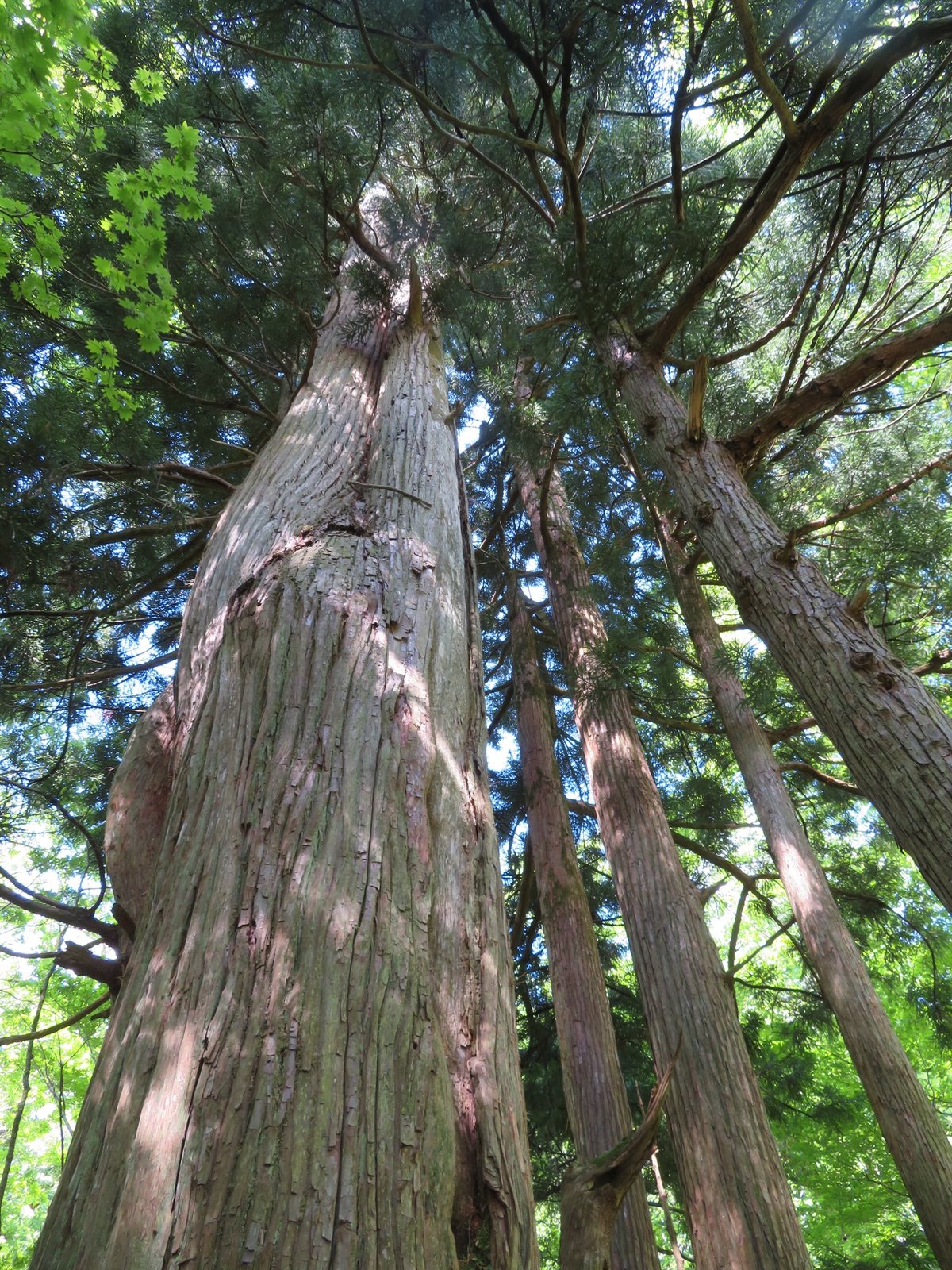
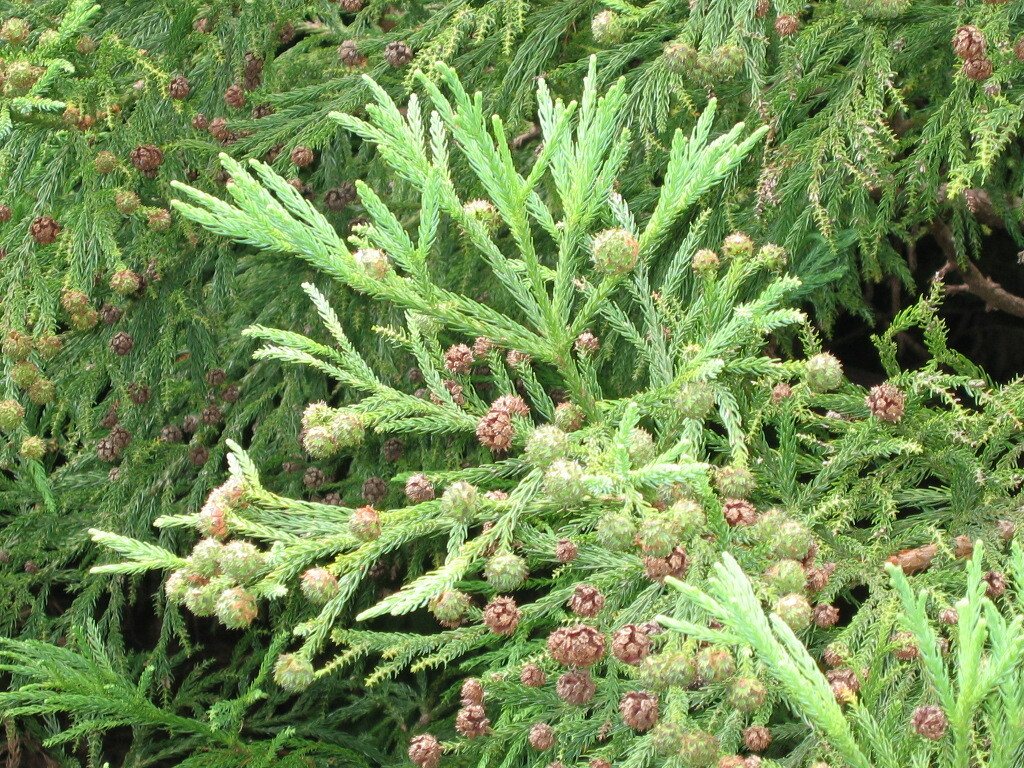
Japanese cedar is a large evergreen conifer with a straight trunk, reddish peeling bark and curved, awl-shaped needles. Gardeners grow it for its graceful outline and year-round foliage; the species needs substantial space, while named dwarf cultivars stay much smaller.
At a glance
- Sun
- Full sun to light partial shade; shelter from strong, drying winds.
- Water
- Keep the root zone evenly moist, especially during establishment. Established trees tolerate brief dry spells but perform poorly in prolonged drought.
- Soil
- Deep, moist, well-drained soil, preferably acidic to neutral. Avoid waterlogged ground and shallow, dry, chalky soil.
- Height
- 50-70 ft (15-21 m), sometimes taller in favourable conditions
- Spread
- 20-30 ft (6-9 m)
- Foliage
- Evergreen, curved, pointed needles arranged spirally around the shoots. Usually green, often turning bronze or brownish-purple in cold weather before greening again in spring.
- Growth
- Moderate to fast once established, often 1-2 ft (0.3-0.6 m) a year in favourable conditions.
- Care needed
- Low
The year at a glance
- Heat tolerant
- Wildlife
| J | F | M | A | M | J | J | A | S | O | N | D | |
|---|---|---|---|---|---|---|---|---|---|---|---|---|
| Fruit | ||||||||||||
| Plant |
Northern hemisphere months. In Australia, shift them by six.
- Difficulty
- Easy
- Toughness
- Fairly tough
Will it suit your garden?
Pick your zone, country, light and whether you have pets.
Full sun is 6 or more hours of direct sun a day, part shade 3 to 6 hours, shade under 3.
How it grows
Planting day
7 ft (2.2 m)
After 1 year
10 ft (3.2 m)
After 2 years
14 ft (4.1 m)
After 3 years
17 ft (5.1 m)
After 5 years
23 ft (7.1 m)
About 16 years to full size.
From a typical nursery size, at an average rate for this kind of plant. A rule of thumb, not a forecast.
Good to know
- Cats and dogs
- Safe
- Growth rate
- Fast
Care
Jobs through the year
- WaterMar–May, Sep–Nov, every 14 days
- Deep-water established trees when soil dries; young trees need more frequent watering.
- WaterJun–Aug, every 7 days
- During dry spells, soak the root zone without leaving it waterlogged.
- MulchApr, Oct
- Top up organic mulch to 5–8 cm, keeping it clear of the trunk.
- PruneFeb–Mar
- Remove dead, damaged or crossing branches; retain the leader and avoid bare old wood.
- ProtectJan–Feb, Dec
- Check ties and gently brush off loose heavy snow before branches bend.
- Water deeply during dry spells for the first two or three growing seasons.
- Spread 2-3 in (5-8 cm) of organic mulch over the root zone, keeping it clear of the trunk.
- Plant with the root flare at ground level and allow room for the mature canopy.
- Feed in spring only if growth is weak and a soil test indicates a nutrient shortage.
- Stake only if the root ball moves in wind; use flexible ties and remove the support once roots are secure.
Pruning. Prune dead, damaged or crossing branches in late winter or early spring, retaining the main leader. Avoid topping or cutting back into bare old wood, which usually does not regrow reliably.
Through the year
- Early spring
- Inspect for winter damage and remove dead or broken branches.
- Spring
- Plant in cold-winter regions once the ground is workable; water thoroughly and mulch.
- Late spring
- Check that bronzed winter foliage is greening again; investigate shoots that remain brown.
- Summer
- Water young trees deeply during dry weather and check beneath the canopy for dry soil.
- Autumn
- Plant in mild climates while the soil is warm, and replenish mulch without covering the trunk.
- Winter
- Check tree ties and gently remove loose, heavy snow before branches bend or split.
In the garden
- Use as a specimen in a large lawn where its full outline and reddish trunk can be seen.
- Plant with Japanese maples, ferns and hostas along a sheltered woodland edge.
- Use a loose group as an evergreen backdrop or screen, allowing for mature width.
- Choose a verified dwarf cultivar for a Japanese-style garden or smaller conifer planting; do not substitute the full-sized species.
Garden styles it suits: Japanese, Woodland, Grand estate, Pacific Northwest woodland, Green on green and Winter interest.
Plant it with: Japanese maple, Rhododendron, Camellia, Hosta, Japanese painted fern and Hakone grass.
Wildlife: Dense branches provide shelter and nesting sites for birds. It is wind-pollinated and offers little nectar value to pollinating insects.
Problems to watch for
- Drought or wind scorch: needles turn brown, especially on exposed sides. Water deeply, mulch and provide shelter; dead foliage will not recover.
- Root rot in waterlogged soil: growth weakens and foliage browns. Improve drainage before planting and avoid persistently saturated sites.
- Needle blight or twig dieback: remove affected shoots in dry weather, clear fallen debris and avoid overhead watering; seek a diagnosis if damage spreads.
- Spider mites in hot, dry conditions: look for fine webbing and stippled foliage. Hose foliage thoroughly and use a labelled horticultural oil if needed.
Safety
Not known to be toxic to cats, dogs, horses or people. Needles and cones are not edible and may cause irritation if chewed; sap or foliage can irritate sensitive skin. Its pollen can cause significant hay fever in susceptible people.
Where it spreads. Reported as invasive on Réunion in the Indian Ocean. Check local guidance before planting near native forest in humid, mild climates.
Easily confused with
Giant sequoia (Sequoiadendron giganteum)
Both have fibrous reddish bark and pointed foliage, but giant sequoia has shorter, more tightly overlapping leaves and much larger, woody, egg-shaped cones.
Coast redwood (Sequoia sempervirens)
Most coast redwood side shoots carry flat needles in two ranks; Japanese cedar has curved, awl-shaped needles spiralling around its shoots.
Japanese umbrella pine (Sciadopitys verticillata)
Japanese umbrella pine has long, thick, glossy green needles in conspicuous umbrella-like whorls, unlike Japanese cedar's short spiral needles.
The name
Cryptomeria comes from Greek words meaning 'hidden parts', referring to concealed flower structures, while japonica means 'of Japan'; despite its common name, it is not a true cedar.
Propagation. Raise the species from seed, using cold-moist stratification to improve germination. Propagate named cultivars by semi-ripe cuttings in late summer or by grafting; seedlings will not reliably retain cultivar characteristics.
Checked against open data
- Accepted botanical name
- Cryptomeria japonica
- In the US and Canada
- Introduced in the lower 48 states.
- Native range
- Japan, China Southeast and China South-Central.
- Measured
- Average height 1493 cm.
Sources: GBIF (CC BY 4.0), USDA PLANTS and Trefle (CC BY 4.0). The care and design notes are LandscapeGPT's own.
See it in your own yard.
Upload a photo of your yard and see it redesigned with plants that suit your climate, each checked against your zone.