Japanese persimmon
Diospyros kaki. Family Ebenaceae. Tree.
Also called Asian persimmon, Oriental persimmon, Kaki.
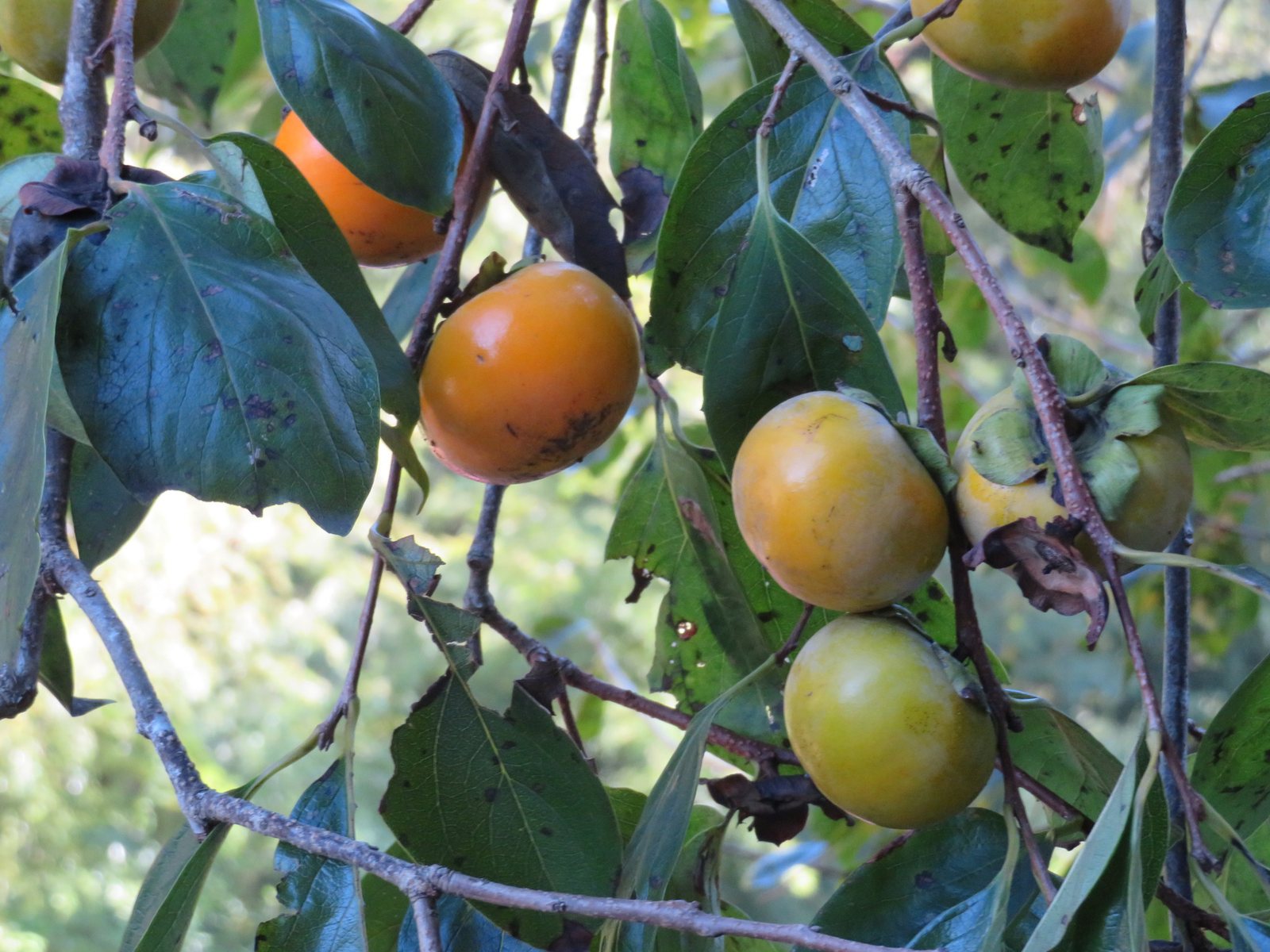
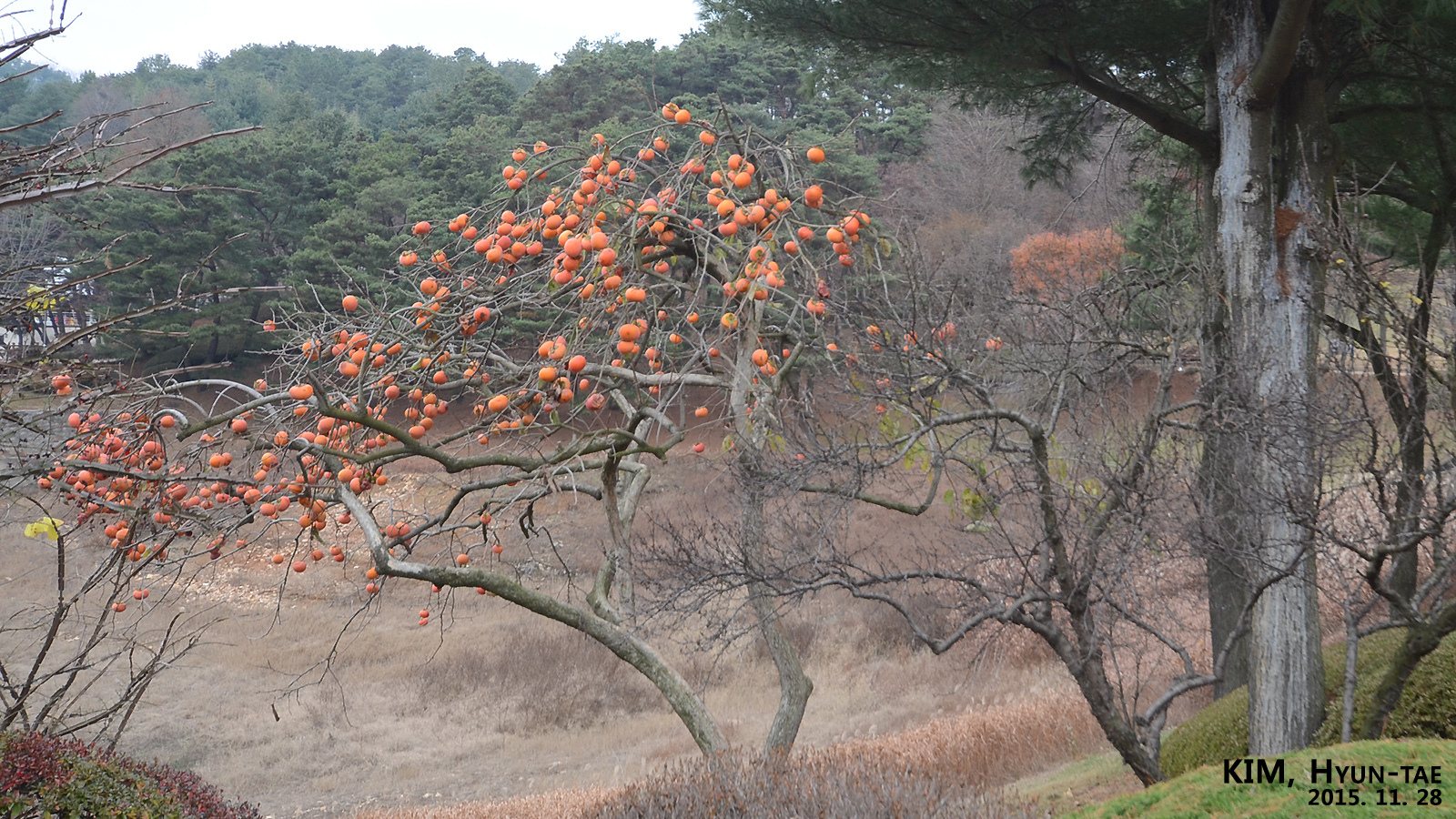
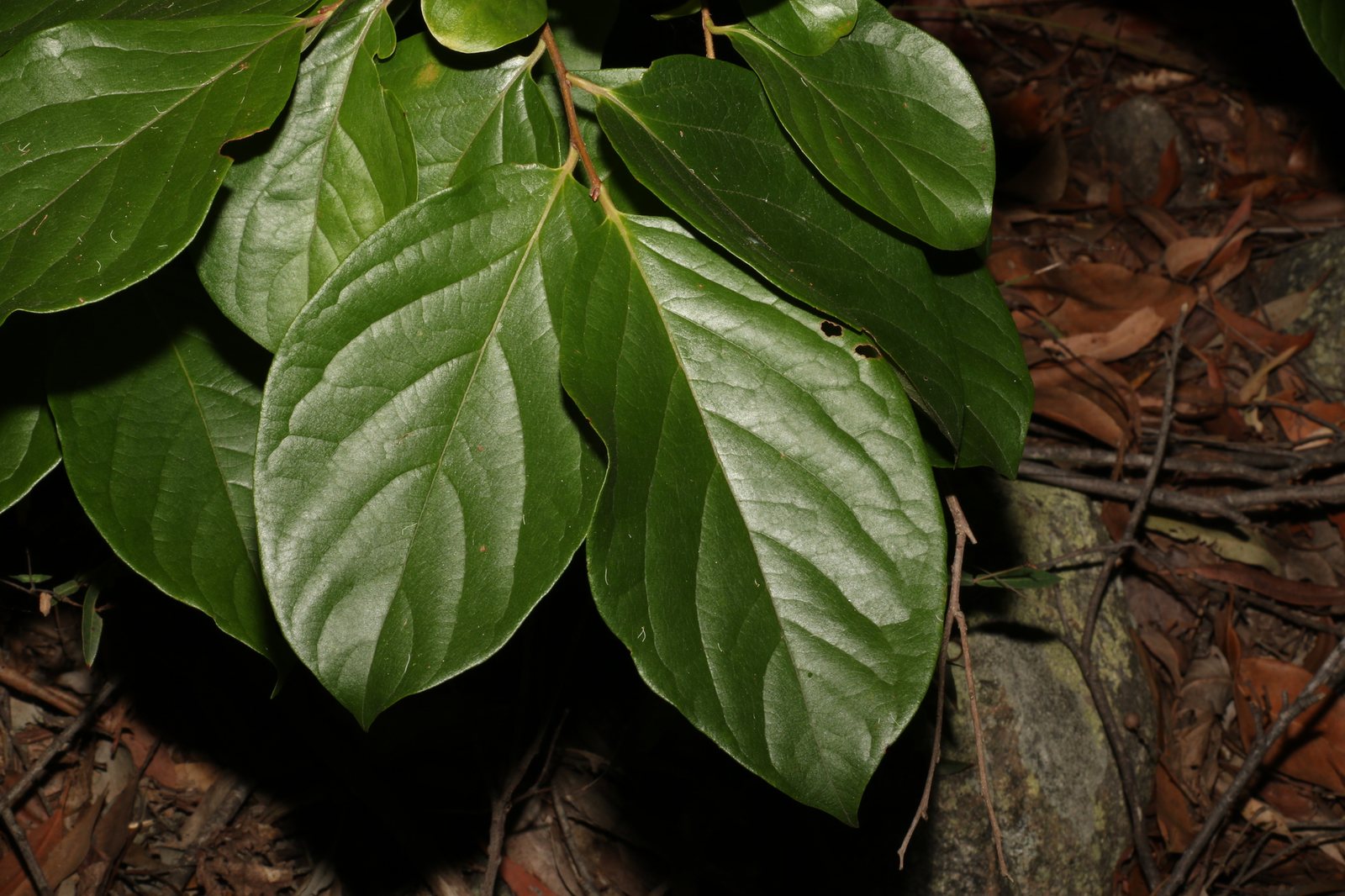
A deciduous fruit tree grown for its orange autumn fruit, glossy leaves and red, orange or yellow autumn colour. It crops best with a long, warm growing season; trees may survive in cooler gardens without reliably ripening fruit. Choose a named cultivar suited to your climate, and check whether its fruit must soften before eating.
At a glance
- Sun
- Full sun in a warm position sheltered from strong winds and late frosts.
- Water
- Water deeply during establishment and during prolonged dry spells, especially while fruit is developing. Avoid waterlogged soil and repeated cycles of drought and heavy watering.
- Soil
- Deep, well-drained loam is ideal, though it tolerates other soil textures if drainage is good. Slightly acidic to neutral soil is preferred.
- Height
- 20-40 ft (6-12 m)
- Spread
- 15-30 ft (4.5-9 m)
- Flowers
- Late spring to early summer; small, inconspicuous cream to pale yellow flowers.
- Foliage
- Large, oval, glossy green leaves turn yellow, orange or red in autumn. Orange fruit often remains on the bare branches.
- Growth
- Moderate
- Care needed
- Medium
The year at a glance
- Pollinators
- Heat tolerant
- Wildlife
- Low allergen
- Edible
| J | F | M | A | M | J | J | A | S | O | N | D | |
|---|---|---|---|---|---|---|---|---|---|---|---|---|
| Flowers | ||||||||||||
| Fruit | ||||||||||||
| Plant |
Northern hemisphere months. In Australia, shift them by six.
- Difficulty
- Moderate
- Toughness
- Fairly tough
Will it suit your garden?
Pick your zone, country, light and whether you have pets.
Full sun is 6 or more hours of direct sun a day, part shade 3 to 6 hours, shade under 3.
How it grows
Planting day
7 ft (2 m)
After 1 year
8 ft (2.3 m)
After 2 years
9 ft (2.7 m)
After 3 years
10 ft (3.1 m)
After 5 years
12 ft (3.7 m)
About 20 years to full size.
From a typical nursery size, at an average rate for this kind of plant. A rule of thumb, not a forecast.
Good to know
- Cats and dogs
- Safe
- Growth rate
- Moderate
Care
Jobs through the year
- WaterApr–May, Sep–Oct, every 14 days
- Deep-water established trees if soil is dry; water more often during the first two seasons.
- WaterJun–Aug, every 7 days
- Deep-water during dry weather, maintaining even moisture while fruit develops.
- MulchMar–Apr
- Renew organic mulch over the roots, keeping it clear of the trunk.
- FeedMar–Apr
- Feed lightly only if growth is weak; excess nitrogen can worsen fruit drop.
- PruneFeb–Mar
- Prune lightly before budbreak, removing dead or crossing wood and retaining a strong framework.
- PruneJun–Jul
- Thin crowded fruit after natural shedding and support heavily loaded branches.
- ProtectJan–Apr, Nov–Dec
- Protect young trees from severe cold and emerging shoots from late frost; use a sheltered site.
- HarvestSep–Dec, every 7 days
- Clip fully coloured fruit before hard frost; let astringent varieties become jelly-soft before eating.
- Plant while dormant, keeping the graft union above soil level; avoid disturbing the roots unnecessarily.
- Water deeply through the first two growing seasons and during dry weather when carrying fruit.
- Apply organic mulch over the root area, keeping it clear of the trunk.
- Feed lightly in spring only if growth is weak; excess nitrogen encourages leafy growth and can worsen fruit drop.
- Thin crowded fruit after natural early-summer shedding, and support heavily loaded branches.
- Check the cultivar's pollination requirements before buying; many crop alone, but some need a compatible pollinizer.
Pruning. Prune in late winter before growth starts, establishing a strong framework of well-spaced branches and removing dead, crossing or damaged wood. Keep pruning light because fruit is carried on new shoots arising from the previous year's growth.
Harvest
Pick fully coloured orange to orange-red fruit in autumn to early winter—usually September–December in the US, October–November in the UK and mildest parts of Canada, and March–June in Australia—clipping the stalk rather than pulling, and harvesting before hard frost. Non-astringent varieties such as ‘Fuyu’ can be eaten firm;
Through the year
- Winter
- Plant dormant trees when the soil is workable and not waterlogged; protect young trees from severe cold.
- Late winter
- Prune lightly to maintain a strong framework and remove damaged or crossing branches.
- Spring
- Renew mulch, feed only if needed, and protect emerging shoots from forecast late frosts.
- Early summer
- After natural fruit drop, thin crowded fruit and check heavily loaded branches for support.
- Summer
- Water during dry spells to reduce stress and premature fruit drop.
- Autumn
- Harvest when fruit has developed its cultivar's mature colour, cutting the stalk rather than pulling. Let astringent cultivars become jelly-soft before eating.
- Late autumn
- Remove fallen fruit and inspect branches after harvest; follow these seasonal tasks in your local hemisphere.
In the garden
- Use as a specimen in a sunny lawn or broad border, where its autumn leaves and fruit can be seen clearly.
- Include in an edible landscape with low herbs and flowering plants outside the mulched root area.
- Plant in a sheltered home orchard, allowing enough space for its spreading crown.
- Use in Japanese-inspired gardens with restrained evergreen planting to contrast with its seasonal colour and bare, fruit-laden branches.
Garden styles it suits: Japanese, Backyard orchard, Edible landscape, Food forest, Autumn colour and Homestead.
Plant it with: Lavender, Thyme, Chives, Yarrow, Daffodils and Japanese forest grass.
Wildlife: Flowers provide food for visiting insects. Ripe fruit attracts birds and mammals, which may take much of the crop unless it is harvested promptly or protected with securely fitted wildlife-safe netting.
Problems to watch for
- Poor ripening: choose an early-ripening cultivar and the warmest sheltered position available; cool summers can prevent useful crops even where the tree is hardy.
- Premature fruit drop: maintain even soil moisture, avoid heavy nitrogen feeding and check cultivar pollination needs; some early fruit shedding is normal.
- Scale insects and mealybugs: inspect stems and leaf undersides, remove small infestations by hand and use a locally approved horticultural oil where appropriate.
- Leaf spots and premature leaf fall: collect affected fallen leaves, improve airflow with light pruning and avoid wetting the foliage when watering.
Safety
Ripe fruit flesh is edible and is not known to be toxic to people, cats or dogs. Seeds and large pieces of fruit can cause choking or intestinal blockage in pets. Unripe, astringent fruit is high in tannins, and heavy consumption can contribute to digestive masses called bezoars in people. Keep horses away from fallen fruit: persimmon fruit and seeds can form intestinal masses and cause serious colic.
Easily confused with
American persimmon (Diospyros virginiana)
Usually has much smaller fruit and smaller, less glossy leaves. Mature bark is deeply divided into blocky plates, and the species is generally much more cold-hardy.
Date-plum (Diospyros lotus)
Bears small, cherry-sized fruits that turn yellow and then purplish-black, rather than the much larger orange fruits typical of Japanese persimmon.
Sharon fruit (Diospyros kaki)
Not a separate species: this is a trade name associated with fruit of the cultivar 'Triumph', commonly treated after harvest to remove astringency.
The name
Diospyros comes from Greek words commonly interpreted as 'divine fruit', while kaki is the Japanese name for the persimmon.
Propagation. Named cultivars are usually grafted or budded onto compatible persimmon rootstocks. Seed needs cold stratification and does not produce plants reliably identical to the parent; seedlings also take longer to fruit.
Checked against open data
- Accepted botanical name
- Diospyros kaki
- Native range
- Assam, China North-Central, China South-Central, China Southeast, Hainan, Taiwan and Vietnam.
- Measured
- Average height 1200 cm.
Sources: GBIF (CC BY 4.0) and Trefle (CC BY 4.0). The care and design notes are LandscapeGPT's own.
See it in your own yard.
Upload a photo of your yard and see it redesigned with plants that suit your climate, each checked against your zone.