Japanese tree lilac
Syringa reticulata. Family Oleaceae. Tree.
Also called Tree lilac.
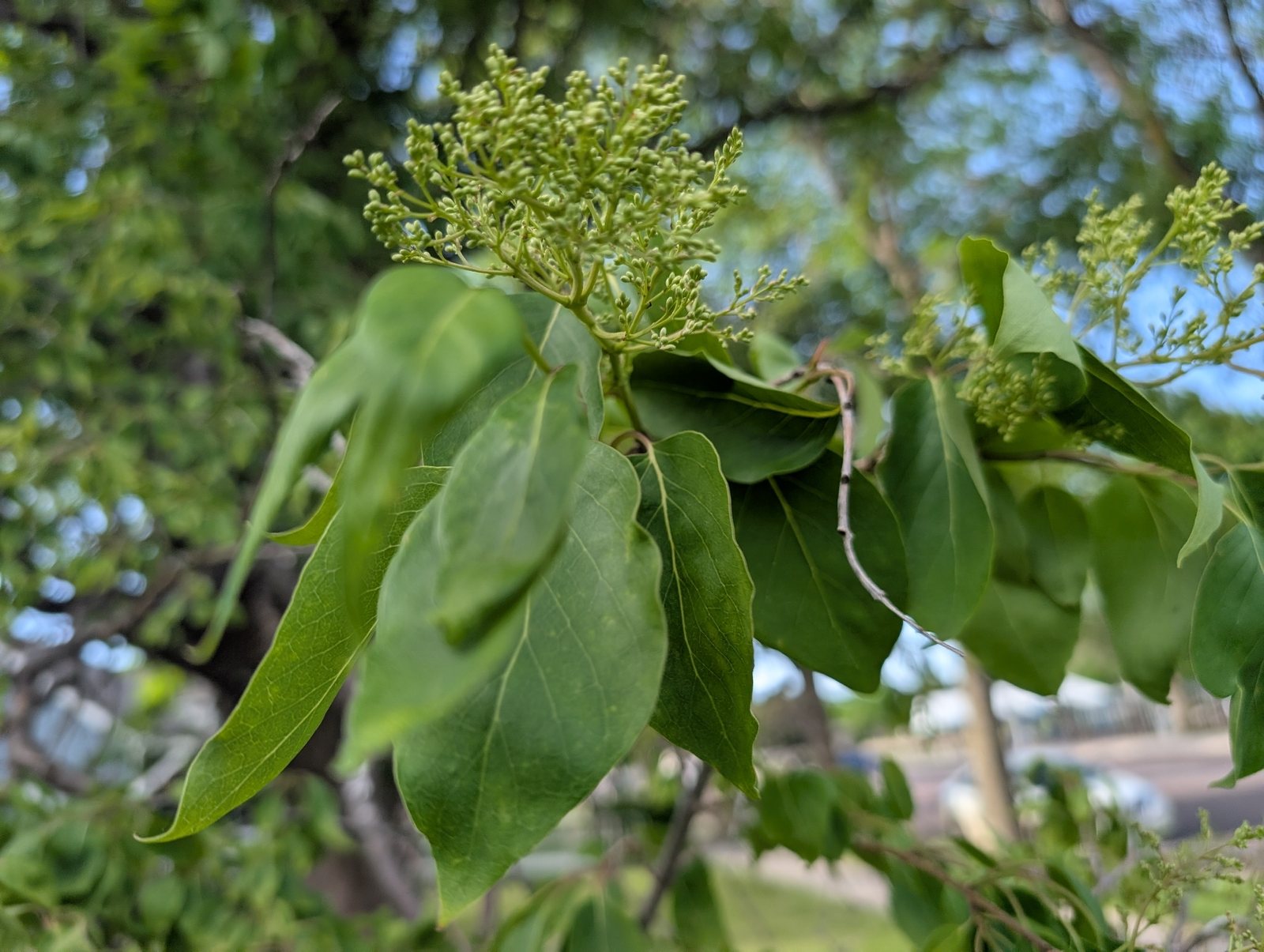
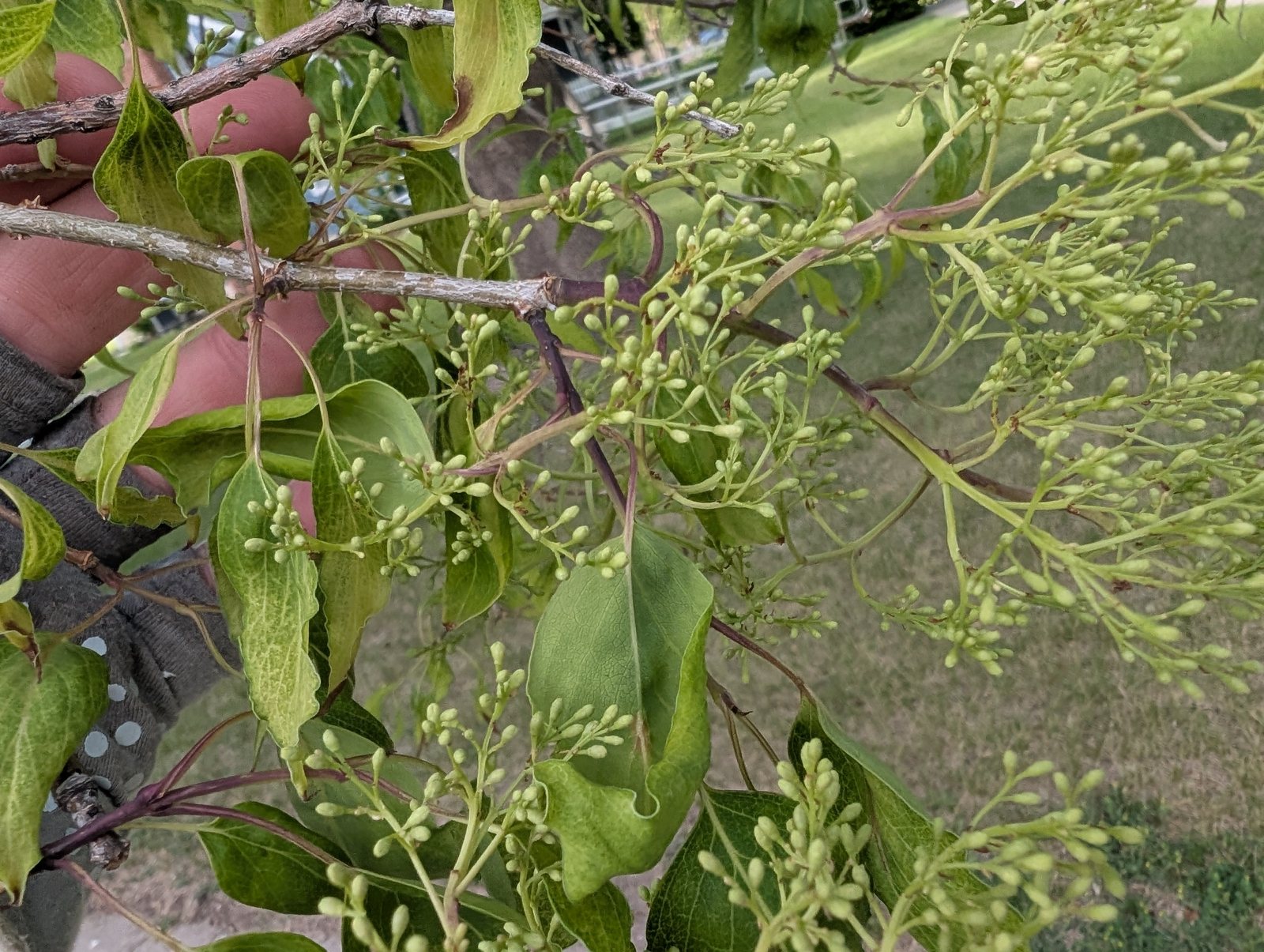
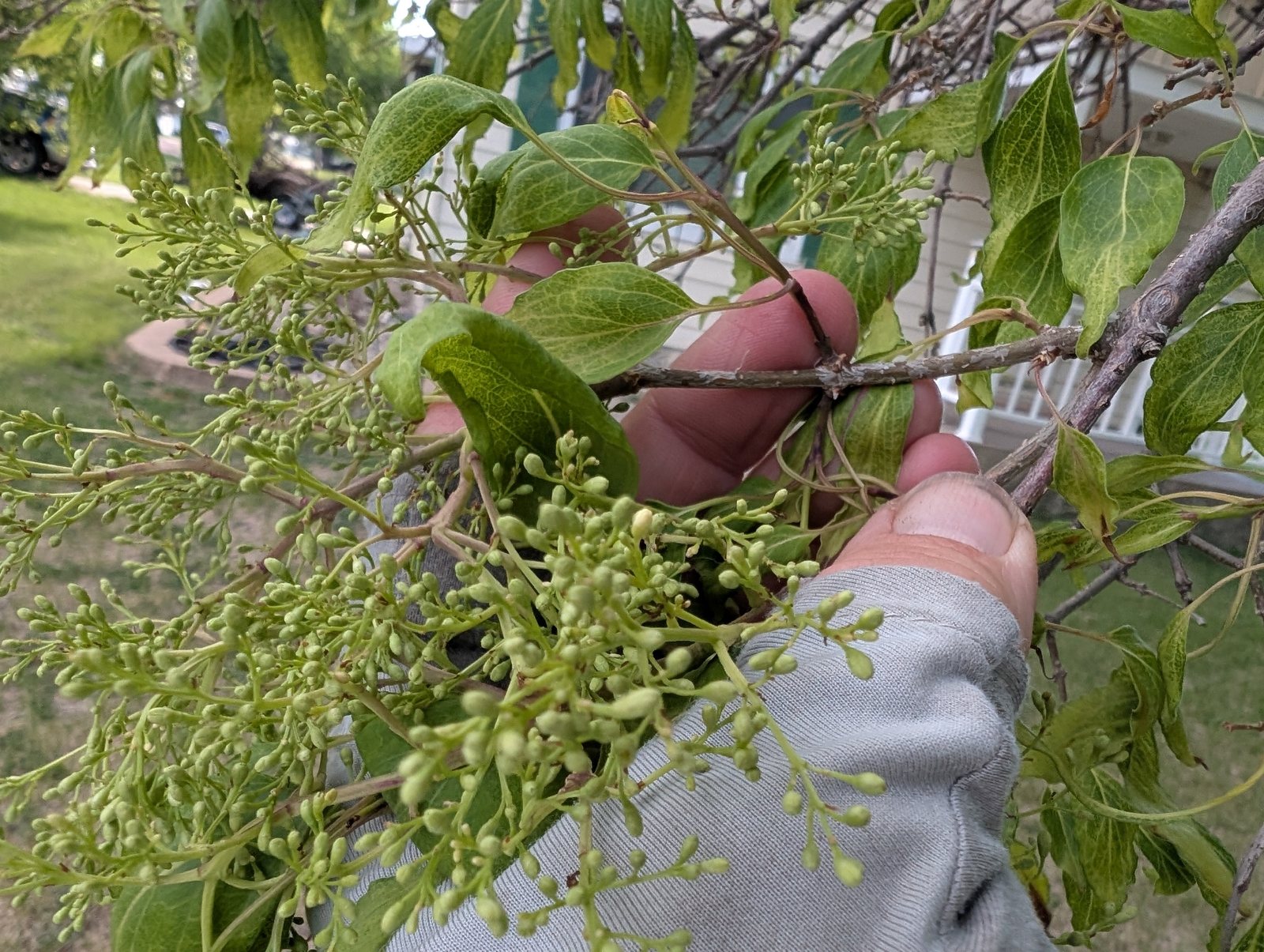
Japanese tree lilac is a small deciduous tree with a rounded crown, glossy reddish-brown young bark and large clusters of creamy-white flowers. It flowers later than common lilac and makes a useful specimen or street tree in cold and temperate climates, but is less suited to hot, humid regions.
At a glance
- Sun
- Full sun gives the best flowering; tolerates light shade.
- Water
- Moderate; water regularly while establishing. Established trees tolerate occasional dry spells but flower and grow better with moisture during prolonged drought.
- Soil
- Well-drained loam, clay or sandy soil; tolerates neutral to alkaline conditions. Avoid persistently waterlogged ground.
- Height
- 20-30 ft (6-9 m)
- Spread
- 15-20 ft (4.5-6 m)
- Flowers
- Late spring to early summer, usually June in northern temperate gardens; large upright clusters of creamy-white flowers with a strong, privet-like scent.
- Foliage
- Opposite, oval, dark-green leaves; autumn colour is usually modest, turning yellowish or falling while still green.
- Growth
- Moderate when young, slowing with age.
- Care needed
- Low
The year at a glance
- Pollinators
- Cold hardy
- Disease resistant
- Wildlife
- Low allergen
- Fragrant
| J | F | M | A | M | J | J | A | S | O | N | D | |
|---|---|---|---|---|---|---|---|---|---|---|---|---|
| Flowers | ||||||||||||
| Fruit | ||||||||||||
| Plant |
Northern hemisphere months. In Australia, shift them by six.
- Difficulty
- Easy
- Toughness
- Very tough
Will it suit your garden?
Pick your zone, country, light and whether you have pets.
Full sun is 6 or more hours of direct sun a day, part shade 3 to 6 hours, shade under 3.
How it grows
Planting day
7 ft (2 m)
After 1 year
7 ft (2.2 m)
After 2 years
8 ft (2.4 m)
After 3 years
9 ft (2.6 m)
After 5 years
10 ft (3.1 m)
About 26 years to full size.
From a typical nursery size, at an average rate for this kind of plant. A rule of thumb, not a forecast.
Good to know
- Cats and dogs
- Safe
- Invasive in
- the US
- Growth rate
- Slow
Care
Jobs through the year
- WaterApr–May, Sep–Oct, every 14 days
- Water established trees only during dry spells; water young trees more frequently for two years.
- WaterJun–Aug, every 7 days
- Water deeply during prolonged drought, checking that the root zone is dry first.
- MulchMar
- Maintain 5–8 cm of organic mulch over the roots, keeping the trunk clear.
- FeedMar–Apr
- Feed only if weak growth and a soil test indicate deficiency; avoid excess nitrogen.
- PruneJun–Jul
- Immediately after flowering, remove crossing branches and unwanted basal shoots without shearing.
- DeadheadJul
- Remove reachable spent flower clusters if preventing seed production is important.
- ProtectApr–May
- Pull self-sown seedlings, particularly near woodland or other natural areas.
- ProtectNov
- Collect diseased fallen leaves and check that young-tree ties are not constricting the bark.
- Water deeply during dry weather for the first two growing seasons, moistening the root zone rather than sprinkling the surface.
- Spread a 2-3 in (5-8 cm) layer of organic mulch over the root area, keeping it clear of the trunk.
- Feed only if growth is weak and a soil test indicates a deficiency; excess nitrogen encourages leaves at the expense of flowers.
- Stake only if the root ball moves in the wind, and remove supports once the tree is firmly rooted.
- Remove seedlings where they appear, especially near woodland or other natural areas.
Pruning. Prune immediately after flowering if shaping is needed, removing crossing branches and unwanted basal shoots without shearing the crown. Remove dead or damaged wood whenever noticed, and avoid heavy pruning that sacrifices next year's flower buds.
Through the year
- Late winter
- Inspect the branch structure and remove broken or dead wood; leave routine shaping until after flowering.
- Spring
- Refresh mulch, check soil moisture and remove self-sown seedlings.
- Late spring to early summer
- Enjoy flowering, then lightly prune if necessary; remove reachable spent flower clusters if seed production is a concern.
- Summer
- Water young trees deeply during dry spells and inspect stressed branches for borer damage.
- Autumn
- Plant while soil remains workable, water thoroughly and collect diseased fallen leaves.
In the garden
- Use as a specimen in a lawn or broad border, allowing room for the mature crown.
- Plant beside a terrace where the flowers and bark can be seen closely, but keep its strong floral scent in mind.
- Repeat along a driveway or generous garden path to create a small-tree avenue.
- Underplant with spring bulbs, hardy geraniums and hostas for successive interest beneath its deciduous canopy.
Garden styles it suits: Traditional, Urban city garden, Japanese, White garden, Pollinator garden and Low-maintenance.
Plant it with: Hardy geraniums, Hostas, Daffodils, Siberian iris, Catmint and Oakleaf hydrangea.
Wildlife: Flowers attract bees and other pollinating insects. The crown provides perching and nesting cover for birds, although it supports fewer specialist native insects than locally native trees.
Problems to watch for
- Lilac borer can cause branch dieback, holes and sawdust-like material near the bark. Keep the tree watered during drought, avoid trunk injuries and seek local advice if an active infestation is suspected.
- Bacterial blight can blacken young shoots, especially in cool, wet springs. Prune affected growth back into healthy wood during dry weather, disinfect tools and avoid overhead watering.
- Powdery mildew occasionally coats leaves white, although this species is relatively resistant. Improve airflow, avoid overcrowding and clear heavily affected fallen leaves.
- Poor flowering often follows shade, excess nitrogen or pruning at the wrong time. Provide more sun, avoid unnecessary feeding and prune only just after flowering.
Safety
Not known to be toxic to cats, dogs, horses or people. No part is generally recognised as poisonous, though eating substantial amounts of leaves, bark or flowers may cause stomach upset.
Where it spreads. Can escape cultivation and self-seed into natural areas in parts of the northeastern and midwestern United States, including Minnesota. Avoid planting beside sensitive habitats where local authorities report it spreading, and remove volunteer seedlings.
Easily confused with
Common lilac (Syringa vulgaris)
Usually a suckering shrub with heart-shaped leaves and earlier flowers, commonly purple, pink or white; Japanese tree lilac has more oval leaves, a tree-like framework and later creamy-white flowers.
Peking tree lilac (Syringa reticulata subsp. pekinensis)
Often has a looser, finer-branched crown and more conspicuously peeling coppery bark. It is closely related and sometimes treated as the separate species Syringa pekinensis.
Japanese privet (Ligustrum japonicum)
Has thick, glossy evergreen leaves and later clusters of dark berries; Japanese tree lilac loses its leaves and produces dry seed capsules.
The name
Japanese tree lilac refers to its Japanese origin and tree-like habit; Syringa comes from the Greek for a pipe or tube, and reticulata means netted, referring to the leaf veins.
Propagation. Grow the species from seed given a period of moist chilling; flowering takes several years. Named cultivars are usually propagated by grafting or budding, since seedlings do not reliably retain their characteristics.
Checked against open data
- Accepted botanical name
- Syringa reticulata
- In the US and Canada
- Introduced in the lower 48 states.
- Native range
- Amur, China North-Central, China South-Central, China Southeast, Inner Mongolia, Japan, Khabarovsk, Korea, Kuril Is., Manchuria and Primorye.
- Measured
- Average height 600 cm.
Sources: GBIF (CC BY 4.0), USDA PLANTS and Trefle (CC BY 4.0). The care and design notes are LandscapeGPT's own.
See it in your own yard.
Upload a photo of your yard and see it redesigned with plants that suit your climate, each checked against your zone.