Kashmir rowan
Sorbus cashmiriana. Family Rosaceae. Tree.
Also called Kashmir mountain ash.
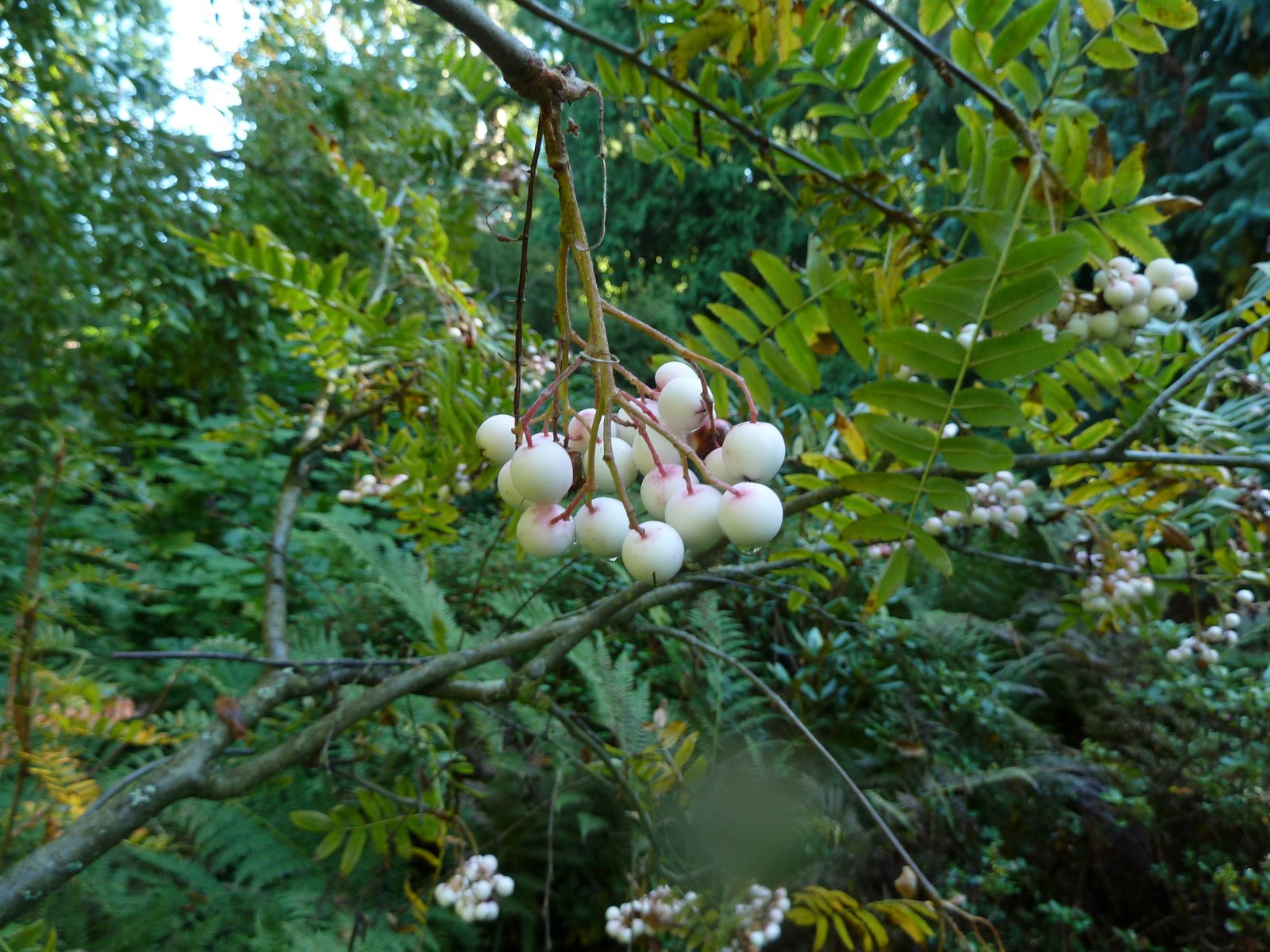
Kashmir rowan is a small deciduous tree grown for its pale pink flowers, divided leaves and clusters of white berries that often remain after leaf fall. Its open crown suits smaller gardens, especially in cool climates with moist, well-drained soil; it struggles with prolonged heat and drought.
At a glance
- Sun
- Full sun or light partial shade; some afternoon shade helps in warmer locations.
- Water
- Moderate; keep the root zone evenly moist, especially while establishing and during dry summers.
- Soil
- Humus-rich, moist but well-drained soil; slightly acidic to neutral conditions are ideal. Avoid waterlogged ground and shallow, drought-prone soil.
- Height
- 15-25 ft (4.5-7.5 m)
- Spread
- 12-20 ft (3.7-6 m)
- Flowers
- Late spring to early summer; clusters of pale pink flowers.
- Foliage
- Pinnate leaves with toothed green leaflets, turning yellow or gold in autumn.
- Growth
- Slow to moderate
- Care needed
- Low
The year at a glance
- Pollinators
- Wildlife
- Low allergen
| J | F | M | A | M | J | J | A | S | O | N | D | |
|---|---|---|---|---|---|---|---|---|---|---|---|---|
| Flowers | ||||||||||||
| Fruit | ||||||||||||
| Plant |
Northern hemisphere months. In Australia, shift them by six.
- Difficulty
- Easy
- Toughness
- Fairly tough
Will it suit your garden?
Pick your zone, country, light and whether you have pets.
Full sun is 6 or more hours of direct sun a day, part shade 3 to 6 hours, shade under 3.
How it grows
Planting day
7 ft (2 m)
After 1 year
7 ft (2.2 m)
After 2 years
8 ft (2.3 m)
After 3 years
8 ft (2.5 m)
After 5 years
9 ft (2.8 m)
About 26 years to full size.
From a typical nursery size, at an average rate for this kind of plant. A rule of thumb, not a forecast.
Good to know
- Cats and dogs
- Mildly toxic: may upset a stomach
- Growth rate
- Slow
Care
Jobs through the year
- WaterApr–May, Sep–Oct, every 14 days
- Deep-water established trees if soil is dry; keep roots evenly moist during the first two or three growing seasons.
- WaterJun–Aug, every 7 days
- Soak the root zone during prolonged dry weather; check young trees more often.
- MulchMar–Apr
- Top-dress with compost and maintain 5–8 cm of organic mulch, clear of the trunk.
- PruneFeb
- Sparingly remove dead, damaged or crossing branches, retaining the natural crown.
- ProtectMay–Aug
- Check for fire blight and defoliating sawfly larvae; remove affected shoots or small larval colonies promptly.
- ProtectOct–Nov
- Remove diseased fallen leaves but leave healthy berries for birds.
- Water deeply during dry spells for the first two or three growing seasons.
- Spread a 2-3 in (5-8 cm) layer of organic mulch over the root zone, keeping it clear of the trunk.
- Top-dress with compost in spring; avoid heavy nitrogen feeding.
- Stake only if the root ball moves in the wind, and remove the support once the tree is firmly rooted.
- Keep grass and vigorous groundcovers away from the trunk while the tree establishes.
Pruning. Prune sparingly in late winter while dormant, removing dead, damaged or crossing branches and retaining a balanced framework. Avoid topping or heavy crown reduction; remove diseased wood promptly in dry weather.
Through the year
- Autumn
- Plant while the soil is workable and moist; in very cold regions, plant in spring instead.
- Late winter
- Remove dead or crossing branches and check that tree ties are not rubbing or constricting the trunk.
- Spring
- Refresh the mulch and add a light compost top-dressing.
- Late spring
- Inspect new shoots for aphids and sudden blackening that could indicate fire blight.
- Summer
- Water deeply during prolonged dry weather, particularly around young trees.
- Late autumn
- Remove fallen leaves if leaf disease has been troublesome; leave healthy fruit for birds and winter display.
In the garden
- Use as a small specimen tree where its white fruit can be seen from a window.
- Plant against dark evergreen shrubs to make the flowers, pale berries and autumn foliage stand out.
- Underplant with spring bulbs and shade-tolerant perennials beneath its light canopy.
- Place at a woodland edge with other moisture-loving shrubs, allowing room for its spreading crown.
Garden styles it suits: Woodland, Cottage garden, English country, White garden, Autumn colour and Winter interest.
Plant it with: Snowdrops, Hellebores, Hardy geraniums, Japanese anemones, Christmas fern and Oakleaf hydrangea.
Wildlife: Flowers provide food for pollinating insects. Birds may eat the berries, although the white fruit is often left longer than the red fruit of other rowans; branches also provide perching and nesting cover.
Problems to watch for
- Fire blight: flowers and shoots may blacken and look scorched. Cut affected branches well back into healthy wood in dry weather, disinfect tools between cuts and avoid excessive nitrogen feeding.
- Aphids: colonies can curl young leaves and leave sticky honeydew. Wash them off small trees with water and encourage ladybirds and other predators.
- Sawfly larvae: caterpillar-like larvae can strip the leaflets. Inspect foliage and hand-pick small infestations before damage spreads.
- Heat and drought stress: leaf edges may brown and foliage may fall early. Water deeply, maintain mulch and avoid planting in hot, exposed or confined paved sites.
Safety
Not generally listed as toxic to people, cats, dogs or horses. The berries are ornamental rather than recommended food, and eating quantities of raw rowan fruit can cause stomach upset; discourage children and pets from eating them.
Easily confused with
Koehne's mountain ash (Sorbus koehneana)
Also carries white berries, but usually forms a smaller, more shrubby plant with more numerous, narrower leaflets and white rather than pink flowers.
Hupeh rowan (Sorbus hupehensis)
Usually has conspicuously blue-green foliage, white flowers and smaller white berries that are often tinged pink; Kashmir rowan has greener foliage and pink flowers.
The name
Both Kashmir rowan and the species name cashmiriana refer to Kashmir in the western Himalayas.
Propagation. Raise from cleaned seed sown outdoors in autumn; germination can be slow and may require more than one seasonal cycle. Selected forms are usually grafted by specialist nurseries to preserve their characteristics.
Checked against open data
- Accepted botanical name
- Sorbus cashmiriana
- Native range
- Afghanistan and West Himalaya.
Sources: GBIF (CC BY 4.0) and Trefle (CC BY 4.0). The care and design notes are LandscapeGPT's own.
See it in your own yard.
Upload a photo of your yard and see it redesigned with plants that suit your climate, each checked against your zone.