Leadwort
Ceratostigma plumbaginoides. Family Plumbaginaceae. Groundcover.
Also called Hardy plumbago, Dwarf plumbago, Blue leadwort.
Leadwort is a low, deciduous perennial that spreads by underground stems to form a leafy carpet. Gardeners grow it for its clear blue flowers in late summer and autumn, when the leaves also turn bronze and red. It emerges late in spring, making it useful over spring bulbs but easy to disturb accidentally.
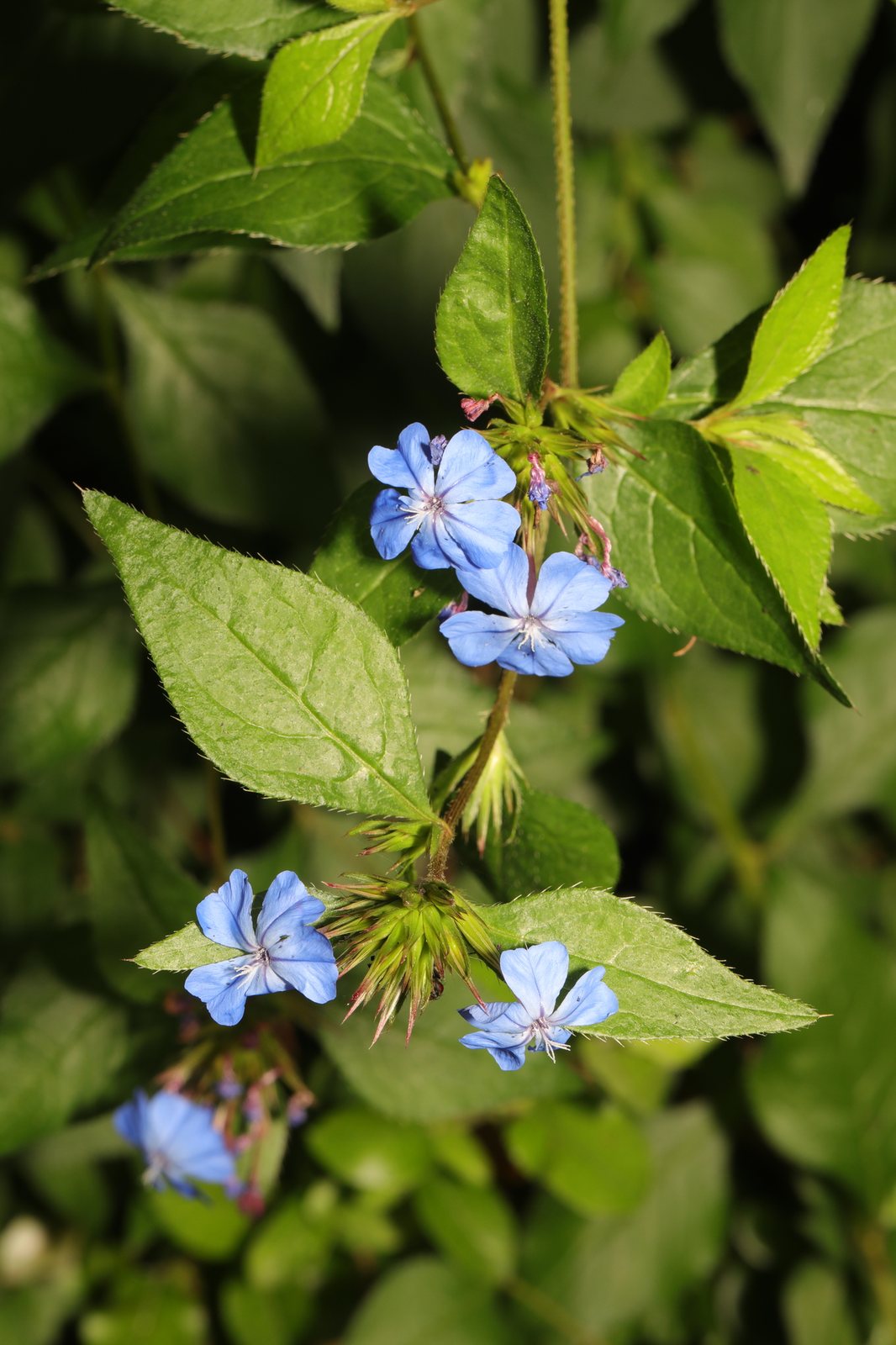
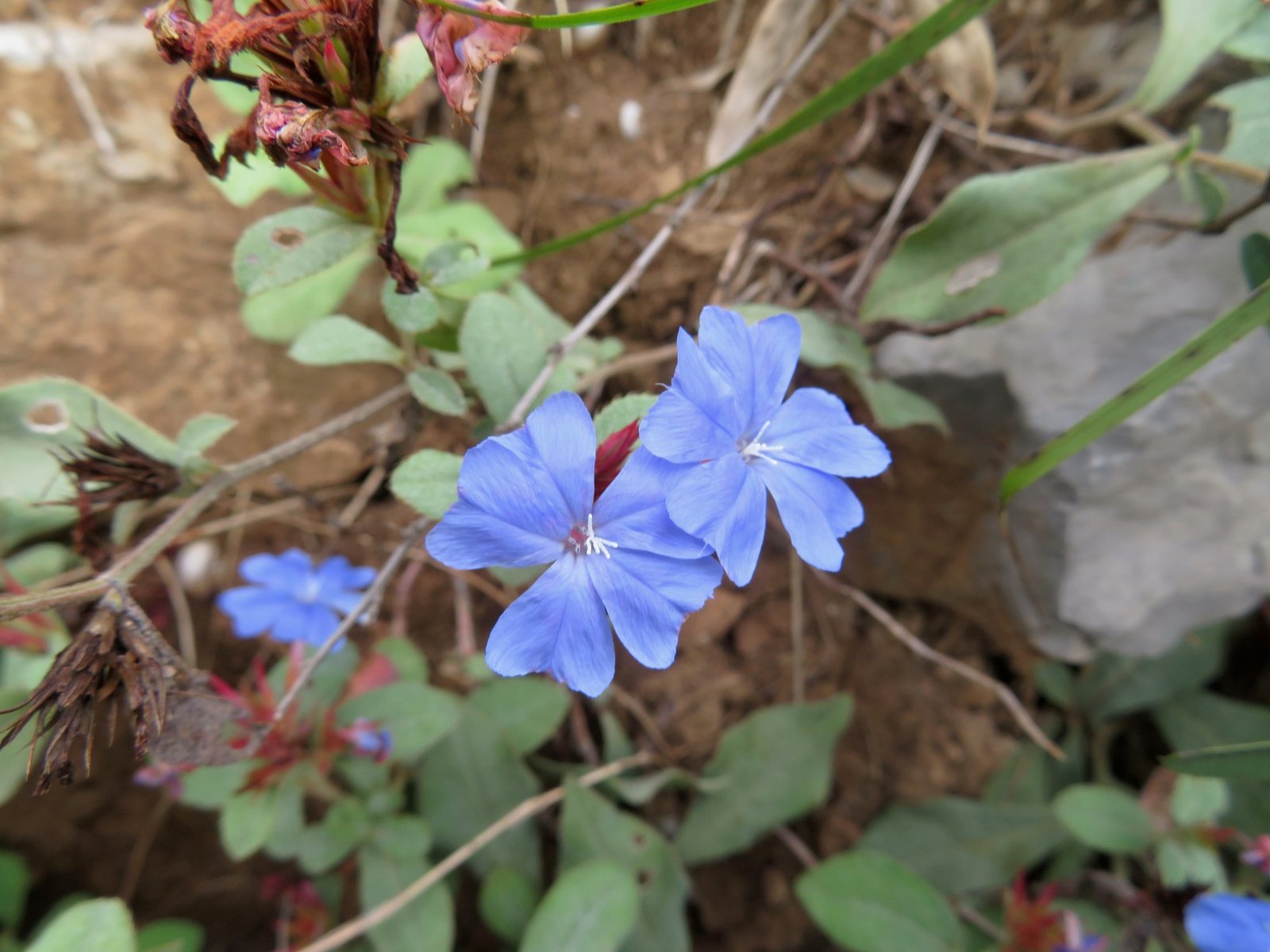
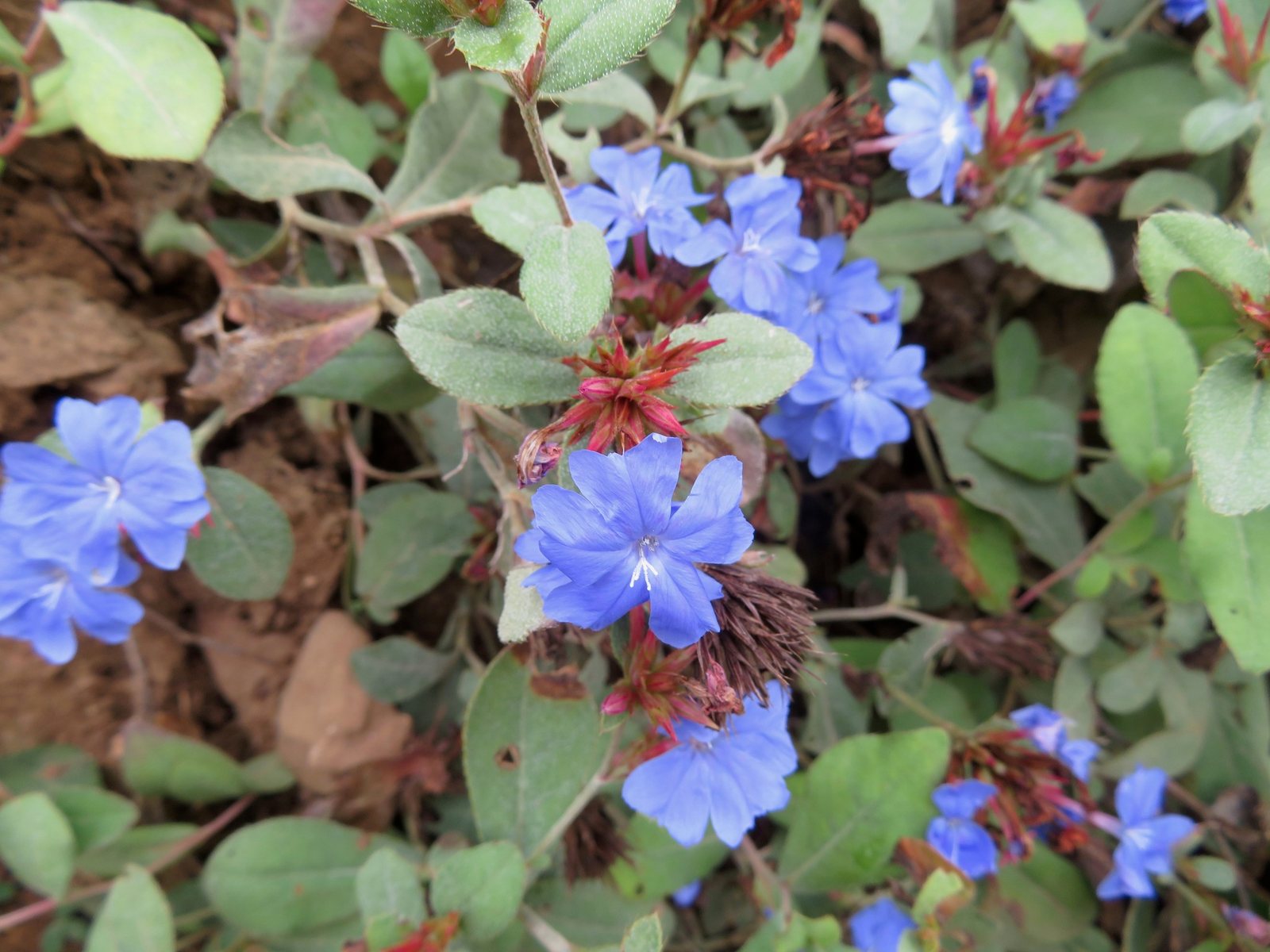
At a glance
- Sun
- Full sun to partial shade; afternoon shade helps in hot climates. Flowering and autumn colour are usually best with good light.
- Water
- Water regularly while establishing, then during prolonged dry spells. Established plants tolerate some drought but dislike persistently wet soil.
- Soil
- Well-drained soil of average fertility; tolerates chalk and a range of soil pH levels. Improve drainage in heavy clay.
- Height
- 0.5-1 ft (0.15-0.3 m)
- Spread
- 1-2 ft (0.3-0.6 m), spreading farther over time
- Flowers
- Late summer to autumn; vivid blue flowers with reddish calyces
- Foliage
- Oval green leaves turn bronze, burgundy and red in autumn before falling. New shoots appear relatively late in spring.
- Growth
- Moderate; faster in warm, well-drained soil
- Care needed
- Low
The year at a glance
- Pollinators
- Deer resistant
- Drought tolerant
- Heat tolerant
- Low allergen
| J | F | M | A | M | J | J | A | S | O | N | D | |
|---|---|---|---|---|---|---|---|---|---|---|---|---|
| Flowers | ||||||||||||
| Plant |
Northern hemisphere months. In Australia, shift them by six.
- Difficulty
- Easy
- Toughness
- Very tough
Will it suit your garden?
Pick your zone, country, light and whether you have pets.
Full sun is 6 or more hours of direct sun a day, part shade 3 to 6 hours, shade under 3.
How it grows
Planting day
0.2 ft (0.06 m)
After 1 year
0.5 ft (0.14 m)
After 2 years
0.7 ft (0.22 m)
full size
About 2 years to full size.
From a typical nursery size, at an average rate for this kind of plant. A rule of thumb, not a forecast.
Good to know
- Cats and dogs
- Mildly toxic: may upset a stomach
- Growth rate
- Fast
Care
Jobs through the year
- WaterApr–May, Sep, every 21 days
- Water established patches only if soil is dry after an extended rainless spell; water young plants more often.
- WaterJun–Aug, every 14 days
- Water established plants deeply during prolonged drought, allowing soil to dry between waterings.
- PruneFeb–Mar
- Cut dead stems close to ground level before new shoots develop.
- DivideApr–May
- Divide congested patches when growth starts; lift unwanted spreading shoots.
- MulchMar–Apr
- Apply a light compost dressing without burying the crowns.
- ProtectNov
- In colder gardens, add loose winter mulch after soil cools, keeping crowns clear.
- Water deeply during the first growing season whenever the soil begins to dry.
- Avoid frequent watering once established, especially in heavy soil.
- Apply a light dressing of compost in spring; routine heavy feeding is unnecessary.
- In colder areas, apply a loose winter mulch after the ground cools, keeping it away from the crown.
- Divide congested patches in spring and remove unwanted spreading shoots.
- Mark the planting area so you do not dig into dormant plants before they emerge.
Pruning. Cut dead stems back close to ground level in late winter or early spring, before new shoots develop. Trim or dig out growth that extends beyond its allotted space.
Through the year
- Late winter
- Cut back dead stems, taking care not to damage emerging buds.
- Spring
- Plant or divide once the soil is workable and severe frost has passed.
- Late spring
- Check for new growth before assuming a dormant patch has died; weed carefully around it.
- Summer
- Water young plants during dry weather and remove shoots spreading into neighbouring plants.
- Autumn
- Enjoy the flowers and red foliage; leave stems standing until late winter if they remain tidy.
- Late autumn
- In colder gardens, add a loose protective mulch without burying the crown.
In the garden
- Plant over spring bulbs to cover their fading foliage after flowering.
- Use along sunny or lightly shaded border edges for late-season blue flowers.
- Let it spread between established shrubs where the soil is not crowded with dense roots.
- Combine with ornamental grasses and autumn-flowering perennials for contrasting red foliage and blue flowers.
- Use in raised beds or at the top of low retaining walls where drainage is good.
Garden styles it suits: Cottage garden, Autumn colour, Low-maintenance, Dry gravel garden, Blues and silvers and Small-space.
Plant it with: Daffodils, Crocuses, Stonecrops, Dwarf fountain grass, Hardy geraniums and Autumn-flowering asters.
Wildlife: Flowers provide late-season nectar for visiting bees and butterflies.
Problems to watch for
- Root and crown rot in waterlogged soil: improve drainage or move plants to a raised bed; avoid winter irrigation.
- Winter loss in cold, wet sites: choose a sheltered, freely drained position and apply a loose winter mulch in colder areas.
- Sparse flowering in deep shade: move to a brighter position with several hours of direct sun.
- Unwanted spread into neighbouring plants: lift out the underground stems at the edge of the patch in spring.
Safety
Contact with the plant or sap may irritate human skin, so wear gloves if sensitive. It is not known as a major poisoning plant, but reliable species-specific information for cats, dogs and horses is limited. Do not treat any part as edible or allow pets or livestock to browse it.
Easily confused with
Cape leadwort (Plumbago auriculata)
A much larger, frost-tender, scrambling shrub with usually pale blue flowers in rounded clusters; it does not form the same low, winter-dormant carpet.
Chinese plumbago (Ceratostigma willmottianum)
Forms a woody shrub with persistent branching stems, rather than a low perennial patch that dies back to ground level.
The name
Ceratostigma comes from Greek words meaning 'horn' and 'stigma', referring to the flower's horn-like stigmas, while plumbaginoides means resembling Plumbago.
Propagation. Divide established patches in spring, retaining roots and buds on each piece. Softwood cuttings can also be taken in late spring or early summer.
Checked against open data
- Accepted botanical name
- Ceratostigma plumbaginoides
- In the US and Canada
- Introduced in the lower 48 states.
- Native range
- China North-Central and China Southeast.
- Measured
- Average height 30 cm.
Sources: GBIF (CC BY 4.0), USDA PLANTS and Trefle (CC BY 4.0). The care and design notes are LandscapeGPT's own.
See it in your own yard.
Upload a photo of your yard and see it redesigned with plants that suit your climate, each checked against your zone.