London pride
Saxifraga × urbium. Family Saxifragaceae. Groundcover.
Also called London-pride, None-so-pretty.
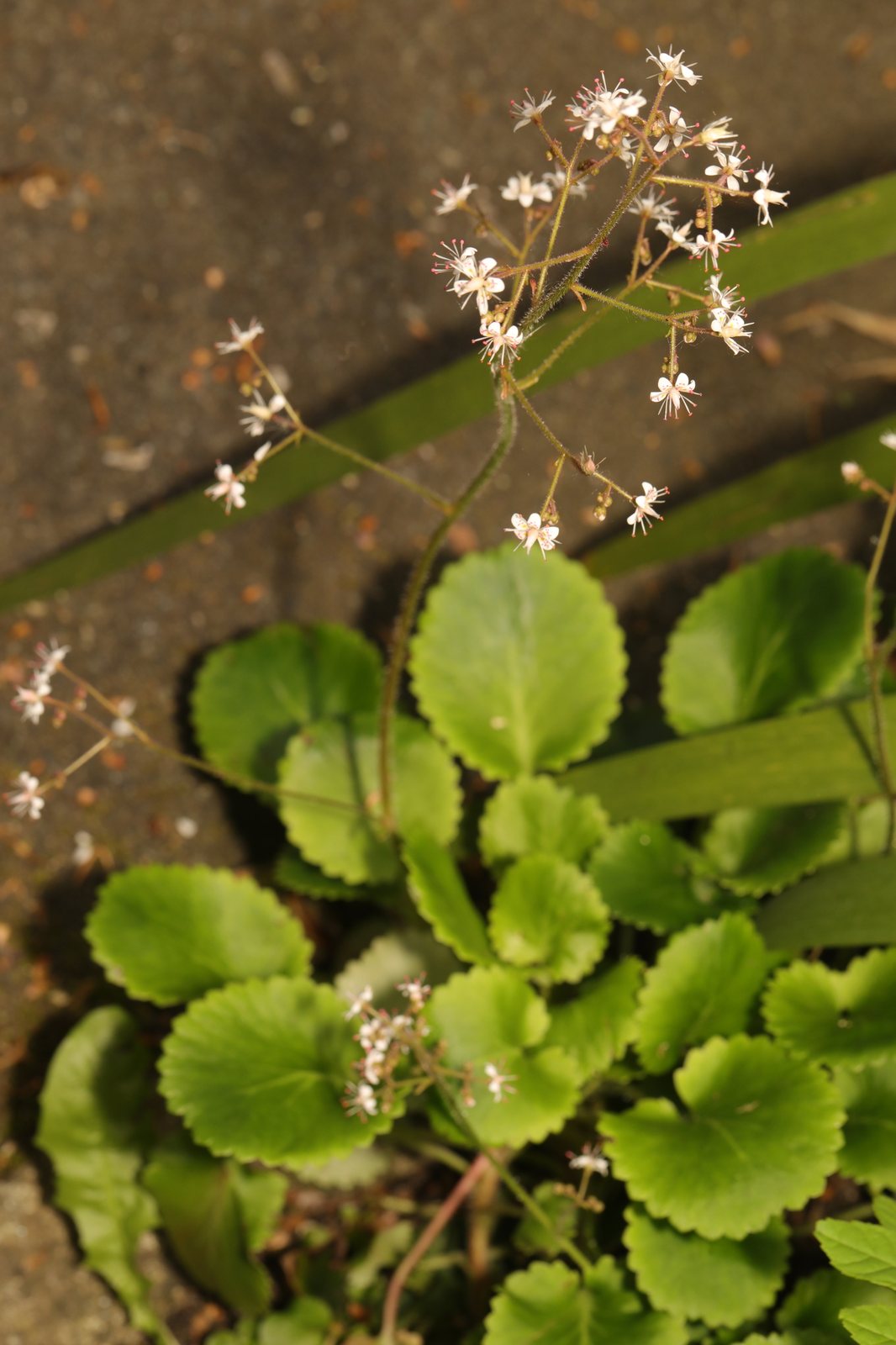
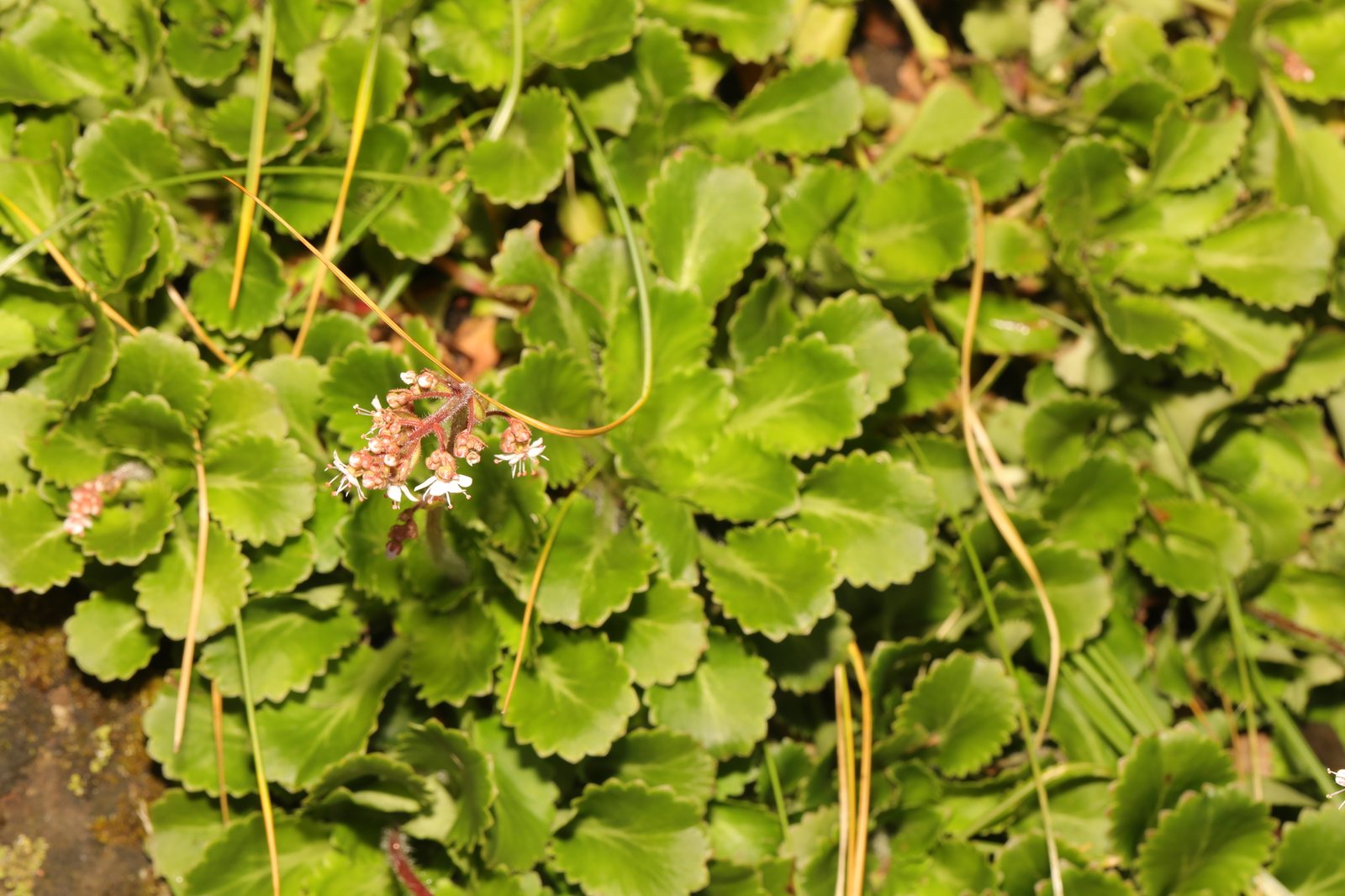
London pride is an evergreen perennial that forms spreading mats of leathery leaf rosettes, topped by airy sprays of tiny flowers. A hybrid of Saxifraga umbrosa and Saxifraga spathularis, it is useful for edging shaded paths, softening stonework and covering small patches beneath shrubs.

At a glance
- Sun
- Partial shade; tolerates full shade, but flowers less freely. Morning sun is suitable in cool climates; protect from strong afternoon sun.
- Water
- Keep moderately moist while establishing. Established mats tolerate short dry spells in shade, but need watering during prolonged drought.
- Soil
- Humus-rich, well-drained soil; tolerates a range of soil pH. Avoid waterlogged ground, especially in winter.
- Height
- 0.5-1 ft (0.15-0.3 m), including flower stems
- Spread
- 1-2 ft (0.3-0.6 m), gradually spreading farther where conditions suit
- Flowers
- Late spring to early summer; tiny white to pale pink flowers with pink or reddish spotting, held on slender, branching stems.
- Foliage
- Evergreen rosettes of spoon-shaped, leathery green leaves with scalloped margins; foliage may bronze in cold weather.
- Growth
- Moderate, spreading by short runners that produce new rosettes
- Care needed
- Low
The year at a glance
- Pollinators
- Wildlife
- Low allergen
| J | F | M | A | M | J | J | A | S | O | N | D | |
|---|---|---|---|---|---|---|---|---|---|---|---|---|
| Flowers | ||||||||||||
| Plant |
Northern hemisphere months. In Australia, shift them by six.
- Difficulty
- Easy
- Toughness
- Very tough
Will it suit your garden?
Pick your zone, country, light and whether you have pets.
Full sun is 6 or more hours of direct sun a day, part shade 3 to 6 hours, shade under 3.
How it grows
Planting day
0.2 ft (0.06 m)
After 1 year
0.4 ft (0.12 m)
After 2 years
0.6 ft (0.19 m)
After 3 years
0.7 ft (0.22 m)
full size
About 3 years to full size.
From a typical nursery size, at an average rate for this kind of plant. A rule of thumb, not a forecast.
Good to know
- Cats and dogs
- Safe
- Growth rate
- Moderate
Care
Jobs through the year
- WaterApr–May, Sep–Oct, every 14 days
- Water established mats only if soil is drying during prolonged dry weather; water new rosettes whenever the surface dries.
- WaterJun–Aug, every 7 days
- During prolonged drought, water established mats deeply, especially beneath trees; young plants need more frequent checks.
- MulchMar–Apr
- Apply a thin dressing of leaf mould or compost around mats, leaving rosette centres uncovered.
- PruneMar
- Remove dead leaves and unwanted spreading rosettes without cutting healthy crowns.
- DeadheadJun–Jul
- Cut spent flower stems back to the foliage.
- DivideMar–Apr, Sep
- Divide only crowded or patchy mats, replanting healthy rooted outer rosettes.
- ProtectJan–Feb, Oct–Dec
- Clear heavy fallen leaves and keep drainage routes open to prevent crown rot.
- Water newly planted rosettes whenever the surface soil begins to dry.
- Water established plants during prolonged dry weather, especially beneath trees.
- Apply a thin layer of leaf mould or compost around the mats in spring, keeping rosette centres uncovered.
- Avoid heavy feeding; a light compost dressing is usually enough.
- Divide crowded or patchy mats in spring or early autumn and replant healthy outer rosettes.
Pruning. Cut spent flower stems back to the foliage after flowering. Remove dead leaves and trim back unwanted spreading rosettes in spring without shearing through healthy crowns.
Through the year
- Early spring
- Remove winter-damaged leaves and check that soil or mulch has not buried the rosette centres.
- Spring
- Plant or divide clumps, water them in and add a thin compost dressing around them.
- Late spring
- Keep newly planted sections moist as flower stems develop.
- Summer
- Remove faded flower stems and water during extended dry spells.
- Early autumn
- Divide and replant rooted rosettes to fill gaps or extend the groundcover.
- Winter
- Clear heavy accumulations of fallen leaves and keep drainage outlets open.
In the garden
- Edge a shaded path with low evergreen rosettes and a soft haze of spring flowers.
- Plant in soil-filled pockets beside steps or at the base of a shaded stone wall to soften hard edges.
- Use beneath open shrubs with small ferns and hellebores for layered, year-round foliage.
- Combine with primroses and lungwort in a small woodland border for successive spring flowers.
Garden styles it suits: Cottage garden, Woodland, Arts and Crafts, Secret garden, Low-maintenance and Small-space.
Plant it with: Hellebores, Lungwort, Primroses, Epimedium, Japanese painted fern and Snowdrops.
Wildlife: The small, open flowers offer nectar and pollen to visiting insects. Dense mats provide shelter for small garden invertebrates.
Problems to watch for
- Vine weevil larvae can eat roots and loosen whole rosettes, especially in pots; inspect failing plants and treat with suitable beneficial nematodes when soil temperatures allow.
- Crown and root rot can develop in saturated soil; improve drainage and replant healthy rosettes with their centres above the soil surface.
- Slugs and snails may damage young leaves; remove hiding places and use targeted controls where damage is persistent.
- Hot sun and prolonged drought can scorch leaves and thin the mat; provide afternoon shade and water deeply during dry spells.
Safety
Not known to be toxic to people, cats, dogs or horses. No part is generally recognised as poisonous, but it is not a food plant and animal-specific safety information is limited.
Easily confused with
Strawberry saxifrage (Saxifraga stolonifera)
Has rounded, often silver-veined leaves and long, thin runners carrying plantlets. Its flowers have two conspicuously elongated lower petals, unlike the more evenly proportioned flowers of London pride.
Mossy saxifrage (Saxifraga × arendsii)
Forms cushions of small, finely divided leaves rather than broad, leathery rosettes, and usually carries larger, more conspicuous flowers.
The name
The epithet urbium means 'of cities', and the common name London pride reflects the plant's long association with London gardens.
Propagation. Divide mats in spring or early autumn, or detach rooted daughter rosettes and replant them immediately. Division preserves named varieties; seedlings may differ from the parent.
Checked against open data
- Accepted botanical name
- Saxifraga urbium
Sources: GBIF (CC BY 4.0). The care and design notes are LandscapeGPT's own.
See it in your own yard.
Upload a photo of your yard and see it redesigned with plants that suit your climate, each checked against your zone.