Love-in-a-mist
Nigella damascena. Family Ranunculaceae. Annual.
Also called Devil-in-a-bush, Ragged lady.
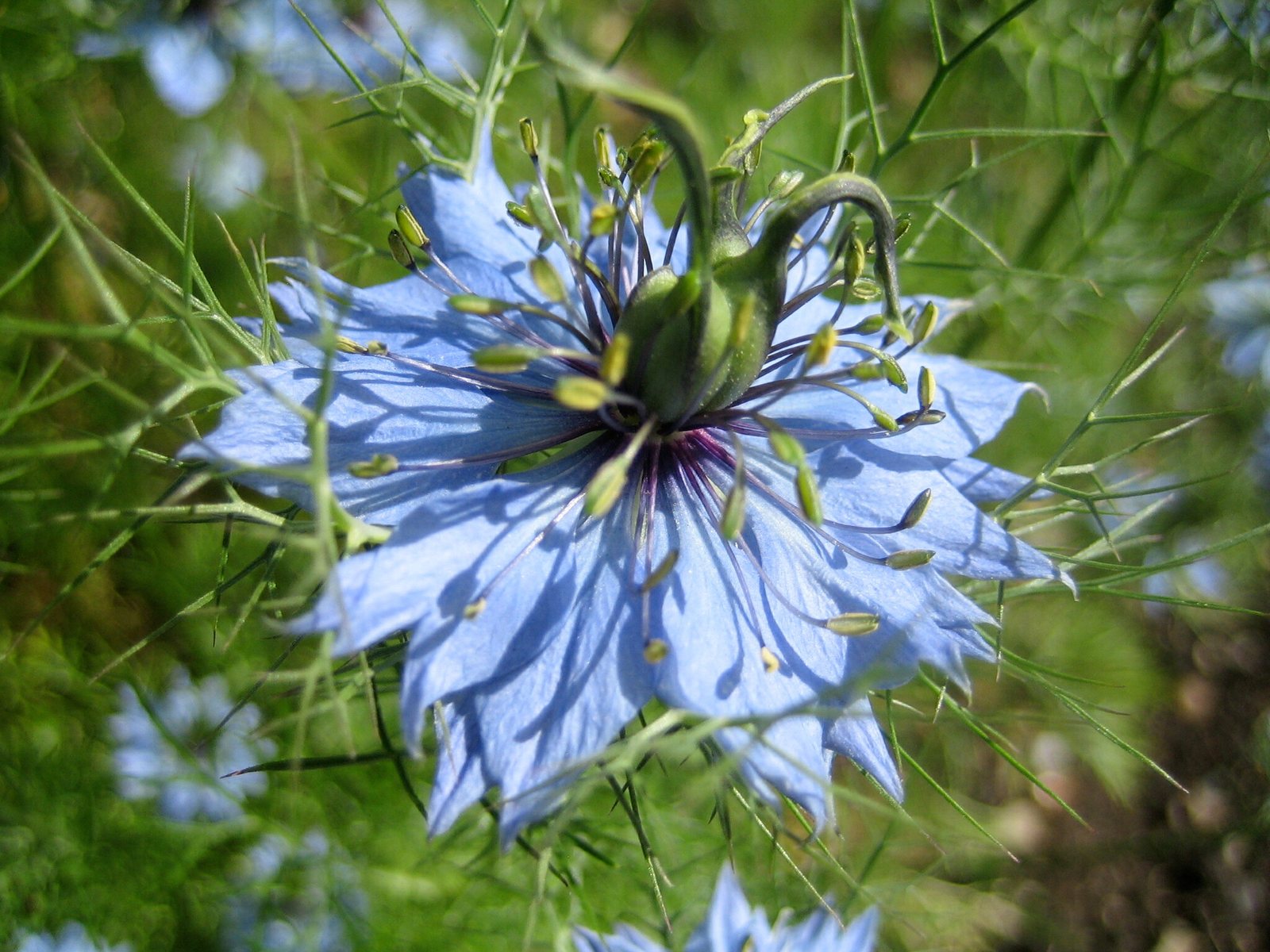
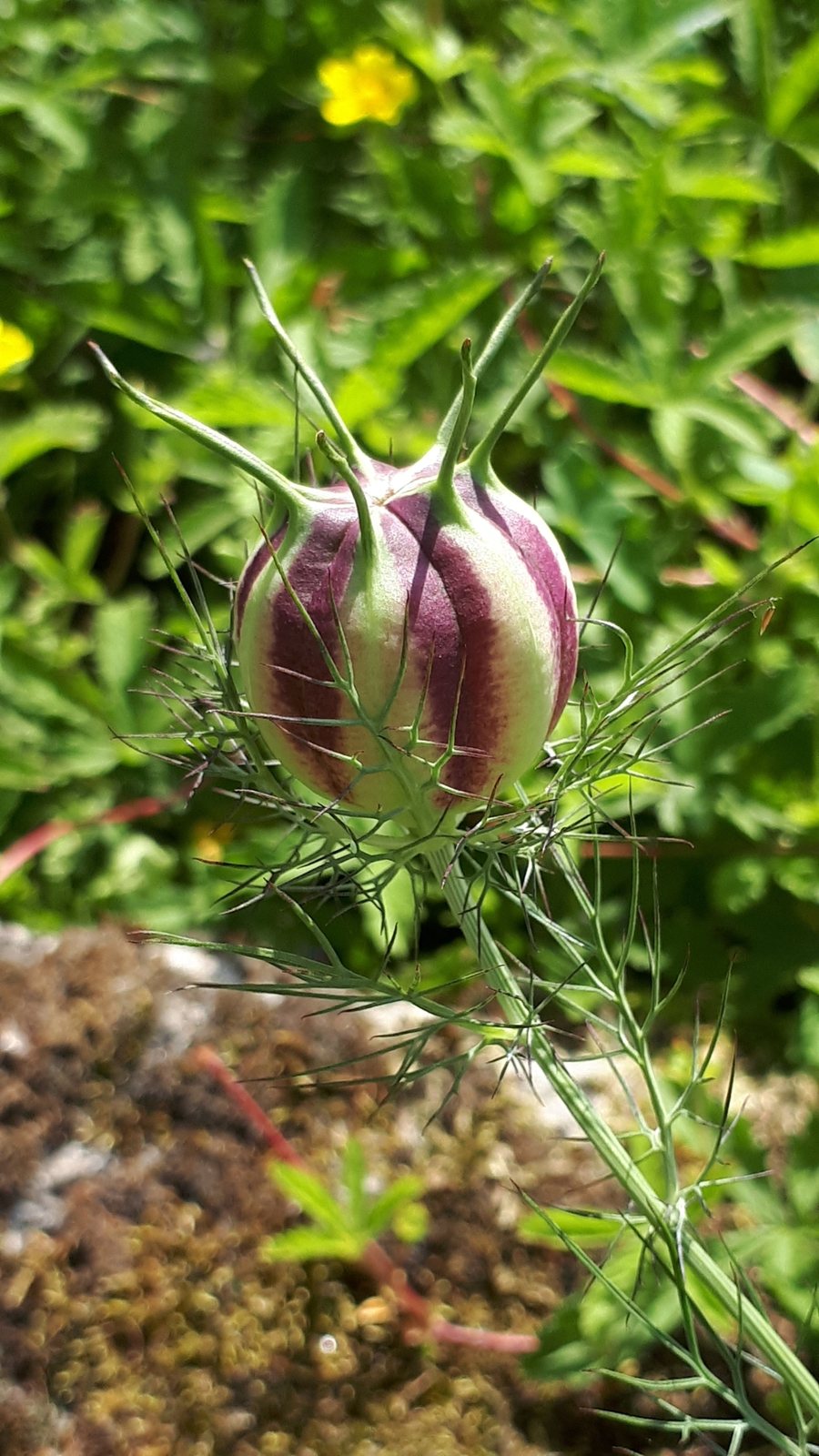
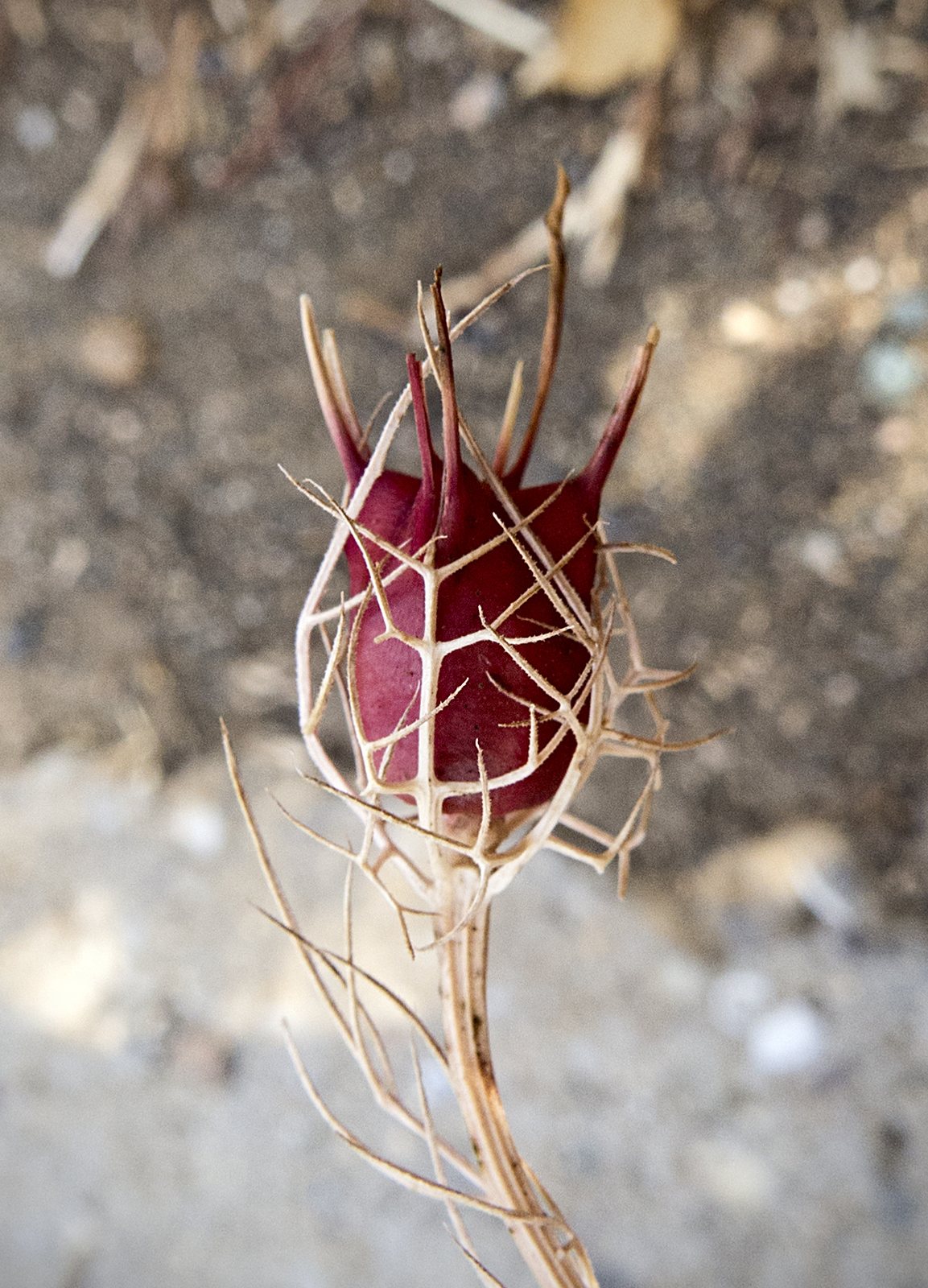
Love-in-a-mist is grown as an annual for its blue, white or pink flowers, surrounded by finely divided green bracts. It fills small gaps in sunny borders and produces inflated, horned seedpods useful for dried arrangements, often leaving seedlings for the following year.
At a glance
- Sun
- Full sun; tolerates light shade, but flowers less freely.
- Water
- Keep seedbeds moist until established, then water during prolonged dry spells. Avoid persistently wet soil.
- Soil
- Well-drained soil of average fertility; tolerates chalk and relatively poor soil. Rich soil encourages leafy, floppy growth.
- Height
- 1-2 ft (0.3-0.6 m)
- Spread
- 0.5-1 ft (0.15-0.3 m)
- Flowers
- Late spring to summer, depending on sowing time and climate; usually blue, with white, pink and mauve forms.
- Foliage
- Soft green leaves divided into fine, threadlike segments, with similarly divided bracts forming a mist around each flower.
- Growth
- Fast; completes its life cycle in one growing season.
- Care needed
- Low
The year at a glance
- Pollinators
- Deer resistant
- Drought tolerant
- Low allergen
| J | F | M | A | M | J | J | A | S | O | N | D | |
|---|---|---|---|---|---|---|---|---|---|---|---|---|
| Flowers | ||||||||||||
| Fruit | ||||||||||||
| Plant |
Northern hemisphere months. In Australia, shift them by six.
- Difficulty
- Easy
- Toughness
- Very tough
Will it suit your garden?
Pick your zone, country, light and whether you have pets.
Full sun is 6 or more hours of direct sun a day, part shade 3 to 6 hours, shade under 3.
How it grows
Planting day
0.5 ft (0.15 m)
After 1 year
1.5 ft (0.45 m)
full size
Full size in one season.
From a typical nursery size, at an average rate for this kind of plant. A rule of thumb, not a forecast.
Good to know
- Cats and dogs
- Toxic
- Invasive in
- Australia
- In the garden
- Spreads vigorously: plan to contain it.
- Growth rate
- Fast
Care
Jobs through the year
- WaterMar–May, every 7 days
- Water established plants only if dry; keep newly sown seedbeds moist with more frequent light watering.
- WaterJun–Aug, every 14 days
- Water established plants during prolonged dry spells, avoiding persistently wet soil.
- DeadheadMay–Aug, every 7 days
- Remove faded flowers for more blooms, leaving selected stems for decorative pods.
- PruneAug–Oct
- Cut down brown plants before pods split if self-seeding is unwanted.
- Sow directly where plants will flower; seedlings resent root disturbance.
- Thin seedlings to 0.5-0.75 ft (0.15-0.23 m) apart.
- Water young plants regularly, then water only when the soil becomes dry.
- Avoid routine feeding, especially high-nitrogen fertilisers.
- Keep heavy mulch off the seedbed if you want seeds to germinate.
- Remove unwanted seedlings while small to control self-seeding.
Pruning. During flowering, remove faded flowers to encourage more blooms, or leave selected stems to form decorative seedpods. Pull up or cut down plants when they turn brown, before pods open if you want to prevent self-seeding.
Through the year
- Early spring
- Direct-sow into a weed-free, finely raked seedbed as soon as the soil is workable.
- Mid-spring
- Thin crowded seedlings and water during dry weather.
- Late spring
- Make another sowing for a later display where summers are not extremely hot.
- Summer
- Deadhead for continued flowering, leaving some blooms if you want seedpods.
- Late summer
- Cut firm, developed seedpods for drying; collect seed when the remaining pods turn brown.
- Autumn
- Clear spent plants. In mild-winter areas, direct-sow for earlier flowers the following spring.
In the garden
- Scatter through cottage borders between roses and early-flowering perennials for a light, informal layer.
- Sow among spring bulbs to soften their fading foliage without adding dense permanent growth.
- Grow in cutting-garden rows for fresh flowers and decorative dried seedpods.
- Use blue and white forms beside silver foliage or pale flowers in cool-coloured borders.
Garden styles it suits: Cottage garden, English country, Romantic rose garden, Potager (kitchen garden), Pastel border and Blues and silvers.
Plant it with: Roses, Cornflowers, Calendulas, Shirley poppies, Sweet alyssum and Lavender.
Wildlife: Flowers provide pollen and nectar for bees and other visiting insects. It is not a native wildflower in the United States, Canada, the United Kingdom or Australia.
Problems to watch for
- Poor establishment after transplanting: sow directly rather than moving established seedlings.
- Tall, floppy plants with few flowers: provide more sun, avoid rich feeding and thin crowded seedlings.
- Rot or seedling collapse in wet soil: improve drainage and avoid repeated watering while the soil is still moist.
- Unwanted self-seeding: remove pods before they split and hoe out surplus seedlings while small.
Safety
Seeds contain potentially harmful compounds and should not be eaten; this is not culinary black cumin, Nigella sativa. Human poisoning information is limited, and reliable species-specific toxicity information for cats, dogs and horses is sparse. Keep seeds away from children and animals, and seek medical or veterinary advice after ingestion rather than assuming they are safe.
Where it spreads. Self-seeds freely and has escaped cultivation. It is regarded as an environmental weed in parts of Australia, including Victoria; avoid allowing seed to spread into nearby natural vegetation.
Easily confused with
Black cumin (Nigella sativa)
Its flowers lack the conspicuous collar of finely divided, mist-like bracts found immediately beneath love-in-a-mist flowers. Do not identify edible seed by appearance alone.
Spanish love-in-a-mist (Nigella hispanica)
Usually has larger, more open blue flowers with prominent dark stamens and much less of the feathery collar surrounding each flower.
The name
Nigella means 'little black one', referring to the seeds, damascena means 'of Damascus', and love-in-a-mist describes the flowers nestled among fine, mist-like bracts.
Propagation. Grow from seed, sown directly in early spring or in autumn where winters are mild. Cover lightly with soil and keep moist until germination. Saved seed from mixed varieties may produce different flower colours.
Checked against open data
- Accepted botanical name
- Nigella damascena
- In the US and Canada
- Introduced in the lower 48 states.
- Native range
- Albania, Algeria, Baleares, Bulgaria, Canary Is., Corse, Cyprus, East Aegean Is., France, Greece, Iran and Italy.
- Measured
- Average height 24 cm.
Sources: GBIF (CC BY 4.0), USDA PLANTS and Trefle (CC BY 4.0). The care and design notes are LandscapeGPT's own.
See it in your own yard.
Upload a photo of your yard and see it redesigned with plants that suit your climate, each checked against your zone.