Meadow saffron
Colchicum autumnale. Family Colchicaceae. Bulb.
Also called Autumn crocus, Naked ladies.
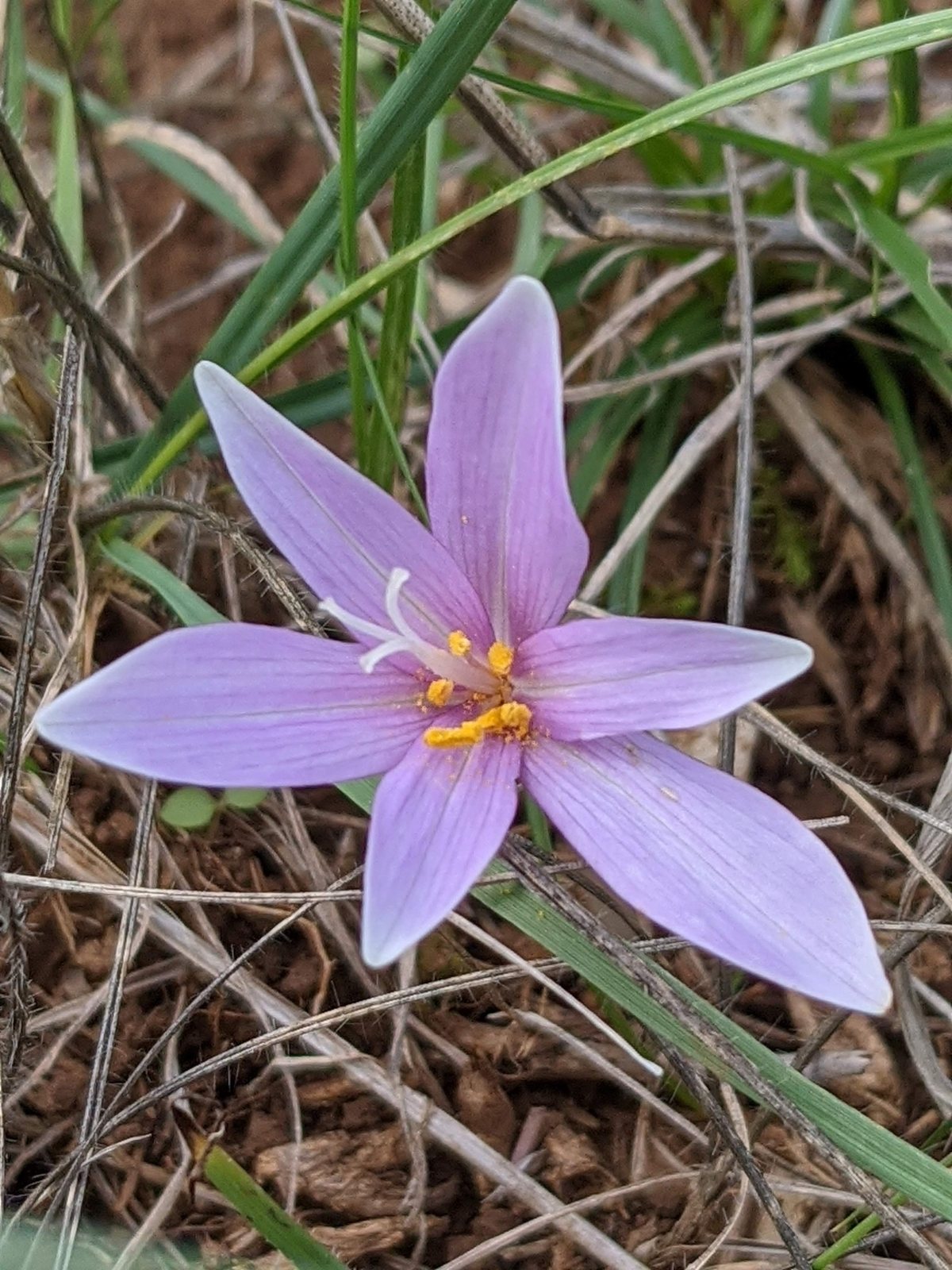
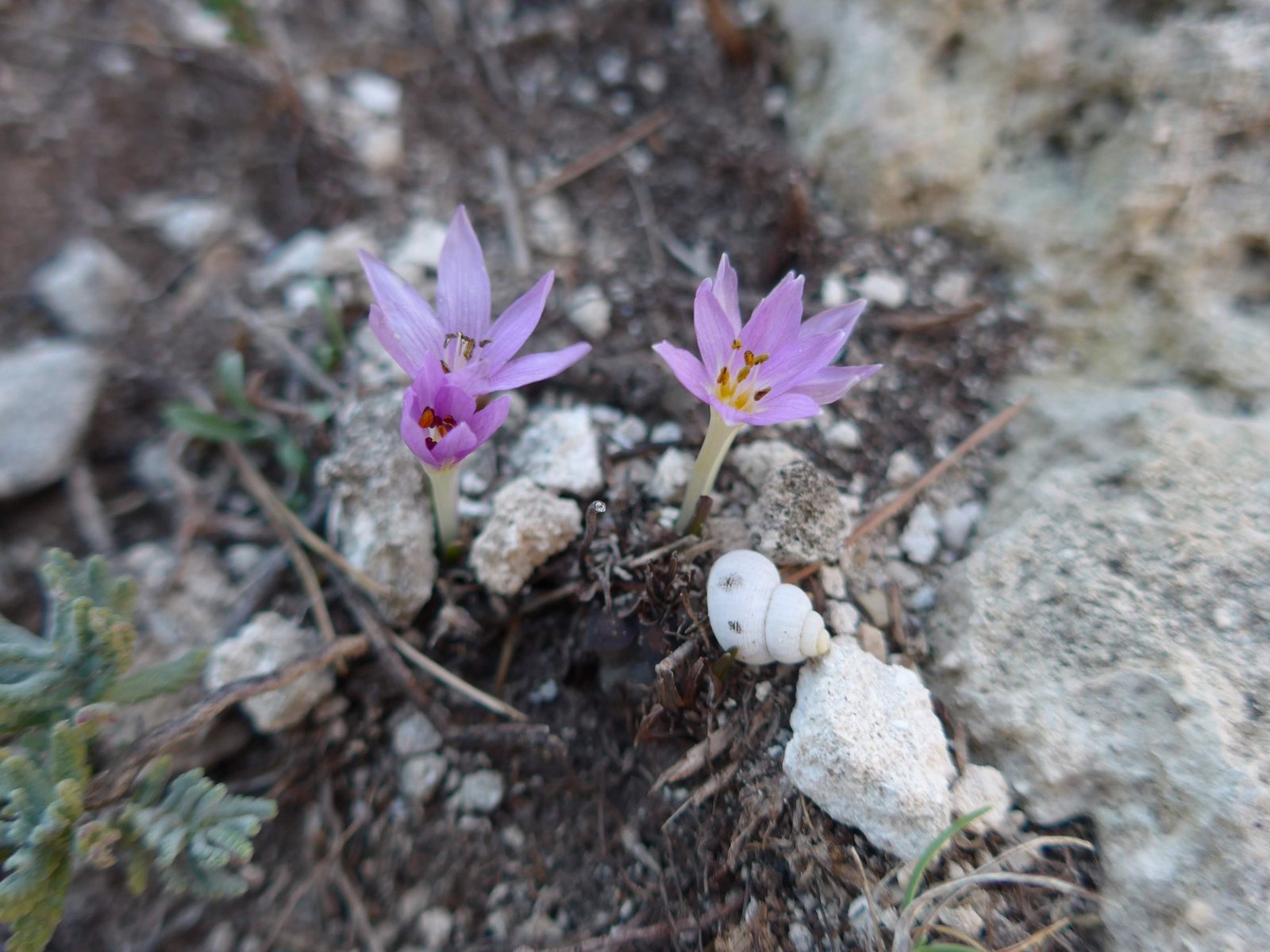
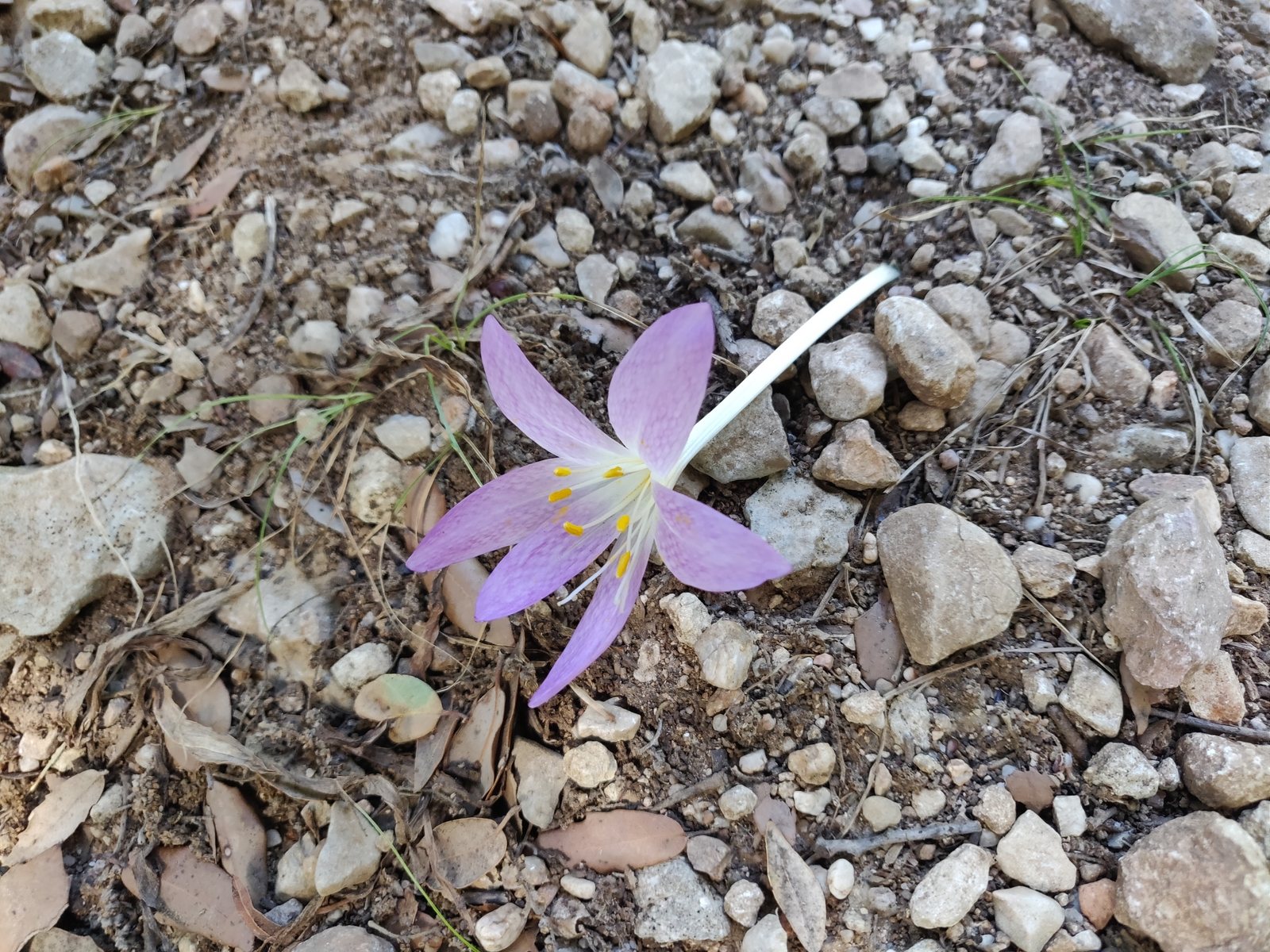
Meadow saffron is a hardy, corm-forming perennial grown for pink to lilac flowers that emerge from bare ground in autumn. Its broad leaves appear in spring and die back before flowering. Despite its common names, it is neither a true crocus nor edible saffron; every part is highly poisonous.
At a glance
- Sun
- Full sun to partial shade; avoid deep shade.
- Water
- Keep soil moderately moist during spring growth and autumn flowering. Water sparingly during summer dormancy, without letting the soil remain waterlogged.
- Soil
- Fertile, moisture-retentive but well-drained soil; tolerates clay if drainage is good.
- Height
- Flowers 0.3-0.5 ft (0.1-0.15 m); spring foliage 0.5-1 ft (0.15-0.3 m)
- Spread
- 0.3-0.5 ft (0.1-0.15 m) per plant, gradually forming wider clumps
- Flowers
- Early to mid-autumn; pink to lilac, goblet-shaped flowers without leaves.
- Foliage
- Broad, upright, glossy green leaves emerge in spring and yellow by early summer; dormant and leafless through much of summer.
- Growth
- Moderate; clumps enlarge gradually through corm offsets.
- Care needed
- Low
The year at a glance
- Pollinators
- Deer resistant
- Cold hardy
- Low allergen
| J | F | M | A | M | J | J | A | S | O | N | D | |
|---|---|---|---|---|---|---|---|---|---|---|---|---|
| Flowers | ||||||||||||
| Plant |
Northern hemisphere months. In Australia, shift them by six.
- Difficulty
- Easy
- Toughness
- Very tough
Will it suit your garden?
Pick your zone, country, light and whether you have pets.
Full sun is 6 or more hours of direct sun a day, part shade 3 to 6 hours, shade under 3.
How it grows
Planting day
0.4 ft (0.13 m)
full size
About 1 years to full size.
From a typical nursery size, at an average rate for this kind of plant. A rule of thumb, not a forecast.
Good to know
- Cats and dogs
- Toxic
- Native to
- the UK
- Growth rate
- Moderate
Care
Jobs through the year
- WaterMar–Apr, Sep–Oct, every 14 days
- Water established clumps during prolonged dry spells in leaf or flower; water new corms in.
- WaterMay–Jun, every 7 days
- Water only if dry while leaves remain green; stop when summer dormancy begins.
- MulchMar
- Apply a thin compost dressing around clumps without covering emerging shoots.
- PruneJun–Jul
- Clear foliage only after it has fully yellowed; never mow or tie green leaves.
- DivideJul–Aug
- Divide crowded dormant corms and replant promptly, wearing gloves.
- DeadheadSep–Oct
- Optionally remove collapsed flowers, wearing gloves.
- ProtectMar–Apr, Sep–Oct
- Check for slug damage; keep this severely poisonous plant away from children, pets and livestock.
- Plant dormant corms in late summer, with about 3-4 in (8-10 cm) of soil above them and 6 in (15 cm) between plants.
- Water during prolonged dry spells while leaves are green or flowers are developing; avoid persistently wet soil.
- Apply a thin layer of garden compost around clumps in spring, keeping it clear of emerging shoots.
- Let spring leaves die back naturally; do not tie them up or mow them while green.
- Lift and divide crowded clumps during summer dormancy, then replant promptly; wear gloves when handling corms.
Pruning. Remove spent flowers if desired and clear away foliage only once it has yellowed and died back in early summer. No other pruning is needed.
Through the year
- Spring
- Top-dress with compost and water if dry while the leaves are actively growing.
- Early summer
- Allow leaves to yellow completely before removing them or mowing naturalised grass.
- Summer
- Divide congested clumps while dormant and replant the corms promptly.
- Late summer
- Plant new corms as soon as available; mark their positions to avoid accidental digging.
- Autumn
- Check emerging flowers for slug damage and water during prolonged dry weather.
- Winter
- Check that the planting area drains freely and does not remain saturated.
In the garden
- Plant in loose groups beneath deciduous shrubs, where spring light supports the leaves and autumn flowers show through.
- Use at the front of perennial borders beside plants that soften the gap left by summer dormancy.
- Naturalise in ornamental grass that can remain uncut until the spring foliage has died back; never use grazing land.
- Repeat small drifts along a lightly shaded path, away from edible beds and places where children or pets may investigate.
Garden styles it suits: Cottage garden, English country, Woodland, Autumn colour, Romantic rose garden and Grand estate.
Plant it with: Hardy geraniums, Hostas, Lady's mantle, Japanese anemones, Sedges and Deciduous ferns.
Wildlife: Bees may visit the autumn flowers. Its severe toxicity makes it unsuitable for livestock pasture or hay meadows.
Problems to watch for
- Slugs and snails can damage flowers and leaves; inspect regularly and use barriers, hand-picking or a locally approved control.
- Corm rot develops in waterlogged ground; improve drainage or move dormant corms to a better-drained site, discarding rotten ones.
- Poor flowering can follow deep shade or premature leaf removal; provide more spring light and leave foliage intact until fully yellow.
- Autumn flowers may flop in heavy rain or exposed positions; plant in a sheltered spot among low, open companions.
Safety
Highly poisonous to people, cats, dogs and horses. All parts, including flowers, leaves, seeds and corms, contain colchicine; ingestion can cause fatal poisoning, and dried material remains dangerous. Never use it as saffron or eat leaves mistaken for wild garlic. Suspected ingestion requires immediate medical or veterinary advice, even before symptoms appear.
Easily confused with
Saffron crocus (Crocus sativus)
Saffron crocus has three stamens, three conspicuous red stigma branches and narrow, grass-like leaves. Meadow saffron has six stamens and broad leaves that appear separately in spring;
Autumn-flowering crocus (Crocus speciosus)
This true crocus has three stamens and usually violet-blue flowers with darker veins and branched orange stigmas. Meadow saffron has six stamens and generally pinker flowers.
Wild garlic (Allium ursinum)
Wild garlic has individual leaves on distinct stalks, a garlic scent and white spring flower clusters. Meadow saffron produces a tight cluster of broad leaves, often around a developing seed capsule;
The name
Colchicum refers to Colchis, an ancient region by the Black Sea, while autumnale means autumn-flowering.
Propagation. Separate corm offsets during summer dormancy and replant promptly. Seed propagation is possible but slow, with germination sometimes delayed and flowering taking several years.
Checked against open data
- Accepted botanical name
- Colchicum autumnale
- In the US and Canada
- Introduced in the lower 48 states.
- Native range
- Albania, Austria, Belgium, Bulgaria, Czechoslovakia, France, Germany, Great Britain, Greece, Hungary, Ireland and Italy.
- Measured
- Soil pH 6.5 to 7. Average height 36 cm.
Sources: GBIF (CC BY 4.0), USDA PLANTS and Trefle (CC BY 4.0). The care and design notes are LandscapeGPT's own.
See it in your own yard.
Upload a photo of your yard and see it redesigned with plants that suit your climate, each checked against your zone.