Mediterranean fan palm
Chamaerops humilis. Family Arecaceae. Tree.
Also called European fan palm, Dwarf fan palm.
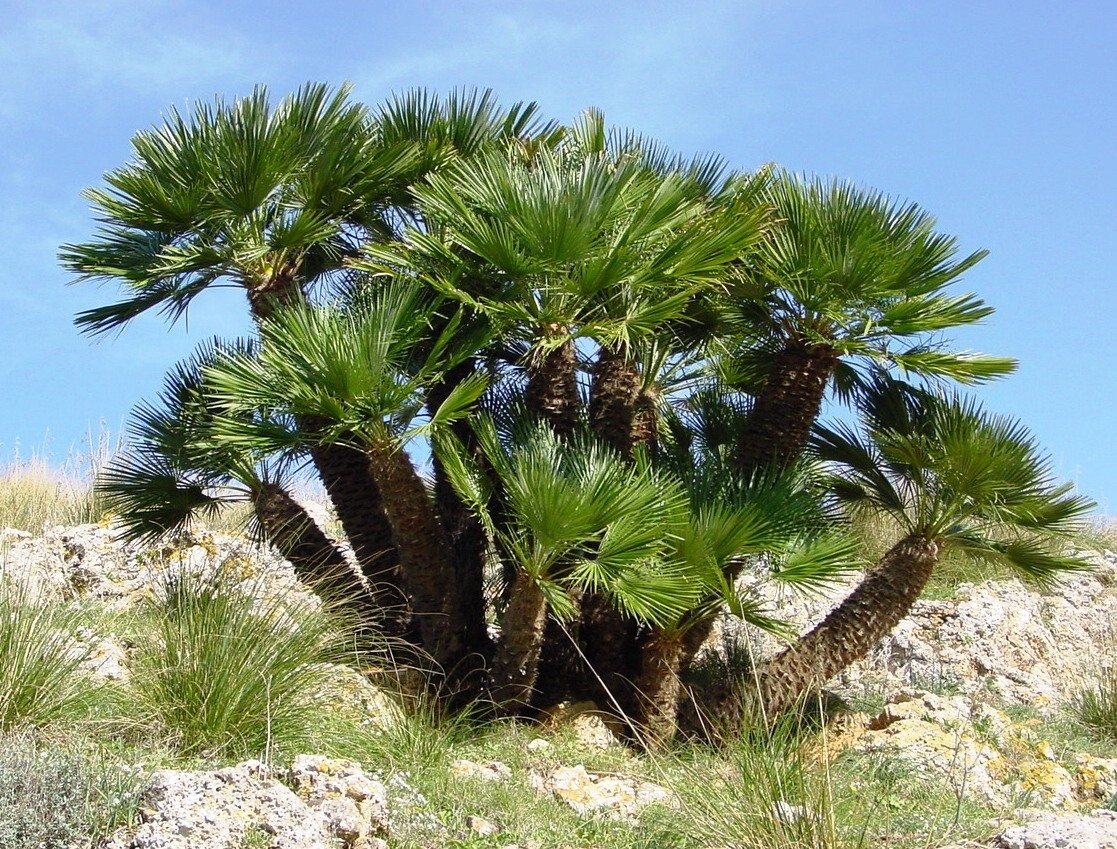
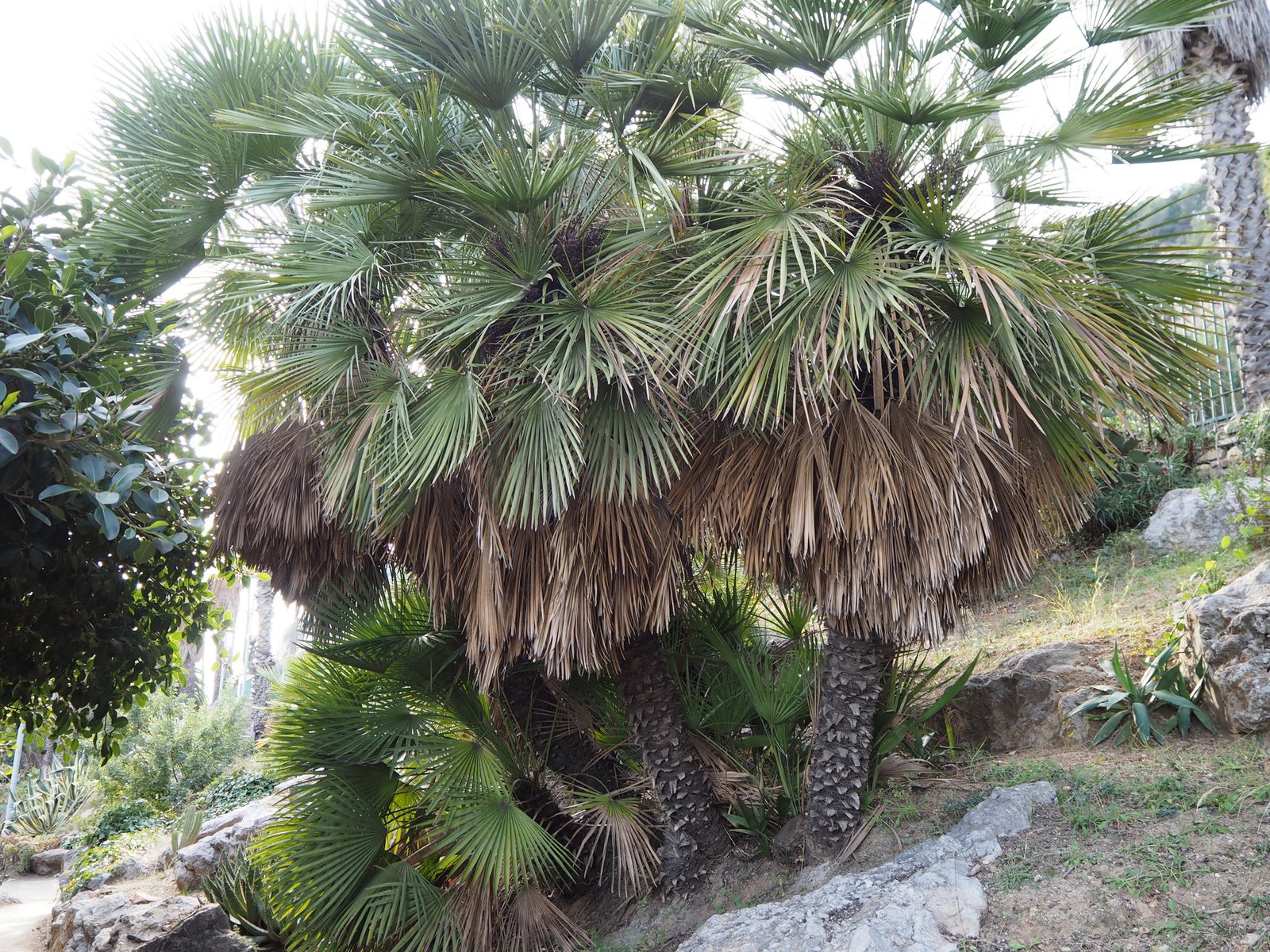
A slow-growing evergreen palm that usually forms a clump of short, fibrous trunks topped with stiff, fan-shaped leaves. Gardeners grow it for year-round structure in sunny borders, gravel gardens and large containers. It tolerates drought once established, but winter wet and severe frost can damage it.
At a glance
- Sun
- Full sun is best; tolerates light shade but grows more slowly and less densely.
- Water
- Water regularly during establishment, letting the surface soil dry between waterings. Established plants tolerate drought; container plants need more frequent watering.
- Soil
- Well-drained sandy, gravelly or loamy soil; tolerates alkaline conditions. Avoid heavy soil that stays wet in winter.
- Height
- 6-15 ft (1.8-4.6 m)
- Spread
- 6-10 ft (1.8-3 m)
- Flowers
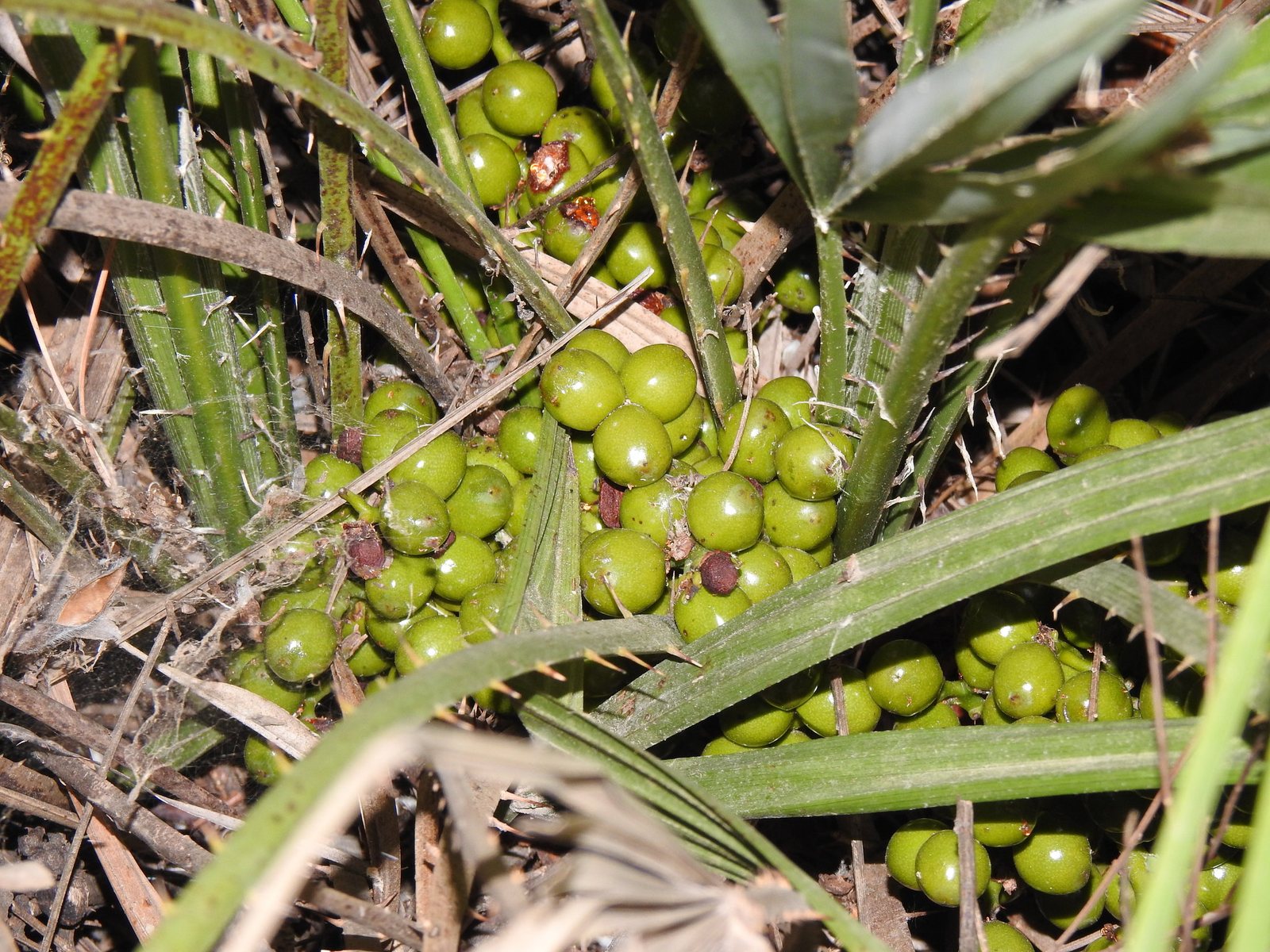
- Small yellow flowers in dense clusters among the leaf bases in spring to early summer; female plants may produce yellow-brown to reddish-brown fruits after pollination.
- Foliage
- Evergreen. Stiff, deeply divided green to grey-green fans on leaf stalks armed with sharp spines; trunks retain a covering of fibres and old leaf bases.
- Growth
- Slow
- Care needed
- Low
The year at a glance
- Pollinators
- Drought tolerant
- Heat tolerant
- Wildlife
| J | F | M | A | M | J | J | A | S | O | N | D | |
|---|---|---|---|---|---|---|---|---|---|---|---|---|
| Flowers | ||||||||||||
| Fruit | ||||||||||||
| Plant |
Northern hemisphere months. In Australia, shift them by six.
- Difficulty
- Moderate
- Toughness
- Fairly tough
Will it suit your garden?
Pick your zone, country, light and whether you have pets.
Full sun is 6 or more hours of direct sun a day, part shade 3 to 6 hours, shade under 3.
How it grows
Planting day
7 ft (2 m)
After 1 year
7 ft (2 m)
After 2 years
7 ft (2.1 m)
After 3 years
7 ft (2.1 m)
After 5 years
7 ft (2.2 m)
About 32 years to full size.
From a typical nursery size, at an average rate for this kind of plant. A rule of thumb, not a forecast.
Good to know
- Cats and dogs
- Safe
- Growth rate
- Slow
Care
Jobs through the year
- WaterApr–May, Sep, every 28 days
- Water established outdoor palms only during prolonged dry spells; young palms need more frequent watering.
- WaterJun–Aug, every 21 days
- Deep-water established outdoor palms during drought, letting the surface dry; check pots more frequently.
- FeedMay
- Apply a modest dose of palm fertiliser only if growth is weak or soil is poor.
- MulchMay
- Keep a light mulch over the root zone, clear of trunk bases and growing points.
- PruneMay–Jun
- Wear gloves and eye protection to remove fully brown fronds; retain healthy green leaves.
- ProtectJan–Apr, Oct–Dec
- In zones 6–7, move containers to bright frost-protected shelter; fleece alone is insufficient in severe winters.
- Plant in spring after hard frosts, in a sunny position sheltered from cold winds.
- Water deeply through the first growing season, allowing the surface soil to dry between soakings.
- Use a modest application of palm fertiliser in spring if growth is weak or the soil is poor; avoid heavy feeding.
- Keep mulch clear of the trunk bases and growing points.
- In colder areas, protect the crown with breathable fleece during severe freezes and remove it when conditions improve.
- Use a container with drainage holes and move it to a bright, frost-protected position where winters exceed its tolerance.
Pruning. In late spring or early summer, remove fully brown fronds with clean tools, leaving healthy green leaves in place. Wear thick gloves and eye protection, and remove unwanted basal shoots only if you want a more open clump.
Through the year
- Spring
- Plant or repot once hard frosts have passed, keeping the palm at its previous planting depth.
- Spring
- Feed lightly if needed and check container drainage.
- Late spring
- Remove dead fronds and assess winter damage; do not cut into the central growing point.
- Summer
- Water young and container-grown plants during dry spells, and inspect leaf undersides for pests.
- Autumn
- Reduce watering as growth slows and clear debris that traps moisture around the crown.
- Winter
- Protect during severe freezes and keep containers sheltered from persistent rain and freezing winds.
In the garden
- Use as an evergreen focal point in a sunny gravel garden with lavender, rock roses and ornamental grasses.
- Plant in a broad raised bed to provide architectural foliage where winter drainage is otherwise poor.
- Grow in a large container on a sunny terrace, leaving room around the spiny leaf stalks.
- Group with other drought-tolerant plants in coastal or Mediterranean-style gardens for contrasting leaf shapes.
Garden styles it suits: Modern Mediterranean, Architectural minimal, Dry gravel garden, Coastal, Desert / xeriscape and Modern courtyard.
Plant it with: Lavender, Rock rose, Rosemary, Santolina, Red yucca and Blue fescue.
Wildlife: Flowers provide pollen for visiting insects, and a mature clump offers shelter for small animals. Its main garden value is structural rather than as a major wildlife food plant.
Problems to watch for
- Root or crown rot in waterlogged soil: improve drainage, reduce watering and keep debris away from the crown; severely rotted plants may not recover.
- Scale insects on leaves and stalks: wipe off small infestations and use a labelled horticultural oil where appropriate, following temperature restrictions.
- Spider mites, especially under cover: look for fine webbing and pale stippling, rinse leaf undersides and use a labelled treatment if the infestation persists.
- Frost injury: shelter young plants and protect during severe freezes; wait until late spring to remove damaged foliage so surviving growth can be assessed.
Safety
Not known to be toxic to cats, dogs, horses or people. The fruits are not recommended for eating. Sharp spines along the leaf stalks can cause painful puncture wounds, so keep it away from narrow paths and play areas.
Easily confused with
Windmill palm (Trachycarpus fortunei)
Usually forms one taller, upright trunk rather than a suckering clump, and its leaf stalks lack the large, sharp spines of Mediterranean fan palm.
Lady palm (Rhapis excelsa)
Has slender, cane-like stems and leaves divided into fewer, broad segments with blunt or ragged tips; its leaf stalks are not armed with large spines.
The name
Chamaerops comes from Greek words meaning 'low shrub', while humilis is Latin for 'low-growing', referring to the palm's usually short, clumping habit.
Propagation. Raise from fresh seed in a warm propagator; germination can be slow and irregular. Basal suckers can sometimes be separated in late spring if they have their own roots, but unrooted shoots rarely establish.
Checked against open data
- Accepted botanical name
- Chamaerops humilis
- Native range
- Algeria, Baleares, France, Italy, Libya, Morocco, Portugal, Sardegna, Sicilia, Spain and Tunisia.
- Measured
- Soil pH 5.5 to 6.5. Average height 143 cm.
Sources: GBIF (CC BY 4.0) and Trefle (CC BY 4.0). The care and design notes are LandscapeGPT's own.
See it in your own yard.
Upload a photo of your yard and see it redesigned with plants that suit your climate, each checked against your zone.