Michailovsky's fritillary
Fritillaria michailovskyi. Family Liliaceae. Bulb.
Also called Michael's flower, Fritillaria.
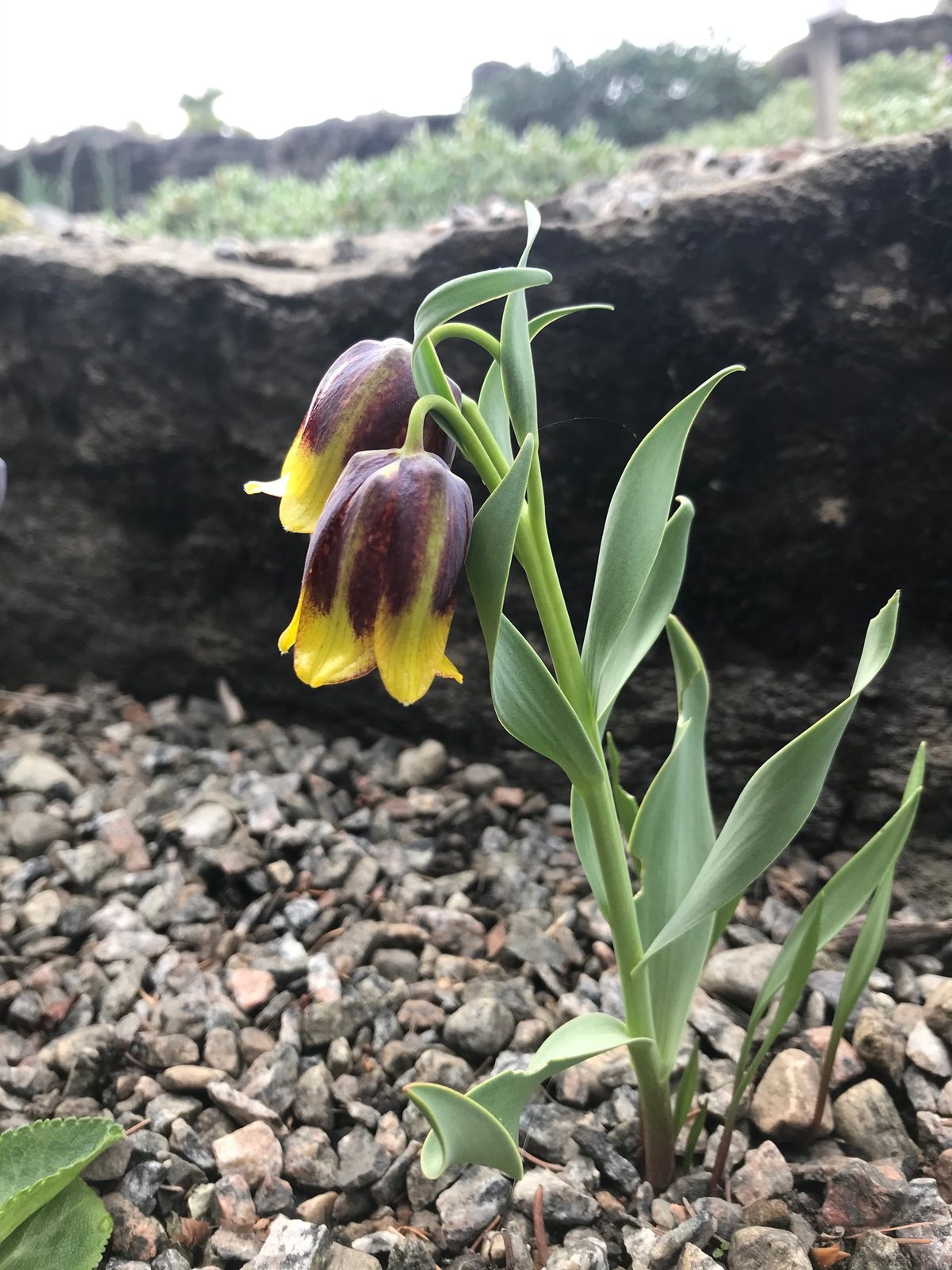
This small, spring-flowering bulb from Turkey bears nodding, dark reddish-purple bells with bright yellow rims. Grow it in a rock garden, raised bed or pot where you can see the flowers closely and provide excellent drainage, especially during summer dormancy.
At a glance
- Sun
- Full sun or light partial shade; avoid deep shade.
- Water
- Keep moderately moist during active spring growth, then much drier after the leaves die back. Avoid waterlogged soil in any season.
- Soil
- Well-drained, gritty soil with some organic matter; neutral to slightly alkaline conditions suit it well.
- Height
- 0.5-0.8 ft (0.15-0.25 m)
- Spread
- 0.25-0.5 ft (0.08-0.15 m) per bulb, gradually forming a small clump
- Flowers
- Mid-spring; nodding, dark reddish-purple bells with broad yellow rims.
- Foliage
- Narrow, grey-green leaves on short upright stems; foliage dies back after flowering.
- Growth
- Slow to moderate; established bulbs may produce offsets.
- Care needed
- Medium
The year at a glance
- Pollinators
- Deer resistant
- Low allergen
| J | F | M | A | M | J | J | A | S | O | N | D | |
|---|---|---|---|---|---|---|---|---|---|---|---|---|
| Flowers | ||||||||||||
| Plant |
Northern hemisphere months. In Australia, shift them by six.
- Difficulty
- Moderate
- Toughness
- Fairly tough
Will it suit your garden?
Pick your zone, country, light and whether you have pets.
Full sun is 6 or more hours of direct sun a day, part shade 3 to 6 hours, shade under 3.
How it grows
Planting day
0.5 ft (0.15 m)
After 1 year
0.6 ft (0.19 m)
After 2 years
0.7 ft (0.2 m)
full size
About 1 years to full size.
From a typical nursery size, at an average rate for this kind of plant. A rule of thumb, not a forecast.
Good to know
- Cats and dogs
- Toxic
- Growth rate
- Slow
Care
Jobs through the year
- WaterMar–Apr, every 7 days
- Water established bulbs only if spring soil dries; avoid saturation.
- WaterMay, every 14 days
- Water only while leaves remain green; stop as foliage yellows.
- FeedMar
- Apply a light bulb-fertilizer dressing as shoots emerge, following label rates.
- ProtectFeb–May, every 7 days
- Inspect shoots for slugs and lily beetles; remove pests promptly.
- DeadheadApr–May
- Remove faded flowers unless seed is wanted; retain all green foliage.
- PruneJun
- Cut foliage to soil level only after it has completely yellowed.
- DivideJul–Aug
- Separate crowded bulbs only when dormant and replant promptly.
- ProtectJun–Aug
- Keep dormant bulbs relatively dry; shelter pots from persistent summer rain.
- Plant bulbs in autumn, about 3-4 in (8-10 cm) deep and apart; plant promptly rather than storing them dry.
- Water during spring growth if the soil dries, but never leave bulbs standing in wet soil.
- Apply a light dressing of bulb fertiliser as shoots emerge, following the label rate.
- Reduce watering when the leaves yellow; shelter pots from persistent summer rain.
- Lift and separate crowded clumps during summer dormancy, then replant promptly.
Pruning. Remove faded flowers if you do not want seed. Leave stems and leaves until they have yellowed completely, then cut them off at soil level.
Through the year
- Autumn
- Plant fresh bulbs in gritty, freely draining soil or containers with drainage holes.
- Late winter
- Check emerging shoots for slug damage and make sure pots are draining freely.
- Early spring
- Apply a light bulb feed and water if conditions are dry.
- Mid-spring
- Enjoy the flowers; remove spent blooms unless you want to collect seed.
- Late spring
- Allow foliage to yellow naturally and gradually reduce watering.
- Summer
- Keep dormant bulbs relatively dry; divide crowded clumps if needed.
In the garden
- Plant small groups beside a rock-garden path so the two-tone bells can be seen closely.
- Use in raised gravel beds with other small bulbs that prefer dry summer conditions.
- Grow in terracotta pots or alpine troughs for a close-up spring display.
- Place near the front of a sunny border among low plants that will not crowd the bulbs.
Garden styles it suits: Alpine rock garden, Dry gravel garden, Cottage garden, Modern courtyard, Small-space and Traditional.
Plant it with: Species crocuses, Dwarf irises, Grape hyacinths, Rock cress and Creeping thyme.
Wildlife: Flowers can provide spring nectar and pollen for bees. Its small size and brief flowering season make it a supplementary rather than a major wildlife planting.
Problems to watch for
- Bulb rot in wet soil: improve drainage or grow in a raised bed or gritty potting mix; discard soft, rotten bulbs.
- Slugs and snails eating shoots: inspect new growth and use hand removal or locally approved controls.
- Scarlet lily beetle, where present: check leaves and stems regularly and remove beetles, eggs and larvae by hand.
- Leaves but few flowers: improve light, avoid cutting green foliage, and divide overcrowded bulbs after they become dormant.
Safety
Treat all parts, especially the bulbs, as poisonous if eaten by people, cats, dogs or horses. Fritillaries contain toxic alkaloids; species-specific poisoning information is limited, but ingestion may cause vomiting, diarrhoea and potentially serious effects. Keep bulbs away from children and animals, and seek medical or veterinary advice after ingestion.
Easily confused with
Fox's grape fritillary (Fritillaria uva-vulpis)
Usually taller, with narrower, longer bells in muted brownish-purple and green tones; its yellow edging is less broad and striking.
Snake's head fritillary (Fritillaria meleagris)
Has conspicuously chequered purple or white bells rather than dark bells with a broad yellow rim; it also prefers moister growing conditions.
The name
Fritillaria comes from the Latin fritillus, meaning a dice box, traditionally linked to the chequered markings of some species.
Propagation. Separate offsets during summer dormancy and replant promptly. Alternatively, sow ripe seed in a pot outdoors and allow natural seasonal temperature changes; seedlings usually take several years to flower.
Checked against open data
- Accepted botanical name
- Fritillaria michailovskyi
- Native range
- Turkey.
Sources: GBIF (CC BY 4.0) and Trefle (CC BY 4.0). The care and design notes are LandscapeGPT's own.
See it in your own yard.
Upload a photo of your yard and see it redesigned with plants that suit your climate, each checked against your zone.