Midsummer Beauty hebe
Hebe 'Midsummer Beauty'. Family Plantaginaceae. Shrub.
Also called Hebe 'Midsummer Beauty', Veronica 'Midsummer Beauty'.
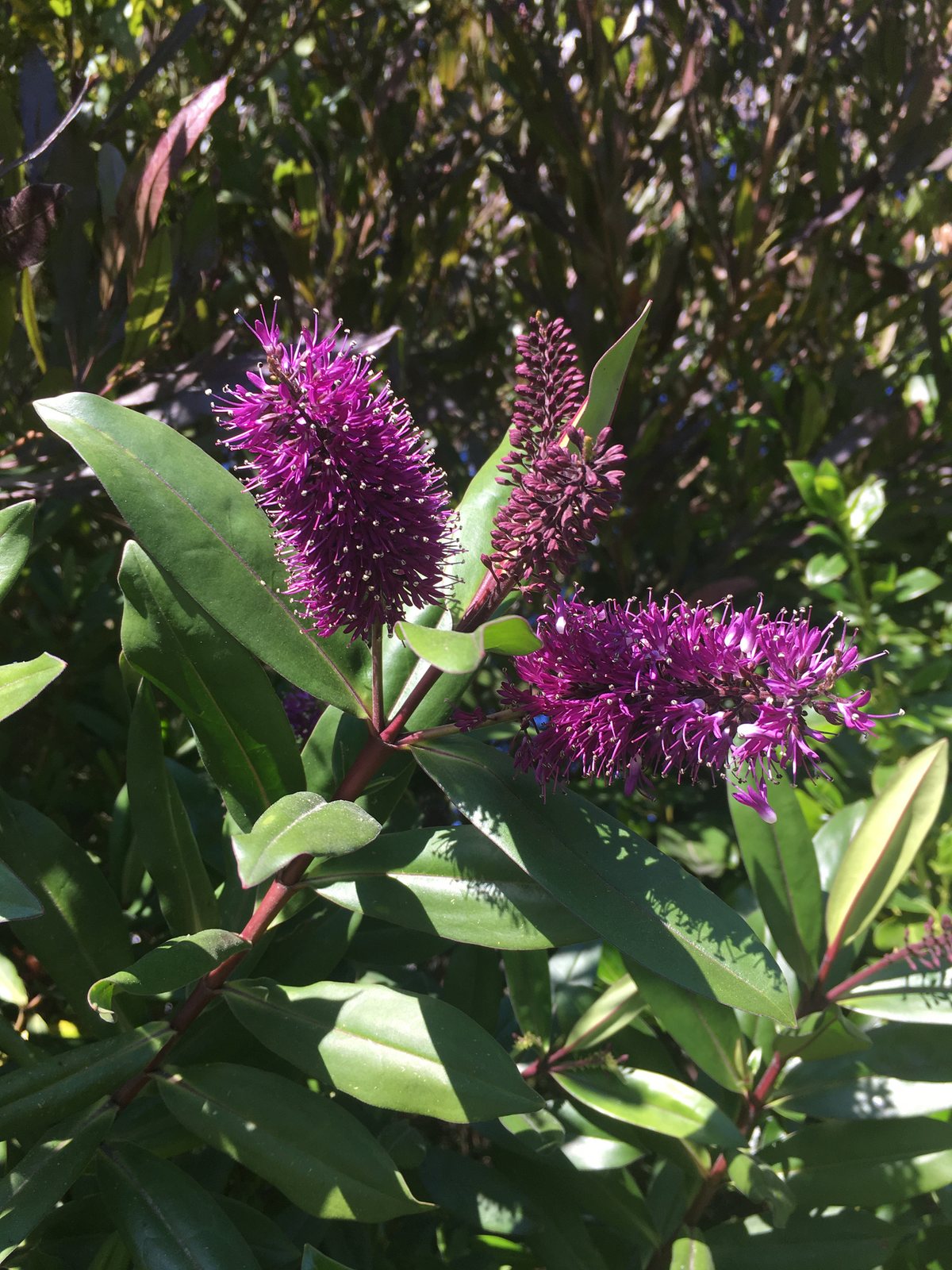
An evergreen shrub with narrow, glossy leaves and long spikes of lilac flowers that fade towards white. It provides summer and autumn colour in mild coastal gardens, but needs shelter from freezing winds and is not reliably hardy through cold continental winters.
At a glance
- Sun
- Full sun for the best flowering; tolerates light partial shade. Shelter from cold, drying winds.
- Water
- Water regularly during establishment, then during prolonged dry spells. Keep container plants evenly moist but never waterlogged.
- Soil
- Well-drained soil, preferably moderately fertile. Avoid heavy ground that stays wet in winter.
- Height
- 5-8 ft (1.5-2.4 m)
- Spread
- 5-8 ft (1.5-2.4 m)
- Flowers
- Summer into autumn; long spikes of lilac-purple flowers fade to pale lilac or white.
- Foliage
- Evergreen, narrow, lance-shaped, glossy green leaves; young growth is often flushed purple.
- Growth
- Moderate to fast in mild conditions.
- Care needed
- Low
The year at a glance
- Pollinators
- Heat tolerant
- Wildlife
- Low allergen
| J | F | M | A | M | J | J | A | S | O | N | D | |
|---|---|---|---|---|---|---|---|---|---|---|---|---|
| Flowers | ||||||||||||
| Plant |
Northern hemisphere months. In Australia, shift them by six.
- Difficulty
- Moderate
- Toughness
- Needs looking after
Will it suit your garden?
Pick your zone, country, light and whether you have pets.
Full sun is 6 or more hours of direct sun a day, part shade 3 to 6 hours, shade under 3.
How it grows
Planting day
1.6 ft (0.5 m)
After 1 year
2.8 ft (0.86 m)
After 2 years
4 ft (1.2 m)
After 3 years
5 ft (1.6 m)
After 5 years
6 ft (2 m)
full size
About 4 years to full size.
From a typical nursery size, at an average rate for this kind of plant. A rule of thumb, not a forecast.
Good to know
- Cats and dogs
- Safe
- Growth rate
- Fast
Care
Jobs through the year
- WaterApr–May, Sep–Oct, every 14 days
- For established plants in mild-climate ground, water only if dry; young plants and containers need more frequent checks.
- WaterJun–Aug, every 7 days
- Water established plants deeply during dry spells; water containers sooner when the surface begins to dry.
- MulchApr
- Apply a thin compost mulch, keeping it away from the stems.
- FeedApr
- Use a light balanced slow-release feed only if growth is weak or soil is poor.
- PruneApr–May
- After frost risk passes, remove dead shoots and lightly shape within leafy growth.
- DeadheadJul–Oct, every 14 days
- Snip off spent flower spikes if practical without cutting into bare wood.
- ProtectJan–Apr, Oct–Dec
- In zones 6–7, overwinter a container plant in a bright frost-free place; fleece alone is insufficient.
- Water deeply during the first growing season, allowing the soil surface to dry slightly between waterings.
- Apply a thin compost mulch in spring, keeping it away from the stems.
- Feed sparingly; use a balanced slow-release fertiliser in spring only if growth is weak or the soil is poor.
- Protect young plants with horticultural fleece during sharp frosts, particularly near the cold end of its range.
- Grow in a container with drainage holes where winter shelter is necessary, and move it to a bright, frost-free place before hard freezes.
Pruning. In spring, once frost risk has passed, remove dead or frost-damaged shoots and lightly shorten straggly growth into leafy stems. Snip off spent flower spikes if practical, but avoid cutting hard into bare old wood because regrowth can be unreliable.
Through the year
- Spring
- Plant after severe frost risk has passed, choosing a sheltered site with good drainage.
- Spring
- Remove frost-damaged shoots once new growth shows which stems are alive, then apply a light compost mulch.
- Summer
- Water young plants and containers during dry weather; avoid leaving pots standing in water.
- Late summer
- Take semi-ripe cuttings from healthy, non-flowering shoots.
- Autumn
- Remove spent flower spikes if desired, but avoid substantial pruning before winter.
- Winter
- Protect against severe frost and check that rain drains freely from the root area and containers.
In the garden
- Use as an evergreen anchor in a sunny mixed border, allowing room for its broad mature shape.
- Combine with lavender, rock roses and ornamental grasses in a well-drained coastal border.
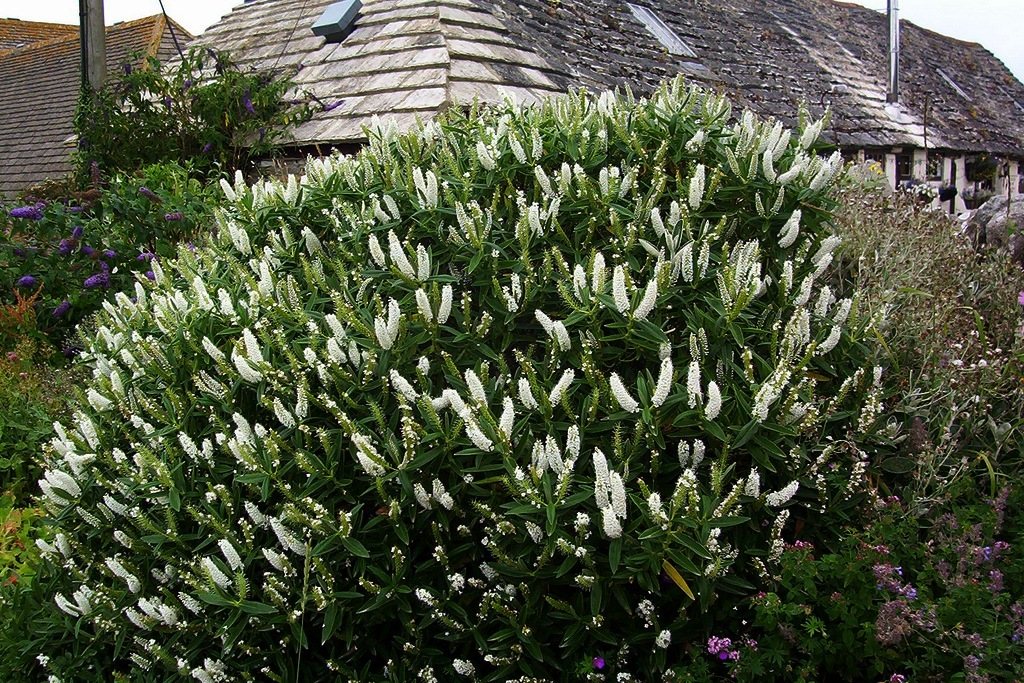
- Plant as a loose flowering screen in mild gardens rather than clipping it into a formal hedge.
- Grow in a large patio container where its flowers can be seen closely and winter shelter is available.
Garden styles it suits: Coastal, Mediterranean, Cottage garden, Pollinator garden, Low-maintenance and Dry gravel garden.
Plant it with: Lavender, Rock rose, Rosemary, Agapanthus, Catmint and Blue oat grass.
Wildlife: The flowers provide nectar for bees and other pollinating insects. Its evergreen branches also offer shelter for small garden wildlife.
Problems to watch for
- Frost and cold-wind damage can blacken leaves and kill shoots. Choose a sheltered position, protect during severe freezes, and wait until spring growth starts before removing damaged wood.
- Root rot can cause yellowing, wilting and collapse in wet soil. Improve drainage or move to a raised bed or free-draining container; do not keep watering already wet roots.
- Leaf spot can mark foliage, especially in damp, crowded conditions. Remove badly affected leaves, improve airflow and water at soil level.
- Aphids may cluster on soft new shoots. Wash them off with water and encourage ladybirds and other natural predators.
Safety
Not known to be toxic to people, cats, dogs or horses; no particular plant part is recognised as poisonous. It is not an edible plant, and eating substantial amounts may still cause stomach upset.
Easily confused with
Great Orme hebe (Hebe 'Great Orme')
Has pink flowers that fade towards white, rather than the lilac-purple flowers of 'Midsummer Beauty', and generally broader leaves.
Willow-leaved hebe (Hebe salicifolia)
Also has long, narrow leaves and an upright shrubby habit, but its flower spikes are usually white or very pale lilac rather than distinctly lilac-purple.
The name
Hebe is named after the Greek goddess of youth.
Propagation. Take semi-ripe cuttings in late summer and root them in a free-draining medium under cover. Cuttings preserve the cultivar; seedlings will not reliably come true.
Checked against open data
- Accepted botanical name
- Veronica Hebe 'Midsummer Beauty' is an older name for Veronica.
Sources: GBIF (CC BY 4.0). The care and design notes are LandscapeGPT's own.
See it in your own yard.
Upload a photo of your yard and see it redesigned with plants that suit your climate, each checked against your zone.