Mimosa tree
Albizia julibrissin. Family Fabaceae. Tree.
Also called Persian silk tree, Silk tree, Pink silk tree.
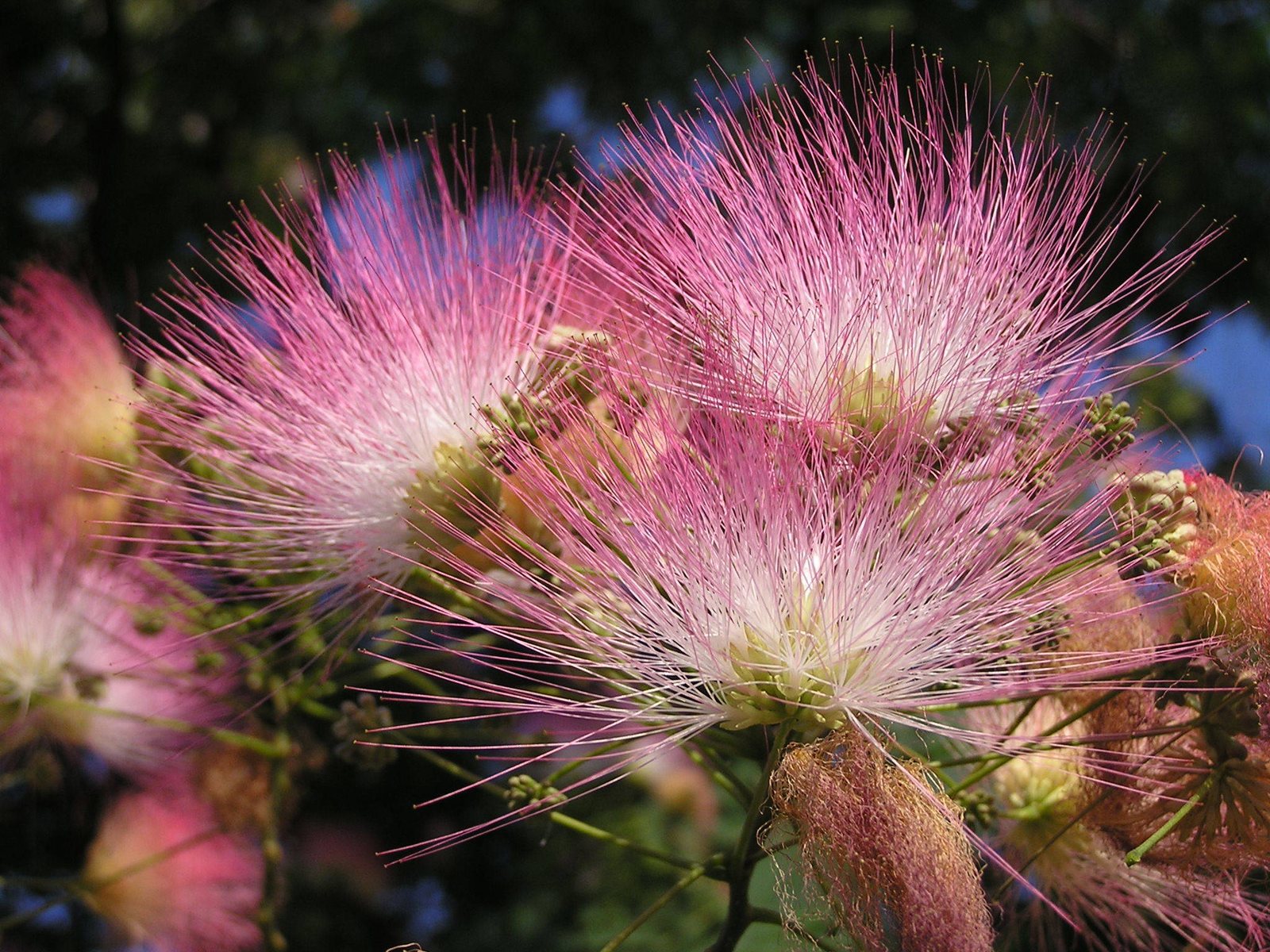
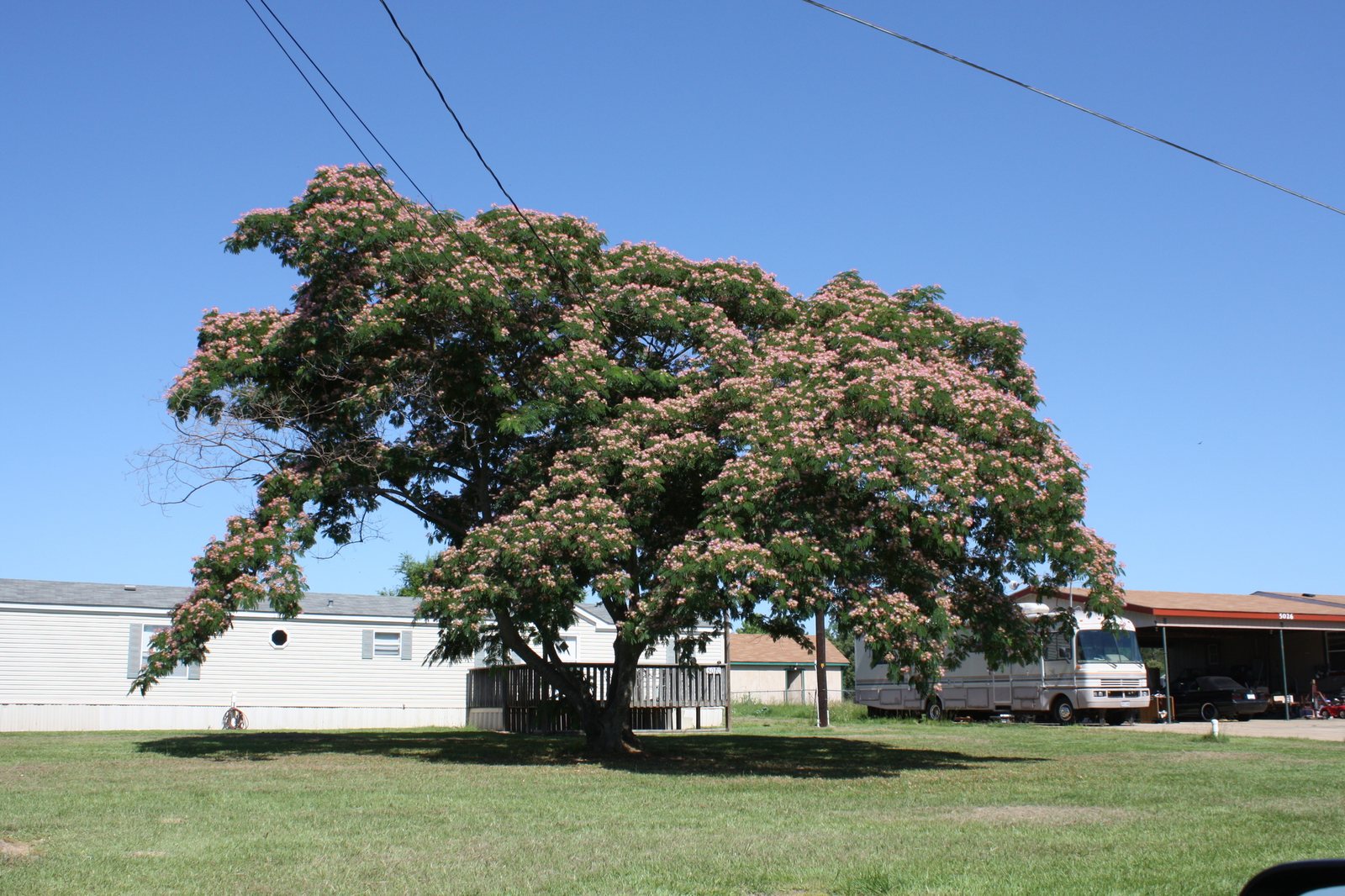
A deciduous tree with a broad, umbrella-shaped crown, finely divided leaves and fluffy pink summer flowers. Gardeners grow it for light shade and a tropical appearance, but it has brittle branches, produces considerable litter and spreads invasively in parts of the United States.
At a glance
- Sun
- Full sun; choose a warm position sheltered from strong winds. Flowering is less reliable in cool summers.
- Water
- Water regularly while establishing; established trees tolerate drought but benefit from deep watering during prolonged dry spells.
- Soil
- Well-drained soil, including sandy, loamy or moderately clay soils; tolerates a broad pH range. Avoid waterlogged ground.
- Height
- 20-40 ft (6-12 m)
- Spread
- 20-50 ft (6-15 m)
- Flowers
- Summer to early autumn; fragrant, pink, powder-puff flower heads, often paler or white at the base.
- Foliage
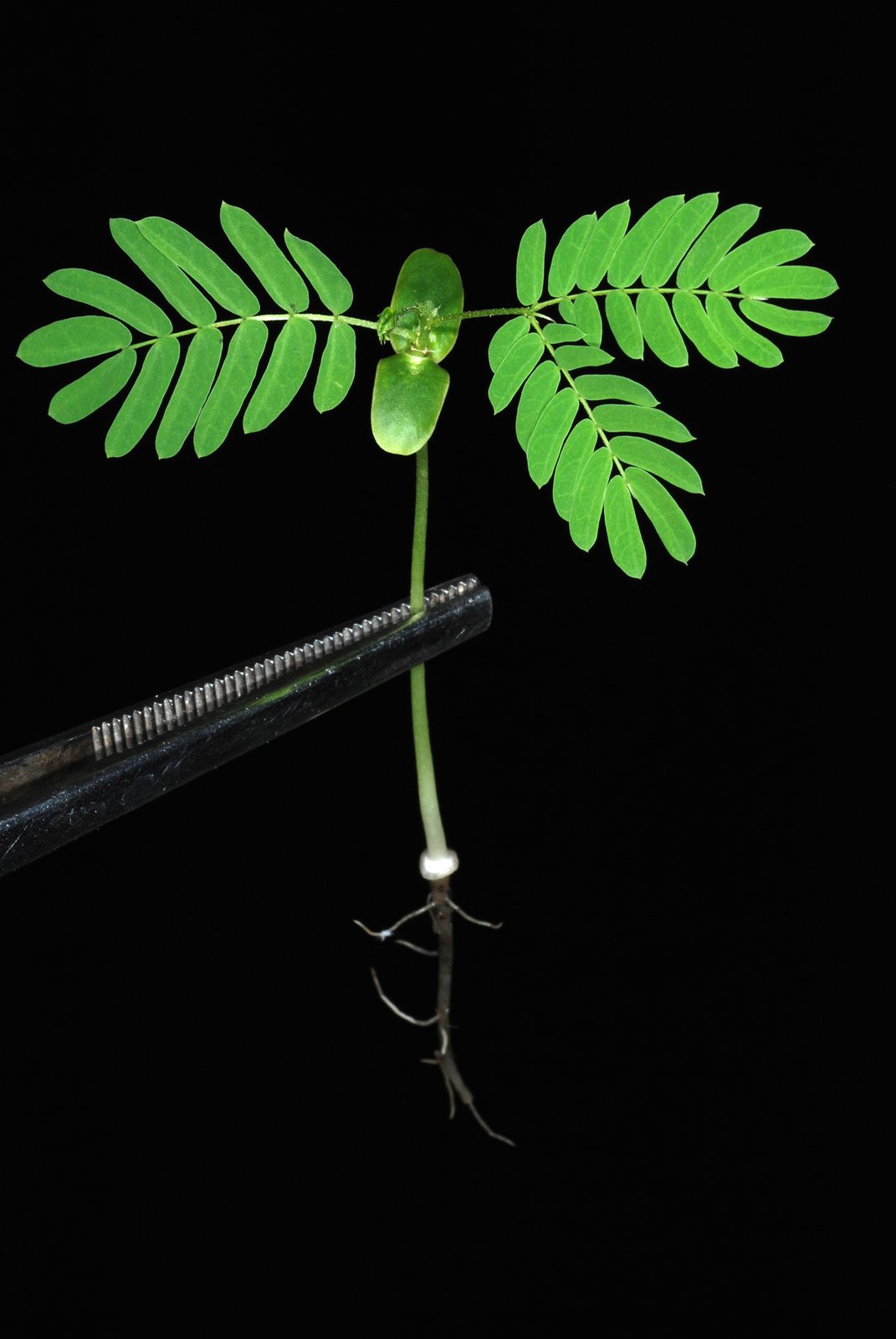
- Fern-like, twice-divided green leaves with many small leaflets that fold at night; autumn colour is usually unremarkable.
- Growth
- Fast in warm climates; slower in cool summers.
- Care needed
- Medium
The year at a glance
- Pollinators
- Drought tolerant
- Heat tolerant
- Wildlife
- Low allergen
- Fragrant
| J | F | M | A | M | J | J | A | S | O | N | D | |
|---|---|---|---|---|---|---|---|---|---|---|---|---|
| Flowers | ||||||||||||
| Fruit | ||||||||||||
| Plant |
Northern hemisphere months. In Australia, shift them by six.
- Difficulty
- Moderate
- Toughness
- Fairly tough
Will it suit your garden?
Pick your zone, country, light and whether you have pets.
Full sun is 6 or more hours of direct sun a day, part shade 3 to 6 hours, shade under 3.
How it grows
Planting day
7 ft (2 m)
After 1 year
8 ft (2.3 m)
After 2 years
9 ft (2.7 m)
After 3 years
10 ft (3.1 m)
After 5 years
12 ft (3.7 m)
About 20 years to full size.
From a typical nursery size, at an average rate for this kind of plant. A rule of thumb, not a forecast.
Good to know
- Cats and dogs
- Toxic
- Invasive in
- the US
- In the garden
- Spreads vigorously: plan to contain it.
- Growth rate
- Moderate
Care
Jobs through the year
- WaterApr–May, Sep, every 21 days
- Deep-water established trees only during prolonged dry spells; young trees need more frequent watering.
- WaterJun–Aug, every 14 days
- Deep-water established trees during extended drought, allowing soil to dry between waterings.
- MulchApr
- Renew a 5–8 cm organic mulch, leaving the trunk clear.
- PruneMar–Apr
- After severe frosts, remove damaged or crossing branches; wait for late leaf emergence if uncertain.
- ProtectSep–Nov
- Collect pods and remove seedlings; do not plant where this tree is invasive.
- ProtectNov–Dec
- Guard young trunks against browsing and check supports before winter storms.
- Plant in spring in colder regions, allowing room for the mature crown away from buildings and overhead wires.
- Water deeply through the first two growing seasons whenever the root zone becomes dry; avoid keeping it constantly wet.
- Apply a 2-3 in (5-8 cm) layer of mulch over the root area, keeping it clear of the trunk.
- Do not routinely fertilise established trees; excessive feeding encourages weak, fast growth.
- Remove unwanted seedlings promptly and collect seed pods where practical; do not plant where it is invasive.
Pruning. Prune lightly in late winter or early spring after the worst frosts, removing dead, damaged or crossing branches. Train young trees to a sound framework with well-spaced branches, and avoid topping or heavy pruning that encourages weak shoots.
Through the year
- Late winter
- Inspect branch unions and remove damaged or crossing growth once severe frosts have passed.
- Spring
- Plant in colder climates, refresh mulch and check for seedlings from last year's seed crop.
- Late spring
- Allow time for late leaf emergence before deciding that bare branches are dead.
- Summer
- Water young trees deeply during dry weather and inspect foliage for webbing or premature wilting.
- Autumn
- Collect fallen pods where practical and pull seedlings before their roots become established.
- Early winter
- Check young trees for loose stakes and protect exposed young trunks from browsing animals.
In the garden
- Use as a broad-canopied specimen in a sunny lawn where it is not invasive.
- Provide light, filtered shade beside a seating area, set back far enough to keep flowers and pods off paving.
- Combine its fine foliage with bold-leaved shrubs and perennials for a tropical effect.
- Use against a sheltered, sunny backdrop in warm urban gardens where summer heat supports flowering.
Garden styles it suits: Modern tropical, Mediterranean, Southern, Luxury resort, Sensory garden and Architectural minimal.
Plant it with: Lavender, Russian sage, Catmint, Agapanthus, Red hot poker and Stonecrop.
Wildlife: Flowers attract bees, butterflies and, in North America, hummingbirds. These benefits do not outweigh its invasive impact where seedlings displace native vegetation.
Problems to watch for
- Mimosa wilt: this soilborne Fusarium disease causes yellowing, wilting and branch death, sometimes killing the tree. There is no reliable garden cure; remove severely affected trees and do not replace them with another susceptible mimosa.
- Mimosa webworm: caterpillars bind leaflets together and cause browning. Remove small webbed clusters where reachable; on young trees, treat actively feeding young caterpillars with a locally approved caterpillar treatment if needed.
- Weak or storm-damaged branches: establish a strong framework while young and avoid exposed sites. Have large splits or damaged limbs assessed by a qualified arborist.
- Winter dieback or poor flowering: cold winters damage young growth, while cool summers limit bloom. Choose a sheltered, sunny site and wait until new growth is visible before removing doubtful wood.
Safety
Seeds are toxic to dogs, cats and horses, and ingestion can cause serious illness, including neurological signs. Keep animals away from fallen pods and seeds. Human poisoning information is limited; do not eat the seeds or pods, and seek poison-control advice after ingestion.
Where it spreads. Invasive across much of the southeastern and south-central United States, including Florida, Georgia, the Carolinas, Tennessee and parts of Texas, and extending into the Mid-Atlantic. It spreads along roadsides, waterways and disturbed ground. It is also naturalised in parts of eastern Australia; check state and local weed guidance before planting.
Easily confused with
Silver wattle (Acacia dealbata)
Has evergreen, usually silvery foliage and yellow flower balls in late winter or spring, rather than deciduous green leaves and pink summer flowers.
Sensitive plant (Mimosa pudica)
A small, often prickly herb or subshrub whose leaves close rapidly when touched; it does not develop the silk tree's substantial trunk and spreading crown.
Powder puff tree (Calliandra haematocephala)
A frost-tender shrub or small tree with much larger leaflets and rounded red or pink flower heads, rather than the silk tree's many tiny leaflets.
The name
Albizia honours Filippo degli Albizzi, who introduced the tree to Florence in the eighteenth century, while julibrissin derives from Persian words meaning silk flower.
Propagation. Grow the species from seed after carefully nicking the hard seed coat and soaking overnight, then sowing in warmth. Named cultivars are generally grafted to preserve their characteristics. Do not propagate or distribute it where it is invasive or restricted.
Checked against open data
- Accepted botanical name
- Albizia julibrissin
- In the US and Canada
- Introduced in the lower 48 states.
- Native range
- Assam, Bangladesh, China North-Central, China South-Central, China Southeast, East Himalaya, Iran, Japan, Korea, Myanmar, Nansei-shoto and Nepal.
- Measured
- Average height 762 cm.
Sources: GBIF (CC BY 4.0), USDA PLANTS and Trefle (CC BY 4.0). The care and design notes are LandscapeGPT's own.
See it in your own yard.
Upload a photo of your yard and see it redesigned with plants that suit your climate, each checked against your zone.