Miss Willmott's ghost
Eryngium giganteum. Family Apiaceae. Perennial.
Also called Giant sea holly, Ivory thistle.
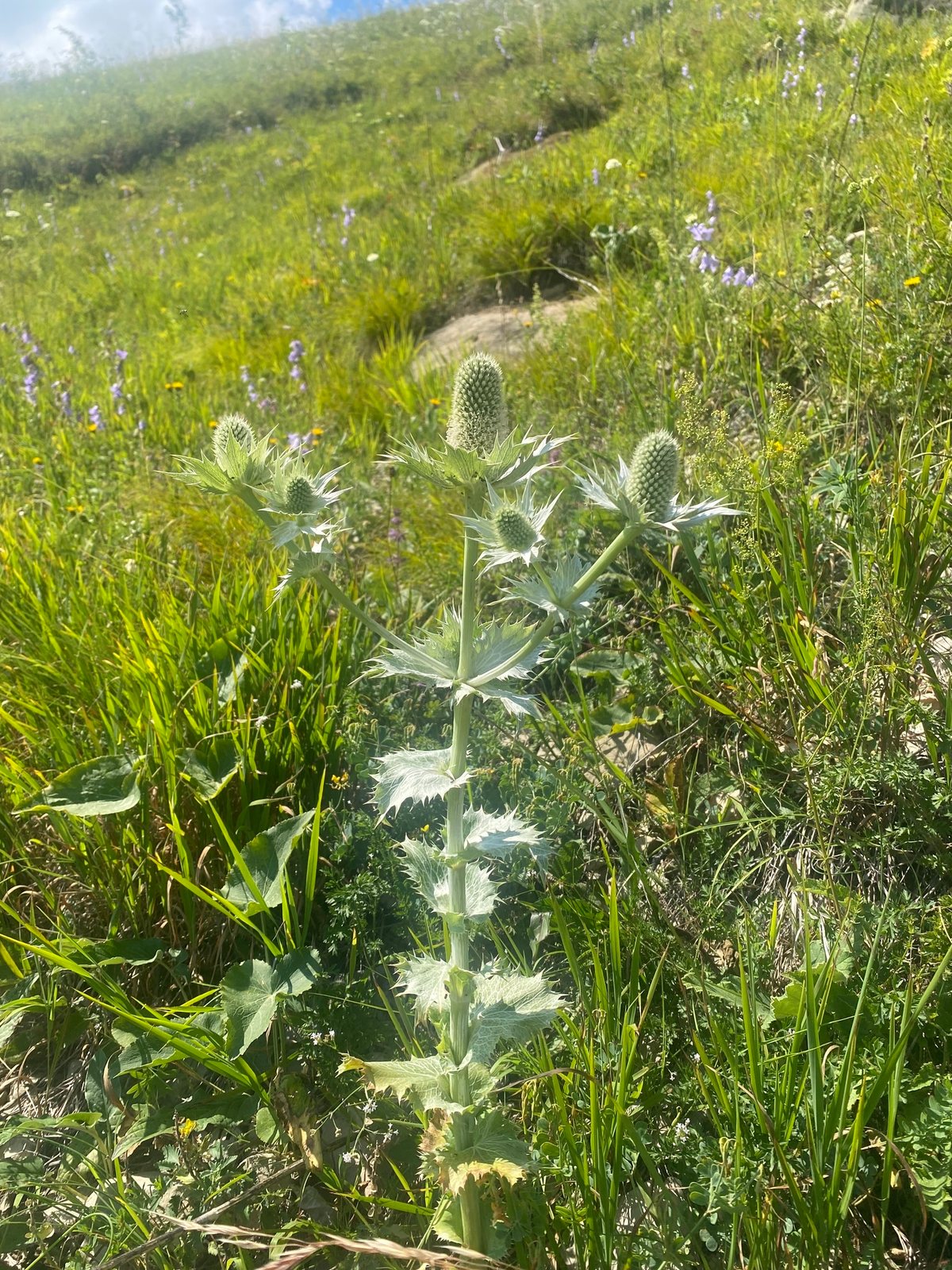
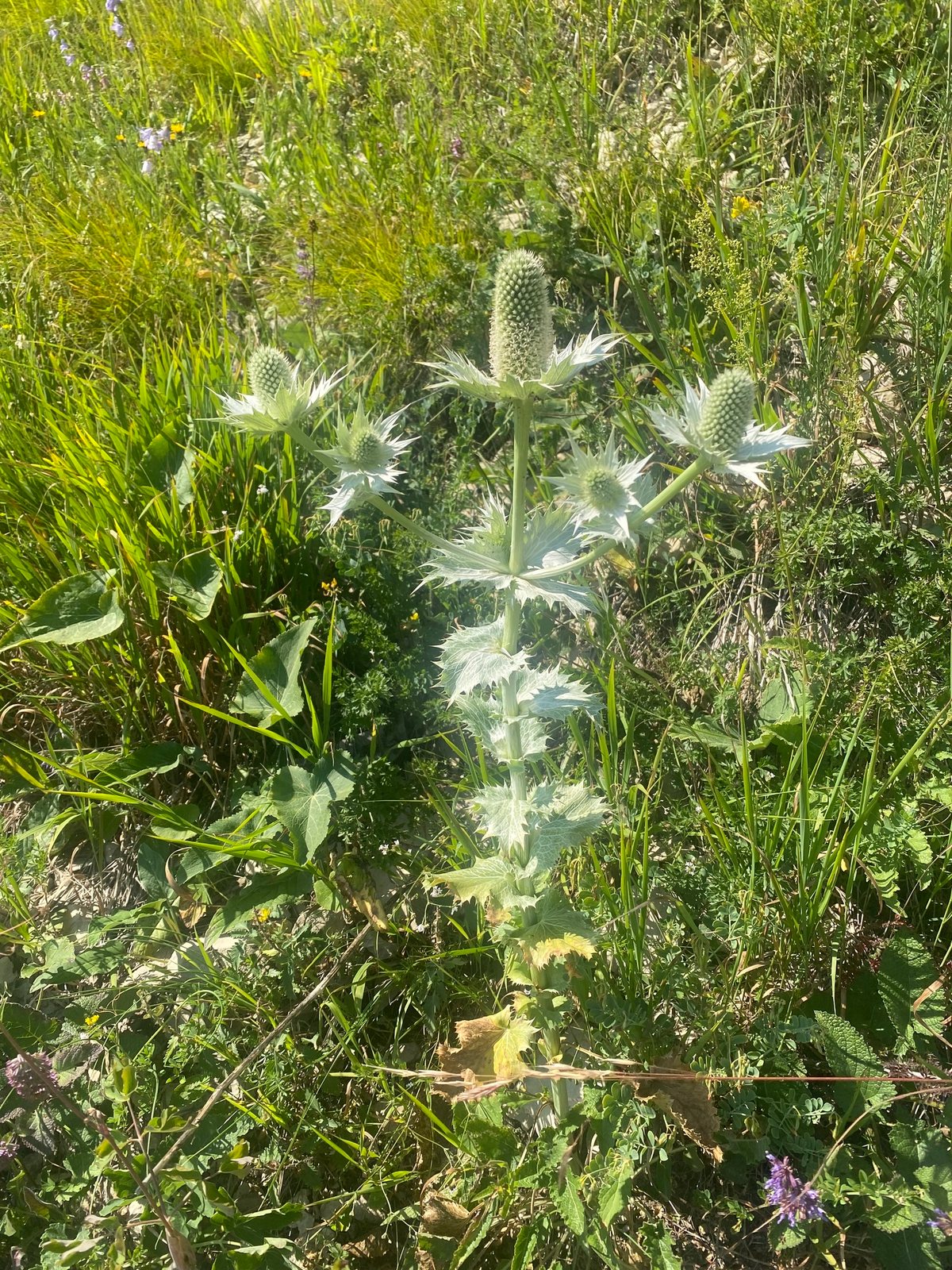
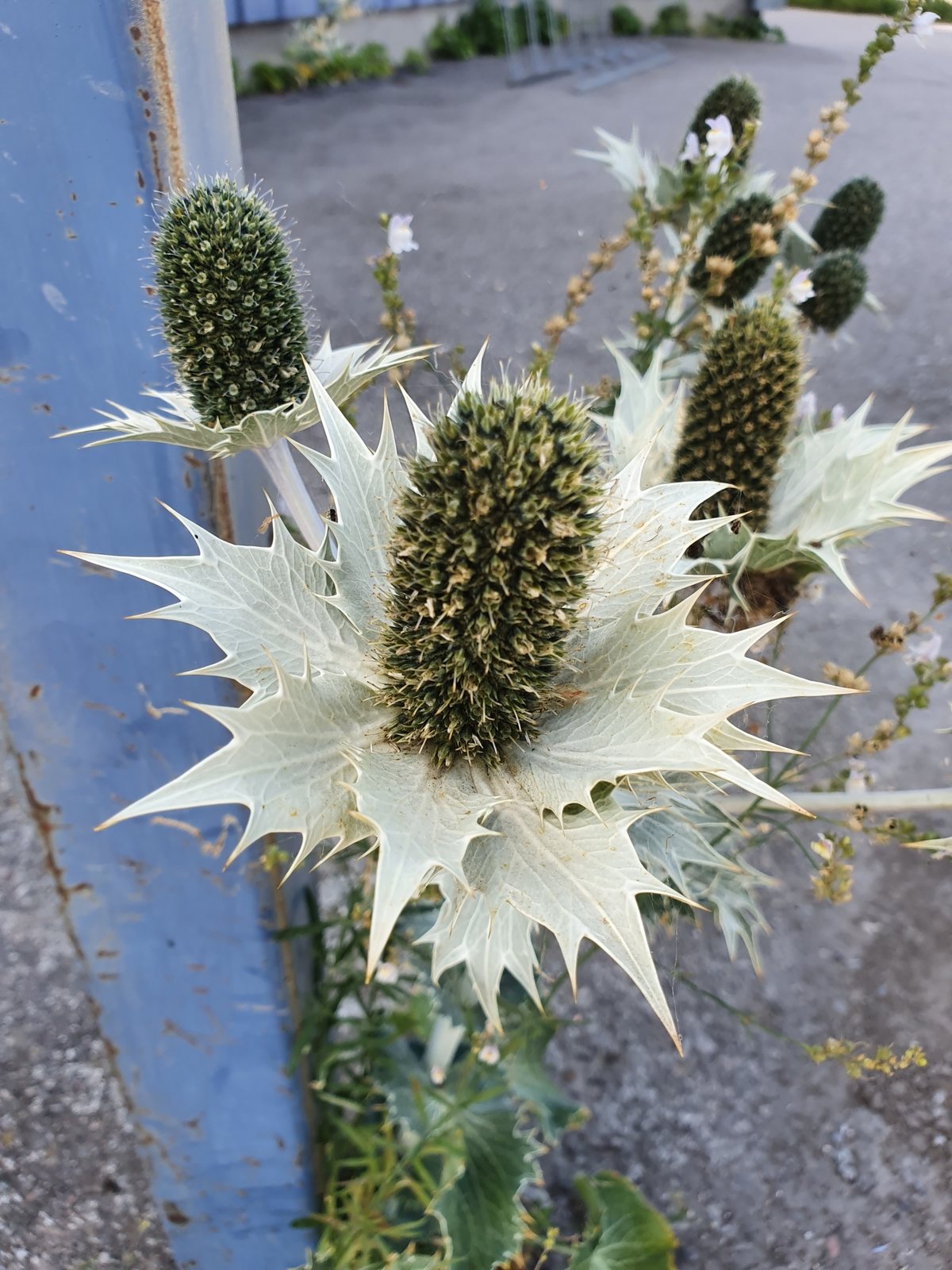
This upright sea holly produces cone-shaped flower heads surrounded by large, spiny, silver-white bracts. Usually a biennial or short-lived perennial, it forms a leafy rosette before flowering, often in its second year, and commonly maintains itself by self-seeding. Gardeners grow it for its pale, architectural flowers, which attract pollinators and dry well.
At a glance
- Sun
- Full sun.
- Water
- Water regularly while establishing; once established, water only during prolonged dry spells. Avoid persistently wet soil, especially in winter.
- Soil
- Well-drained sandy, gravelly or loamy soil, preferably lean to moderately fertile. Tolerates alkaline soil; heavy clay needs improved drainage.
- Height
- 3-4 ft (0.9-1.2 m)
- Spread
- 1-2 ft (0.3-0.6 m)
- Flowers
- Early to late summer; small greenish flowers mature to pale blue-grey, surrounded by conspicuous ivory to silver-white spiny bracts.
- Foliage
- Green, heart-shaped basal leaves, with smaller, deeply lobed and spiny leaves on the flowering stems.
- Growth
- Moderate; usually forms a rosette in the first year and flowering stems in the second.
- Care needed
- Low
The year at a glance
- Pollinators
- Deer resistant
- Drought tolerant
- Cold hardy
- Wildlife
- Low allergen
| J | F | M | A | M | J | J | A | S | O | N | D | |
|---|---|---|---|---|---|---|---|---|---|---|---|---|
| Flowers | ||||||||||||
| Fruit | ||||||||||||
| Plant |
Northern hemisphere months. In Australia, shift them by six.
- Difficulty
- Easy
- Toughness
- Very tough
Will it suit your garden?
Pick your zone, country, light and whether you have pets.
Full sun is 6 or more hours of direct sun a day, part shade 3 to 6 hours, shade under 3.
How it grows
Planting day
1 ft (0.3 m)
After 1 year
1.8 ft (0.55 m)
After 2 years
2.6 ft (0.8 m)
After 3 years
3 ft (1.1 m)
full size
About 3 years to full size.
From a typical nursery size, at an average rate for this kind of plant. A rule of thumb, not a forecast.
Good to know
- Cats and dogs
- Safe
- In the garden
- Spreads vigorously: plan to contain it.
- Growth rate
- Moderate
Care
Jobs through the year
- WaterApr–May, Sep, every 28 days
- Water established plants only in prolonged drought; water young plants more regularly.
- WaterJun–Aug, every 21 days
- Water established plants only during prolonged dry spells, allowing soil to dry between soakings.
- MulchApr
- Apply a thin gravel mulch around the crown rather than moisture-retaining organic material.
- PruneFeb–Mar
- Cut remaining dead stems to ground level before fresh growth develops.
- PruneMay
- Remove surplus seedlings while small, retaining replacements for short-lived flowering plants.
- DeadheadAug–Sep
- Remove unwanted heads before seed falls; retain some for renewal and winter structure.
- ProtectMar–May
- Check young rosettes for slugs and snails and hand-pick pests.
- ProtectOct–Nov
- Keep the crown clear of wet leaves and ensure winter rain drains freely.
- Plant young plants in their final positions; the deep taproot dislikes disturbance.
- Water new plants during dry weather, then reduce watering once roots are established.
- Avoid rich feeds and heavy compost applications, which encourage floppy growth.
- Use a light gravel mulch rather than moisture-holding mulch around the crown.
- Keep a few seedlings to replace plants that die after flowering; remove surplus seedlings while small.
Pruning. Leave flower heads standing through autumn and winter if you want seed and structure, then cut dead stems to ground level in late winter. To limit self-seeding, remove the heads before the seeds ripen.
Through the year
- Late winter
- Cut down remaining dead stems before new growth develops.
- Spring
- Plant young plants in a sunny, freely drained position and water them in.
- Late spring
- Thin volunteer seedlings, retaining a few well-spaced replacements.
- Summer
- Water establishing plants during dry spells; cut stems for drying when the bracts are fully coloured.
- Late summer
- Remove unwanted seed heads before seed falls, or retain selected heads for natural renewal.
- Autumn
- Sow fresh seed in deep pots outdoors and allow natural winter chilling.
In the garden
- Repeat through sunny gravel borders for upright silver accents among low, spreading plants.
- Combine with ornamental grasses for a contrast between rigid flower heads and soft, moving foliage.
- Place among purple-flowered perennials such as catmint and sage to make the pale bracts stand out.
- Use in white gardens and dry cottage borders, leaving seed heads for autumn and winter structure.
Garden styles it suits: Dry gravel garden, Cottage garden, New perennial (prairie), White garden, Pollinator garden and Architectural minimal.
Plant it with: Lavender, Catmint, Perennial sage, Yarrow, Russian sage and Feather reed grass.
Wildlife: The flowers provide nectar and pollen for bees, hoverflies and other insects. Standing stems and seed heads add winter shelter for small invertebrates.
Problems to watch for
- Crown and root rot in wet soil: improve drainage or move future plantings to a raised, gravelly position.
- Slugs and snails eating young rosettes: inspect during damp weather and use barriers or iron phosphate bait according to the label.
- Flopping stems in rich soil or shade: provide full sun, stop feeding and support stems discreetly if needed.
- Failure to return after flowering: often normal for this short-lived plant; retain seedlings or sow fresh seed each year.
Safety
Not known to be toxic to people, cats, dogs or horses, although species-specific information is limited. The stiff, sharp bracts and leaves can scratch skin and injure mouths; wear gloves and discourage chewing.
Easily confused with
Alpine sea holly (Eryngium alpinum)
Usually has blue flower heads surrounded by finely divided, feathery blue bracts rather than broad, jagged silver-white bracts.
Flat sea holly (Eryngium planum)
Has many smaller blue flower heads on branching stems, with much smaller, narrower bracts.
Mediterranean sea holly (Eryngium bourgatii)
Usually shorter, with conspicuously pale-veined, deeply divided leaves and blue-toned flower heads and bracts.
The name
The common name commemorates the English gardener Ellen Willmott, while the species name giganteum means gigantic.
Propagation. Propagate by seed, preferably sown fresh in autumn in deep pots outdoors. Germination can be slow and irregular, and winter chilling often helps. Plant seedlings out while small, keeping the rootball intact; division is unsuitable because of the taproot.
Checked against open data
- Accepted botanical name
- Eryngium giganteum
- Native range
- North Caucasus, Transcaucasus and Turkey.
Sources: GBIF (CC BY 4.0) and Trefle (CC BY 4.0). The care and design notes are LandscapeGPT's own.
See it in your own yard.
Upload a photo of your yard and see it redesigned with plants that suit your climate, each checked against your zone.