Native hibiscus
Alyogyne huegelii. Family Malvaceae. Shrub.
Also called Blue hibiscus, Lilac hibiscus.
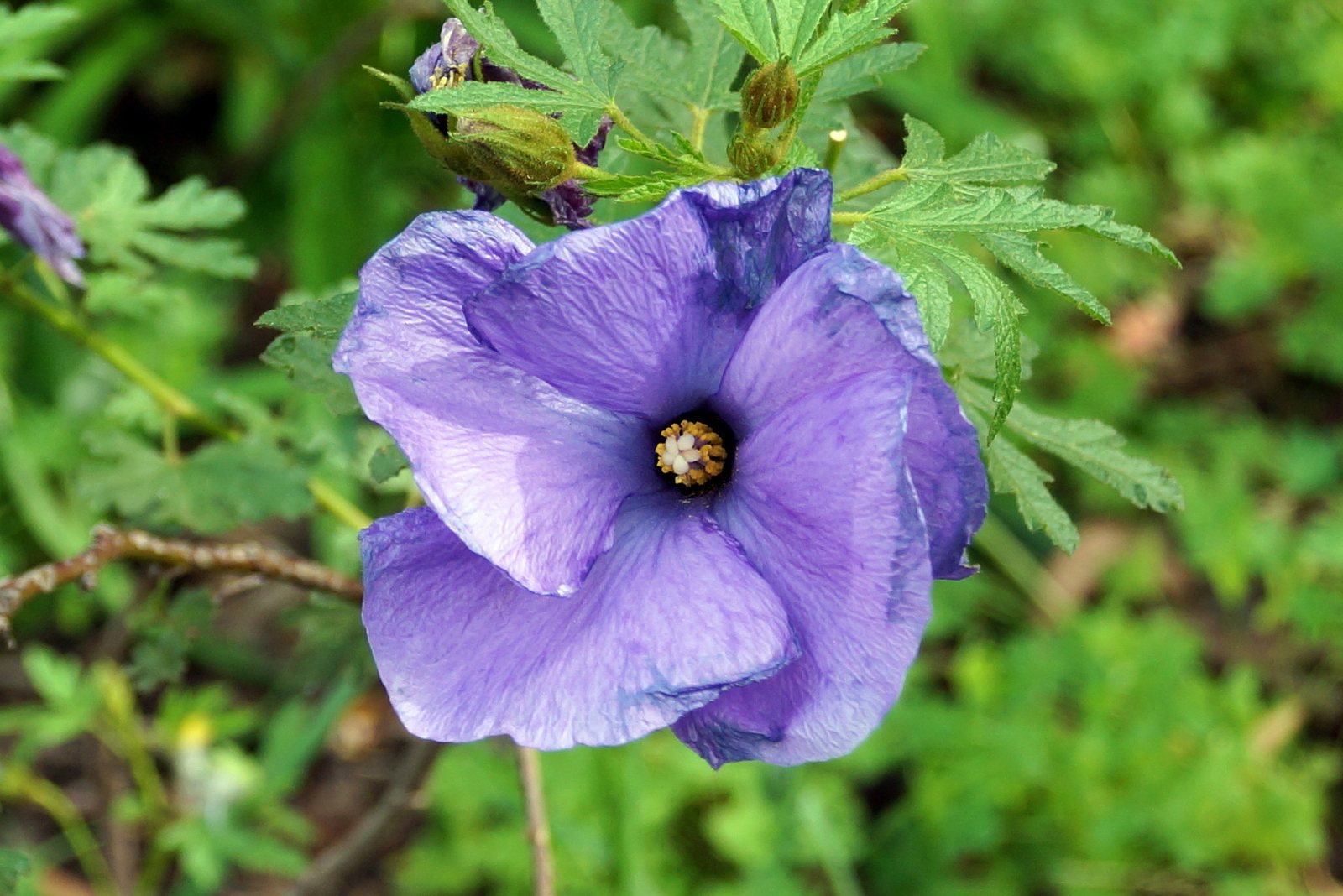
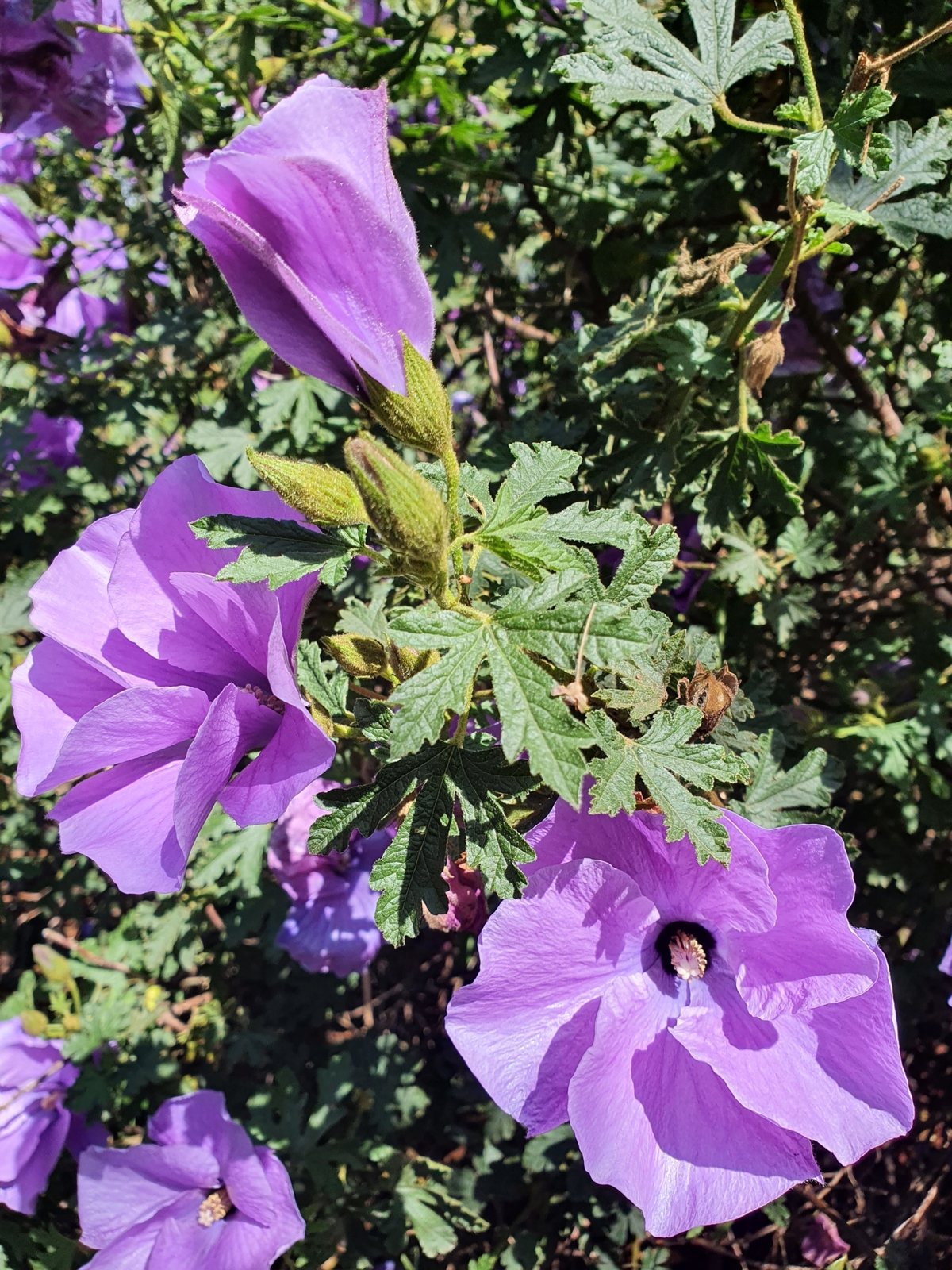
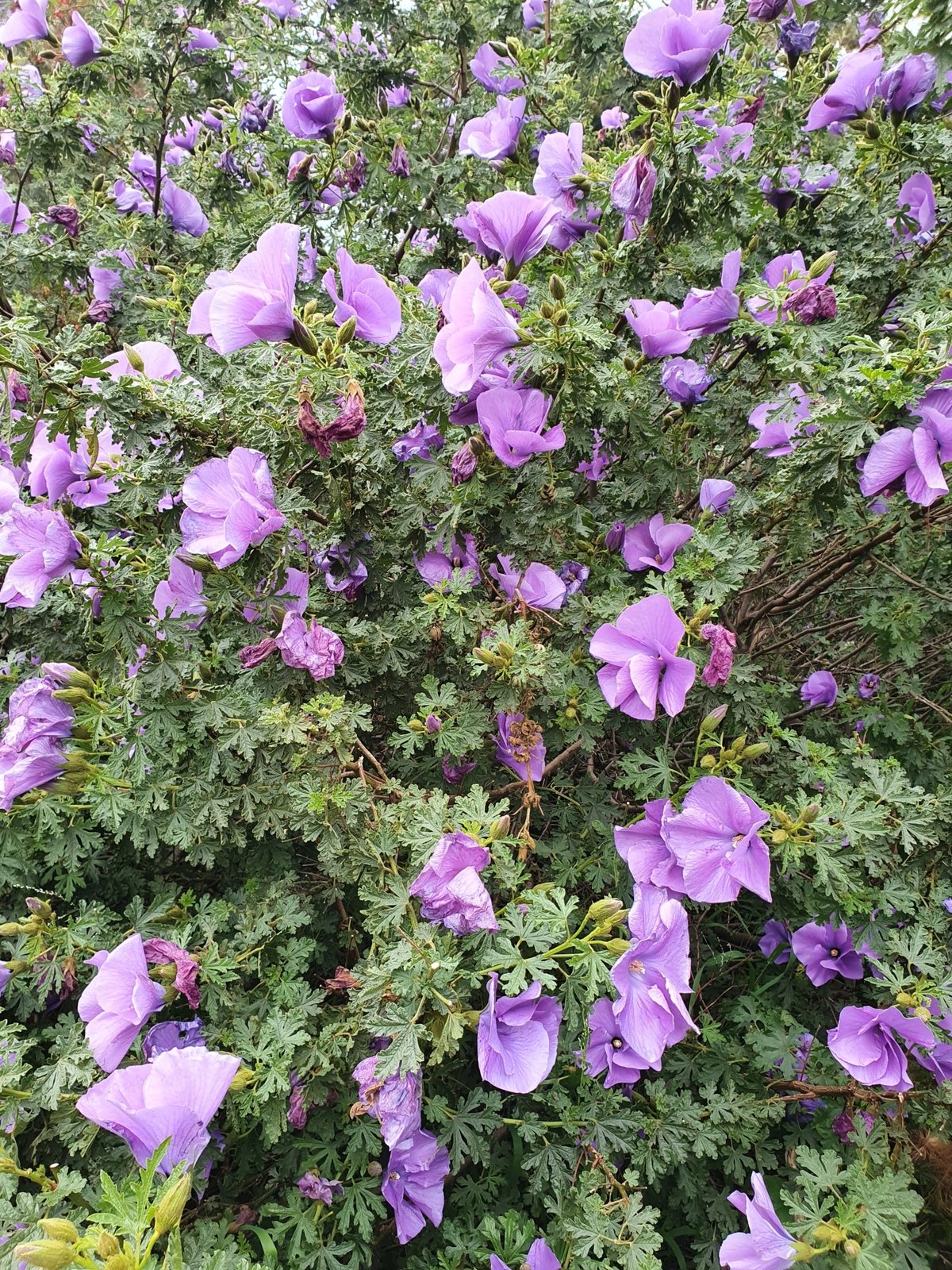
Native hibiscus is a fast-growing evergreen shrub from southern and western Australia, grown for its large, silky, lilac-purple flowers. It suits sunny, dry gardens with excellent drainage, but needs protection from hard frost and cold, wet winters. Despite its common name, it belongs to Alyogyne rather than Hibiscus.
At a glance
- Sun
- Full sun; tolerates light shade but flowers less freely.
- Water
- Water regularly during establishment, then deeply during prolonged dry spells. Let the soil dry between waterings; established plants tolerate drought.
- Soil
- Well-drained sandy, gravelly or loamy soil. Avoid waterlogged ground and heavy clay unless drainage is substantially improved.
- Height
- 6-10 ft (1.8-3 m)
- Spread
- 6-10 ft (1.8-3 m)
- Flowers
- Mainly spring and summer, often continuing into autumn in warm climates; large lilac to violet-purple flowers, each usually lasting one day.
- Foliage
- Evergreen. Green to grey-green, softly hairy leaves with three to five deeply cut lobes.
- Growth
- Fast
- Care needed
- Low
The year at a glance
- Pollinators
- Drought tolerant
- Heat tolerant
- Wildlife
- Low allergen
| J | F | M | A | M | J | J | A | S | O | N | D | |
|---|---|---|---|---|---|---|---|---|---|---|---|---|
| Flowers | ||||||||||||
| Plant |
Northern hemisphere months. In Australia, shift them by six.
- Difficulty
- Moderate
- Toughness
- Fairly tough
Will it suit your garden?
Pick your zone, country, light and whether you have pets.
Full sun is 6 or more hours of direct sun a day, part shade 3 to 6 hours, shade under 3.
How it grows
Planting day
1.6 ft (0.5 m)
After 1 year
4 ft (1.1 m)
After 2 years
5 ft (1.7 m)
After 3 years
7 ft (2.3 m)
After 5 years
8 ft (2.4 m)
full size
About 3 years to full size.
From a typical nursery size, at an average rate for this kind of plant. A rule of thumb, not a forecast.
Good to know
- Cats and dogs
- Safe
- Growth rate
- Fast
Care
Jobs through the year
- WaterApr–May, Sep, every 14 days
- Water established ground plants only when dry; young plants and containers need closer monitoring.
- WaterJun–Aug, every 14 days
- Deep-water established ground plants during prolonged drought, letting soil dry between waterings.
- WaterJan–Mar, Oct–Dec, every 21 days
- Check sheltered containers and water lightly only as needed to prevent the root ball drying completely.
- FeedApr–May
- Feed lightly only if growth is weak; avoid heavy nitrogen feeding.
- MulchMay
- Apply a thin mulch, keeping it away from stems and the crown.
- PruneApr–May
- Remove dead or frost-damaged shoots once healthy new growth reveals where to cut.
- PruneJul–Aug
- Lightly shorten shoots after the main flowering flush; avoid cutting into bare old wood.
- ProtectJan–Apr, Oct–Dec
- In zone 6–7, grow in a container and overwinter in a bright frost-free place before frost arrives.
- Plant in a sunny position sheltered from cold winds, with the root crown at soil level.
- Water deeply through the first growing season, allowing the surface soil to dry between waterings.
- Feed lightly in spring only if growth is weak; avoid heavy feeding that encourages soft, sprawling growth.
- Apply a thin mulch over the root area, keeping it clear of the stems.
- In colder regions, grow in a container with free-draining compost and overwinter in a bright, frost-free place.
Pruning. Lightly shorten shoots after the main flowering flush to encourage branching and prevent a straggly shape. Remove dead or damaged stems in spring once frost danger has passed; avoid severe cutting into bare old wood.
Through the year
- Spring
- Plant after frost danger has passed, choosing a sunny, freely drained site.
- Spring
- Remove frost-damaged shoots once healthy new growth shows where to cut.
- Summer
- Water young plants deeply during dry weather; check containers more frequently.
- Summer
- Lightly trim after the main flowering flush and take semi-ripe cuttings.
- Autumn
- Move container plants under bright, frost-free cover before the first frost.
- Winter
- Keep sheltered container plants on the dry side, without letting the root ball dry out completely.
In the garden
- Use as a flowering specimen in a sunny gravel garden, allowing room for its broad, open habit.
- Combine with silver-leaved shrubs and ornamental grasses for a drought-tolerant border.
- Grow against a sunny, sheltered wall in mild coastal gardens.
- Use in an informal Australian native planting with kangaroo paws and westringia.
- Grow in a large container where winter shelter is needed.
Garden styles it suits: Australian native, Mediterranean, Dry gravel garden, Desert / xeriscape, Coastal and Pollinator garden.
Plant it with: Kangaroo paw, Coastal rosemary, Lomandra, Lavender, Rockrose and Blue fescue.
Wildlife: The flowers provide pollen and nectar for bees and other visiting insects. Its branching growth also offers some shelter for small garden wildlife.
Problems to watch for
- Root rot in wet soil: improve drainage, avoid frequent watering and do not leave containers standing in water.
- Frost damage: choose a sheltered site, cover during brief cold spells or overwinter containers under cover.
- Aphids on young shoots: wash off with water; use insecticidal soap if an infestation persists.
- Sparse, sprawling growth: provide more sun, reduce feeding and lightly trim after flowering.
Safety
Not known to be toxic to people, cats, dogs or horses, although species-specific safety information is limited. No particular part is established as poisonous; it is an ornamental plant, not a food plant.
Easily confused with
Red-centred hibiscus (Alyogyne hakeifolia)
Has narrow, almost needle-like leaf segments rather than the broad, deeply lobed leaves of Alyogyne huegelii.
Rose of Sharon (Hibiscus syriacus)
A deciduous, much hardier shrub with less deeply divided leaves and a prominent staminal column projecting from the flower centre.
Tropical hibiscus (Hibiscus rosa-sinensis)
Usually has glossy, largely unlobed leaves and flowers with a conspicuous projecting staminal column; native hibiscus has softly hairy, deeply lobed foliage.
The name
The species name huegelii honours the Austrian botanist and explorer Carl von Hügel, while 'native hibiscus' refers to its Australian origin and hibiscus-like flowers.
Propagation. Take semi-ripe cuttings in summer and root in a freely draining medium with gentle humidity. Seed is another option, but seedlings may differ from the parent; named selections should be propagated by cuttings.
Checked against open data
- Accepted botanical name
- Hibiscus huegelii Alyogyne huegelii is an older name for Hibiscus huegelii.
Sources: GBIF (CC BY 4.0). The care and design notes are LandscapeGPT's own.
See it in your own yard.
Upload a photo of your yard and see it redesigned with plants that suit your climate, each checked against your zone.