Nectarine
Prunus persica var. nucipersica. Family Rosaceae. Tree.
Also called Smooth-skinned peach.
Nectarines are deciduous peach trees grown for their smooth-skinned, juicy fruit and pink spring blossom. They need summer warmth to ripen well, and a cultivar matched to your winter chilling; most are self-fertile, so one tree can produce a crop. In cool or wet climates, a sunny wall and protection from spring rain improve results.
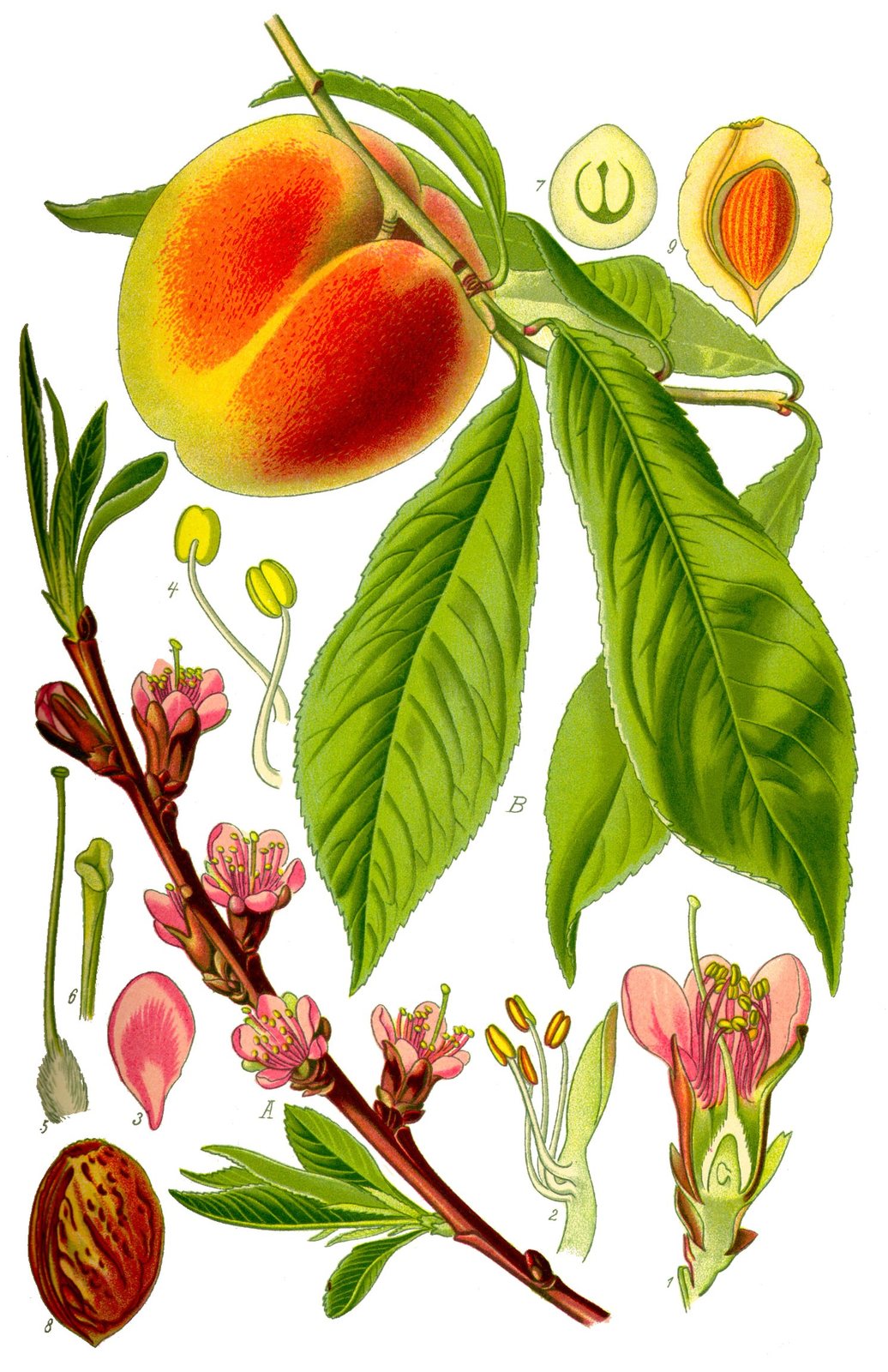
At a glance
- Sun
- Full sun, with at least 6-8 hours of direct light; choose a warm, sheltered position away from frost pockets.
- Water
- Water deeply during dry spells, especially while fruit is swelling. Keep the root zone evenly moist but never waterlogged; container trees need more frequent watering.
- Soil
- Fertile, well-drained loam, ideally pH 6.0-7.0. Avoid poorly drained clay unless drainage is improved or the tree is planted on a broad raised mound.
- Height
- 12-20 ft (3.7-6 m); dwarf trees commonly 5-8 ft (1.5-2.4 m), depending on rootstock and training
- Spread
- 12-20 ft (3.7-6 m); dwarf trees commonly 5-8 ft (1.5-2.4 m)
- Flowers
- Pink flowers in late winter or early spring, usually before the leaves; blossom is vulnerable to frost.
- Foliage
- Narrow, pointed green leaves with finely toothed edges; sometimes yellow in autumn before falling.
- Growth
- Moderate to fast; rootstock, climate and pruning strongly affect growth.
- Care needed
- High
The year at a glance
- Pollinators
- Wildlife
- Low allergen
- Edible
| J | F | M | A | M | J | J | A | S | O | N | D | |
|---|---|---|---|---|---|---|---|---|---|---|---|---|
| Flowers | ||||||||||||
| Fruit | ||||||||||||
| Plant |
Northern hemisphere months. In Australia, shift them by six.
- Difficulty
- Hard
- Toughness
- Needs looking after
Will it suit your garden?
Pick your zone, country, light and whether you have pets.
Full sun is 6 or more hours of direct sun a day, part shade 3 to 6 hours, shade under 3.
How it grows
Planting day
7 ft (2 m)
After 1 year
7 ft (2.2 m)
After 2 years
8 ft (2.4 m)
After 3 years
8 ft (2.5 m)
After 5 years
9 ft (2.9 m)
About 16 years to full size.
From a typical nursery size, at an average rate for this kind of plant. A rule of thumb, not a forecast.
Good to know
- Cats and dogs
- Toxic
- Growth rate
- Fast
Care
Jobs through the year
- WaterApr–May, Sep, every 14 days
- Water established trees deeply during dry spells; young and container trees need more frequent watering.
- WaterJun–Aug, every 7 days
- During dry weather, soak the root zone consistently as fruit swells; avoid waterlogging.
- FeedMar
- Apply a balanced fruit-tree fertiliser at the label rate; avoid excess nitrogen.
- MulchMar–Apr
- Spread 5–8 cm of organic mulch over the root zone, clear of the trunk.
- PruneApr–May
- Prune in dry weather after growth starts, maintaining an open framework and young fruiting shoots.
- PruneJun
- After natural fruit drop, thin fruit to roughly 15–20 cm apart.
- PruneAug–Sep
- After harvest, renew fruited shoots in dry weather while retaining strong young replacement growth.
- ProtectJan–Apr, Dec
- Use an open-sided rain cover before bud swelling through early leaf growth to reduce peach leaf curl.
- ProtectMar–Apr
- Fleece opening blossom on frosty nights, removing the covering during the day.
- ProtectJul–Sep
- Protect ripening fruit with taut wildlife-safe netting on a frame and check it regularly.
- HarvestJul–Sep
- Pick individual fragrant fruits when the background colour changes and flesh yields slightly near the stalk.
- ProtectOct–Nov
- Remove fallen leaves and mummified or rotten fruit to reduce disease carryover.
- Plant with the graft union above soil level, and stake young trees if the site or rootstock requires support.
- Water deeply through dry periods, particularly from fruit set to harvest; check container compost frequently.
- Apply a balanced fruit-tree fertiliser in early spring according to the label; avoid heavy nitrogen feeding.
- Spread 2-3 in (5-8 cm) of organic mulch over the root zone, keeping it clear of the trunk.
- Thin young fruit after the natural drop, leaving roughly 6-8 in (15-20 cm) between fruits.
- Cover small trees with horticultural fleece during blossom frosts, removing it during the day for pollinators.
Pruning. Prune in spring or summer during dry weather, rather than winter, to reduce disease risk. Maintain an open-centred tree or trained fan, renewing shoots that have fruited and retaining strong young growth because nectarines fruit mainly on the previous year's wood.
Harvest
Pick fruit in summer when its green background colour has changed to cream or yellow, depending on the cultivar, and it smells fragrant and yields slightly near the stalk. Lift and twist gently; red skin alone does not indicate ripeness, and fruit is easily bruised. A healthy grafted tree commonly gives its first worthwhile crop 2-4 years after planting.
Through the year
- Late autumn
- Remove fallen leaves and shrivelled fruit, and check drainage before winter.
- Winter
- Plant bare-root trees when soil is workable; in wet climates, arrange an open-sided rain cover before buds begin swelling.
- Early spring
- Feed and mulch, and protect opening flowers from frost.
- Spring
- Prune in dry weather once growth starts; hand-pollinate sheltered trees if insects cannot reach the flowers.
- Late spring
- Thin developing fruit after the natural drop and check new shoots for aphids.
- Summer
- Water consistently, protect ripening fruit with wildlife-safe netting, and harvest as individual fruits ripen.
- Late summer
- After harvest, remove damaged shoots and shorten or replace fruited growth while retaining young replacement shoots.
In the garden
- Train as a fan against a sunny wall to save space and improve fruit ripening in cool climates.
- Use as a small orchard tree with an open crown and clear access for picking.
- Grow a genuinely dwarf tree in a large, well-drained container on a sunny terrace.
- Place in an edible garden where spring blossom and summer fruit provide seasonal interest.
Garden styles it suits: Backyard orchard, Potager (kitchen garden), Edible landscape, Cottage garden, Homestead and Small-space.
Plant it with: Chives, Thyme, Calendula and Nasturtium.
Wildlife: Flowers provide pollen and nectar for early insects. Birds, wasps and mammals may eat ripe fruit; use taut, wildlife-safe netting on a supporting frame and check it regularly.
Problems to watch for
- Peach leaf curl: red, thickened, curled spring leaves indicate infection. Keep rain off buds from winter through early leaf development using an open-sided cover; remove fallen leaves and use a locally approved dormant treatment where recommended.
- Brown rot: rotting fruit may develop rings of pale fungal growth. Remove affected and mummified fruit promptly, thin crowded fruit and prune for airflow.
- Aphids: clusters on young shoots cause curled leaves and sticky honeydew. Encourage predators and wash off small colonies; use a labelled insecticidal soap if needed, avoiding flowers and beneficial insects.
- Poor or absent crops: blossom frost, inadequate winter chilling or cool summers can prevent cropping. Choose a locally suitable cultivar, avoid frost pockets and use a warm, sheltered site.
Safety
Leaves, stems and the seed kernels inside the stones contain cyanogenic compounds and can seriously poison people, cats, dogs and horses if eaten, especially when kernels are chewed. Wilted foliage is particularly hazardous to livestock. Ripe fruit flesh is edible, but remove the stone; swallowed stones can also cause choking or intestinal blockage in pets.
Easily confused with
Peach (Prunus persica)
Peach fruit has fuzzy skin, while nectarine skin is smooth. Leaves, flowers and tree shape are otherwise very similar.
Japanese plum (Prunus salicina)
Plums commonly have a waxy bloom on the fruit, broader leaves and white flowers, often clustered; nectarines usually have pink flowers and longer, narrower leaves.
Apricot (Prunus armeniaca)
Apricot leaves are broader and more rounded, often with a heart-shaped base; its fruit is usually smaller, orange and lightly downy.
The name
Nectarine comes from 'nectar', referring to the sweet fruit, while persica reflects the peach's historical association with Persia, although it originated in China.
Propagation. Usually propagated by budding or grafting a named cultivar onto a suitable peach or other compatible rootstock. Seedlings vary in fruit quality, size and chilling requirement and do not reliably reproduce the parent cultivar.
Checked against open data
- Accepted botanical name
- Prunus persica Prunus persica var. nucipersica is an older name for Prunus persica.
- In the US and Canada
- Introduced in Canada, the lower 48 states and US Virgin Islands.
- Native range
- China North-Central.
- Measured
- Average height 640 cm.
Sources: GBIF (CC BY 4.0), USDA PLANTS and Trefle (CC BY 4.0). The care and design notes are LandscapeGPT's own.
See it in your own yard.
Upload a photo of your yard and see it redesigned with plants that suit your climate, each checked against your zone.