Olympic Fire mountain laurel
Kalmia latifolia 'Olympic Fire'. Family Ericaceae. Shrub.
Also called Kalmia latifolia 'Olympic Fire', Olympic Fire calico bush.
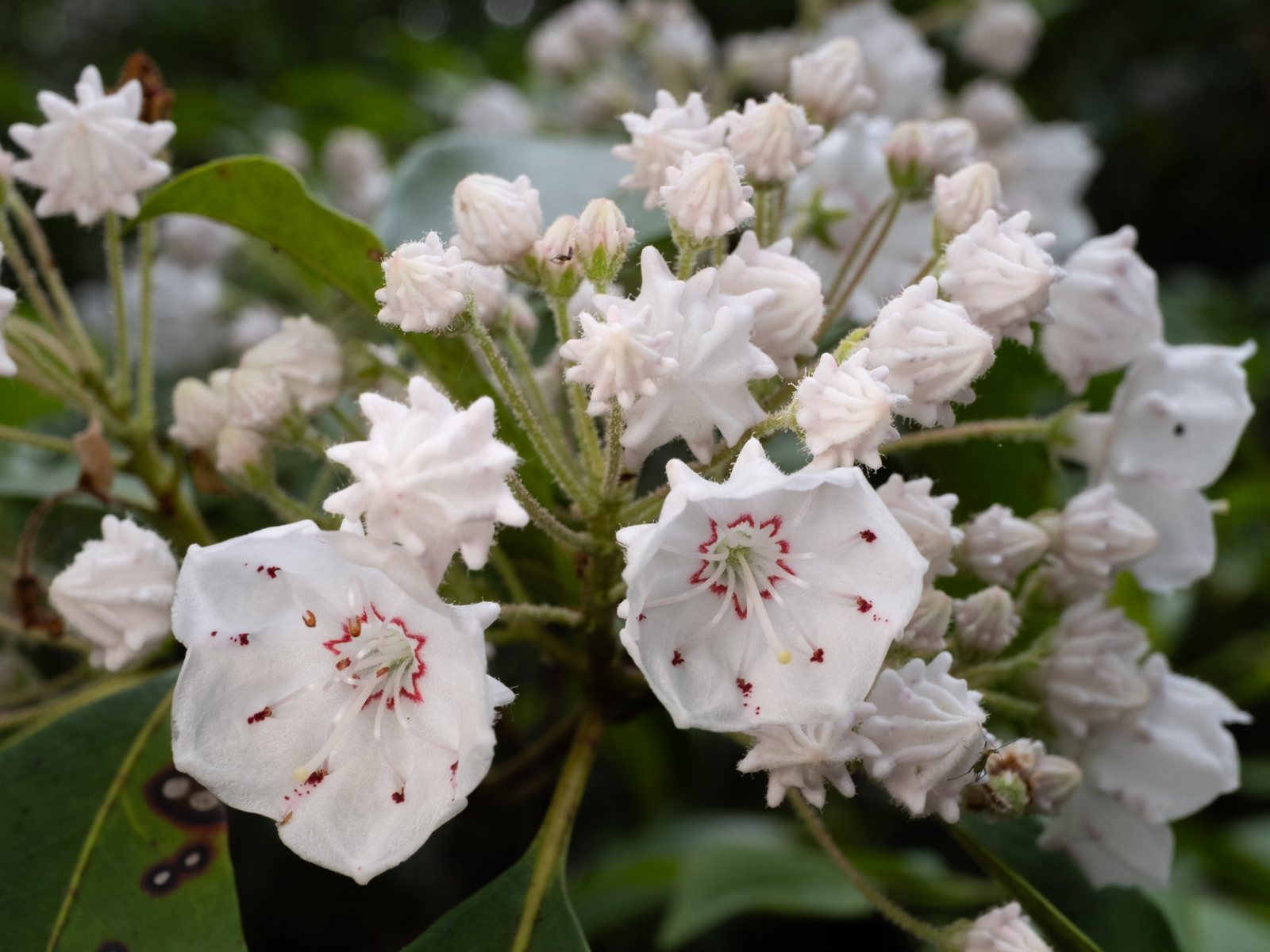
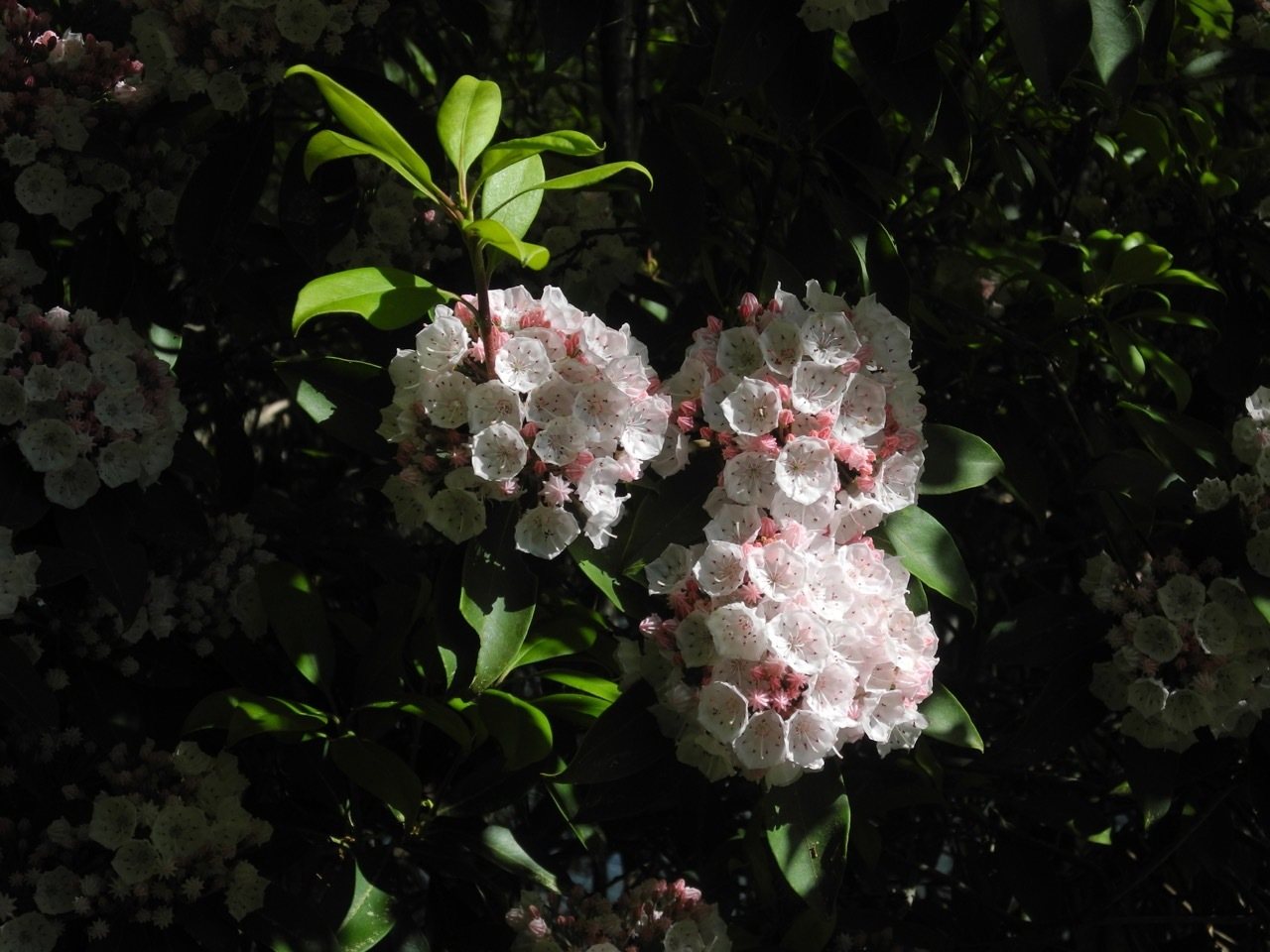
This slow-growing evergreen shrub has deep red flower buds that open into clusters of pale pink, cup-shaped flowers in late spring or early summer. Gardeners grow it for the contrast between buds and open flowers, glossy foliage and a rounded shape that suits sheltered woodland borders. It needs acidic soil and good drainage rather than ordinary lime-rich garden soil.
At a glance
- Sun
- Partial shade, ideally morning sun with afternoon shade. Full sun is possible in cooler climates if the roots stay moist; deep shade reduces flowering.
- Water
- Keep evenly moist but never waterlogged, especially during establishment and dry summers. Its shallow roots are vulnerable to drought.
- Soil
- Acidic, humus-rich, well-drained soil, ideally around pH 4.5-6.0. Avoid chalk, lime and heavy soil that stays saturated.
- Height
- 4-6 ft (1.2-1.8 m), occasionally taller with age
- Spread
- 4-6 ft (1.2-1.8 m)
- Flowers
- Late spring to early summer; deep red buds open to pale pink flowers, often fading lighter.
- Foliage
- Evergreen. Glossy, leathery, dark green leaves held year-round.
- Growth
- Slow
- Care needed
- Medium
The year at a glance
- Pollinators
- Deer resistant
- Heat tolerant
- Wildlife
- Low allergen
| J | F | M | A | M | J | J | A | S | O | N | D | |
|---|---|---|---|---|---|---|---|---|---|---|---|---|
| Flowers | ||||||||||||
| Plant |
Northern hemisphere months. In Australia, shift them by six.
- Difficulty
- Moderate
- Toughness
- Fairly tough
Will it suit your garden?
Pick your zone, country, light and whether you have pets.
Full sun is 6 or more hours of direct sun a day, part shade 3 to 6 hours, shade under 3.
How it grows
Planting day
1.6 ft (0.5 m)
After 1 year
2.1 ft (0.63 m)
After 2 years
2.5 ft (0.75 m)
After 3 years
2.9 ft (0.87 m)
After 5 years
4 ft (1.1 m)
About 8 years to full size.
From a typical nursery size, at an average rate for this kind of plant. A rule of thumb, not a forecast.
Good to know
- Cats and dogs
- Toxic
- Native to
- the US
- Growth rate
- Slow
Care
Jobs through the year
- WaterMar–May, Sep–Nov, every 7 days
- Check beneath mulch and water established plants if drying; keep young plants consistently moist.
- WaterJun–Aug, every 4 days
- Check moisture and water deeply before shallow roots dry out; skip watering when soil is moist.
- MulchMar–Apr, Oct
- Maintain 5–8 cm of leaf mould or fine pine bark, clear of stems.
- FeedApr
- Use a light acid-loving shrub feed only if growth is weak; maintain acidic, well-drained soil.
- DeadheadJun
- Carefully remove spent clusters without damaging the new shoots beneath.
- PruneJun
- After flowering, remove dead or damaged wood and shorten shoots only where necessary.
- ProtectJan–Feb, Nov–Dec
- Shelter exposed plants from drying winds and keep de-icing salt away.
- Plant with the top of the root ball level with, or slightly above, the surrounding soil; do not bury the stem base.
- Water deeply during dry spells, checking moisture beneath the mulch rather than watering by a fixed schedule.
- Apply 2-3 in (5-8 cm) of leaf mould or fine pine bark, keeping it clear of the stems.
- Feed lightly in spring with an acid-loving shrub fertiliser only if growth is weak; avoid heavy feeding.
- Keep cultivation and foot traffic away from the shallow roots, and shelter plants from drying winter winds.
Pruning. Prune immediately after flowering, removing dead or damaged wood and lightly shortening shoots only where needed. Carefully remove spent flower clusters without damaging the new shoots beneath them.
Through the year
- Early spring
- Check for winter damage and remove dead branches once healthy growth is clear.
- Spring
- Plant when the soil is workable, refresh mulch and feed lightly only if needed.
- Late spring to early summer
- Enjoy flowering, then remove spent clusters and carry out any light shaping.
- Summer
- Check soil moisture during dry weather and water deeply before the root zone dries out.
- Autumn
- Top up leaf mould or bark mulch and water during dry weather before winter.
- Winter
- Protect exposed plants from drying winds and avoid using de-icing salt nearby.
In the garden
- Plant along a woodland edge with ferns and hostas for contrasting leaf shapes beneath its spring flowers.
- Group with rhododendrons, azaleas and pieris in an acidic-soil border for a sequence of spring flowering.
- Use as a flowering evergreen specimen beside a sheltered path, allowing room for its mature spread.
- Repeat in loose groups beneath high-canopied trees to give a shaded garden year-round structure.
Garden styles it suits: Woodland, English country, Traditional, Romantic rose garden, Pacific Northwest woodland and New England.
Plant it with: Rhododendrons, Azaleas, Japanese pieris, Hostas, Christmas fern and Foamflower.
Wildlife: Flowers attract bees, particularly bumblebees, and the evergreen branching provides shelter for small birds. It is native to eastern North America, although this named cultivar is a garden selection.
Problems to watch for
- Yellow leaves with green veins usually indicate unsuitable soil pH: test the soil and correct the growing conditions rather than repeatedly adding iron; use an acidic raised bed where the underlying soil is chalky.
- Phytophthora root rot can cause wilting and dieback in wet soil: improve drainage, stop overwatering and remove severely affected plants.
- Leaf spot causes brown or purple-marked patches: remove fallen infected leaves, improve airflow and water at soil level.
- Lace bugs cause pale stippling on leaves: inspect leaf undersides and treat active infestations with insecticidal soap labelled for the pest, covering undersides and avoiding flowers.
Safety
All parts, including leaves, flowers and nectar, contain grayanotoxins and are poisonous to people, cats, dogs and horses if eaten. Poisoning can be severe or fatal; keep clippings away from livestock and seek urgent medical or veterinary advice after ingestion.
Easily confused with
Rhododendron (Rhododendron spp.)
Many evergreen rhododendrons have larger leaves and larger, funnel-shaped flowers; mountain laurel has shallow, five-sided cups with ten small pockets holding the anthers.
Sheep laurel (Kalmia angustifolia)
Sheep laurel has much narrower leaves and small, usually deeper pink flowers clustered below the leafy shoot tips rather than in large terminal clusters.
Japanese pieris (Pieris japonica)
Pieris bears hanging chains of small bell-shaped flowers, often with red young foliage; mountain laurel bears upright clusters of open cups.
The name
Kalmia honours the botanist Pehr Kalm, and latifolia means broad-leaved.
Propagation. Named plants must be propagated vegetatively to retain the cultivar's features. Semi-ripe cuttings can be attempted in late summer with rooting hormone, acidic rooting medium and controlled humidity, but rooting is difficult and slow; seed will not reliably produce 'Olympic Fire'.
Checked against open data
- Accepted botanical name
- Kalmia latifolia
- In the US and Canada
- Native in the lower 48 states.
- Native range
- Alabama, Connecticut, Delaware, Florida, Georgia, Indiana, Kentucky, Louisiana, Maine, Maryland, Masachusettes and Mississippi.
- Measured
- Soil pH 4.5 to 5.5. Average height 295 cm.
Sources: GBIF (CC BY 4.0), USDA PLANTS and Trefle (CC BY 4.0). The care and design notes are LandscapeGPT's own.
See it in your own yard.
Upload a photo of your yard and see it redesigned with plants that suit your climate, each checked against your zone.