Papyrus
Cyperus papyrus. Family Cyperaceae. Ornamental grass.
Also called Egyptian papyrus, Paper reed, Papyrus sedge.
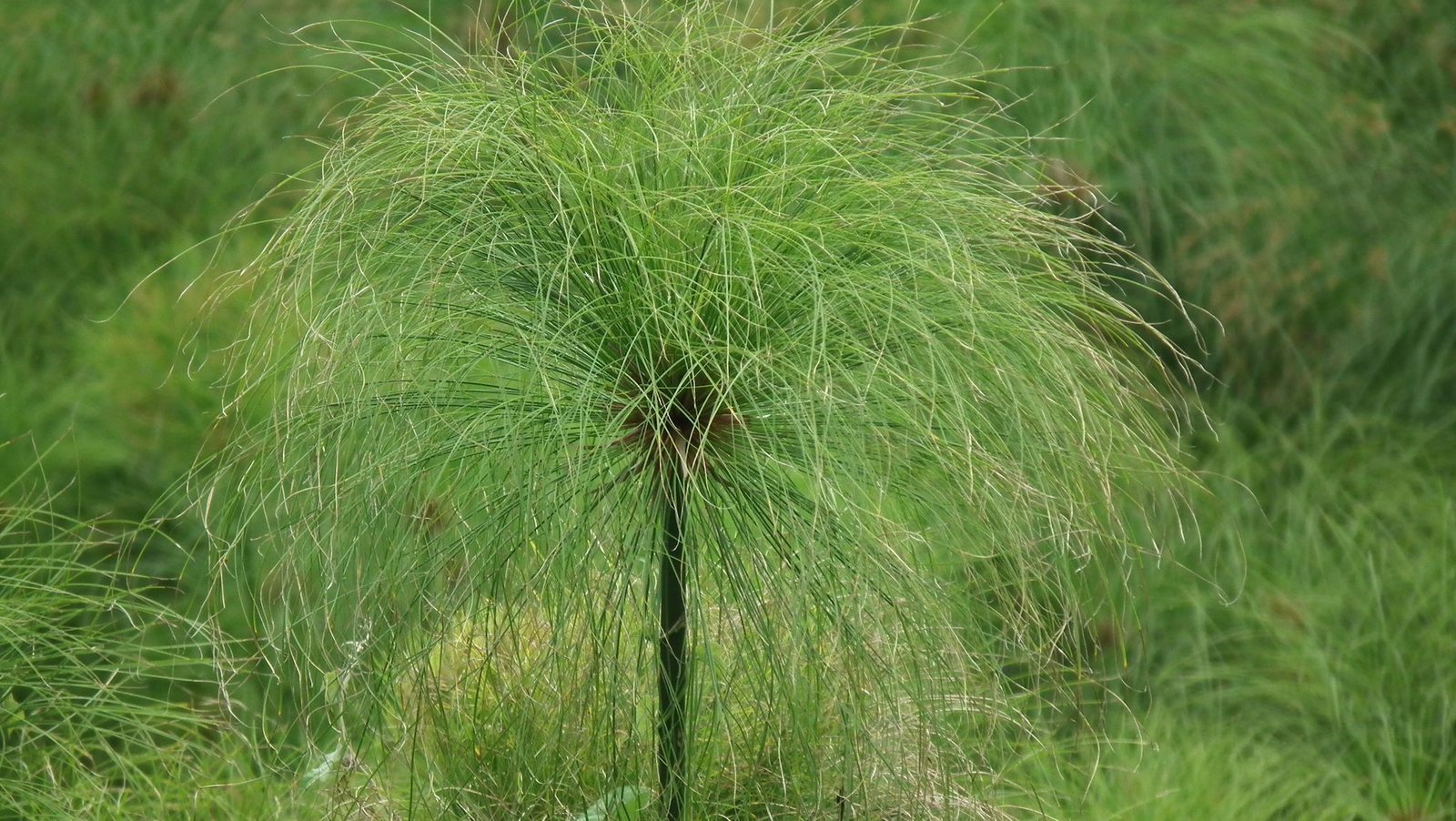
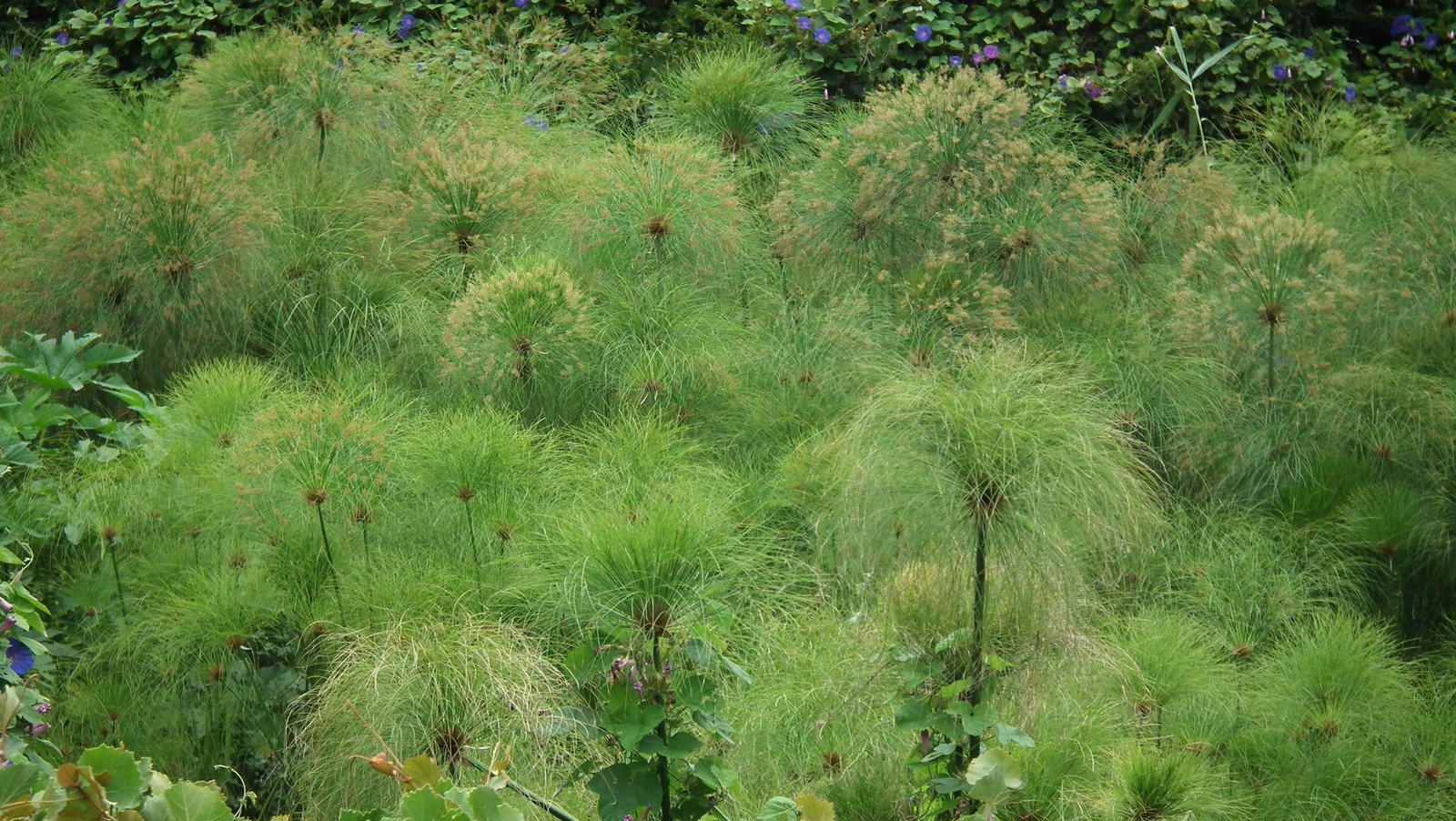
Papyrus is a tall, clump-forming aquatic sedge with upright stems topped by airy, umbrella-like heads. Gardeners grow it for its architectural shape beside ponds and in large water-filled containers. It is a tender perennial, often grown as an annual or overwintered indoors in colder climates.
At a glance
- Sun
- Full sun to partial shade; give it the brightest position available in cool climates.
- Water
- Keep the root zone permanently wet. Grow in saturated soil or shallow water, with the crown at the surface or just submerged.
- Soil
- Rich, heavy loam or aquatic planting soil that retains water; ordinary free-draining borders are unsuitable unless kept consistently saturated.
- Height
- 6-12 ft (1.8-3.7 m), occasionally taller in frost-free climates
- Spread
- 3-6 ft (0.9-1.8 m), expanding farther through rhizomes where unrestricted
- Flowers
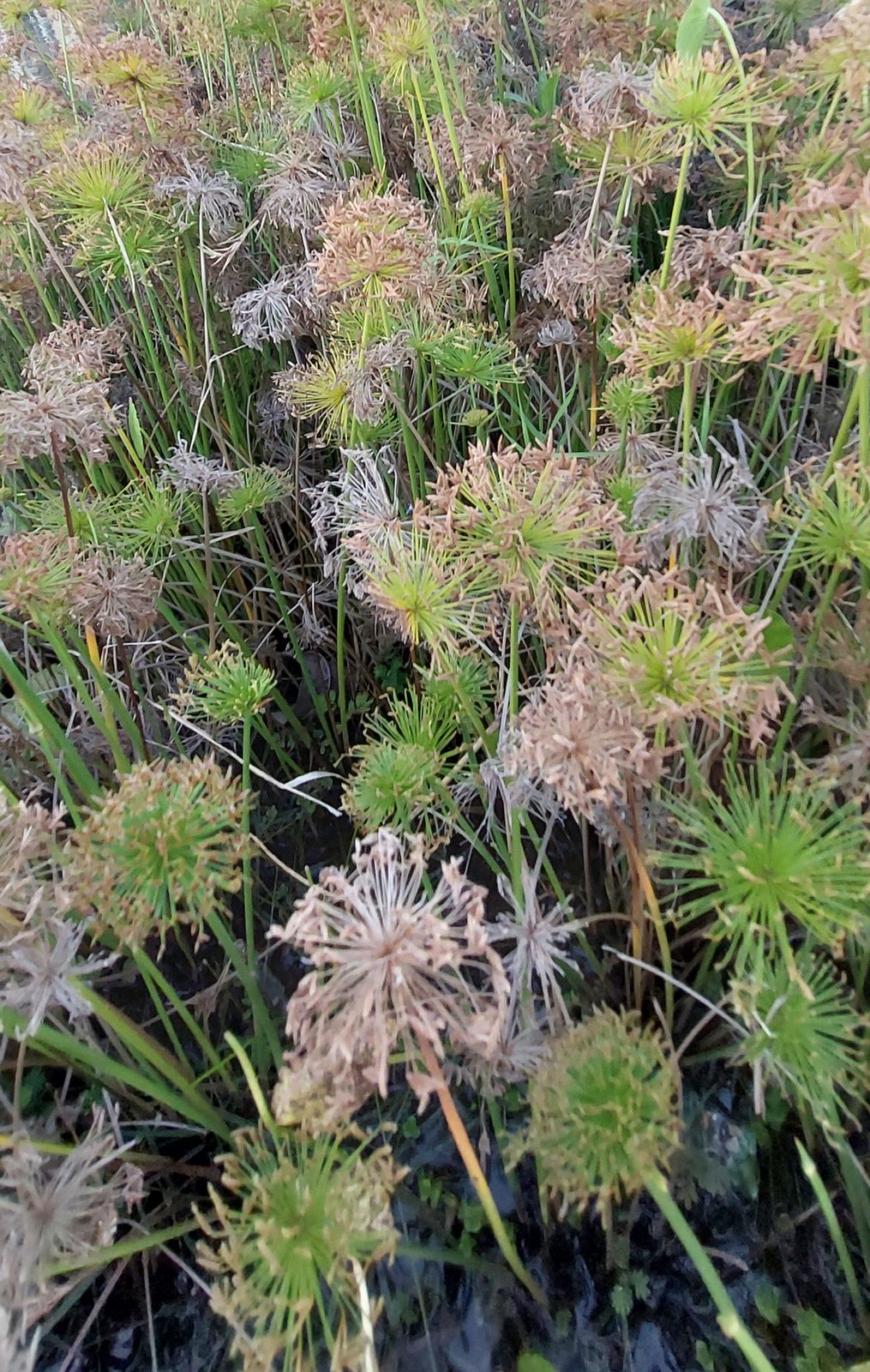
- Summer to autumn; tiny greenish-brown flowers appear within the radiating heads, which turn brown as seed develops.
- Foliage
- Evergreen. Tall, triangular green stems carry dense heads of fine, threadlike rays; true leaves are reduced mainly to sheaths at the stem bases.
- Growth
- Fast in warm weather with plentiful water and nutrients.
- Care needed
- Medium
The year at a glance
- Heat tolerant
- Wildlife
| J | F | M | A | M | J | J | A | S | O | N | D | |
|---|---|---|---|---|---|---|---|---|---|---|---|---|
| Plant |
Northern hemisphere months. In Australia, shift them by six.
- Difficulty
- Moderate
- Toughness
- Needs looking after
Will it suit your garden?
Pick your zone, country, light and whether you have pets.
Full sun is 6 or more hours of direct sun a day, part shade 3 to 6 hours, shade under 3.
How it grows
Planting day
1.1 ft (0.35 m)
After 1 year
6 ft (1.8 m)
After 2 years
9 ft (2.8 m)
full size
About 2 years to full size.
From a typical nursery size, at an average rate for this kind of plant. A rule of thumb, not a forecast.
Good to know
- Cats and dogs
- Mildly toxic: may upset a stomach
- Invasive in
- Australia
- In the garden
- Spreads vigorously: plan to contain it.
- Growth rate
- Fast
Care
Jobs through the year
- WaterMay–Sep
- Check water levels and keep roots permanently wet; grow in a movable container in this climate.
- WaterJan–Apr, Oct–Dec, every 3 days
- Check overwintering plants under cover and replenish water to keep the root ball wet.
- FeedMay–Aug, every 28 days
- Feed container plants lightly; use aquatic fertilizer in ponds without enriching the water.
- PruneMar–Apr
- Cut dead or winter-damaged stems at the base without damaging emerging shoots.
- PruneMay–Sep
- Remove broken or exhausted stems at the base as needed.
- DivideMar–Apr
- Divide or repot crowded clumps under cover as new growth begins.
- ProtectMay–Jun
- Move outside only after frost risk passes and nights are mild; acclimatise and shelter from wind.
- ProtectSep–Oct
- Before frost, move to bright frost-free shelter, preferably above 5°C.
- Use a large, heavy container to support the tall stems and contain the spreading rhizomes.
- Keep the soil saturated throughout active growth; check containers daily in hot weather.
- Feed container plants lightly during spring and summer; use aquatic fertiliser in ponds and avoid enriching the pond water.
- Shelter stems from strong winds, which can bend or break them.
- Before frost, move plants to a bright, frost-free place, preferably above 5°C, and keep the root ball wet.
- Divide crowded clumps in spring as new growth begins.
Pruning. Cut brown, broken or exhausted stems cleanly at the base whenever needed. In spring, remove any winter-damaged stems without cutting into emerging shoots.
Through the year
- Early spring
- Remove dead stems and divide or repot crowded plants as growth resumes.
- Late spring
- Move overwintered plants outdoors after frost risk has passed and nights are reliably mild; acclimatise them gradually to direct sun.
- Summer
- Check water levels frequently and feed container plants lightly while they are growing strongly.
- Late summer
- Remove broken stems and check whether rhizomes are escaping their container.
- Autumn
- Bring plants under cover before frost in cold climates and stop feeding as growth slows.
- Winter
- Keep overwintering plants in bright light with wet roots; inspect regularly for spider mites and aphids.
In the garden
- Plant in a contained pond margin to create a tall, airy backdrop to lower aquatic plants.
- Use a single large specimen in a watertight courtyard container as a vertical focal point.
- Pair with cannas and taro in a wet tropical-style planting for contrasting leaf shapes.
- Repeat substantial containers beside a terrace or pool for a strong architectural rhythm.
Garden styles it suits: Architectural minimal, Modern tropical, Tropical, Bog garden, Modern courtyard and Green on green.
Plant it with: Canna, Taro, Pickerelweed and Japanese iris.
Wildlife: Dense clumps provide shelter and perching places for pond-edge insects. The flowers are mainly wind-pollinated and are not a significant nectar source.
Problems to watch for
- Brown tips and collapsing stems from drying out: restore a consistently wet root zone and remove badly damaged stems.
- Frost damage: cut away dead stems once growth resumes; prevent recurrence by overwintering plants under cover.
- Spider mites indoors, causing pale or stippled growth: rinse stems and heads thoroughly and use insecticidal soap if needed, following the label.
- Aphids on young growth: wash them off with water or treat persistent colonies with insecticidal soap.
Safety
Not known to be toxic to people, cats, dogs or horses. No part is recognised as a serious poisoning hazard, but it is not a culinary plant and chewing coarse stems may cause irritation or stomach upset.
Where it spreads. Rhizomes can spread aggressively in frost-free wetlands. It is reported as an environmental weed in parts of Queensland and New South Wales, Australia. Keep it contained and never discard plants or rhizomes into waterways.
Easily confused with
Umbrella sedge (Cyperus involucratus)
Its stem tops have a conspicuous umbrella of broad, flat, leaflike bracts rather than the dense cloud of fine rays typical of papyrus.
Dwarf papyrus (Cyperus haspan)
Usually much shorter, with smaller, more open heads and fewer rays; it lacks the towering stems and large, dense heads of mature papyrus.
The name
Papyrus comes from the Greek papyros, the name for the plant used to make ancient writing material, while Cyperus derives from an ancient Greek name for sedges.
Propagation. Divide the rhizomes in spring, keeping several healthy shoots and roots on each section. Seed can also be sown on the surface of consistently wet compost in warm conditions; unlike umbrella sedge, true papyrus is not reliably propagated by placing detached heads upside down in water.
Checked against open data
- Accepted botanical name
- Cyperus papyrus
- In the US and Canada
- Introduced in Hawaii, the lower 48 states and Puerto Rico.
- Native range
- Angola, Benin, Botswana, Burundi, Cape Provinces, Caprivi Strip, Central African Repu, Chad, Congo, Egypt, Ethiopia and Gabon.
- Measured
- Soil pH 7 to 7.5.
Sources: GBIF (CC BY 4.0), USDA PLANTS and Trefle (CC BY 4.0). The care and design notes are LandscapeGPT's own.
See it in your own yard.
Upload a photo of your yard and see it redesigned with plants that suit your climate, each checked against your zone.