Passionfruit
Passiflora edulis. Family Passifloraceae. Climber.
Also called Passion fruit, Purple passionfruit, Yellow passionfruit.
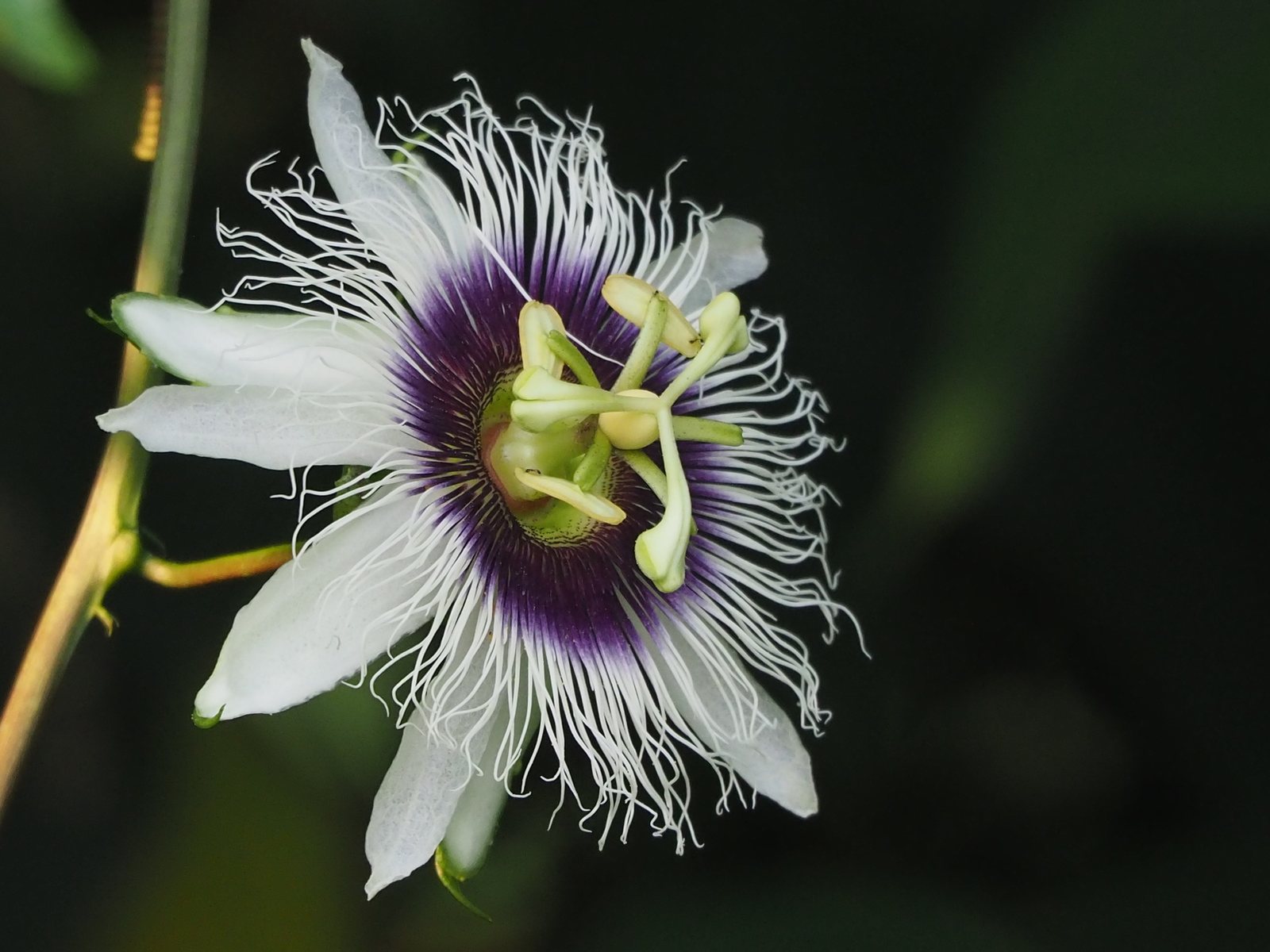
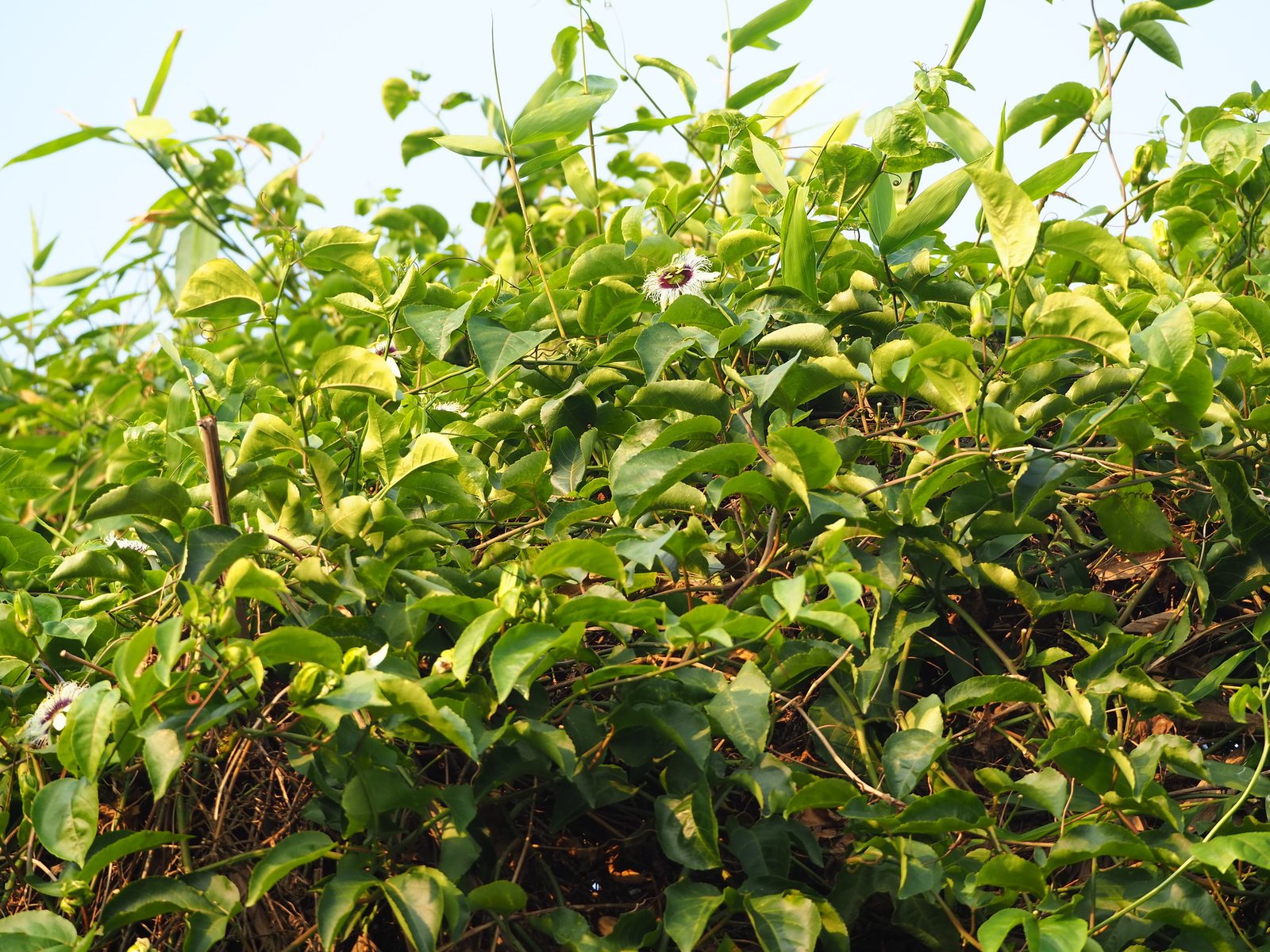
Passionfruit is a vigorous evergreen vine grown for its fragrant flowers and aromatic, seed-filled fruit. It needs a strong support, a long warm growing season and protection from frost; in most of the United Kingdom and Canada, grow it in a heated greenhouse or conservatory. Purple-fruited forms generally tolerate cooler conditions better than yellow-fruited forms.
At a glance
- Sun
- Full sun for reliable flowering and fruiting; light afternoon shade is helpful in very hot inland gardens.
- Water
- Keep the root zone evenly moist during growth, flowering and fruit development. Water deeply during dry weather, but never leave roots standing in water.
- Soil
- Fertile, well-drained soil enriched with compost, preferably slightly acidic to neutral. Avoid waterlogged clay and strongly alkaline soil.
- Height
- 10-20 ft (3-6 m) on a support
- Spread
- 10-30 ft (3-9 m) along wires or trellis
- Flowers
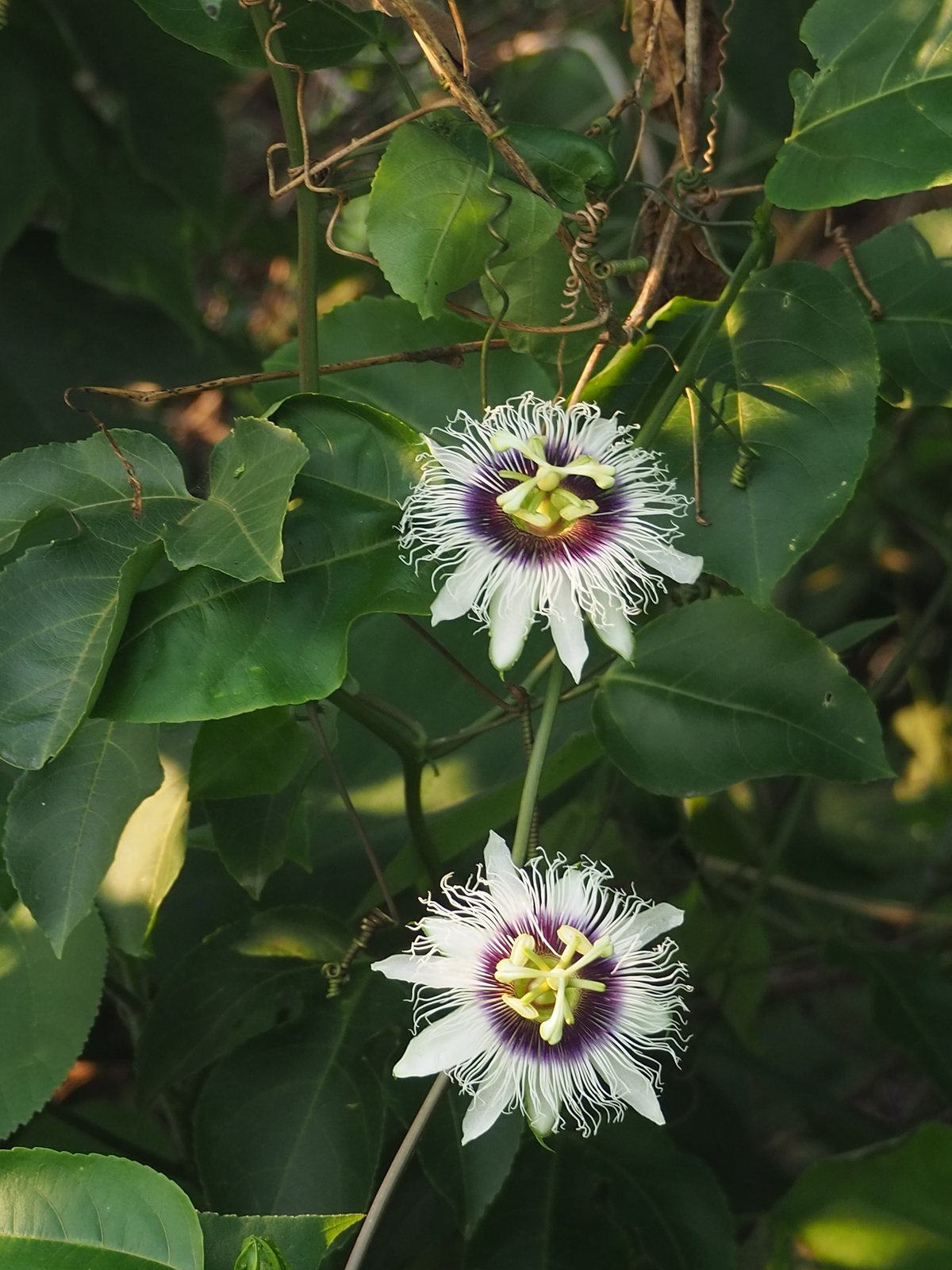
- Spring through autumn in warm conditions; white flowers with a prominent purple-and-white crown of filaments.
- Foliage
- Evergreen. Glossy, dark green leaves, usually with three lobes on mature growth; tendrils attach the stems to supports.
- Growth
- Fast in warm weather
- Care needed
- Medium
The year at a glance
- Pollinators
- Heat tolerant
- Wildlife
- Low allergen
- Edible
| J | F | M | A | M | J | J | A | S | O | N | D | |
|---|---|---|---|---|---|---|---|---|---|---|---|---|
| Flowers | ||||||||||||
| Fruit | ||||||||||||
| Plant |
Northern hemisphere months. In Australia, shift them by six.
- Difficulty
- Hard
- Toughness
- Needs looking after
Will it suit your garden?
Pick your zone, country, light and whether you have pets.
Full sun is 6 or more hours of direct sun a day, part shade 3 to 6 hours, shade under 3.
How it grows
Planting day
2 ft (0.6 m)
After 1 year
3 ft (1.1 m)
After 2 years
5 ft (1.5 m)
After 3 years
6 ft (1.8 m)
full size
About 3 years to full size.
From a typical nursery size, at an average rate for this kind of plant. A rule of thumb, not a forecast.
Good to know
- Cats and dogs
- Toxic
- Invasive in
- the US and Australia
- In the garden
- Spreads vigorously: plan to contain it.
- Growth rate
- Fast
Care
Jobs through the year
- WaterApr–May, Sep–Oct, every 7 days
- For established plants, soak when upper soil dries; containers and young vines need more frequent checks.
- WaterJun–Aug, every 3 days
- Keep established roots evenly moist during flowering and fruit swelling, without waterlogging.
- WaterJan–Mar, Nov–Dec, every 14 days
- Under frost-free shelter, water sparingly when the upper compost dries.
- FeedApr–May
- Apply balanced fruit fertiliser at the label rate; avoid excess nitrogen.
- MulchMay
- Mulch the root zone without covering the stem.
- PruneApr–May
- As growth resumes under frost-free conditions, retain the framework and shorten fruited laterals to healthy buds.
- ProtectSep–Oct
- Move into bright frost-free shelter before cold nights; outdoor overwintering is unsuitable in zones 6–7.
- ProtectJan–May, Nov–Dec
- Maintain bright frost-free conditions and keep outside only once frost risk has passed.
- HarvestAug–Oct
- Collect fully coloured fruit that detaches easily; promptly gather sound fallen fruit.
- Install a strong trellis or tensioned wires before planting, and tie in the main stems while young.
- Water deeply whenever the upper soil begins to dry, especially while fruit is swelling.
- Apply a balanced fruit fertiliser in spring according to the label; avoid heavy nitrogen feeding, which encourages leaves rather than fruit.
- Mulch the root zone, keeping mulch clear of the stem.
- Protect from frost and cold winds; move container plants into bright, frost-free shelter before cold weather.
- Check pollination requirements before buying: many purple forms are self-fertile, while many yellow forms need a genetically different compatible vine.
Pruning. In early spring, once frost risk has passed, remove dead, weak and tangled stems and shorten previously fruited side shoots to several healthy buds. Retain the main framework and train new shoots along the support; flowers and fruit develop on new growth.
Harvest
A first useful crop usually comes 1-3 years after planting, depending on the plant's starting size, warmth and pollination. Harvest from summer into autumn, or over a longer season in tropical climates, when fruit reaches its full purple or yellow colour and detaches easily; collect naturally fallen fruit promptly. Slightly wrinkled skin is normal in ripe fruit, but discard fruit that is mouldy or fermenting.
Through the year
- Early spring
- Prune established vines as growth resumes, after frost risk has passed.
- Spring
- Plant after the soil warms, install supports, feed and renew mulch.
- Late spring
- Tie in new growth and check that shoots are not climbing into nearby trees.
- Summer
- Water consistently and check flowers for pollinator visits; hand-pollinate if fruit set is poor.
- Summer to autumn
- Gather ripe fruit frequently and remove fallen or damaged fruit.
- Autumn
- Move container plants under frost-free cover before cold nights arrive.
- Winter
- Keep sheltered plants bright and frost-free, watering less while growth is slow.
In the garden
- Train along sturdy boundary wires to create an evergreen edible screen in frost-free gardens.
- Cover a strong pergola for summer shade, keeping fruit within reach for harvesting.
- Grow against a sunny, sheltered wall to make use of a warm microclimate.
- Train a container-grown vine on a substantial trellis in a greenhouse or conservatory.
Garden styles it suits: Edible landscape, Tropical, Modern courtyard, Potager (kitchen garden), Food forest and Homestead.
Plant it with: Basil, Chives, Calendula and Nasturtium.
Wildlife: Flowers provide pollen and nectar for bees; large bees are particularly effective pollinators. Birds and mammals may eat the fruit and disperse the seeds.
Problems to watch for
- Flowers but little fruit: check cultivar compatibility and pollinator activity; transfer pollen between compatible flowers by hand if necessary.
- Root or collar rot: improve drainage, keep mulch away from the stem and avoid planting in persistently wet ground.
- Aphids and scale insects: inspect young growth and stems; wash off aphids and treat persistent infestations with an appropriately labelled insecticidal soap or horticultural oil.
- Woodiness virus: mottled or distorted leaves and unusually hard, misshapen fruit have no cure; remove affected vines, use clean tools and replace with healthy planting stock.
Safety
Ripe pulp and seeds are edible for people. Leaves, stems, rind and immature fruit contain cyanogenic compounds and should not be eaten; substantial ingestion can cause serious poisoning. Keep these parts away from cats, dogs and horses, although species-specific poisoning reports are limited.
Where it spreads. Can escape cultivation and smother vegetation in Hawaii, northern New Zealand and parts of eastern Australia, including Queensland and New South Wales. Collect fallen fruit, remove unwanted seedlings and check local weed guidance before planting near natural areas.
Easily confused with
Blue passionflower (Passiflora caerulea)
Usually has five- to seven-lobed leaves, blue-and-white flowers and orange ripe fruit. It is substantially more cold-tolerant and is grown mainly as an ornamental.
Maypop (Passiflora incarnata)
A cold-hardy herbaceous vine that dies back in winter, with lavender-purple flowers and greenish-yellow ripe fruit.
Banana passionfruit (Passiflora tripartita var. mollissima)
Has long, hanging pink flowers and elongated yellow fruit rather than the rounded fruit of common passionfruit; its leaves are softly hairy.
The name
Passiflora refers to flower structures that Christian missionaries associated with the Passion of Christ, while edulis means edible.
Propagation. Take semi-ripe cuttings during warm weather to preserve a known variety. Fresh seed also germinates in warmth, but seedlings vary in fruit quality and pollination requirements. On grafted plants, remove shoots arising below the graft union.
Checked against open data
- Accepted botanical name
- Passiflora edulis
- In the US and Canada
- Introduced in Hawaii, the lower 48 states, Puerto Rico and US Virgin Islands.
- Native range
- Argentina Northeast, Brazil Northeast, Brazil South, Brazil Southeast, Brazil West-Central and Paraguay.
Sources: GBIF (CC BY 4.0), USDA PLANTS and Trefle (CC BY 4.0). The care and design notes are LandscapeGPT's own.
See it in your own yard.
Upload a photo of your yard and see it redesigned with plants that suit your climate, each checked against your zone.