Perennial sweet pea
Lathyrus latifolius. Family Fabaceae. Climber.
Also called Everlasting pea, Broad-leaved everlasting pea, Perennial pea.
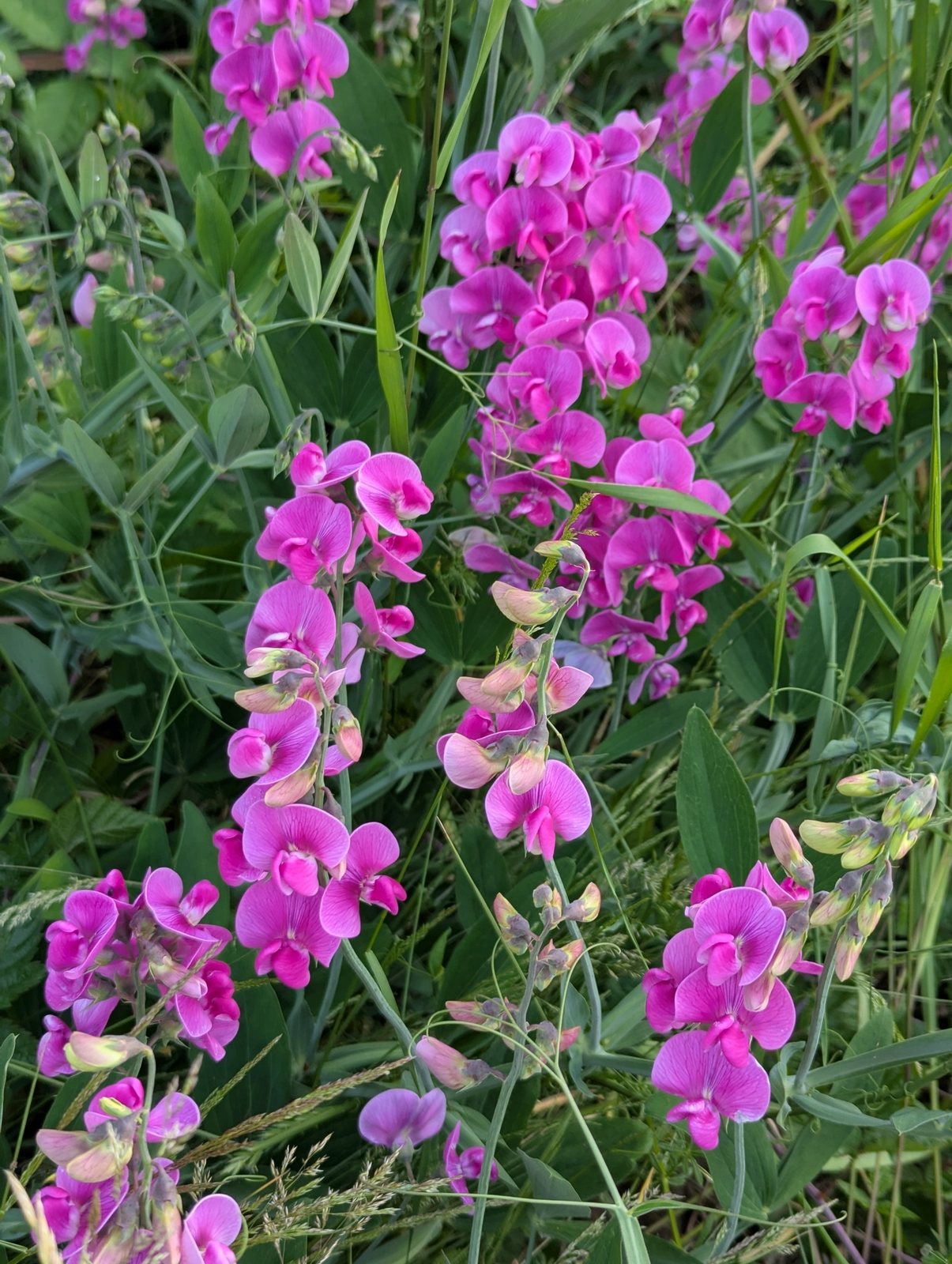
Perennial sweet pea is a vigorous, deciduous climber grown for clusters of pink, pea-shaped flowers through summer. Unlike annual sweet peas, its flowers are unscented, and it returns each year from a persistent rootstock. Give it a sturdy support and room to spread; it can overwhelm small neighbours.
At a glance
- Sun
- Full sun for the best flowering; tolerates partial shade.
- Water
- Water regularly during establishment. Established plants tolerate some drought, but flower better with deep watering during prolonged dry spells.
- Soil
- Well-drained soil with moderate fertility; tolerates clay if drainage is adequate. Neutral to alkaline soil suits it well.
- Height
- 6-9 ft (1.8-2.7 m) with support
- Spread
- 3-6 ft (0.9-1.8 m), potentially wider as established clumps spread
- Flowers
- Summer into early autumn; usually rose-pink, with white and deeper pink forms also available. Flowers are unscented.
- Foliage
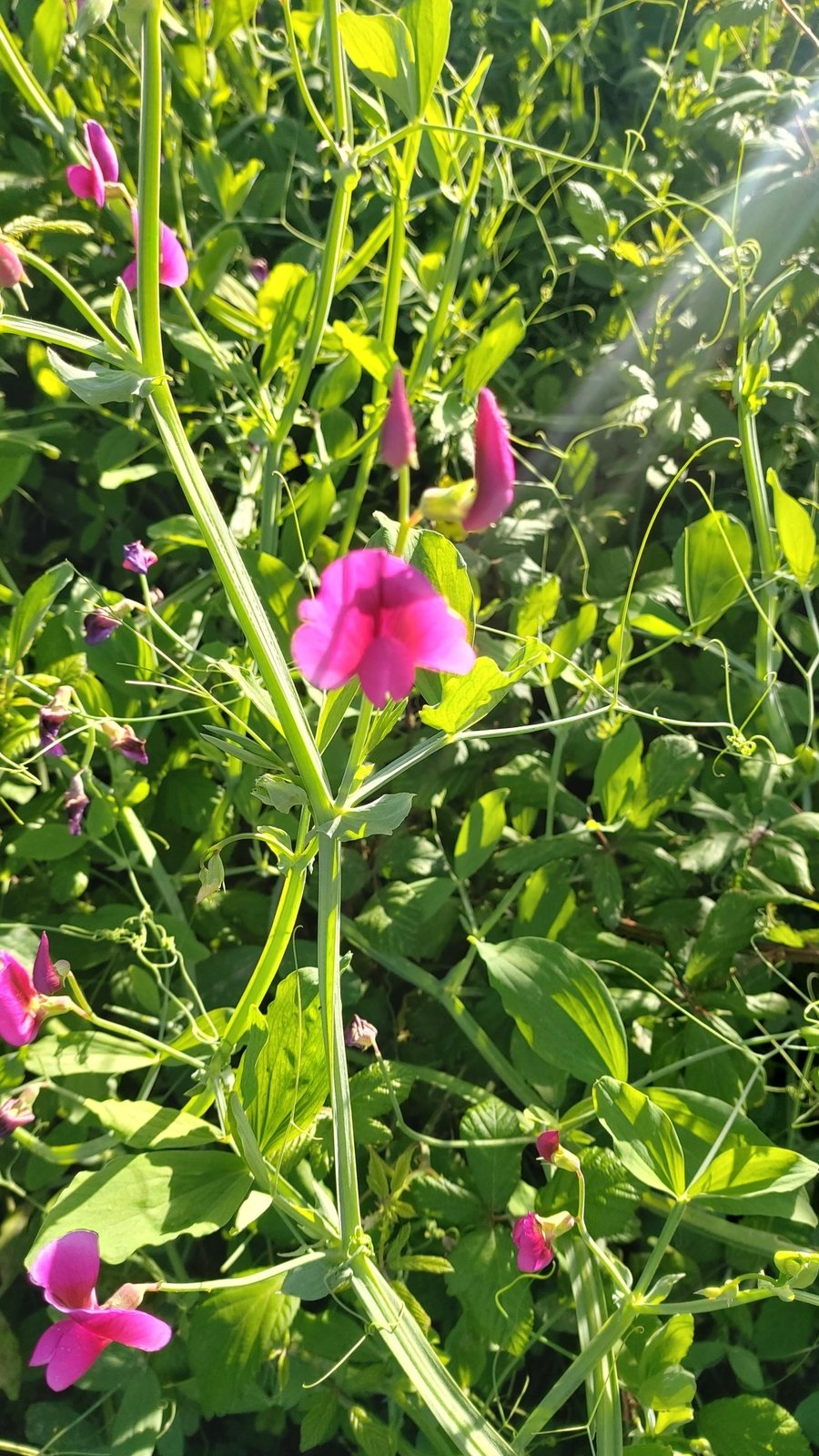
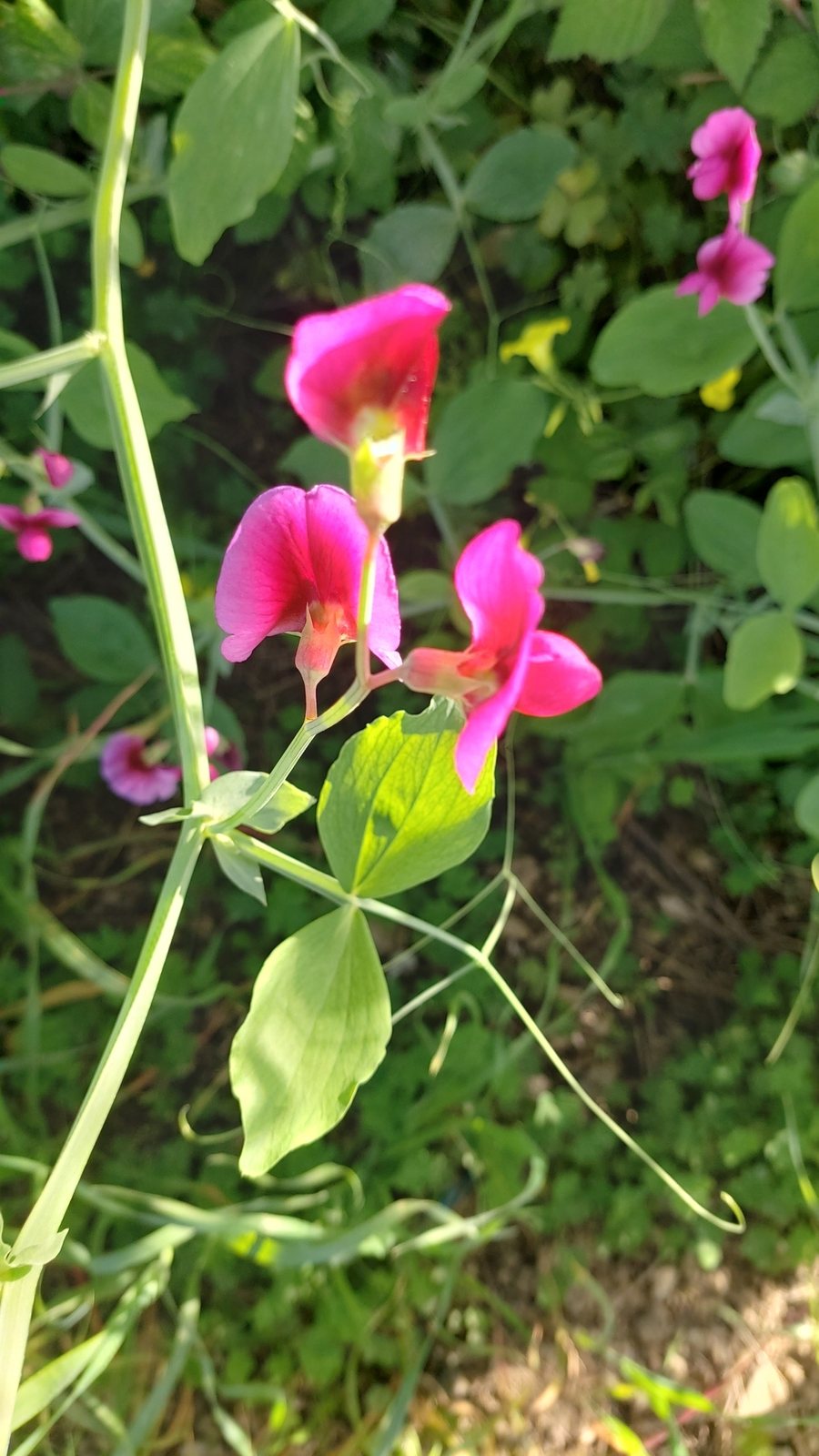
- Blue-green leaves with paired, broad leaflets and branching tendrils, carried on flattened, winged stems. Top growth dies back for winter.
- Growth
- Fast once established
- Care needed
- Medium
The year at a glance
- Pollinators
- Drought tolerant
- Cold hardy
- Low allergen
| J | F | M | A | M | J | J | A | S | O | N | D | |
|---|---|---|---|---|---|---|---|---|---|---|---|---|
| Flowers | ||||||||||||
| Fruit | ||||||||||||
| Plant |
Northern hemisphere months. In Australia, shift them by six.
- Difficulty
- Moderate
- Toughness
- Very tough
Will it suit your garden?
Pick your zone, country, light and whether you have pets.
Full sun is 6 or more hours of direct sun a day, part shade 3 to 6 hours, shade under 3.
How it grows
Planting day
2 ft (0.6 m)
After 1 year
3 ft (1.1 m)
After 2 years
5 ft (1.5 m)
After 3 years
6 ft (1.8 m)
full size
About 3 years to full size.
From a typical nursery size, at an average rate for this kind of plant. A rule of thumb, not a forecast.
Good to know
- Cats and dogs
- Toxic
- Invasive in
- the US and Australia
- In the garden
- Spreads vigorously: plan to contain it.
- Growth rate
- Fast
Care
Jobs through the year
- WaterApr–May, Sep, every 14 days
- Water established plants deeply only if soil is dry; water young plants more often.
- WaterJun–Aug, every 14 days
- Deep-water established plants during prolonged dry spells; young plants need more frequent watering.
- MulchMar–Apr
- Apply a thin compost mulch, keeping the crown clear; avoid high-nitrogen feeds.
- ProtectMar–Apr
- Install or repair sturdy climbing supports before shoots lengthen.
- PruneFeb–Mar
- Cut remaining dead stems to ground level before new growth.
- PruneMay–Sep, every 14 days
- Guide stems onto supports and remove spreading shoots or unwanted seedlings.
- DeadheadJun–Sep, every 7 days
- Remove faded clusters before poisonous seed pods mature to prolong bloom and limit seedlings.
- Install a sturdy trellis, wire mesh or other support before spring shoots lengthen.
- Water deeply during the first growing season and during extended summer drought.
- Apply a thin layer of compost in spring; avoid heavy nitrogen feeding, which encourages leaves rather than flowers.
- Mulch around the root zone, keeping mulch away from the crown.
- Remove spent flower clusters before pods mature to prolong flowering and reduce self-seeding.
- Pull unwanted seedlings promptly and remove spreading shoots before they become established.
Pruning. Cut dead stems back to ground level in late autumn or late winter, before new shoots emerge. During growth, guide stems onto their support and shorten or remove shoots that smother neighbouring plants.
Through the year
- Late winter
- Cut away remaining dead stems and repair supports before new growth starts.
- Spring
- Plant container-grown plants, water them in thoroughly and mulch around the root zone.
- Late spring
- Guide young stems onto the support and remove unwanted seedlings.
- Summer
- Water during prolonged dry weather and remove faded flower clusters before seed pods develop.
- Early autumn
- Remove remaining pods where self-seeding is unwanted and check for shoots spreading beyond the planting area.
- Late autumn
- Cut down collapsed top growth if it is untidy, or leave it until late winter.
In the garden
- Train over a sturdy fence or trellis to provide summer flowers and seasonal screening.
- Use on a large obelisk toward the back of a cottage border, with catmint or hardy geraniums below.
- Combine with a robust climbing rose for overlapping summer colour, keeping the pea from covering the rose.
- Let it scramble over a low wall or sunny bank where its spread can be contained and seedlings removed.
Garden styles it suits: Cottage garden, English country, Romantic rose garden, Traditional, Farmhouse and Pollinator garden.
Plant it with: Climbing roses, Catmint, Hardy geraniums, Yarrow, Hollyhocks and Lavender.
Wildlife: Flowers provide nectar and pollen for bees, particularly larger bees able to work the pea-shaped blooms. Dense summer growth offers temporary shelter for insects.
Problems to watch for
- Aphids cluster on soft shoots: wash them off with water and encourage ladybirds and other predators; use insecticidal soap only if needed.
- Powdery mildew produces a white coating on leaves: improve airflow, water the soil during drought and remove badly affected growth.
- Slugs and snails damage emerging shoots: inspect young growth, remove pests and use barriers or labelled slug controls where necessary.
- Poor flowering often follows deep shade or excessive nitrogen: move to a sunnier position if practical and stop high-nitrogen feeding.
Safety
Toxic to people, cats, dogs and horses if eaten; all parts should be treated as poisonous, especially the seeds. Substantial or repeated ingestion can cause lathyrism, with serious weakness and neurological damage. Do not confuse it with edible garden peas, and keep pods away from children and animals.
Where it spreads. Spreads by seed and an expanding rootstock, and can be difficult to eradicate. It is invasive in parts of the western United States, including California and the Pacific Northwest, and is an environmental weed in parts of southern Australia, including Victoria and Tasmania. Avoid planting near natural areas in these regions and check local guidance.
Easily confused with
Annual sweet pea (Lathyrus odoratus)
Usually has fragrant flowers in a much wider range of colours and dies after one growing season; perennial sweet pea is unscented and regrows from its rootstock.
Narrow-leaved everlasting pea (Lathyrus sylvestris)
Has much narrower, lance-shaped leaflets and generally smaller, duller pink flowers; perennial sweet pea has conspicuously broader leaflets and larger flower clusters.
The name
The epithet latifolius means broad-leaved, while everlasting pea refers to its perennial habit rather than the annual life cycle of ordinary sweet peas.
Propagation. Grow from seed sown in spring or autumn. Lightly nick the hard seed coat away from the small seed scar, or soak seeds overnight before sowing. Flower colour may vary in seedlings; established plants have deep roots and are difficult to divide or move.
Checked against open data
- Accepted botanical name
- Lathyrus latifolius
- In the US and Canada
- Introduced in Canada, Hawaii and the lower 48 states.
- Native range
- Albania, Algeria, Austria, Baleares, Bulgaria, Corse, Czechoslovakia, France, Greece, Hungary, Italy and Krym.
- Measured
- Soil pH 5.8 to 7.5. Average height 56 cm.
Sources: GBIF (CC BY 4.0), USDA PLANTS and Trefle (CC BY 4.0). The care and design notes are LandscapeGPT's own.
See it in your own yard.
Upload a photo of your yard and see it redesigned with plants that suit your climate, each checked against your zone.