Peruvian pepper tree
Schinus molle. Family Anacardiaceae. Tree.
Also called California pepper tree, Peppercorn tree, Peruvian mastic tree.
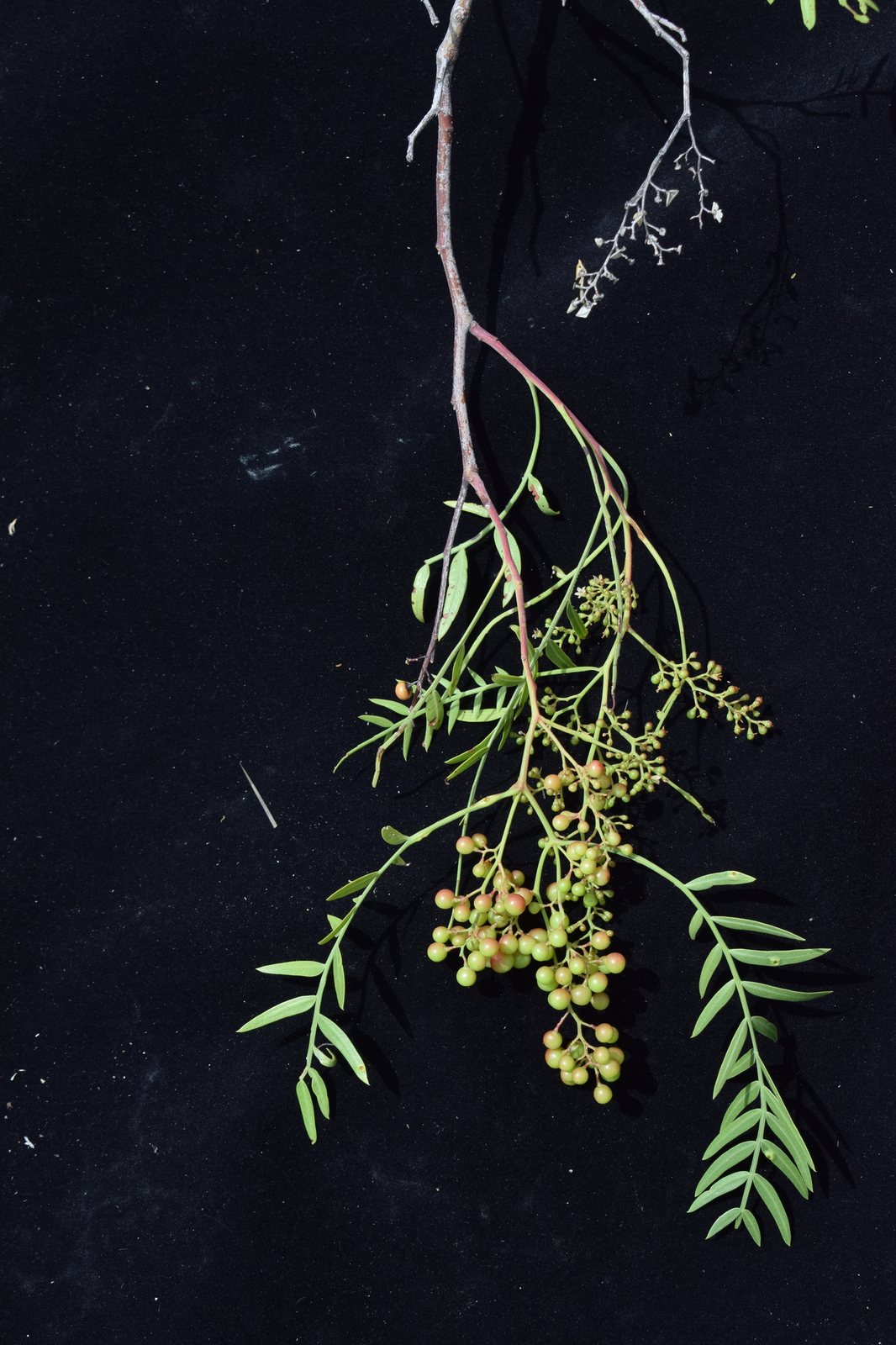
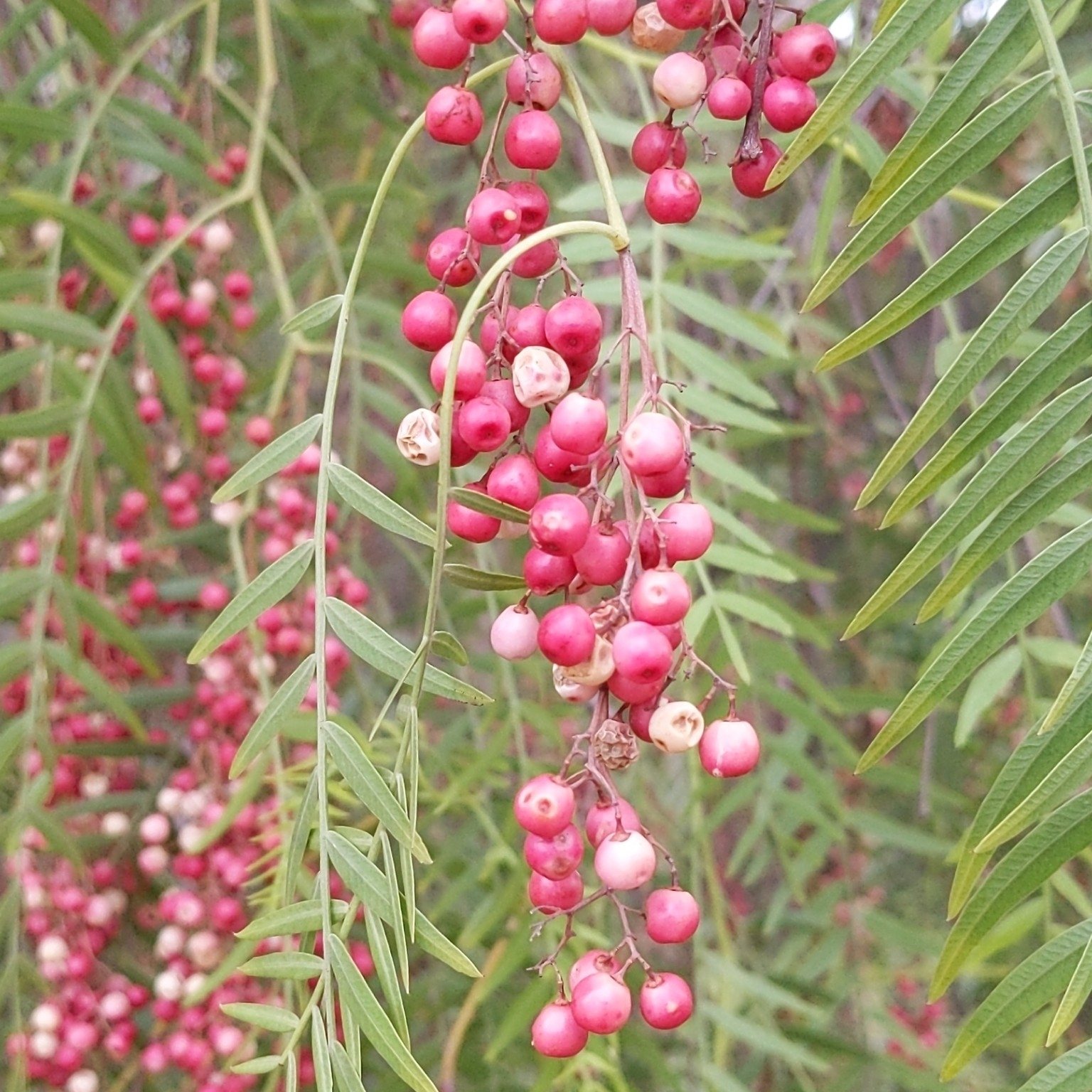
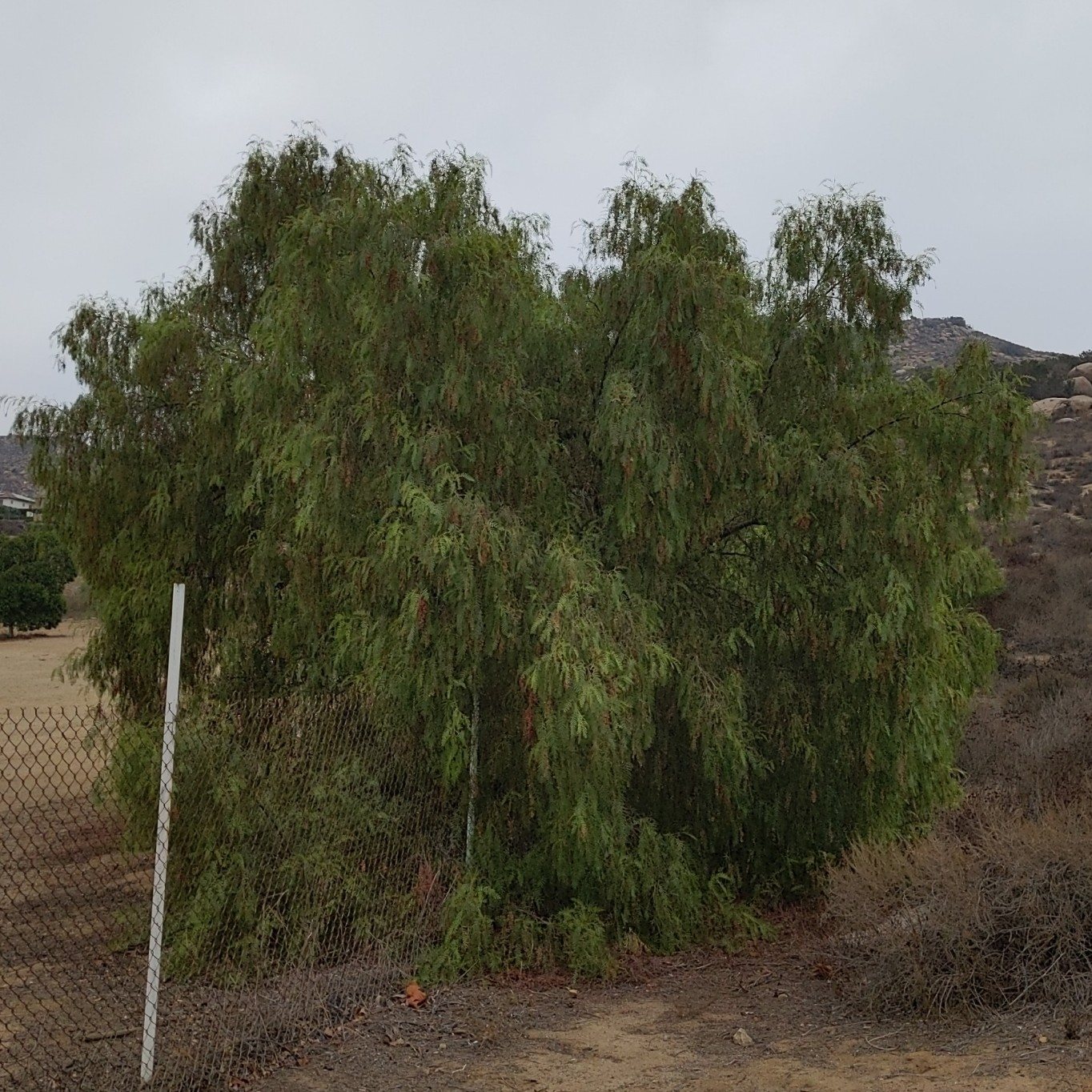
A fast-growing evergreen tree with a broad, weeping crown, finely divided leaves and hanging clusters of pink-red fruit. Gardeners grow it for light shade and its graceful outline in warm, dry climates, but its spreading roots, litter and invasive potential make it unsuitable for small gardens. It is not reliably hardy outdoors through most of the United Kingdom or Canada.
At a glance
- Sun
- Full sun; allow plenty of open space for the crown.
- Water
- Water regularly while establishing; drought tolerant once established. Mature trees usually need little supplementary water except during prolonged drought.
- Soil
- Well-drained sand, loam or gravelly soil; tolerates alkaline and relatively poor soils. Avoid waterlogged ground.
- Height
- 30-50 ft (9-15 m)
- Spread
- 25-40 ft (7.5-12 m)
- Flowers
- Small creamy-white flowers in loose clusters, mainly in spring and summer; flowering can extend longer in warm climates.
- Foliage
- Evergreen, aromatic, pinnate leaves with many narrow leaflets on slender, drooping branches.
- Growth
- Fast in warm conditions.
- Care needed
- Medium
The year at a glance
- Pollinators
- Drought tolerant
- Heat tolerant
- Wildlife
| J | F | M | A | M | J | J | A | S | O | N | D | |
|---|---|---|---|---|---|---|---|---|---|---|---|---|
| Flowers | ||||||||||||
| Fruit | ||||||||||||
| Plant |
Northern hemisphere months. In Australia, shift them by six.
- Difficulty
- Hard
- Toughness
- Needs looking after
Will it suit your garden?
Pick your zone, country, light and whether you have pets.
Full sun is 6 or more hours of direct sun a day, part shade 3 to 6 hours, shade under 3.
How it grows
Planting day
7 ft (2 m)
After 1 year
9 ft (2.8 m)
After 2 years
12 ft (3.5 m)
After 3 years
14 ft (4.3 m)
After 5 years
19 ft (5.8 m)
About 13 years to full size.
From a typical nursery size, at an average rate for this kind of plant. A rule of thumb, not a forecast.
Good to know
- Cats and dogs
- Mildly toxic: may upset a stomach
- Invasive in
- the US and Australia
- In the garden
- Spreads vigorously: plan to contain it.
- Growth rate
- Fast
Care
Jobs through the year
- WaterApr–May, Sep–Oct, every 28 days
- Water established trees only during prolonged drought; water regularly through the first two growing seasons.
- WaterJun–Aug, every 21 days
- Deep-water established trees only if prolonged drought dries the root zone.
- MulchMay
- Mulch the root zone without covering the trunk base.
- PruneMay–Jun
- After frost risk passes, remove damaged or crossing branches; use an arborist for large limbs.
- ProtectJan–Apr, Oct–Dec
- Not reliably hardy outdoors in zones 6–7; ordinary frost wrapping cannot make it suitable for these winters.
- Plant well away from paving, drains and buildings; vigorous surface roots can cause damage.
- Water deeply during the first two growing seasons, allowing the surface soil to dry between waterings.
- Spread mulch over the root zone, keeping it clear of the trunk.
- Do not routinely fertilise established trees; excessive feeding encourages soft growth.
- Protect young trees from frost and cold, drying winds.
- Remove unwanted seedlings promptly and clear fallen fruit from paths.
Pruning. Prune in late spring or early summer after frost risk has passed, removing dead, damaged or crossing branches. Establish a sound branch framework while young; avoid topping and have large limbs assessed by a qualified arborist.
Through the year
- Spring
- Plant after frost risk has passed; water thoroughly and mulch the root zone.
- Late spring
- Check young trees for frost damage and prune back to healthy wood.
- Early summer
- Make light formative cuts on young trees and check that any support ties are not rubbing.
- Summer
- Water establishing trees deeply during dry spells; inspect foliage for scale and distorted growth.
- Autumn
- Clear fallen fruit and pull seedlings before their roots become established.
- Winter
- Protect young trees during cold snaps and check mature trees for storm-damaged branches.
In the garden
- Use as a single shade tree in a large, dry-climate garden, with room for its spreading crown.
- Combine with agaves, yuccas and gravel for contrasting fine and bold foliage.
- Place behind Mediterranean shrubs to create a soft, drooping canopy above lower planting.
- Use in spacious informal landscapes away from paving, pools and frequently used seating areas, where fruit and leaf litter are easier to manage.
Garden styles it suits: Mediterranean, Desert / xeriscape, Dry gravel garden, Spanish courtyard, Modern Mediterranean and Southwestern.
Plant it with: Lavender, Rosemary, Rock rose, Santolina, Agave and Red yucca.
Wildlife: Flowers attract visiting insects, and birds eat the fruit and disperse the seeds. The canopy provides shelter, but outside its native range its spread can displace local vegetation.
Problems to watch for
- Peppertree psyllids can cause pitted, curled or dropping leaves, particularly in California. Avoid excess nitrogen and broad-spectrum insecticides; established trees often tolerate the damage.
- Scale insects can produce sticky honeydew and sooty mould. Encourage natural predators and use a labelled horticultural oil on accessible infestations when necessary.
- Root rot can develop in poorly drained or constantly irrigated soil. Improve drainage and keep routine lawn irrigation away from the root zone.
- Large limbs may break in storms, especially on poorly structured trees. Train young trees carefully and have weak unions or damaged limbs assessed by an arborist.
Safety
Fruit and sap can cause stomach upset or skin irritation in people; do not treat garden-harvested fruit as a safe culinary pepper. Cats and dogs may develop gastrointestinal upset after eating plant material, especially fruit. Reliable horse-specific toxicity information is limited, so keep horses from browsing it or eating fallen fruit. It belongs to the cashew family and may cause allergic reactions in sensitive people.
Where it spreads. Invasive in parts of California and South Africa. It is also naturalised and can spread aggressively in parts of Australia, including Western Australia, South Australia, New South Wales and Victoria. Birds disperse its seeds into bushland and disturbed ground; check local weed guidance before planting.
Easily confused with
Brazilian pepper tree (Schinus terebinthifolia)
Has fewer, much broader leaflets and a denser, less weeping crown; its fruit is usually bright red. It is also highly invasive in several warm regions.
African sumac (Searsia lancea)
Its leaves have three long, narrow leaflets rather than the many leaflets along each Peruvian pepper tree leaf.
Chilean pepper tree (Schinus polygamus)
Usually a thorny shrub or small tree with simple leaves, rather than a large weeping tree with pinnate leaves.
The name
The name molle comes from the Quechua name for the tree, while 'pepper tree' refers to its pepper-scented foliage and peppercorn-like fruit.
Propagation. Raise from cleaned ripe seed in warmth, or try semi-ripe cuttings in summer. Seedlings vary, and seed-grown trees may be male or female; check local restrictions before propagating where the species is invasive.
Checked against open data
- Accepted botanical name
- Schinus molle
- In the US and Canada
- Introduced in Hawaii, the lower 48 states and Puerto Rico.
- Native range
- Argentina Northeast, Brazil South, Chile North, Paraguay, Peru and Uruguay.
- Measured
- Average height 1417 cm.
Sources: GBIF (CC BY 4.0), USDA PLANTS and Trefle (CC BY 4.0). The care and design notes are LandscapeGPT's own.
See it in your own yard.
Upload a photo of your yard and see it redesigned with plants that suit your climate, each checked against your zone.