Pheasant's eye daffodil
Narcissus poeticus. Family Amaryllidaceae. Bulb.
Also called Poet's daffodil, Poet's narcissus.
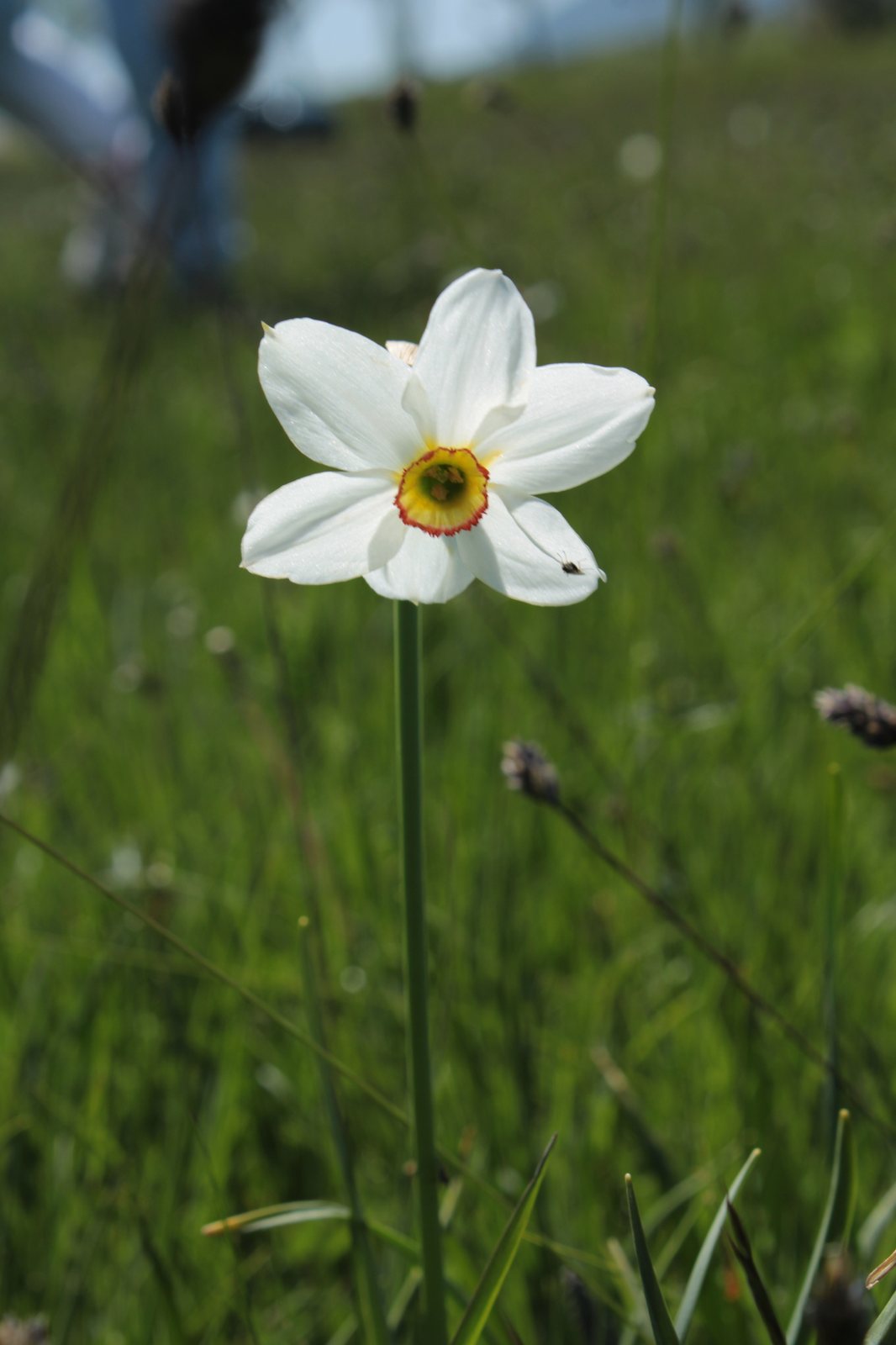
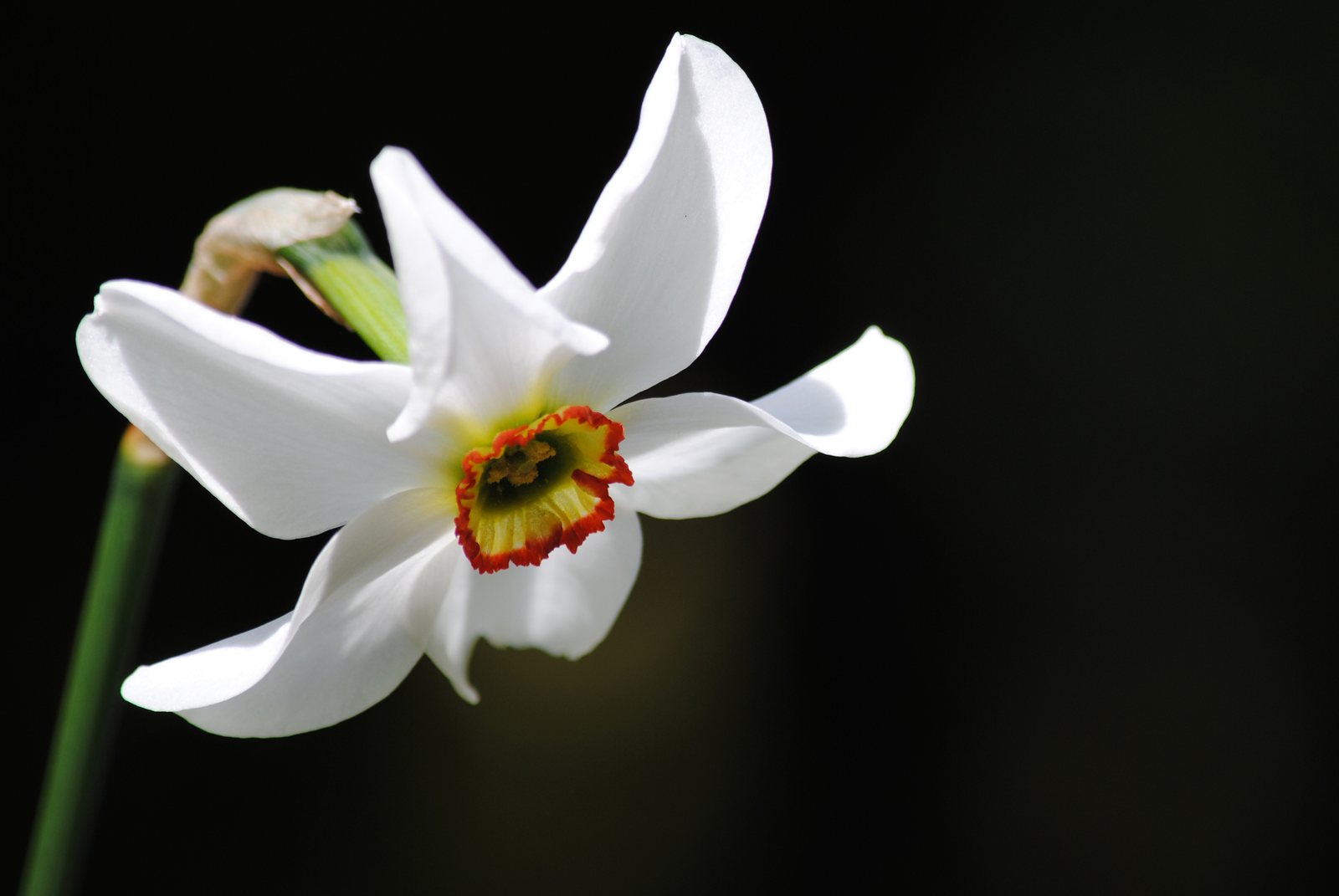
Pheasant's eye daffodil is a late-flowering daffodil with fragrant white flowers and a small yellow cup edged in red. Gardeners grow it in borders, orchards and long grass, where established bulbs can form lasting colonies. It performs best where winters are cool and spring soil stays moist.
At a glance
- Sun
- Full sun or light partial shade; suitable beneath deciduous trees that leaf out after flowering.
- Water
- Keep soil evenly moist during active growth and flowering, without waterlogging. Water needs fall sharply once the leaves die back.
- Soil
- Fertile, moisture-retentive but well-drained soil; tolerates clay if it drains adequately. Avoid sites that remain saturated.
- Height
- 1-1.5 ft (0.3-0.45 m)
- Spread
- 0.25-0.5 ft (0.08-0.15 m) per bulb, gradually widening into clumps
- Flowers
- Late spring, later than most daffodils; fragrant white flowers with a small yellow cup edged in red.
- Foliage
- Upright, narrow, blue-green leaves that emerge before flowering and die back in summer.
- Growth
- Moderate; clumps enlarge gradually through offsets.
- Care needed
- Low
The year at a glance
- Pollinators
- Deer resistant
- Cold hardy
- Low allergen
- Fragrant
| J | F | M | A | M | J | J | A | S | O | N | D | |
|---|---|---|---|---|---|---|---|---|---|---|---|---|
| Flowers | ||||||||||||
| Plant |
Northern hemisphere months. In Australia, shift them by six.
- Difficulty
- Easy
- Toughness
- Very tough
Will it suit your garden?
Pick your zone, country, light and whether you have pets.
Full sun is 6 or more hours of direct sun a day, part shade 3 to 6 hours, shade under 3.
How it grows
Planting day
0.5 ft (0.15 m)
After 1 year
1.2 ft (0.38 m)
full size
About 1 years to full size.
From a typical nursery size, at an average rate for this kind of plant. A rule of thumb, not a forecast.
Good to know
- Cats and dogs
- Toxic
- Growth rate
- Moderate
Care
Jobs through the year
- WaterFeb–Mar, every 14 days
- Water established bulbs during prolonged dry weather if leaves are growing.
- WaterApr–Jun, every 7 days
- Water during dry spells while leaves remain green; newly planted bulbs need closer attention.
- FeedMar
- Apply a light bulb fertilizer as growth begins if soil is poor; avoid excess nitrogen.
- MulchOct–Nov
- Top-dress with a thin layer of compost while maintaining free drainage.
- DeadheadApr–May
- Remove faded flower heads before seed develops unless seedlings are wanted.
- PruneJun–Jul
- Remove or mow foliage only once naturally yellow, usually at least six weeks after flowering.
- DivideJun–Jul
- Lift congested clumps after leaves yellow and replant promptly without drying the bulbs.
- Plant bulbs in autumn with about twice their own height of soil above them, spacing them 3-6 in (8-15 cm) apart.
- Water during dry spells while leaves are green, especially in the first spring after planting.
- Apply a light dressing of bulb fertiliser as growth begins if soil is poor; avoid heavy nitrogen feeding.
- Mulch with compost in autumn, keeping the site well drained.
- Divide crowded clumps when flowering declines, lifting after the leaves yellow and replanting promptly.
- In warm-winter areas, check local performance before planting extensively; flowering can be unreliable without enough winter chilling.
Pruning. Remove spent flower heads before seed develops unless you want seedlings. Leave foliage intact until it yellows naturally, usually at least six weeks after flowering; do not tie it into knots or mow it while green.
Through the year
- Autumn
- Plant bulbs and top-dress established beds with compost.
- Late winter
- Check drainage and remove debris that shelters slugs around emerging shoots.
- Early spring
- Feed lightly if needed and water during prolonged dry weather.
- Late spring
- Enjoy the flowers, then remove fading heads unless saving seed.
- Early summer
- Allow foliage to yellow before cutting it back or mowing naturalised grass.
- Summer
- Lift and divide overcrowded clumps after foliage dies back; replant without leaving bulbs exposed to dry out.
In the garden
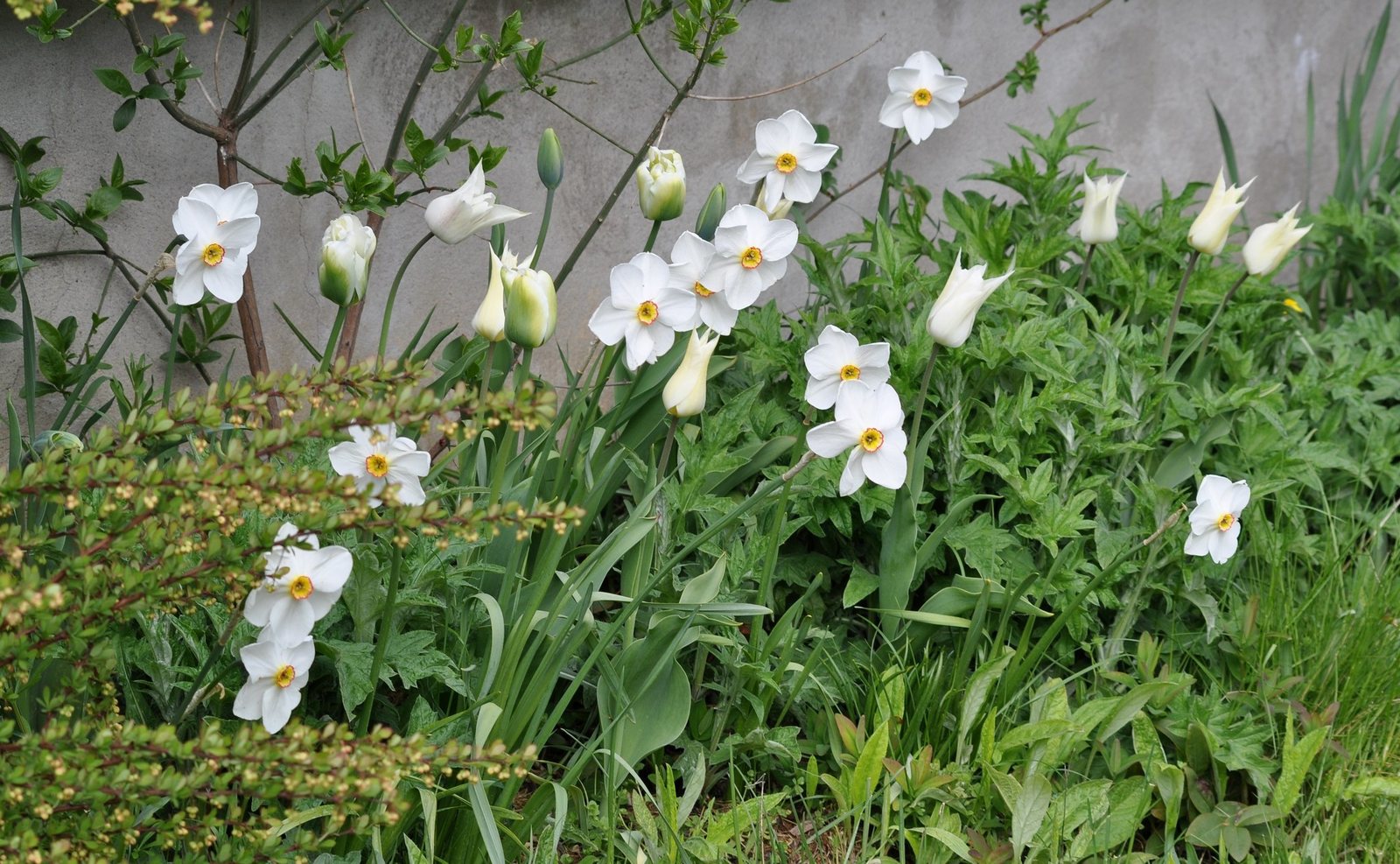
- Plant loose drifts through orchard grass, leaving the area unmown until the foliage dies back.
- Repeat small groups along a border to extend the daffodil season into late spring.
- Place among emerging hostas or hardy geraniums, whose leaves help conceal dying bulb foliage.
- Use beneath open-canopied deciduous trees for a lightly shaded spring display.
- Plant beside a path where the fragrance and fine red cup edging can be appreciated.
Garden styles it suits: English country, Cottage garden, Woodland, Backyard orchard, White garden and Sensory garden.
Plant it with: Hostas, Hardy geraniums, Forget-me-nots, Brunnera, Primroses and Lady's mantle.
Wildlife: Open flowers may be visited by bees and other insects, though this is not a major nectar plant. Deer and rabbits usually avoid the toxic foliage and bulbs.
Problems to watch for
- Leaves but few flowers: improve sunlight, avoid cutting foliage early, and divide congested clumps; newly moved bulbs may need time to settle.
- Narcissus bulb fly: larvae hollow out bulbs and weaken growth. Remove affected bulbs and firm soil around plants after foliage dies back to close gaps where eggs may be laid.
- Basal rot: bulbs become soft or decay from the base. Discard affected bulbs, improve drainage and avoid replanting into contaminated soil.
- Slugs and snails: protect emerging shoots and flowers with hand-picking or wildlife-conscious slug controls.
Safety
Toxic to people, cats, dogs and horses. All parts contain poisonous alkaloids, with the highest risk from bulbs, which can be mistaken for onions. Eating them can cause vomiting, diarrhoea and abdominal pain; larger amounts can cause serious heart or nervous-system effects. Sap can irritate skin, so wear gloves when handling or cutting many plants.
Easily confused with
Common daffodil (Narcissus pseudonarcissus)
Usually has yellow outer segments and a long trumpet, rather than white segments surrounding a very short, red-edged cup.
Paperwhite (Narcissus papyraceus)
Carries clusters of smaller white flowers on each stem, usually without a yellow-and-red eye; it also flowers earlier in mild climates.
Jonquil (Narcissus jonquilla)
Has narrow, nearly cylindrical leaves and several small yellow flowers per stem, rather than broader, flat leaves and usually one white flower.
The name
The epithet poeticus means 'of poets', while pheasant's eye refers to the small red-rimmed cup at the centre of the flower.
Propagation. Separate offsets from established clumps after the foliage yellows and replant promptly. Seed is also possible, but seedlings take several years to flower and may differ from the parent where other daffodils grow nearby.
Checked against open data
- Accepted botanical name
- Narcissus poeticus
- In the US and Canada
- Introduced in Canada and the lower 48 states.
- Native range
- Albania, Austria, France, Greece, Hungary, Italy, Romania, Spain, Switzerland, Ukraine and Yugoslavia.
- Measured
- Soil pH 5.5 to 6.5. Average height 30 cm.
Sources: GBIF (CC BY 4.0), USDA PLANTS and Trefle (CC BY 4.0). The care and design notes are LandscapeGPT's own.
See it in your own yard.
Upload a photo of your yard and see it redesigned with plants that suit your climate, each checked against your zone.