Pincushion hakea
Hakea laurina. Family Proteaceae. Tree.
Also called Pin-cushion hakea, Sea urchin hakea.
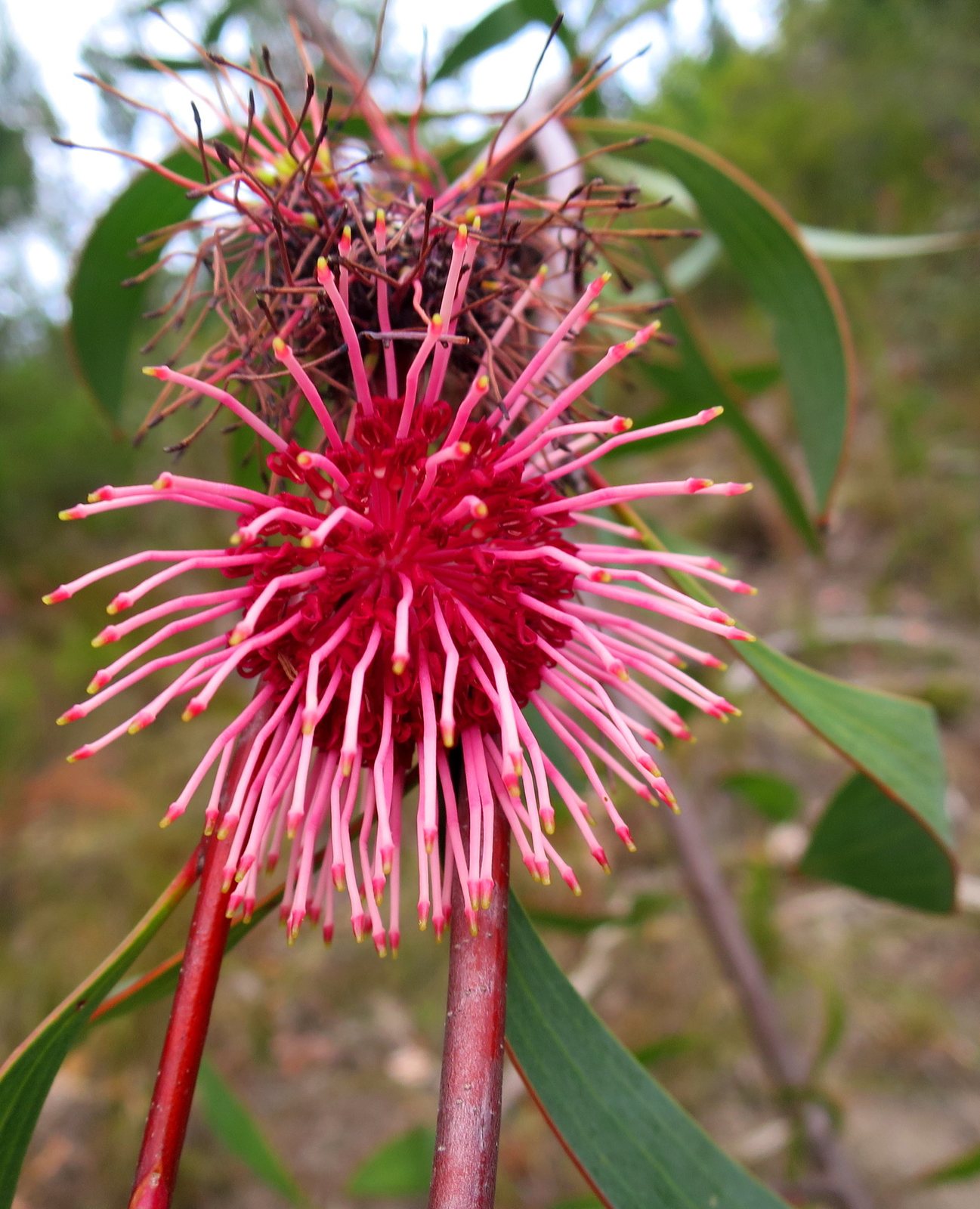
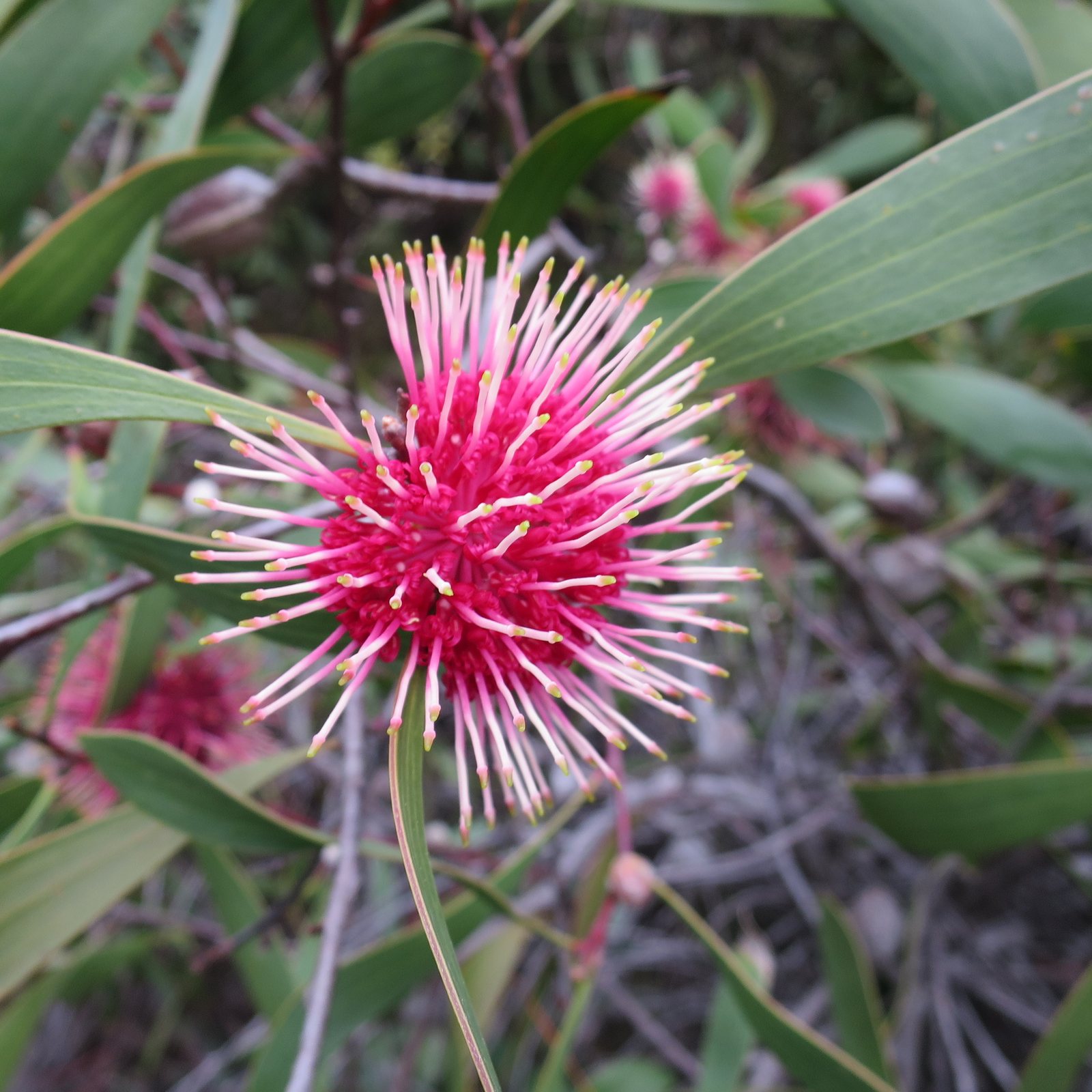
This evergreen shrub or small tree from southwestern Australia has leathery leaves and rounded red flowers studded with long, cream-coloured styles. Grow it as a specimen or loose screen in a sunny, well-drained garden with mild winters; prolonged frost and wet soil are its main limitations.
At a glance
- Sun
- Full sun; tolerates light shade but flowers less freely.
- Water
- Water regularly during establishment, then water deeply during prolonged dry spells. Allow the soil to drain and partly dry between waterings.
- Soil
- Well-drained, low-phosphorus soil, preferably sandy or gravelly and slightly acidic to neutral. Avoid waterlogged ground and heavily enriched planting holes.
- Height
- 10-20 ft (3-6 m)
- Spread
- 10-15 ft (3-4.5 m)
- Flowers
- Rounded rose-red flower heads with projecting cream styles, mainly autumn through winter, sometimes continuing into spring. Typically April-August in Australia; timing varies in the Northern Hemisphere.
- Foliage
- Evergreen, leathery, blue-green to grey-green leaves with conspicuous veins, often hanging downward.
- Growth
- Moderate to fast in suitable conditions.
- Care needed
- Low
The year at a glance
- Pollinators
- Drought tolerant
- Heat tolerant
- Wildlife
- Low allergen
| J | F | M | A | M | J | J | A | S | O | N | D | |
|---|---|---|---|---|---|---|---|---|---|---|---|---|
| Flowers | ||||||||||||
| Fruit | ||||||||||||
| Plant |
Northern hemisphere months. In Australia, shift them by six.
- Difficulty
- Moderate
- Toughness
- Fairly tough
Will it suit your garden?
Pick your zone, country, light and whether you have pets.
Full sun is 6 or more hours of direct sun a day, part shade 3 to 6 hours, shade under 3.
How it grows
Planting day
7 ft (2 m)
After 1 year
7 ft (2.2 m)
After 2 years
8 ft (2.3 m)
After 3 years
8 ft (2.5 m)
After 5 years
9 ft (2.8 m)
About 16 years to full size.
From a typical nursery size, at an average rate for this kind of plant. A rule of thumb, not a forecast.
Good to know
- Cats and dogs
- Safe
- Native to
- Australia
- Growth rate
- Fast
Care
Jobs through the year
- WaterApr–May, Sep–Oct, every 21 days
- Water established ground plants only if dry; water young plants and containers more often.
- WaterJun–Aug, every 14 days
- Water deeply during prolonged drought, allowing partial drying between waterings.
- FeedApr
- Feed only weak growth with a small dose of low-phosphorus native-plant fertiliser.
- MulchMay
- Apply a light mulch, leaving the trunk base clear.
- PruneMar
- After flowering, lightly shorten leafy shoots; avoid bare old wood and freezing conditions.
- ProtectJan–Apr, Oct–Dec
- In zones 6–7, keep in a container under bright, frost-free cover; water sparingly.
- Plant with the root ball undisturbed, keeping its top level with the surrounding soil.
- Water deeply through the first one or two dry seasons; do not keep the root zone constantly wet.
- Avoid manure and general-purpose high-phosphorus fertilisers; use a low-phosphorus native-plant feed only if needed.
- Apply a light mulch, keeping it clear of the trunk.
- Choose a site sheltered from severe frost and strong winds, particularly while the tree is young.
Pruning. Lightly shorten leafy shoots after flowering to encourage branching, starting while the plant is young. Avoid hard cuts into bare old wood, which may not regrow reliably.
Through the year
- Spring
- Plant after the main frost risk has passed in cooler districts; water thoroughly and mulch lightly.
- After flowering
- Lightly trim leafy growth and remove dead or damaged branches.
- Summer
- Check young plants during dry weather and water deeply when the root zone dries.
- Early autumn
- Plant in mild, winter-rainfall districts so roots establish before the next dry season.
- Autumn
- Check drainage before winter rain and keep mulch away from the trunk.
- Winter
- Protect young plants with horticultural fleece during brief frosts; avoid pruning before cold spells.
In the garden
- Use as a small specimen tree where its hanging leaves and unusual flowers can be seen at close range.
- Plant in a loose evergreen screen with other drought-tolerant Australian shrubs.
- Combine with kangaroo paws and mat rushes for contrasting flower shapes and foliage.
- Use in a sunny gravel garden with rock roses and other plants that need sharp drainage.
Garden styles it suits: Australian native, Mediterranean, Dry gravel garden, Wildlife garden, Architectural minimal and Winter interest.
Plant it with: Kangaroo paw, Coastal rosemary, Spiny-headed mat rush, Waxflower, Rock rose and Lavender.
Wildlife: Nectar attracts bees and nectar-feeding birds. In Australia, honeyeaters visit the flowers; established foliage also provides shelter for small birds.
Problems to watch for
- Root rot, including Phytophthora: avoid poorly drained ground and frequent irrigation; badly affected plants may need removal.
- Phosphorus toxicity: avoid high-phosphorus fertilisers and rich manure; use products formulated for phosphorus-sensitive Australian natives.
- Frost damage: provide a warm, sheltered position and protect young plants during cold spells; wait until spring to assess damaged shoots.
- Scale insects: inspect stems and leaves, encourage natural predators and treat persistent infestations with a suitable horticultural oil according to its label.
Safety
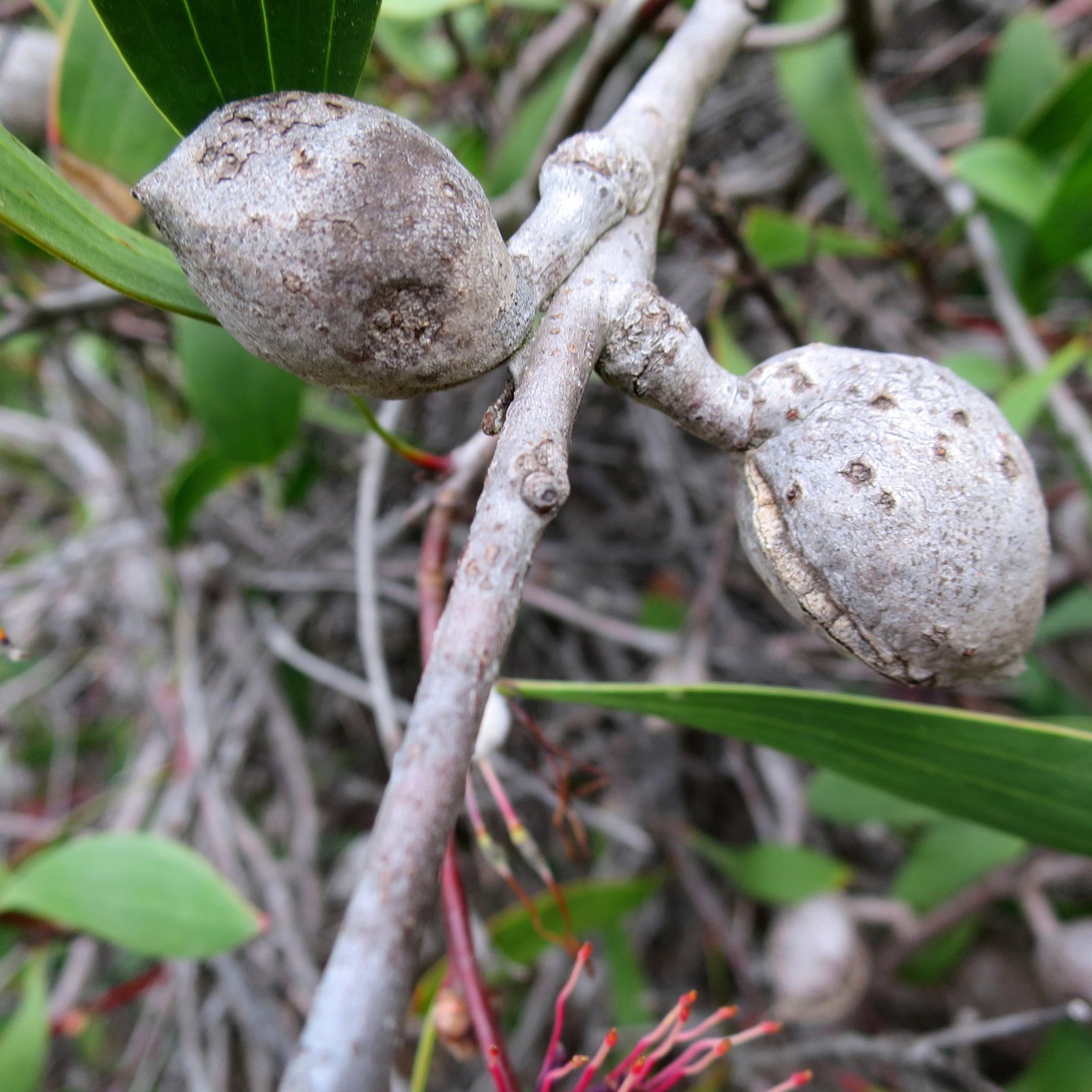
Not known to be toxic to people, cats, dogs or horses, but species-specific safety information is limited. No part is considered food, and the hard, woody fruits can present a chewing or choking hazard.
Easily confused with
Red-flowering hakea (Hakea baxteri)
Its broad, fan-shaped leaves have conspicuous toothed tips, unlike the smooth-edged leaves of pincushion hakea.
Royal hakea (Hakea victoria)
Has broad, prickly, strongly veined leaves, often patterned yellow, orange or red, and much less conspicuous flowers.
Pincushion protea (Leucospermum cordifolium)
Has larger orange, yellow or red flower heads at the shoot tips and usually shorter, broader leaves; hakea flowers sit among the leaves along the stems.
The name
Hakea honours German botanist Christian Ludwig von Hake, laurina means laurel-like in reference to the leaves, and pincushion describes the projecting styles of the flower heads.
Propagation. Usually grown from seed released from mature woody fruits; smoke treatment is not normally necessary. Sow into a free-draining mix and transplant young seedlings carefully before roots become crowded. Semi-ripe cuttings are possible but can be difficult to root.
Checked against open data
- Accepted botanical name
- Hakea laurina
- Native range
- Western Australia.
Sources: GBIF (CC BY 4.0) and Trefle (CC BY 4.0). The care and design notes are LandscapeGPT's own.
See it in your own yard.
Upload a photo of your yard and see it redesigned with plants that suit your climate, each checked against your zone.