Pomegranate
Punica granatum. Family Lythraceae. Shrub.
Also called Granada.
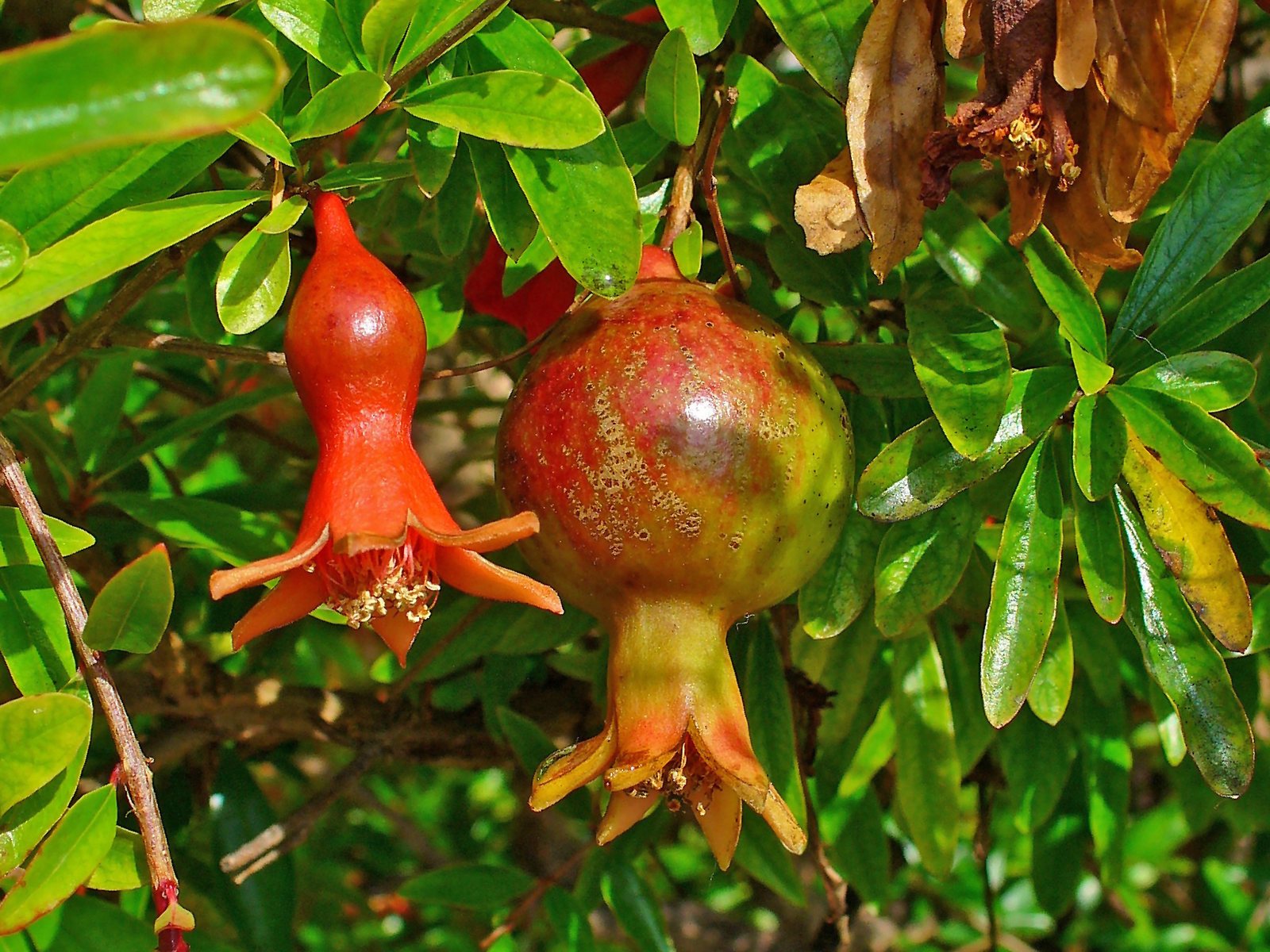
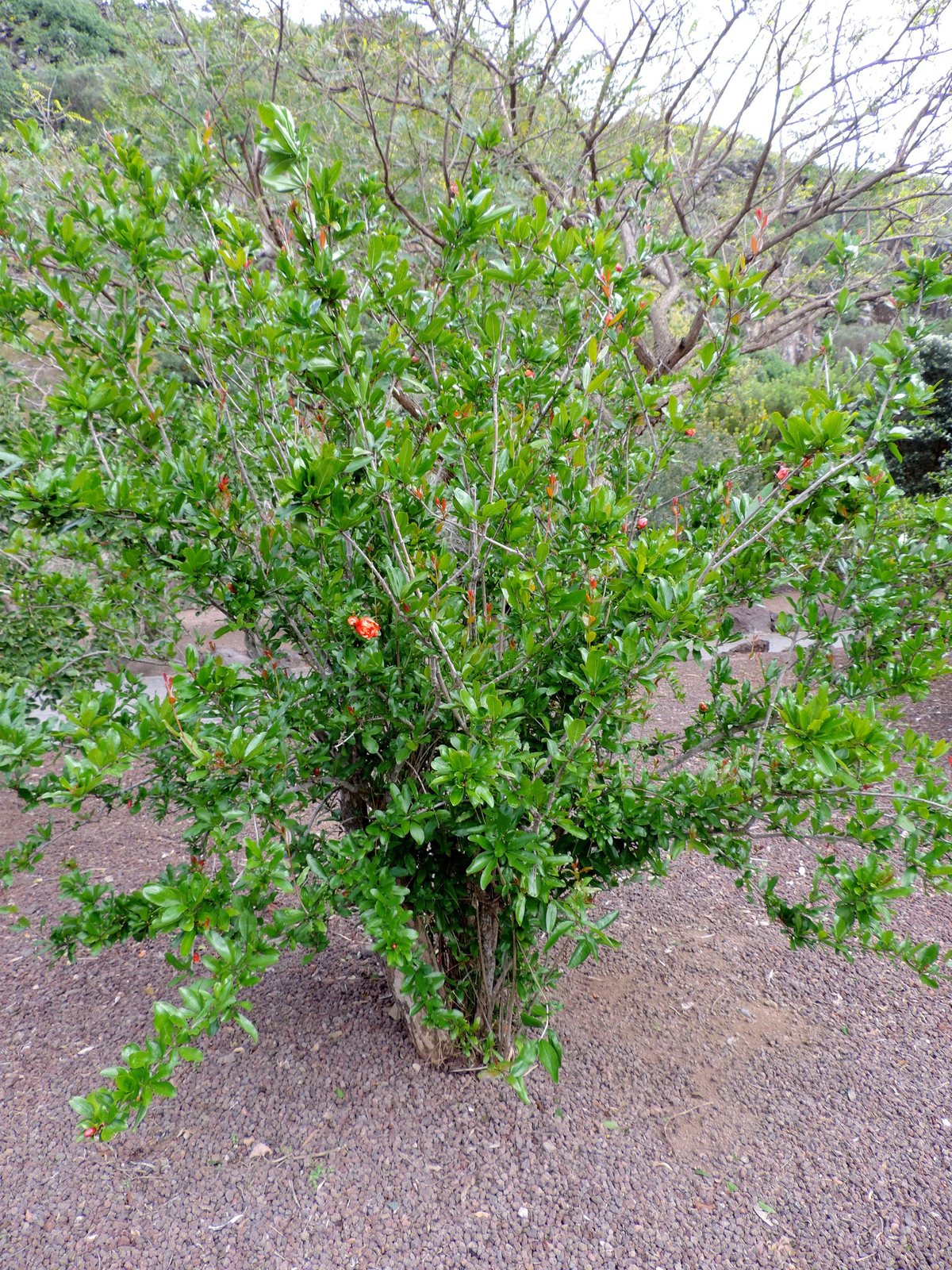
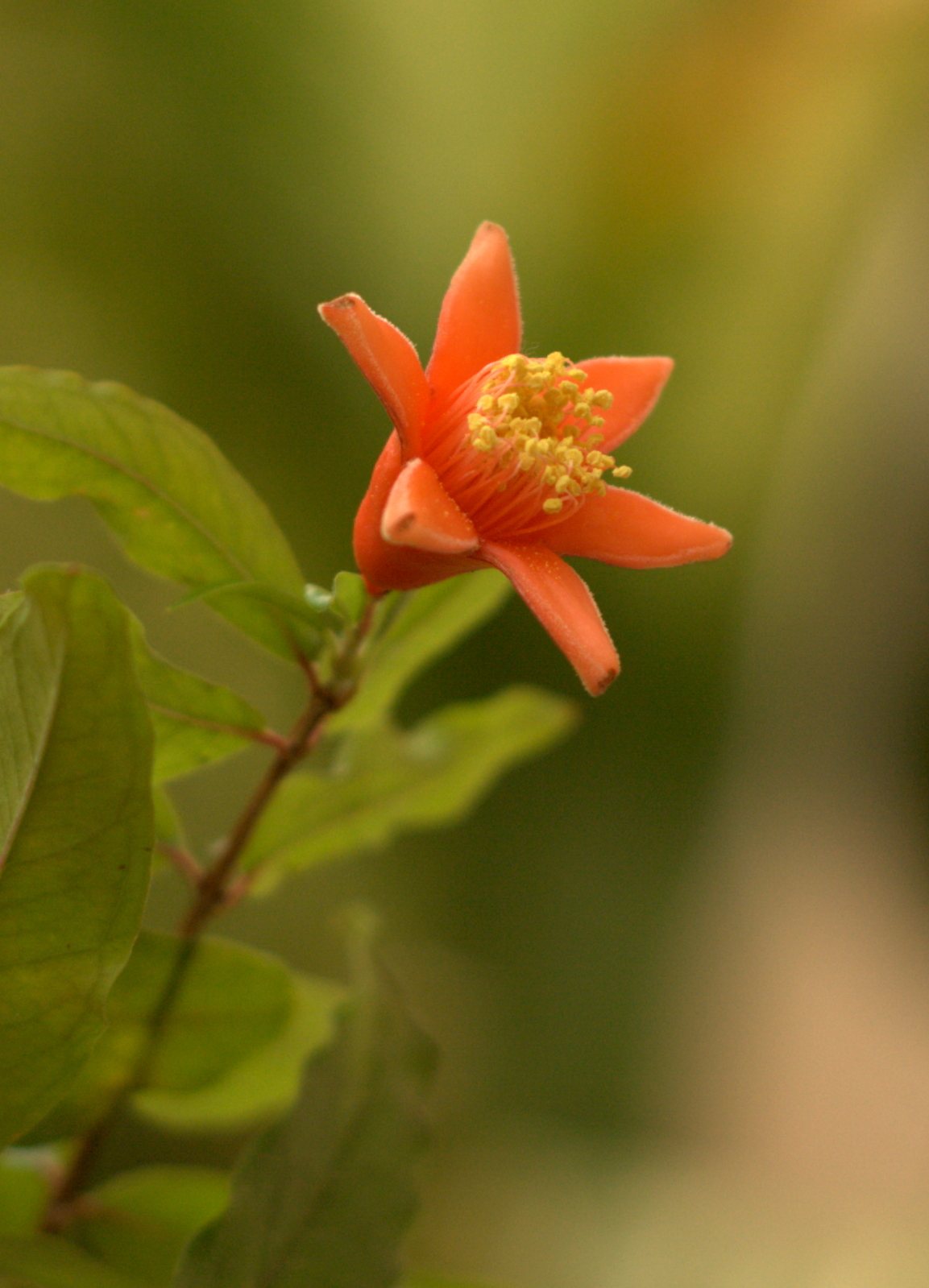
Pomegranate is a deciduous, often thorny shrub or small tree grown for its orange-red flowers and round, leathery fruit filled with juicy seeds. It fruits best where summers are long and hot; in much of the United Kingdom and cooler parts of Canada, it is more dependable as an ornamental or a container plant overwintered under cover.
At a glance
- Sun
- Full sun; choose a warm, sheltered position for reliable flowering and fruit ripening.
- Water
- Drought-tolerant once established, but needs regular, even watering during flowering and fruit development for a worthwhile crop.
- Soil
- Well-drained loam, sand or clay; tolerates alkaline soil but struggles in waterlogged ground.
- Height
- 12-20 ft (3.7-6 m)
- Spread
- 10-15 ft (3-4.6 m)
- Flowers
- Late spring through summer; orange-red flowers with thick, crinkled petals. Some ornamental selections have pink, cream or double flowers.
- Foliage
- Small, narrow, glossy green leaves, often bronze when young and yellow before falling.
- Growth
- Moderate
- Care needed
- Medium
The year at a glance
- Pollinators
- Drought tolerant
- Heat tolerant
- Wildlife
- Low allergen
- Edible
| J | F | M | A | M | J | J | A | S | O | N | D | |
|---|---|---|---|---|---|---|---|---|---|---|---|---|
| Flowers | ||||||||||||
| Fruit | ||||||||||||
| Plant |
Northern hemisphere months. In Australia, shift them by six.
- Difficulty
- Hard
- Toughness
- Fairly tough
Will it suit your garden?
Pick your zone, country, light and whether you have pets.
Full sun is 6 or more hours of direct sun a day, part shade 3 to 6 hours, shade under 3.
How it grows
Planting day
1.9 ft (0.58 m)
After 1 year
5 ft (1.4 m)
After 2 years
8 ft (2.3 m)
After 3 years
10 ft (3.1 m)
After 5 years
16 ft (4.9 m)
full size
About 5 years to full size.
From a typical nursery size, at an average rate for this kind of plant. A rule of thumb, not a forecast.
Good to know
- Cats and dogs
- Toxic
- Growth rate
- Moderate
Care
Jobs through the year
- WaterApr–May, Sep–Oct, every 14 days
- Check established plants and water deeply if dry; young plants and pots need more frequent checks.
- WaterJun–Aug, every 7 days
- Water deeply as needed to maintain even moisture during flowering and fruit development; avoid sudden soaking after drought.
- WaterJan–Mar, Nov–Dec, every 21 days
- Check overwintering pots and water sparingly if compost is drying; do not leave roots saturated.
- FeedApr
- Apply a light balanced feed only if growth is weak; avoid excess nitrogen.
- MulchApr–May
- Refresh organic mulch over the roots, leaving stems clear.
- PruneFeb–Mar
- Remove dead, damaged and crossing branches, preserving the main framework and fruiting wood.
- PruneMay–Aug, every 30 days
- Remove unwanted basal suckers without heavily shortening fruiting shoots.
- ProtectJan–Apr, Oct–Dec
- Not reliably hardy in zones 6–7; overwinter in a container in cool, frost-free shelter.
- HarvestSep–Nov, every 7 days
- Cut fully ripe fruit before splitting or frost; cool summers may prevent ripening, and picked fruit will not ripen further.
- Water deeply during the first two growing seasons, letting the soil surface dry between waterings.
- Keep moisture reasonably even as fruit develops; drought followed by heavy watering can split the skins.
- Apply a light dressing of balanced fertilizer in spring if growth is weak; avoid heavy nitrogen feeding.
- Mulch the root area, leaving a clear gap around the stems.
- Grow container plants in free-draining compost and move them to a cool, frost-protected place before severe winter cold.
Pruning. In late winter or early spring, remove dead, damaged and crossing branches, retaining a framework of several main stems or one trunk. Keep routine pruning light to preserve fruiting wood, and remove unwanted basal suckers during the growing season.
Harvest
Pick ripe pomegranates in autumn, usually September–November in the US, UK and Canada, and March–May in Australia; fruit may not ripen outdoors in cool UK and Canadian gardens. Harvest full-sized fruit with the variety’s mature skin colour and slightly flattened, angular sides; cut the stalk with secateurs before fruit splits or frost arrives, as pomegranates do not ripen after picking.
Through the year
- Late winter
- Prune lightly before growth begins and check container plants for dry compost.
- Spring
- Plant after severe frost has passed; refresh mulch and feed lightly if needed.
- Late spring
- Move overwintered containers outdoors gradually once frost risk has passed.
- Summer
- Water evenly during flowering and fruit development, and remove unwanted suckers.
- Autumn
- Cut ripe fruit from the branches when fully coloured for the variety; fruit does not ripen further after picking.
- Late autumn
- Move containers under cover in cold regions before hard freezes.
In the garden
- Train as a small courtyard tree, allowing room for its spreading crown and keeping thorny branches away from paths.
- Use against a sunny, sheltered wall to improve warmth and fruit ripening in cooler climates.
- Combine with lavender, rosemary and sage in a Mediterranean planting with well-drained soil.
- Include in an edible landscape or informal fruiting hedge where its flowers and autumn fruit remain visible.
Garden styles it suits: Mediterranean, Modern courtyard, Edible landscape, Backyard orchard, Persian (chahar bagh) and Moroccan.
Plant it with: Lavender, Rosemary, Common sage, Thyme, Catmint and Yarrow.
Wildlife: Flowers attract bees and other nectar-feeding insects. Birds and small mammals may eat split fruit.
Problems to watch for
- Fruit splitting: maintain even soil moisture, mulch and harvest ripe fruit promptly; heavy rain after drought can still cause losses.
- Poor fruiting: provide maximum sun and summer warmth, avoid excessive nitrogen and heavy pruning, and check that the plant is a fruiting rather than double-flowered ornamental selection.
- Aphids and scale insects: inspect young shoots and stems; wash off aphids and treat persistent infestations with a labelled horticultural soap or oil, avoiding hot weather.
- Fruit rot: remove damaged and rotting fruit, clear fallen fruit and thin crowded branches to improve airflow.
Safety
Ripe arils and seeds are edible and are not known to be toxic to people, cats, dogs or horses, though large amounts may cause digestive upset. Roots and bark contain potentially poisonous alkaloids and should not be eaten or used in homemade remedies. The rind is not intended as food and can cause digestive upset; toxicity information for other parts in pets and horses is limited.
Easily confused with
Flowering quince (Chaenomeles speciosa)
Also thorny with red flowers, but usually flowers on bare wood in early spring and has broader, toothed leaves; its fruit resembles a small apple rather than a crowned pomegranate.
Crape myrtle (Lagerstroemia indica)
Has similarly small leaves and crinkled flowers, but flowers occur in large terminal clusters and its small, dry seed capsules lack the pomegranate's fleshy fruit and prominent crown.
The name
Punica refers to ancient Carthage, while granatum means seeded or grain-filled; pomegranate comes from words meaning seeded apple.
Propagation. Take hardwood cuttings during dormancy or semi-ripe cuttings in summer. Rooted suckers can also be separated. Seed-grown plants vary in fruit quality and may take several years to crop; cuttings preserve the parent plant's characteristics.
Checked against open data
- Accepted botanical name
- Punica granatum
- In the US and Canada
- Introduced in the lower 48 states, Pacific Basin, Puerto Rico and US Virgin Islands.
- Native range
- Afghanistan, Iran, Iraq, North Caucasus, Pakistan, Tadzhikistan, Transcaucasus, Turkey and Turkmenistan.
- Measured
- Soil pH 6 to 6.9. Average height 610 cm.
Sources: GBIF (CC BY 4.0), USDA PLANTS and Trefle (CC BY 4.0). The care and design notes are LandscapeGPT's own.
See it in your own yard.
Upload a photo of your yard and see it redesigned with plants that suit your climate, each checked against your zone.