Purple beautyberry
Callicarpa dichotoma. Family Lamiaceae. Shrub.
Also called Beautyberry, Early amethyst beautyberry.
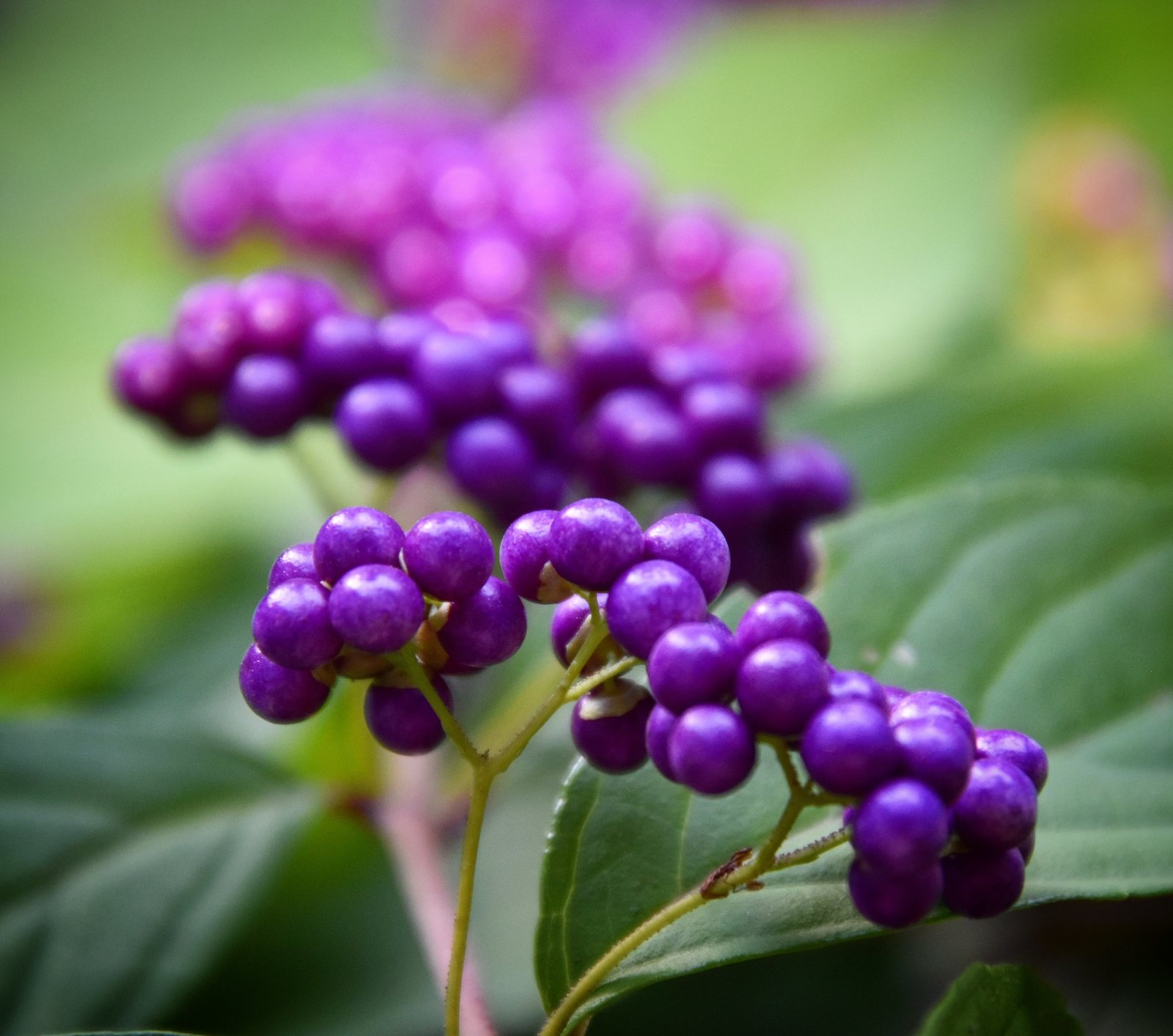
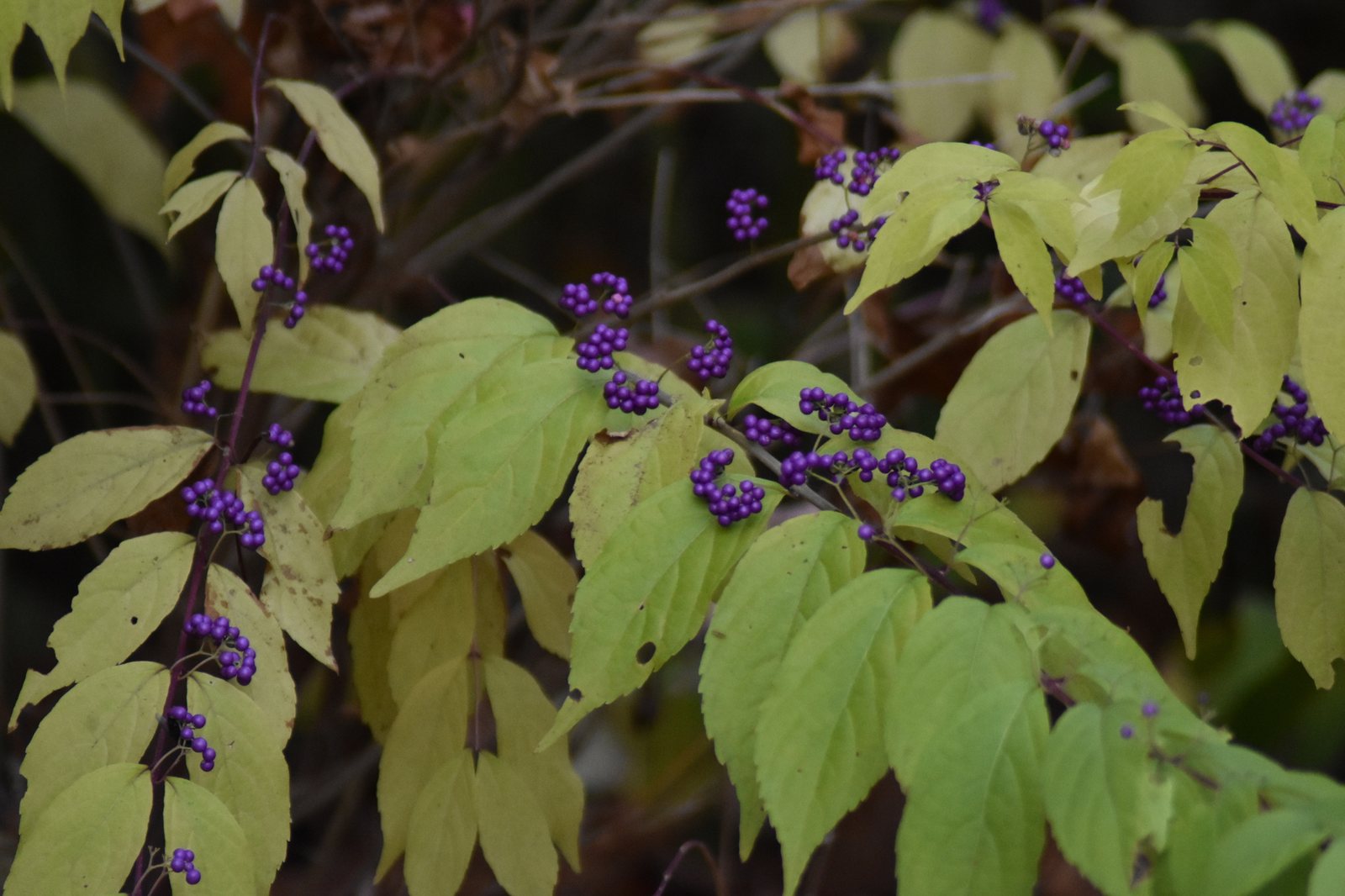
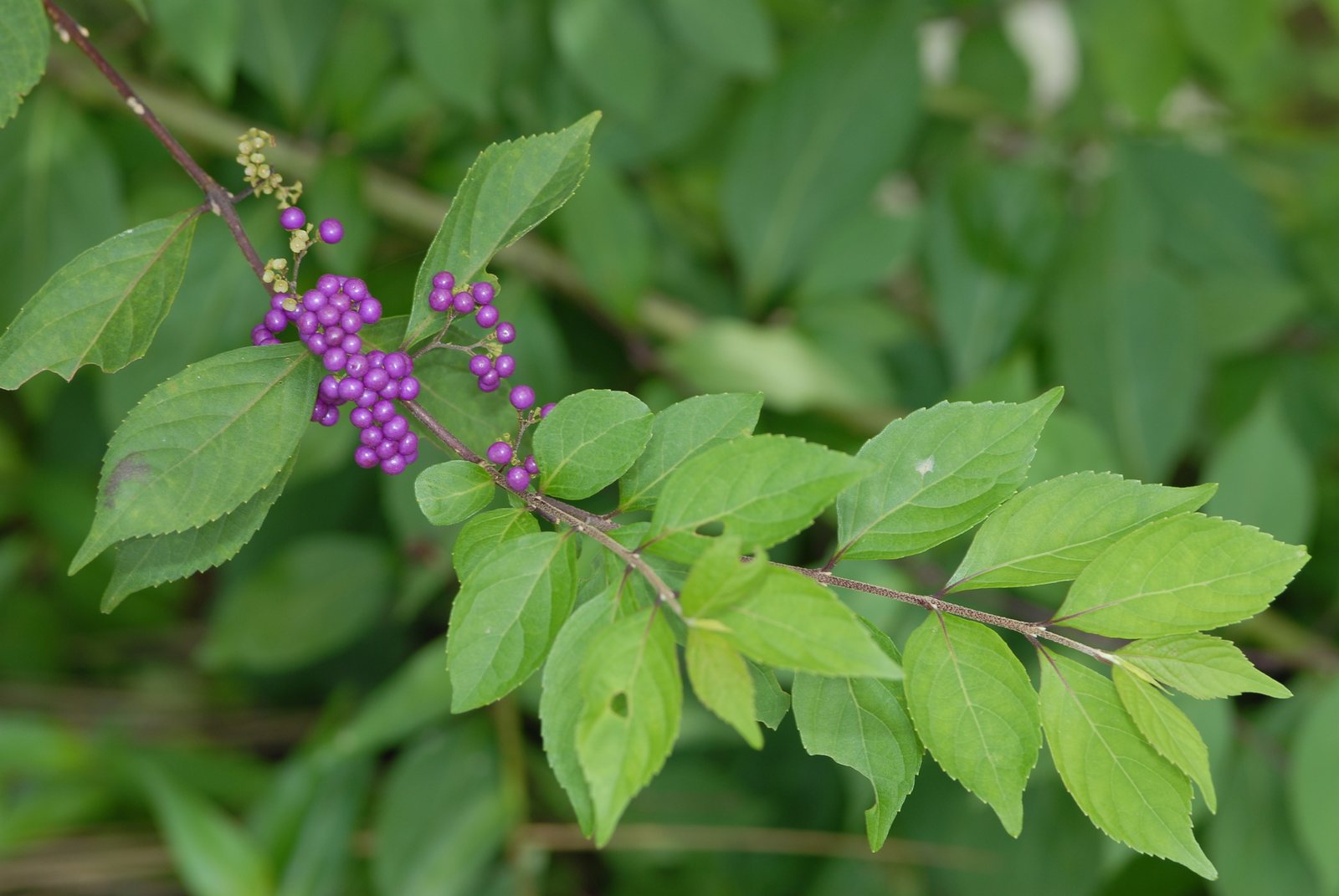
Purple beautyberry is a deciduous shrub with slender, arching branches and clusters of glossy violet-purple berries in autumn. Gardeners grow it mainly for the fruit, which becomes especially conspicuous as the leaves fall and may remain into early winter.
At a glance
- Sun
- Full sun to partial shade; flowering and berry production are usually best with at least six hours of direct sun.
- Water
- Moderate; keep newly planted shrubs evenly moist. Established plants tolerate brief dry spells, but prolonged drought reduces fruit quality.
- Soil
- Well-drained soil with moderate fertility; tolerates clay, loam and sandy soil provided it does not remain waterlogged.
- Height
- 3-4 ft (0.9-1.2 m)
- Spread
- 3-5 ft (0.9-1.5 m)
- Flowers
- Small pale pink to lavender flowers in clusters along the stems in summer.
- Foliage
- Opposite, pointed green leaves with toothed edges; autumn colour is often pale yellow but can be unremarkable.
- Growth
- Moderate to fast
- Care needed
- Low
The year at a glance
- Pollinators
- Wildlife
- Low allergen
| J | F | M | A | M | J | J | A | S | O | N | D | |
|---|---|---|---|---|---|---|---|---|---|---|---|---|
| Flowers | ||||||||||||
| Fruit | ||||||||||||
| Plant |
Northern hemisphere months. In Australia, shift them by six.
- Difficulty
- Easy
- Toughness
- Fairly tough
Will it suit your garden?
Pick your zone, country, light and whether you have pets.
Full sun is 6 or more hours of direct sun a day, part shade 3 to 6 hours, shade under 3.
How it grows
Planting day
1.6 ft (0.5 m)
After 1 year
2.1 ft (0.64 m)
After 2 years
2.5 ft (0.78 m)
After 3 years
3 ft (0.91 m)
After 5 years
3 ft (1.1 m)
full size
About 4 years to full size.
From a typical nursery size, at an average rate for this kind of plant. A rule of thumb, not a forecast.
Good to know
- Cats and dogs
- Mildly toxic: may upset a stomach
- Growth rate
- Fast
Care
Jobs through the year
- WaterApr–May, Sep–Oct, every 14 days
- Water established shrubs if the root zone is dry; keep newly planted shrubs evenly moist.
- WaterJun–Aug, every 7 days
- During dry spells, water established shrubs deeply to support flowers and developing berries.
- FeedApr
- Top-dress lightly with compost; avoid heavy nitrogen feeding.
- PruneMar
- Remove dead wood and shorten stems selectively before growth; cut back hard only if needed.
- MulchApr
- Apply 5–8 cm of organic mulch, keeping it clear of stems.
- ProtectNov
- Check that mulch covers young plants' root zones without burying their crowns.
- Water deeply during dry weather in the first growing season.
- Apply a 2-3 in (5-8 cm) mulch layer, keeping it clear of the stems.
- Add compost in spring; avoid heavy nitrogen feeding, which encourages leafy growth at the expense of flowers and fruit.
- Leave enough room for the branches to arch naturally rather than repeatedly clipping them.
- Plant more than one shrub nearby if space allows; cross-pollination can improve berry production.
Pruning. Prune in late winter or early spring before growth begins, removing dead wood and shortening stems to maintain an open, arching shape. Flowers and fruit form on new growth, so winter-damaged plants can be cut back hard, although routine hard pruning is not essential.
Through the year
- Late winter
- Remove dead or damaged stems and prune for shape before new growth starts.
- Spring
- Plant into workable soil, water thoroughly and apply mulch.
- Late spring
- Check for winter dieback and remove any stems that have failed to leaf out.
- Summer
- Water during prolonged dry spells, particularly while flowers and young fruit are developing.
- Autumn
- Leave the fruiting branches intact for display and birds; remove unwanted seedlings.
- Early winter
- Check mulch around young plants, keeping it away from the crown.
In the garden
- Plant in small groups along a shrub border for a stronger autumn berry display.
- Place against dark evergreen foliage so the purple fruit stands out.
- Combine with ornamental grasses and autumn-flowering perennials for late-season interest.
- Use beside a path or seating area where the small fruit clusters can be seen close up.
Garden styles it suits: Woodland, Cottage garden, Autumn colour, Japanese, Wildlife garden and Low-maintenance.
Plant it with: Oakleaf hydrangea, Japanese forest grass, Switchgrass, Autumn fern, Hardy chrysanthemum and New England aster.
Wildlife: The flowers attract bees and other small pollinating insects. Birds eat the berries, often later in the season, and can disperse the seeds.
Problems to watch for
- Poor berry production: provide more sun, avoid excessive nitrogen and do not prune after spring growth is underway.
- Winter stem dieback: wait until spring growth reveals the damage, then cut back to healthy wood; protect the root zone with mulch.
- Root rot in saturated soil: improve drainage or move the shrub to a better-drained site.
- Leaf spots: remove fallen affected leaves, improve air circulation and water the soil rather than wetting the foliage.
Safety
Not known to be toxic to people, cats, dogs or horses, although species-specific safety information is limited. The berries are ornamental rather than a recommended food; discourage children and pets from eating them, as large amounts may cause stomach upset.
Where it spreads. Can self-seed and has escaped cultivation in parts of the southeastern United States. Check local invasive-plant guidance before planting near natural areas, and remove unwanted seedlings.
Easily confused with
American beautyberry (Callicarpa americana)
Usually has larger, coarser leaves and dense berry clusters that hug and encircle the stems; purple beautyberry has smaller leaves and fruit clusters on short stalks.
Bodinier's beautyberry (Callicarpa bodinieri)
Usually grows taller and more upright, with larger leaves and fruit concentrated in conspicuous clusters along sturdier branches.
Japanese beautyberry (Callicarpa japonica)
Typically has larger leaves with teeth extending farther down their margins; purple beautyberry usually has leaves toothed mainly in the upper half.
The name
Callicarpa comes from Greek words meaning beautiful fruit, while dichotoma refers to the plant's forked branching.
Propagation. Take softwood cuttings in late spring or early summer, or semi-ripe cuttings later in summer. Seed can also be sown, but seedlings may vary and named cultivars should be propagated by cuttings.
Checked against open data
- Accepted botanical name
- Callicarpa dichotoma
- In the US and Canada
- Introduced in the lower 48 states.
- Native range
- China North-Central, China South-Central, China Southeast, Japan, Korea, Nansei-shoto and Vietnam.
- Measured
- Average height 225 cm.
Sources: GBIF (CC BY 4.0), USDA PLANTS and Trefle (CC BY 4.0). The care and design notes are LandscapeGPT's own.
See it in your own yard.
Upload a photo of your yard and see it redesigned with plants that suit your climate, each checked against your zone.