Purple coral pea
Hardenbergia violacea. Family Fabaceae. Climber.
Also called False sarsaparilla, Happy wanderer, Native lilac.
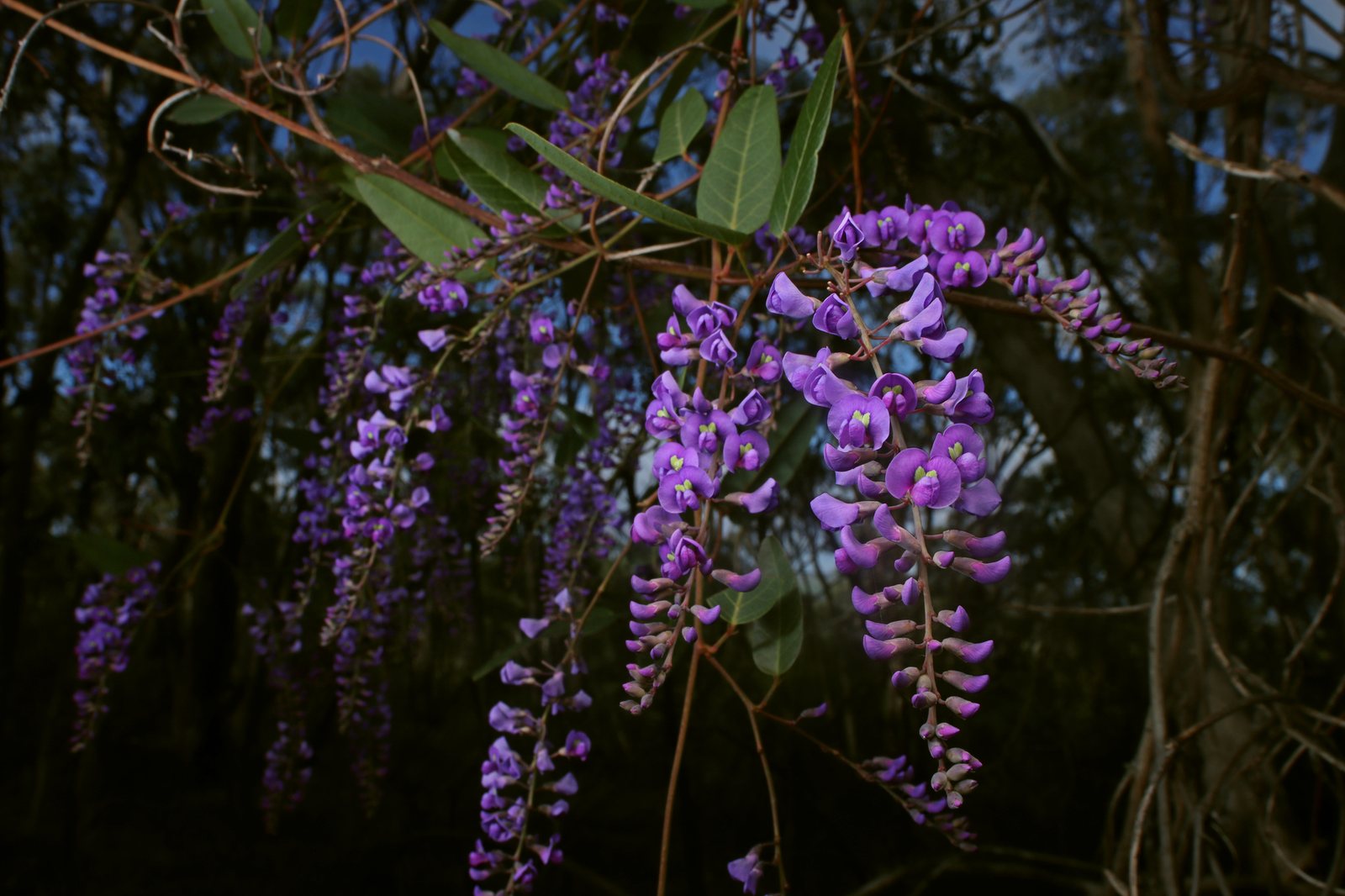
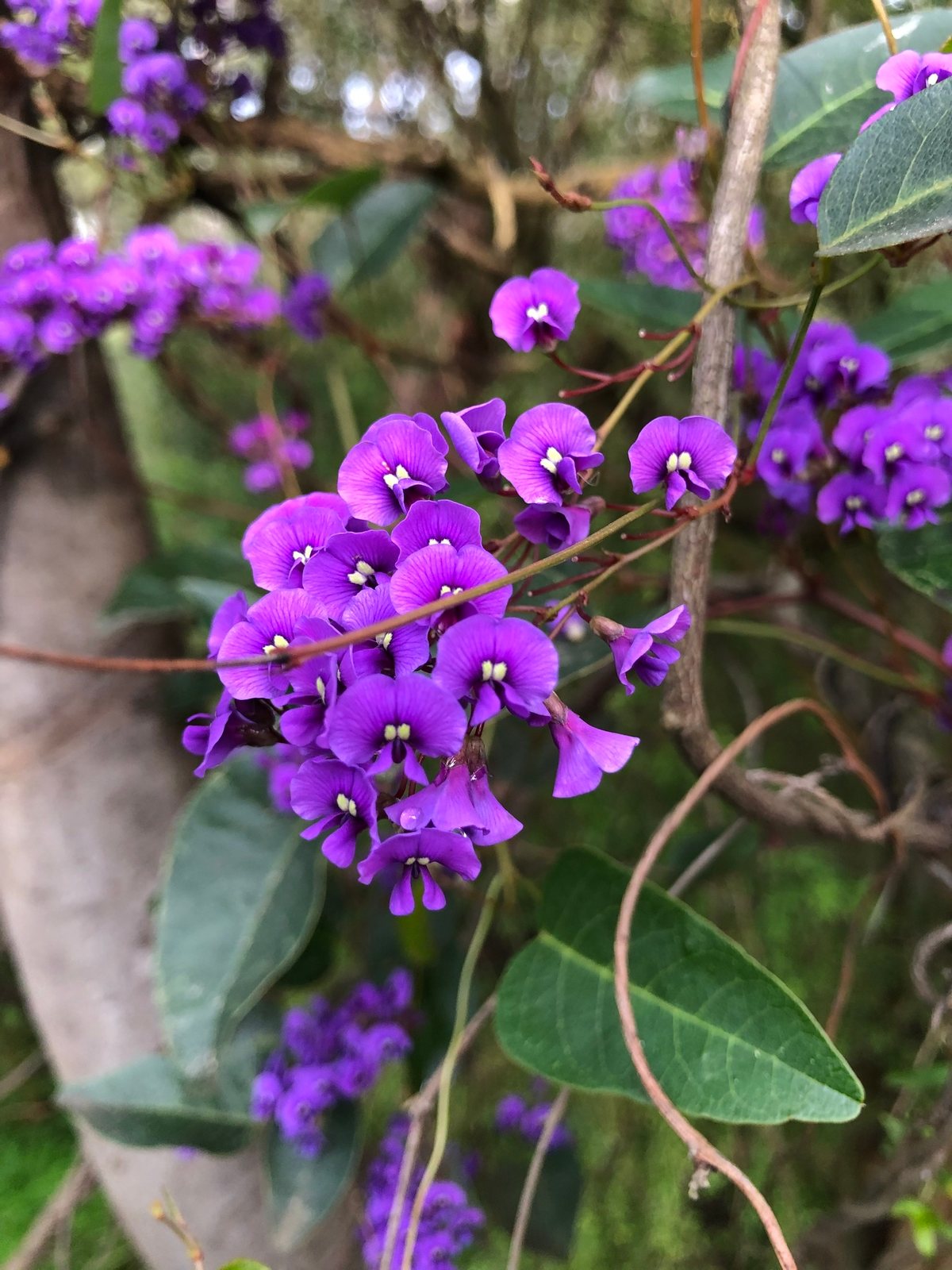
Purple coral pea is an evergreen Australian climber with leathery leaves and sprays of small purple pea flowers in late winter and spring. Grow it on a trellis or fence, or let it trail over a bank; it needs freely draining soil and shelter from hard frost. In colder parts of the United States, Canada and the United Kingdom, grow it in a container that can overwinter under cover.
At a glance
- Sun
- Full sun to partial shade; flowering is usually strongest in sun. Give it some afternoon shade in very hot inland gardens.
- Water
- Water regularly during establishment, allowing the surface soil to dry between waterings. Established plants tolerate dry spells, but container plants need more frequent watering.
- Soil
- Well-drained sandy or loamy soil, preferably slightly acidic to neutral. Avoid waterlogged ground and heavy soil that stays wet in winter.
- Height
- 6-10 ft (1.8-3 m) with support
- Spread
- 6-10 ft (1.8-3 m), depending on support and pruning
- Flowers
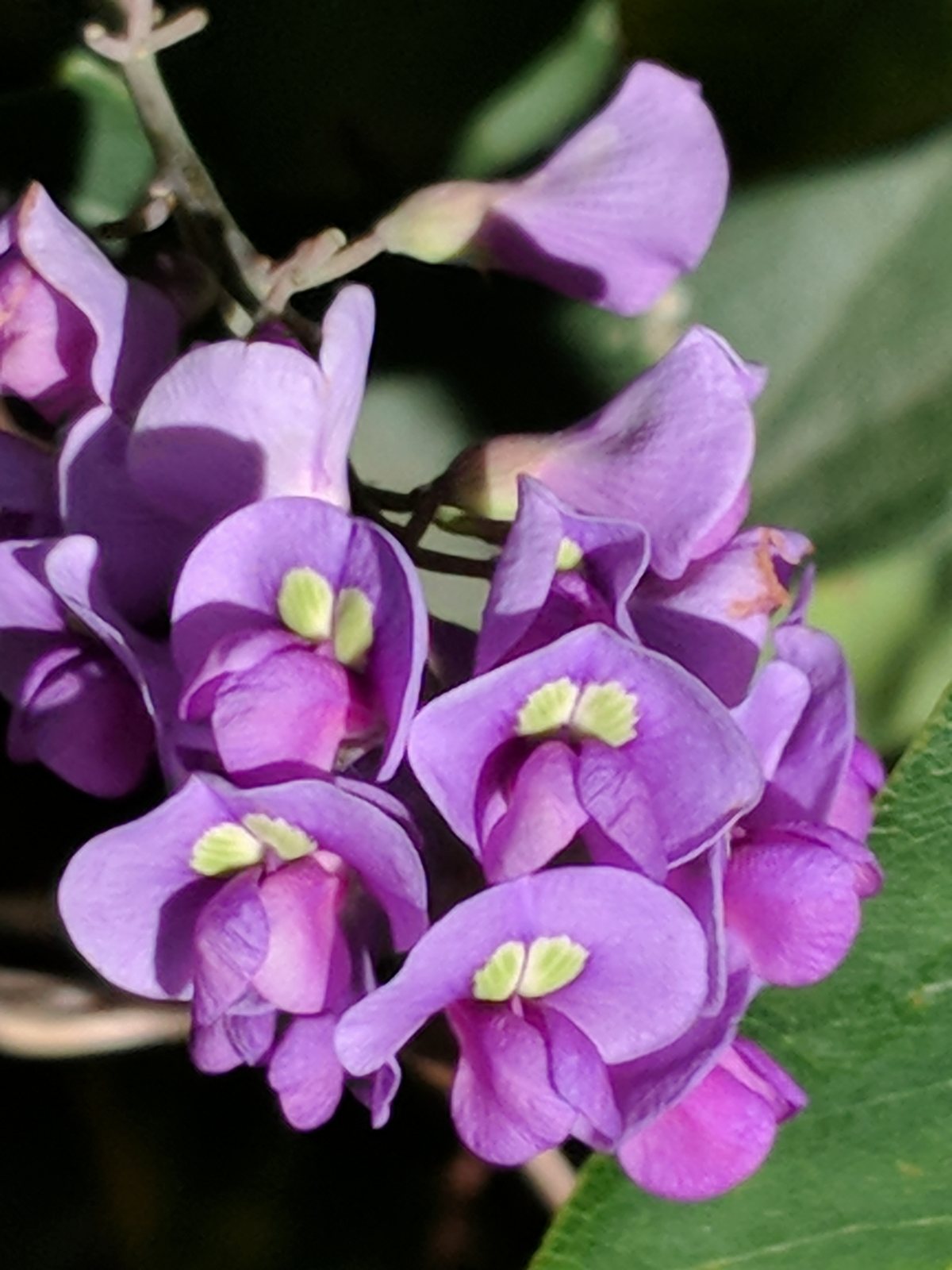
- Late winter to spring; usually violet-purple with a pale greenish-yellow mark on the upper petal. White and pink forms also occur.
- Foliage
- Evergreen. Dark green, leathery, narrowly oval to lance-shaped leaves with conspicuous veins.
- Growth
- Fast in mild conditions once established.
- Care needed
- Low
The year at a glance
- Pollinators
- Drought tolerant
- Heat tolerant
- Wildlife
- Low allergen
| J | F | M | A | M | J | J | A | S | O | N | D | |
|---|---|---|---|---|---|---|---|---|---|---|---|---|
| Flowers | ||||||||||||
| Plant |
Northern hemisphere months. In Australia, shift them by six.
- Difficulty
- Moderate
- Toughness
- Fairly tough
Will it suit your garden?
Pick your zone, country, light and whether you have pets.
Full sun is 6 or more hours of direct sun a day, part shade 3 to 6 hours, shade under 3.
How it grows
Planting day
2 ft (0.6 m)
After 1 year
3 ft (1.1 m)
After 2 years
5 ft (1.5 m)
After 3 years
6 ft (1.8 m)
full size
About 3 years to full size.
From a typical nursery size, at an average rate for this kind of plant. A rule of thumb, not a forecast.
Good to know
- Cats and dogs
- Safe
- Native to
- Australia
- Growth rate
- Fast
Care
Jobs through the year
- WaterApr–May, Sep–Oct, every 14 days
- Water established plants only if dry; let the surface dry between waterings.
- WaterJun–Aug, every 14 days
- Deeply water established roots during prolonged drought; young plants and containers need more.
- WaterJan–Mar, Nov–Dec, every 14 days
- In frost-free shelter, water containers lightly when the surface dries; avoid waterlogging.
- FeedApr–May
- Feed lightly with low-phosphorus fertiliser only if growth is weak.
- MulchApr–May
- Mulch the root area, leaving the main stems clear.
- PruneApr–May
- Immediately after flowering, shorten long shoots without cutting into bare old wood.
- ProtectJan–Apr, Sep–Dec
- Overwinter in bright, cool, frost-free shelter; return outdoors after frost risk passes.
- Provide a trellis, wires or an open fence, and tie young stems in until they begin twining.
- Water deeply during the first growing season; thereafter water during prolonged dry spells.
- Apply a light dressing of low-phosphorus fertiliser in spring only if growth is weak.
- Mulch the root area, keeping mulch clear of the main stems.
- Use a free-draining potting mix in containers and move plants into bright, cool, frost-free shelter before hard frosts.
Pruning. Prune immediately after flowering, shortening long shoots and lightly trimming the plant to encourage branching. Avoid cutting hard into old, bare stems, which may not regrow reliably.
Through the year
- Late winter
- Enjoy the first flowers and protect container plants from freezing weather.
- Spring
- Plant after the risk of hard frost has passed, water thoroughly and provide climbing support.
- Late spring
- After flowering, shorten long shoots and guide new growth along its support.
- Summer
- Water new plants during dry weather and check container plants frequently.
- Late summer
- Take semi-ripe cuttings from healthy, non-flowering shoots.
- Autumn
- Reduce watering as growth slows and move containers under cover where winters are too cold.
In the garden
- Train over a sunny fence or trellis for evergreen cover and early-season flowers.
- Let it cascade over a retaining wall or spread across a well-drained bank.
- Combine with lomandra and westringia in a drought-tolerant Australian planting.
- Grow in a large courtyard container with an obelisk, allowing room to move it under cover in cold climates.
Garden styles it suits: Australian native, Mediterranean, Modern courtyard, Low-maintenance, Dry gravel garden and Winter interest.
Plant it with: Coastal rosemary, Lomandra, Flax lily, Kangaroo paw, Lavender and Rosemary.
Wildlife: The flowers attract bees, including native Australian bees. Dense growth can provide shelter for small garden animals.
Problems to watch for
- Root rot in wet soil: improve drainage, avoid standing water in saucers and let the surface soil dry between waterings.
- Frost damage: choose a sheltered position, cover young plants during brief frosts and overwinter containers under cover in colder regions.
- Aphids on soft shoots: wash them off with water; use insecticidal soap if infestations persist, following the label.
- Sparse growth or a bare base: provide good light and trim lightly after flowering rather than relying on severe renovation pruning.
Safety
Not known to be toxic to people, cats, dogs or horses, but species-specific poisoning information is limited. No part should be treated as food; discourage pets and children from eating the leaves, flowers or seed pods.
Easily confused with
Native wisteria (Hardenbergia comptoniana)
It has leaves divided into three leaflets; purple coral pea has simple, undivided leaves.
Dusky coral pea (Kennedia rubicunda)
It has three leaflets per leaf and much larger, dusky red pea flowers rather than sprays of small purple flowers.
The name
Hardenbergia honours Countess Franziska von Hardenberg, while violacea means violet-coloured, referring to the flowers.
Propagation. Take semi-ripe cuttings in late summer and root them in a freely draining propagation mix. For seed, carefully nick the hard seed coat and soak overnight before sowing in warmth; seedlings may differ from named cultivars.
Checked against open data
- Accepted botanical name
- Hardenbergia violacea
- Native range
- New South Wales, Queensland, South Australia, Tasmania and Victoria.
- Measured
- Average height 125 cm.
Sources: GBIF (CC BY 4.0) and Trefle (CC BY 4.0). The care and design notes are LandscapeGPT's own.
See it in your own yard.
Upload a photo of your yard and see it redesigned with plants that suit your climate, each checked against your zone.