Red flowering gum
Corymbia ficifolia. Family Myrtaceae. Tree.
Also called Scarlet flowering gum, Eucalyptus ficifolia.
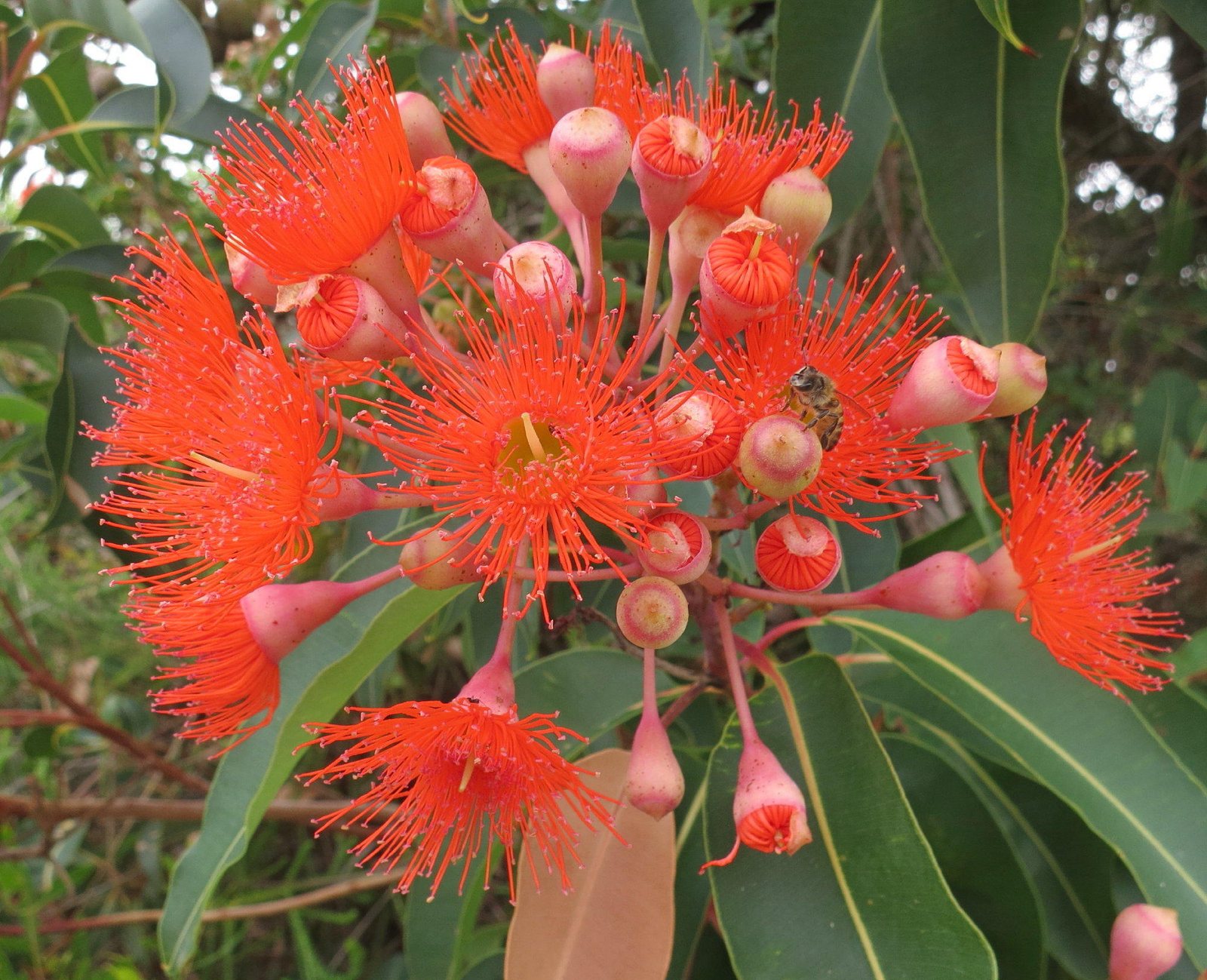
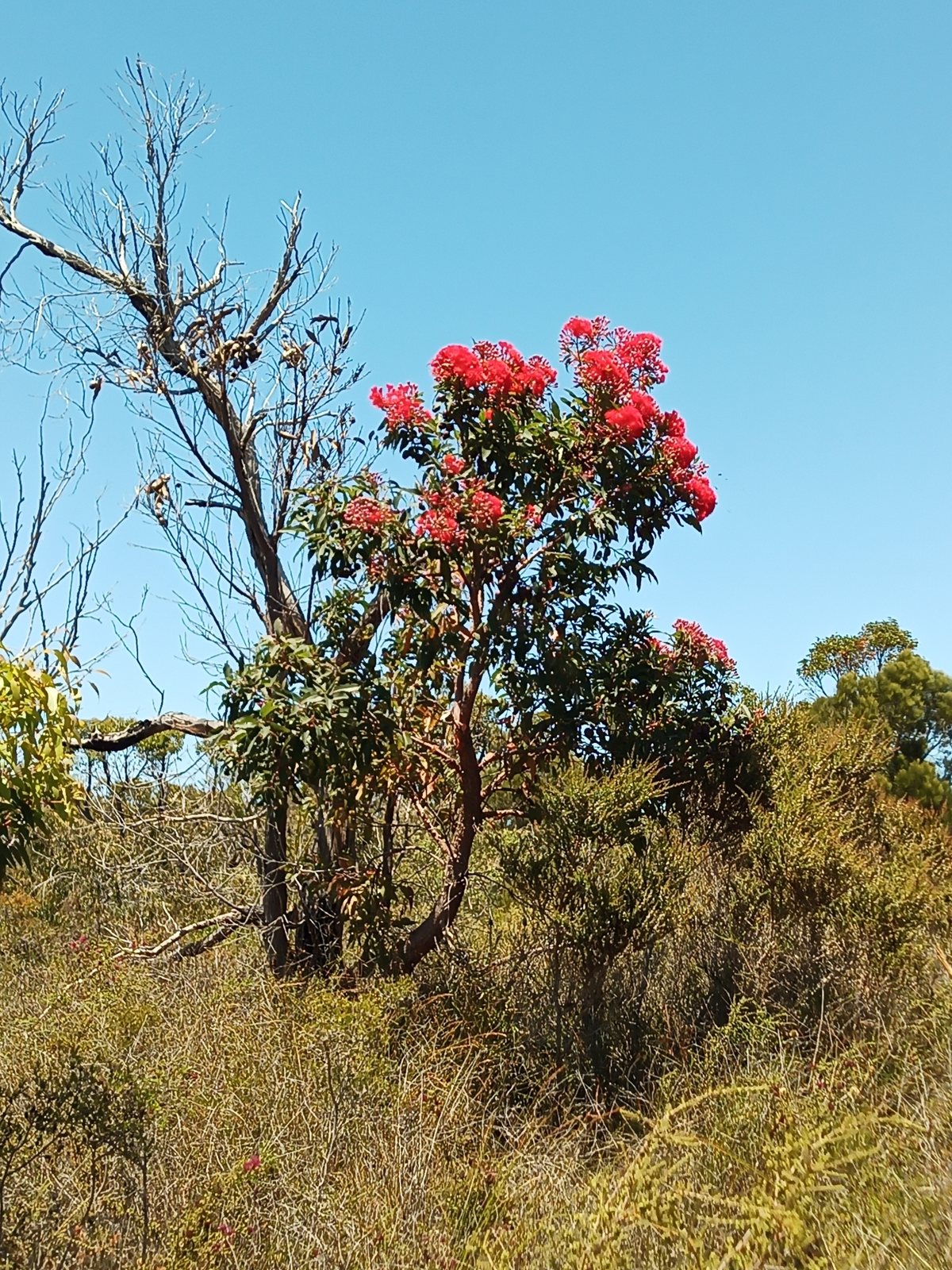
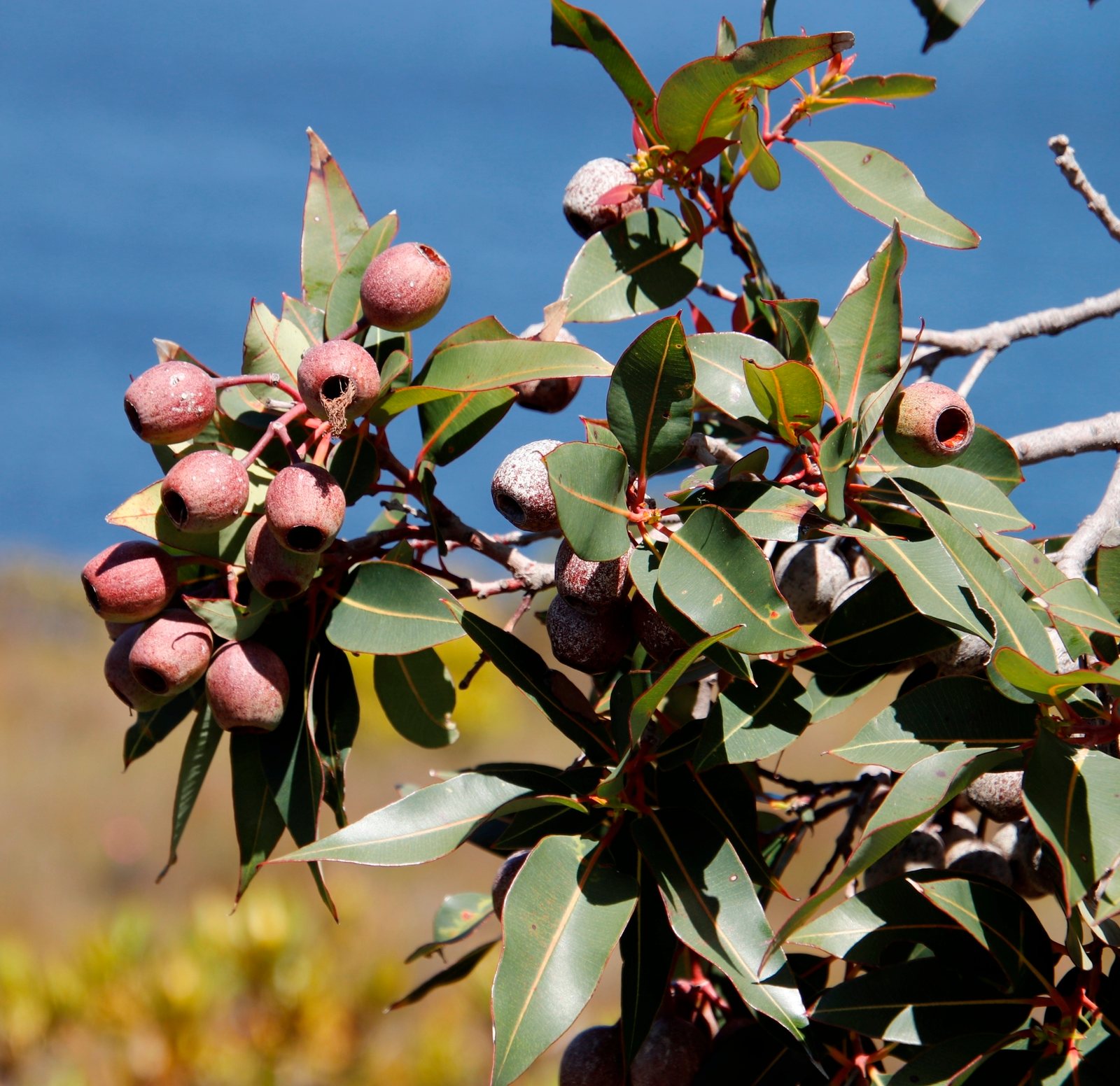
An evergreen tree from southwestern Australia, red flowering gum forms a rounded crown and carries large clusters of showy flowers followed by woody seed capsules. Gardeners grow it for summer colour, shade and nectar-feeding wildlife; it needs a warm climate with little frost, so outdoor growing is generally unsuitable in Canada and most of the United Kingdom. Seed-grown trees vary in flower colour and size, while named grafted selections are more predictable.
At a glance
- Sun
- Full sun, with shelter from cold winds.
- Water
- Water deeply during establishment, allowing the surface soil to dry between waterings. Established trees tolerate seasonal drought but benefit from occasional deep watering during prolonged hot, dry weather.
- Soil
- Well-drained sandy or loamy soil, preferably slightly acidic to neutral. Avoid waterlogged ground and poorly drained heavy clay.
- Height
- 20-40 ft (6-12 m); some grafted selections stay substantially smaller
- Spread
- 15-30 ft (4.5-9 m)
- Flowers
- Summer into early autumn; usually red or scarlet, but seed-grown trees may flower orange, pink or white.
- Foliage
- Evergreen. Leathery, dark green, broadly lance-shaped leaves with paler undersides; rough, persistent bark on the trunk.
- Growth
- Moderate; faster when young in warm conditions.
- Care needed
- Medium
The year at a glance
- Pollinators
- Drought tolerant
- Heat tolerant
- Wildlife
| J | F | M | A | M | J | J | A | S | O | N | D | |
|---|---|---|---|---|---|---|---|---|---|---|---|---|
| Flowers | ||||||||||||
| Fruit | ||||||||||||
| Plant |
Northern hemisphere months. In Australia, shift them by six.
- Difficulty
- Hard
- Toughness
- Needs looking after
Will it suit your garden?
Pick your zone, country, light and whether you have pets.
Full sun is 6 or more hours of direct sun a day, part shade 3 to 6 hours, shade under 3.
How it grows
Planting day
7 ft (2 m)
After 1 year
8 ft (2.4 m)
After 2 years
9 ft (2.9 m)
After 3 years
11 ft (3.3 m)
After 5 years
14 ft (4.2 m)
About 16 years to full size.
From a typical nursery size, at an average rate for this kind of plant. A rule of thumb, not a forecast.
Good to know
- Cats and dogs
- Toxic
- Native to
- Australia
- Growth rate
- Fast
Care
Jobs through the year
- WaterApr–May, Sep–Oct, every 21 days
- Deep-water established ground-grown trees only during dry spells; young trees and containers need more frequent checks.
- WaterJun–Aug, every 14 days
- Give established ground-grown trees a deep soaking in prolonged drought, allowing surface soil to dry.
- FeedApr–May
- Feed lightly only if growth is weak; avoid heavy lawn-fertiliser applications.
- MulchMay, Oct
- Maintain 5–8 cm of organic mulch, clear of the trunk and graft.
- PruneMay
- Lightly train young trees after frost risk; remove crossing growth and any rootstock shoots.
- ProtectJan–Apr, Oct–Dec
- Not winter-hardy in zones 6–7: keep movable containers in bright frost-free winter shelter; flowering may be unreliable.
- Water deeply through the first two summers; increase intervals as roots establish rather than watering lightly every day.
- Spread 2-3 in (5-8 cm) of organic mulch over the root area, keeping it clear of the trunk.
- Feed lightly in spring only if growth is weak; avoid heavy lawn-fertiliser applications around the tree.
- Protect young trees from frost and choose a site away from frost pockets.
- Remove shoots arising below the graft union on grafted trees before they become woody.
- Allow room for the mature crown and keep it away from buildings, overhead wires and heavily used paths where capsules could be a nuisance.
Pruning. Train young trees lightly in spring after frost risk has passed, retaining well-spaced main branches and removing damaged or competing growth. Established trees need little pruning; avoid topping or cutting back hard, and use a qualified arborist for large limbs.
Through the year
- Spring
- Plant after frost risk has passed, water thoroughly and mulch the root area.
- Spring
- Check young trees for crossing branches and remove any shoots below the graft.
- Summer
- Water young trees deeply during dry spells and check that water penetrates beyond the original root ball.
- Late summer
- Check developing branches for poor attachments; arrange professional assessment if large limbs appear weak.
- Autumn
- Refresh mulch without piling it against the trunk, and clear fallen capsules from paths.
- Winter
- Protect small trees during forecast frosts and check that soil is not remaining waterlogged.
In the garden
- Use as a flowering specimen in a sunny lawn or broad planting bed with enough space for its rounded crown.
- Combine with banksias, grevilleas and native grasses in an Australian native garden.
- Plant in a warm, sheltered coastal garden, set back from the most exposed salt-laden winds.
- Use a verified compact grafted selection as a focal tree in a smaller courtyard, allowing for its stated mature spread.
Garden styles it suits: Australian native, Mediterranean, Coastal, Wildlife garden, Pollinator garden and Architectural minimal.
Plant it with: Kangaroo paw, Lomandra, Flax lily, Coastal rosemary, Grevillea and Bottlebrush.
Wildlife: Nectar-rich flowers attract bees and nectar-feeding birds, including honeyeaters and lorikeets where these occur. The crown also provides shelter and perching sites.
Problems to watch for
- Frost injury: young foliage and shoots can blacken after cold weather. Protect young trees and wait until spring growth shows the extent of damage before pruning.
- Root rot and decline in wet soil: improve drainage before planting and avoid frequent irrigation; a severely affected tree may need replacement in a better-drained position.
- Scale insects and sooty mould: check stems and leaf undersides, encourage natural predators and treat accessible infestations with a labelled horticultural oil when necessary.
- Graft failure or rootstock suckers: buy trees with a sound graft union, keep mulch away from it and remove shoots growing below it promptly.
Safety
Treat the leaves and their oils as toxic if eaten by cats, dogs, horses or people. Species-specific poisoning information is limited, but eucalyptus-type oils can cause vomiting, weakness and potentially serious poisoning, especially in concentrated form. Do not use the foliage as food or make home remedies from it; seek veterinary or medical advice after significant ingestion.
Easily confused with
Marri (Corymbia calophylla)
Usually a much larger tree with white or cream flowers, although pink-flowered forms occur. Its seeds lack the conspicuous wings found on red flowering gum seeds; the two species can also hybridise.
Lemon-scented gum (Corymbia citriodora)
Has smooth, pale bark, narrower adult leaves with a strong lemon scent when crushed, and small white flowers rather than large red flower clusters.
The name
The epithet ficifolia means 'fig-leaved', referring to the relatively broad leaves, while red flowering gum describes its best-known flower colour.
Propagation. Grow from seed sown in a warm position in a free-draining seed mix; seedlings do not reliably match the parent's flower colour or mature size. Named selections are generally grafted by specialist nurseries, so buy a grafted tree when a particular colour or compact habit matters.
Checked against open data
- Accepted botanical name
- Corymbia ficifolia
- In the US and Canada
- Introduced in Hawaii.
- Native range
- Western Australia.
Sources: GBIF (CC BY 4.0), USDA PLANTS and Trefle (CC BY 4.0). The care and design notes are LandscapeGPT's own.
See it in your own yard.
Upload a photo of your yard and see it redesigned with plants that suit your climate, each checked against your zone.