Red kangaroo paw
Anigozanthos rufus. Family Haemodoraceae. Perennial.
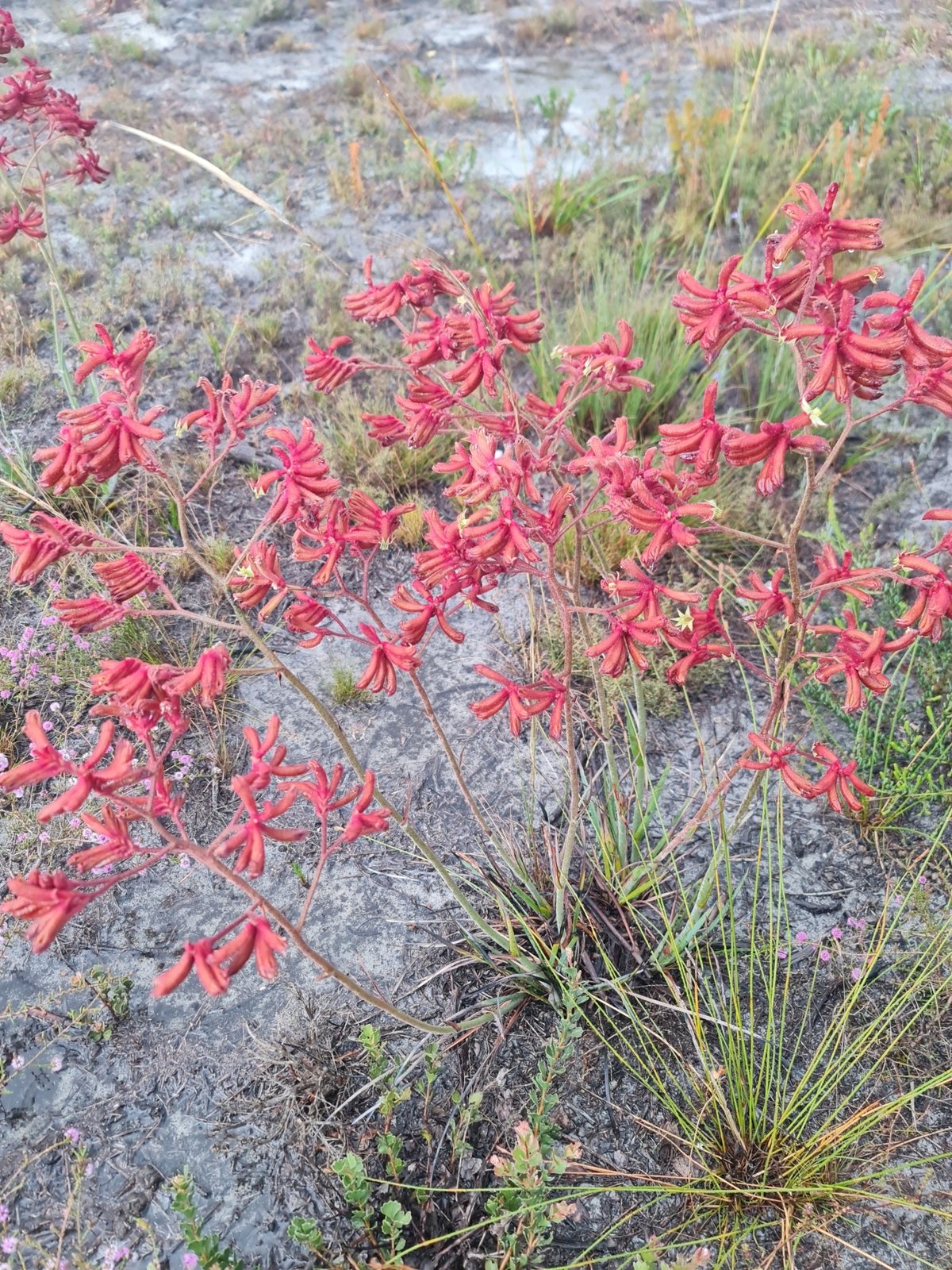
A clump-forming evergreen perennial from southwestern Australia, grown for tall, branching stems of velvety red flowers above narrow, strap-shaped leaves. It suits sunny, well-drained gardens in mild climates; in colder parts of the United States, Canada and the United Kingdom, grow it in a container and overwinter it under cover.
At a glance
- Sun
- Full sun; flowering is reduced in shade.
- Water
- Water regularly while establishing and during active growth, allowing the surface soil to dry between waterings. Established plants tolerate dry spells, but prolonged drought can reduce flowering.
- Soil
- Well-drained sandy or gravelly soil, preferably slightly acidic to neutral. Avoid waterlogged ground and rich, heavily fertilized compost.
- Height
- 3-6 ft (0.9-1.8 m), including flower stems
- Spread
- 2-3 ft (0.6-0.9 m)
- Flowers
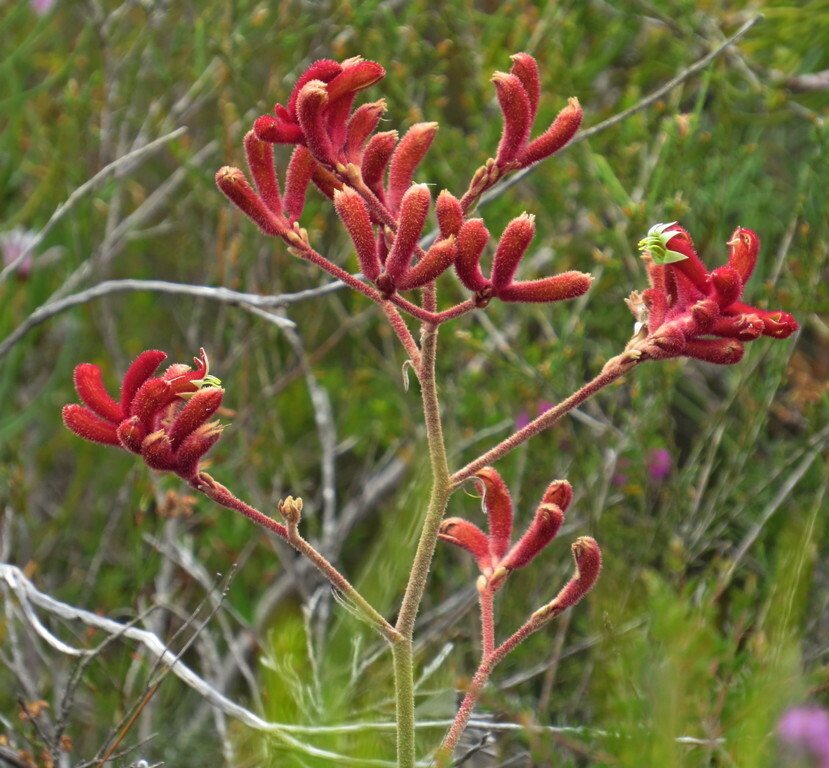
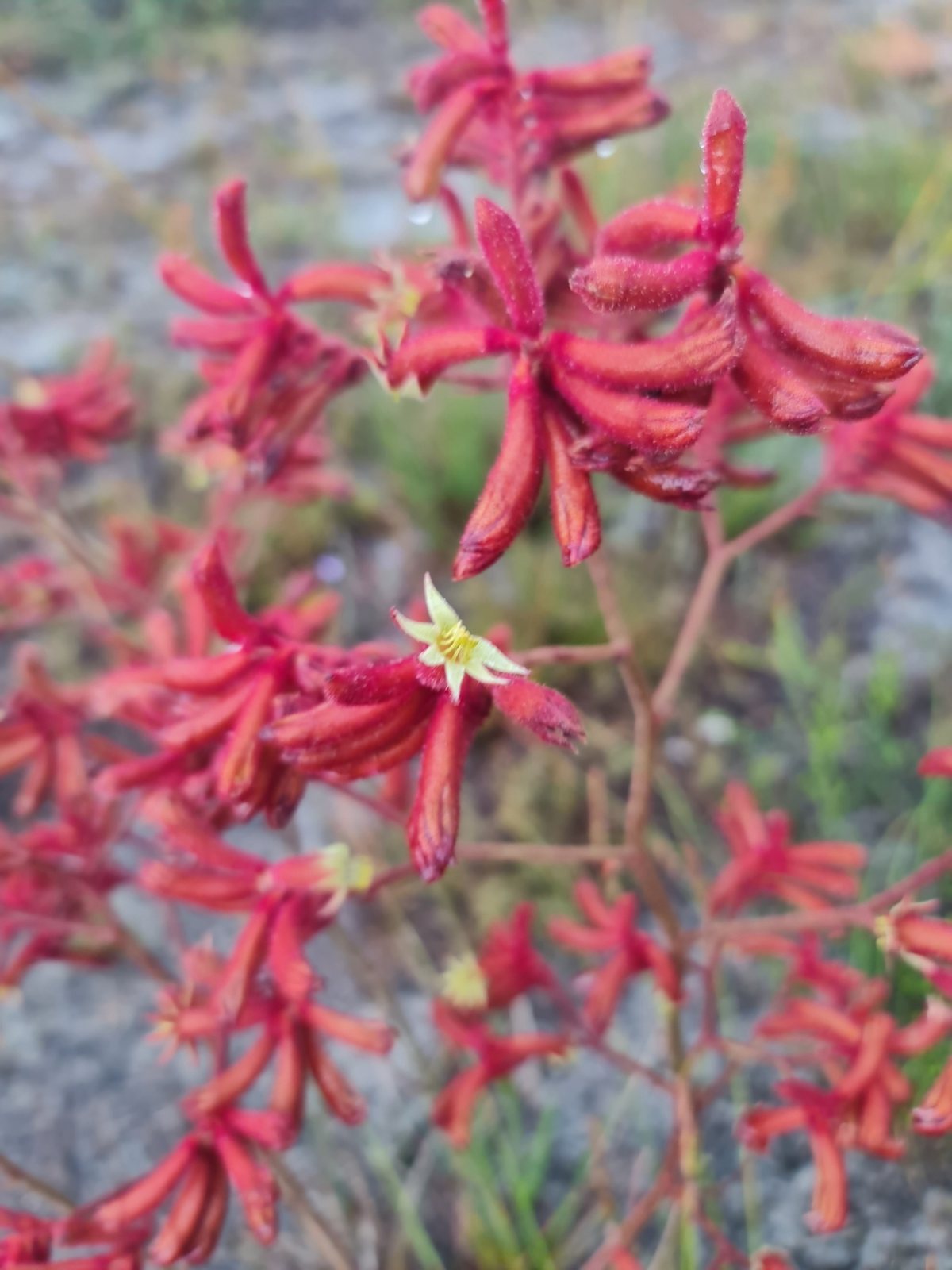
- Mainly spring and summer; densely hairy, deep red tubular flowers open into small, paw-like lobes.
- Foliage
- Evergreen. Narrow, upright to arching, green to grey-green leaves forming basal fans.
- Growth
- Moderate
- Care needed
- Medium
The year at a glance
- Pollinators
- Drought tolerant
- Heat tolerant
- Wildlife
- Low allergen
| J | F | M | A | M | J | J | A | S | O | N | D | |
|---|---|---|---|---|---|---|---|---|---|---|---|---|
| Flowers | ||||||||||||
| Plant |
Northern hemisphere months. In Australia, shift them by six.
- Difficulty
- Hard
- Toughness
- Fairly tough
Will it suit your garden?
Pick your zone, country, light and whether you have pets.
Full sun is 6 or more hours of direct sun a day, part shade 3 to 6 hours, shade under 3.
How it grows
Planting day
1 ft (0.3 m)
After 1 year
2.1 ft (0.65 m)
After 2 years
3 ft (1 m)
After 3 years
4 ft (1.4 m)
full size
About 3 years to full size.
From a typical nursery size, at an average rate for this kind of plant. A rule of thumb, not a forecast.
Good to know
- Cats and dogs
- Safe
- Native to
- Australia
- Growth rate
- Moderate
Care
Jobs through the year
- WaterApr–May, Sep–Oct, every 14 days
- Water established ground plants if soil is dry; young plants and pots need more frequent watering.
- WaterJun–Aug, every 7 days
- During dry weather, water at soil level after the surface dries.
- WaterJan–Mar, Nov–Dec, every 21 days
- In frost-free shelter, keep compost lightly moist, never saturated.
- FeedApr
- Apply a light dose of low-phosphorus native-plant fertilizer.
- DeadheadMay–Sep, every 14 days
- Cut finished flower stems down to their bases.
- PruneApr, Sep
- Remove dead or badly spotted leaves individually without cutting healthy leaf fans.
- DivideMay
- Divide only crowded, vigorous clumps as active growth resumes; keep divisions frost-free.
- ProtectJan–Apr, Sep–Dec
- Move pots into bright, ventilated frost-free shelter before frost; outdoor winters are unsuitable.
- Plant with the crown at soil level in a sunny position with excellent drainage.
- Water at ground level rather than wetting the foliage; reduce watering during cool weather.
- Apply a light dose of low-phosphorus fertilizer formulated for Australian native plants in spring.
- Keep mulch away from the crown and remove accumulated dead leaves.
- Protect from prolonged frost; move pots into a bright, frost-free space before winter in cold climates.
Pruning. Cut spent flower stems down to their base after flowering. Remove dead or badly spotted leaves individually, avoiding damage to healthy new leaf fans.
Through the year
- Spring
- Plant after frost risk has passed, or return overwintered pots outdoors gradually.
- Spring
- Feed lightly with a low-phosphorus native-plant fertilizer and remove winter-damaged leaves.
- Summer
- Water during extended dry spells and cut finished flower stems to the base.
- Early autumn
- In mild climates, divide crowded clumps while conditions are still warm.
- Late autumn
- Move containers under cover where frost is expected and reduce watering.
- Winter
- Keep sheltered plants bright and well ventilated, with compost only lightly moist.
In the garden
- Use as an upright accent among low grasses and silver-leaved plants in a sunny gravel border.
- Plant in repeated groups through an Australian native planting for strong seasonal colour.
- Grow in a large, well-drained container beside a sunny terrace, where the flowers can be seen close up.
- Combine with blue-flowered salvias for contrasting colour and a long-season display.
Garden styles it suits: Australian native, Architectural minimal, Dry gravel garden, Mediterranean, Modern courtyard and Hot border.
Plant it with: Lomandra, Blue fescue, Coastal rosemary, Lavender, Autumn sage and Yellow buttons.
Wildlife: The nectar-rich flowers attract nectar-feeding birds, especially honeyeaters in Australia. Hummingbirds may visit where the plant is grown outdoors in the Americas.
Problems to watch for
- Ink disease causes blackened leaf patches and declining growth: remove affected foliage, improve airflow and avoid overhead watering; discard severely affected plants.
- Crown or root rot develops in wet soil: improve drainage, keep the crown clear of mulch and avoid frequent winter watering.
- Snails and slugs damage young leaves and shoots: inspect at night, remove hiding places and use an appropriate bait if needed.
- Frost can scorch leaves and kill crowns during prolonged cold: use a sheltered site in marginal climates and overwinter containers frost-free.
Safety
Not known to be toxic to people, cats, dogs or horses, although species-specific poisoning information is limited. No part is intended for eating; the fine hairs on flowers and stems may irritate sensitive skin.
Easily confused with
Tall kangaroo paw (Anigozanthos flavidus)
Usually forms a larger, more robust clump with taller, extensively branched flower stems. Its flowers are commonly yellow-green, though red forms and hybrids make flower colour alone unreliable.
Red and green kangaroo paw (Anigozanthos manglesii)
Has conspicuously green flowers with red bases on mostly unbranched stems, rather than the branching clusters of predominantly red flowers of red kangaroo paw.
The name
The common name refers to the paw-like flowers, while the Latin species name rufus means reddish or red-haired, describing their dense red covering.
Propagation. Sow seed in a warm, well-drained seed mix; germination can be slow and uneven. Divide established clumps in spring, or early autumn in mild climates, keeping several healthy leaf fans and roots on each division.
Checked against open data
- Accepted botanical name
- Anigozanthos rufus
- Native range
- Western Australia.
Sources: GBIF (CC BY 4.0) and Trefle (CC BY 4.0). The care and design notes are LandscapeGPT's own.
See it in your own yard.
Upload a photo of your yard and see it redesigned with plants that suit your climate, each checked against your zone.