Rockspray cotoneaster
Cotoneaster horizontalis. Family Rosaceae. Shrub.
Also called Rock cotoneaster, Wall cotoneaster.
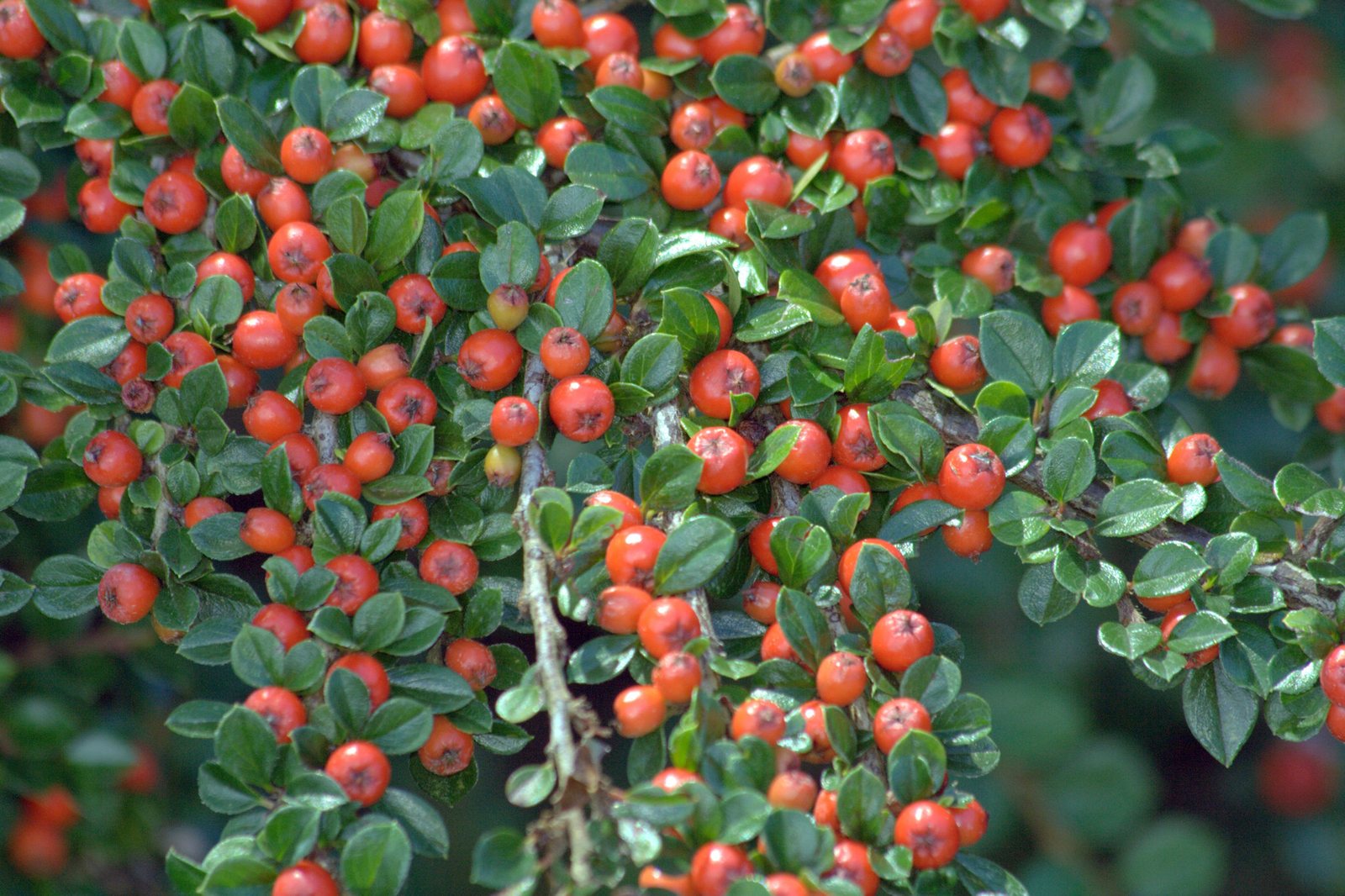
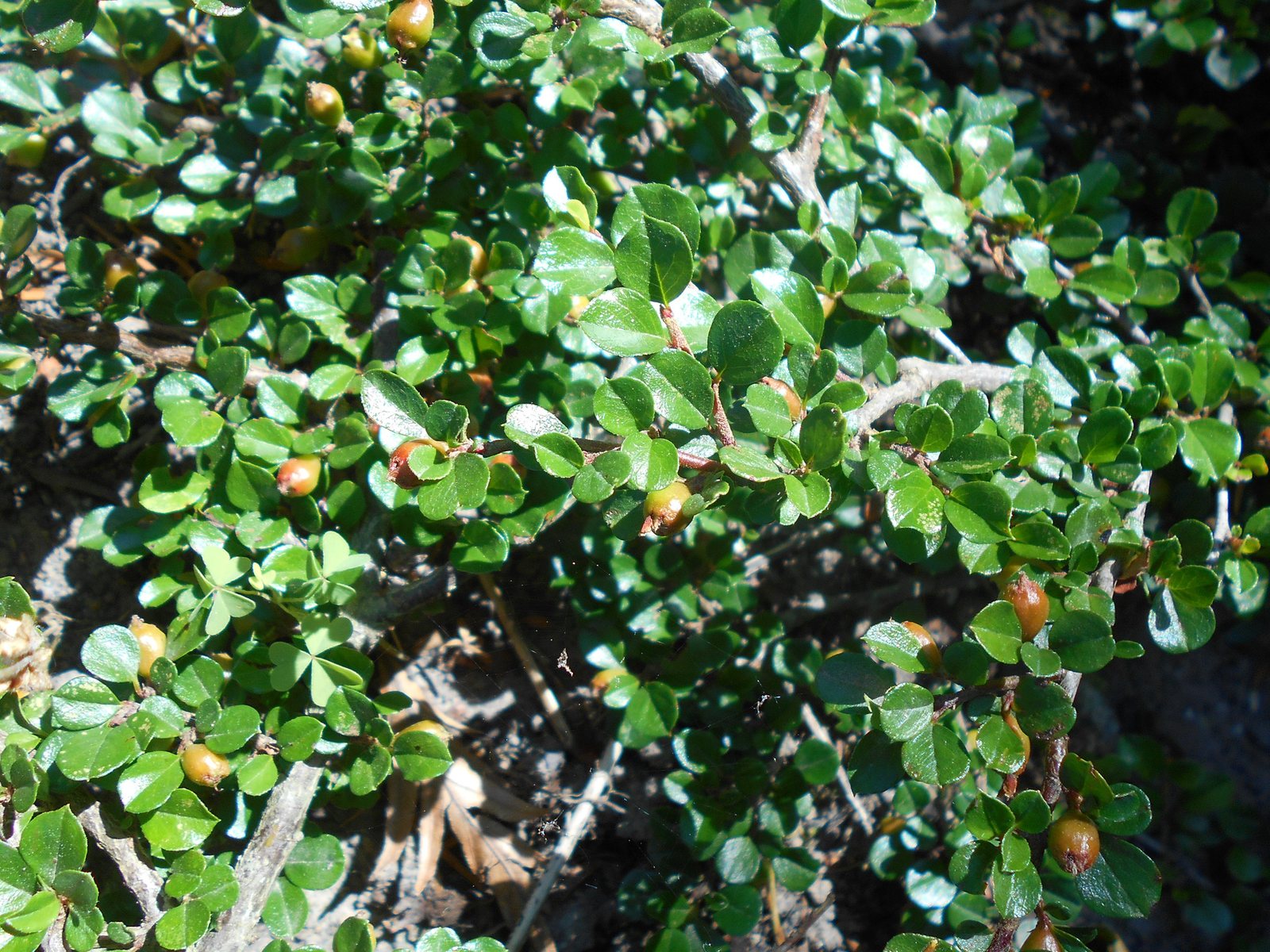
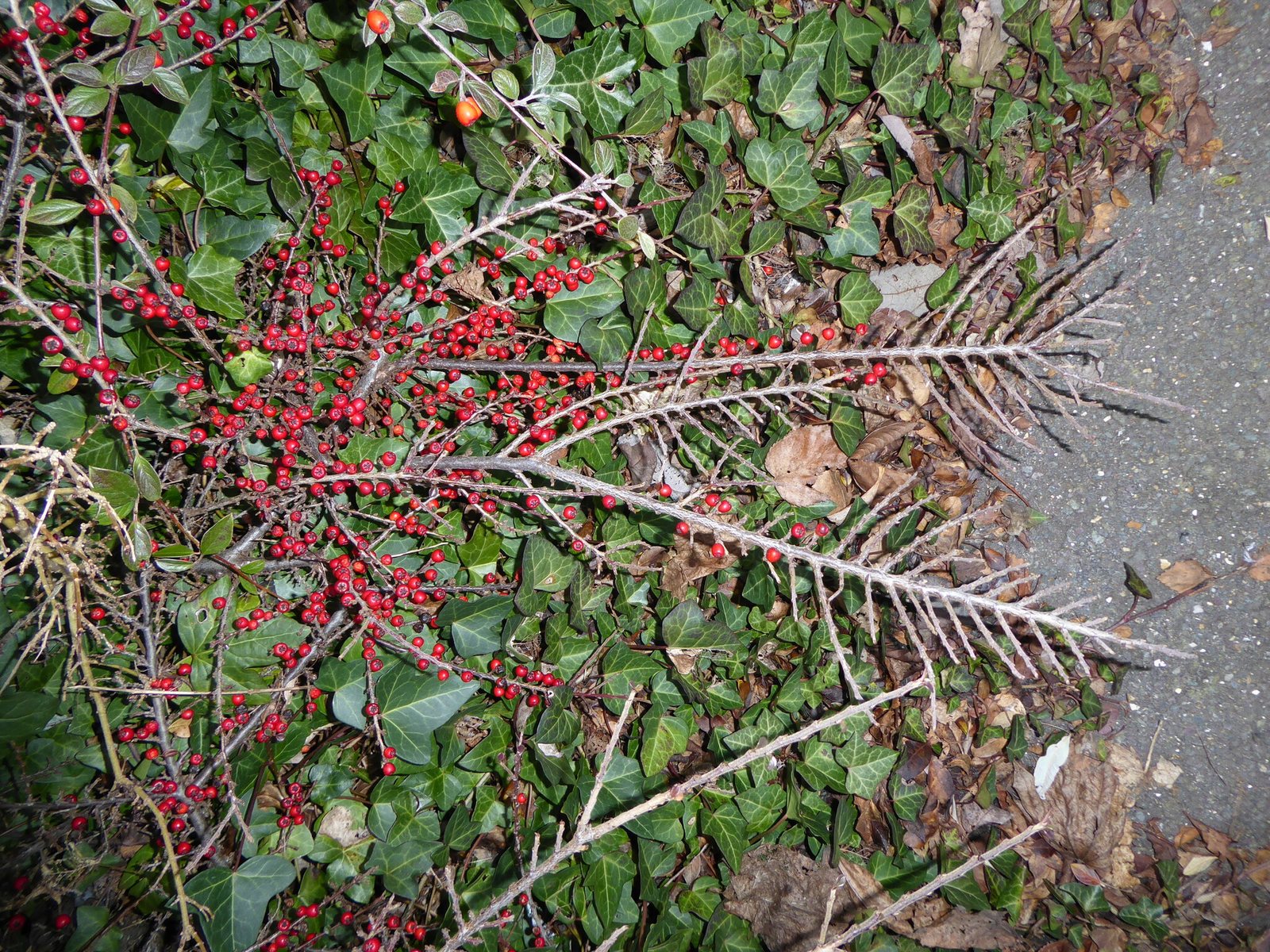
A low, spreading shrub with stiff, herringbone-patterned branches, small leaves and red autumn berries. Gardeners grow it over walls and banks for its branching pattern, autumn colour and fruit, but it escapes into natural habitats in several regions, so check local restrictions before planting.
At a glance
- Sun
- Full sun to partial shade; flowering, fruiting and autumn colour are best in sun.
- Water
- Water regularly during establishment. Once established, it tolerates dry spells but benefits from deep watering during prolonged drought.
- Soil
- Well-drained soil, including chalky, sandy or stony ground; tolerates a broad pH range. Avoid waterlogged sites.
- Height
- 2-3 ft (0.6-0.9 m)
- Spread
- 5-8 ft (1.5-2.4 m)
- Flowers
- Small pinkish-white flowers in late spring to early summer, followed by red berries in autumn.
- Foliage
- Small, rounded, glossy dark-green leaves turn orange-red or red-purple in autumn. Usually deciduous, though some leaves may persist in mild winters.
- Growth
- Moderate
- Care needed
- Low
The year at a glance
- Pollinators
- Drought tolerant
- Wildlife
- Low allergen
| J | F | M | A | M | J | J | A | S | O | N | D | |
|---|---|---|---|---|---|---|---|---|---|---|---|---|
| Flowers | ||||||||||||
| Fruit | ||||||||||||
| Plant |
Northern hemisphere months. In Australia, shift them by six.
- Difficulty
- Easy
- Toughness
- Very tough
Will it suit your garden?
Pick your zone, country, light and whether you have pets.
Full sun is 6 or more hours of direct sun a day, part shade 3 to 6 hours, shade under 3.
How it grows
Planting day
1.6 ft (0.5 m)
After 1 year
1.8 ft (0.55 m)
After 2 years
2 ft (0.6 m)
After 3 years
2.1 ft (0.65 m)
After 5 years
2.5 ft (0.75 m)
full size
About 5 years to full size.
From a typical nursery size, at an average rate for this kind of plant. A rule of thumb, not a forecast.
Good to know
- Cats and dogs
- Toxic
- Invasive in
- the UK
- Growth rate
- Moderate
Care
Jobs through the year
- WaterApr–May, Sep–Oct, every 21 days
- Established shrubs need water only during prolonged dry weather; water new plants more often.
- WaterJun–Aug, every 14 days
- Deep-water established shrubs only in prolonged drought; keep first-year roots more evenly moist.
- MulchMar–Apr
- Apply a thin organic mulch, keeping it clear of the main stems.
- PruneFeb–Mar
- Remove dead, crossing or obstructing branches selectively; do not shear the branching framework.
- PruneMay–Sep
- Remove unwanted rooted branches and diseased shoots promptly; disinfect tools after diseased cuts.
- ProtectSep–Oct
- Remove berries before birds disperse them where escape threatens natural habitats; check local planting restrictions.
- Water deeply through the first growing season whenever the root zone starts to dry.
- Apply a thin organic mulch, keeping it clear of the main stems.
- Do not feed routinely; use a light spring feed only if growth is weak and soil is poor.
- Allow room for the full spread rather than repeatedly shearing the branch tips.
- Remove seedlings and unwanted rooted branches promptly, especially near natural habitats.
Pruning. In late winter, remove dead, damaged or crossing branches and shorten only stems that obstruct paths or neighbouring plants. Avoid shearing, which spoils the herringbone framework and reduces flowering and fruiting.
Through the year
- Late winter
- Prune selectively to preserve the branching pattern; remove dead or damaged wood.
- Spring
- Plant where permitted, water thoroughly and mulch without covering the stems.
- Late spring
- Check new shoots for aphids and watch for blackened, wilted tips that may indicate fire blight.
- Summer
- Water young plants during dry weather and remove unwanted shoots rooting into nearby soil.
- Autumn
- Check surrounding beds for seedlings; where escape is a concern, remove fruit before birds disperse it.
- Winter
- Check drainage after heavy rain and clear debris from the base without damaging the low branches.
In the garden
- Let branches cascade over a low retaining wall where the herringbone framework can be seen.
- Use on a sunny, well-drained bank for low woody cover, only where it is not invasive.
- Place beside steps or a raised bed, allowing enough clearance for its mature spread.
- Combine with spring bulbs and low ornamental grasses for seasonal contrast beneath the spreading branches.
Garden styles it suits: Traditional, English country, Cottage garden, Dry gravel garden, Autumn colour and Winter interest.
Plant it with: Lavender, Catmint, Creeping thyme, Dwarf daffodils and Blue fescue.
Wildlife: Flowers provide nectar and pollen for bees. Birds eat the berries and shelter in the branches, but they also carry seeds into natural habitats.
Problems to watch for
- Fire blight causes blackened, hooked shoot tips: prune well below visible damage in dry weather, disinfect tools between cuts and avoid excessive nitrogen feeding.
- Aphids distort young growth: wash off small colonies with water and allow ladybirds and other predators to work.
- Scale insects weaken stems: inspect branches, prune heavily infested growth and use a labelled horticultural oil when appropriate.
- Waterlogged soil can cause root decline: improve drainage or move the plant to a raised, freely drained position.
Safety
Treat the berries, especially the seeds, and the leaves as potentially harmful to people, cats, dogs and horses because they contain cyanogenic compounds. Small accidental berry ingestions usually cause little or mild stomach upset, but larger amounts may be more serious. Do not use the fruit as food or allow pets or livestock to browse it; seek medical or veterinary advice after significant ingestion.
Where it spreads. Invasive in parts of the United Kingdom, where it colonises limestone grassland and rocky habitats; it is listed on Schedule 9 in England and Wales, making it an offence to plant or otherwise cause it to grow in the wild.
Easily confused with
Rockspray cotoneaster 'Perpusillus' (Cotoneaster horizontalis 'Perpusillus')
A smaller, tighter-growing form of the same species, with smaller leaves and shorter branches; the herringbone arrangement remains visible.
Cranberry cotoneaster (Cotoneaster apiculatus)
Has a more loosely mounded habit, generally larger leaves and less regular herringbone branching.
Bearberry cotoneaster (Cotoneaster dammeri)
Forms a flatter, evergreen carpet with longer trailing stems and larger, more elongated leaves, without the distinct herringbone framework.
The name
Cotoneaster means quince-like, referring to the leaves, while horizontalis describes the spreading, nearly horizontal branches.
Propagation. Take semi-ripe cuttings in summer or layer a low branch and separate it once rooted. Seed needs pretreatment and germination can be slow; avoid propagating it where invasive or restricted.
Checked against open data
- Accepted botanical name
- Cotoneaster horizontalis
- In the US and Canada
- Introduced in Canada and the lower 48 states.
- Native range
- China North-Central, China South-Central, China Southeast and Taiwan.
- Measured
- Soil pH 5.5 to 7. Average height 70 cm.
Sources: GBIF (CC BY 4.0), USDA PLANTS and Trefle (CC BY 4.0). The care and design notes are LandscapeGPT's own.
See it in your own yard.
Upload a photo of your yard and see it redesigned with plants that suit your climate, each checked against your zone.