Rutabaga (swede)
Brassica napus var. napobrassica. Family Brassicaceae. Annual.
Also called Swede, Swedish turnip, Neep.
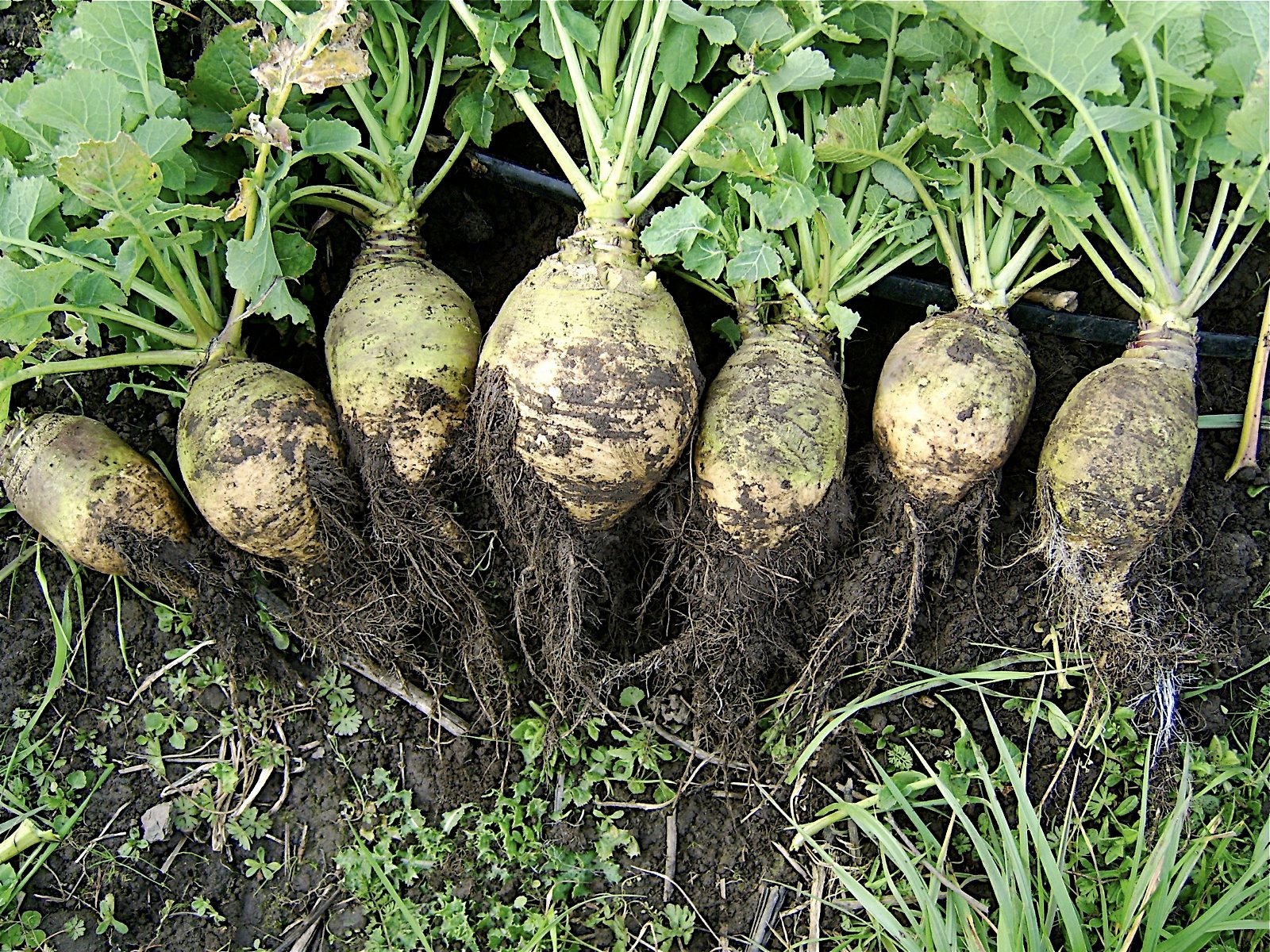
Rutabaga is a cool-season root vegetable with a large, rounded root, usually purple above ground and yellow-fleshed inside. Botanically a biennial, it is grown as an annual for roots used in soups, stews, roasting and mash; cool weather and light frost improve its flavour.
At a glance
- Sun
- Full sun; tolerates light partial shade.
- Water
- Keep soil evenly moist, providing about 1 in (2.5 cm) of water weekly during dry weather.
- Soil
- Deep, moisture-retentive but well-drained soil, preferably pH 6.0-7.5; avoid compacted ground and fresh manure.
- Height
- 1-2 ft (0.3-0.6 m) in the harvest year
- Spread
- 1-1.5 ft (0.3-0.45 m)
- Flowers
- Yellow flowers in spring of the second year if plants are left to overwinter; normally harvested before flowering.
- Foliage
- Broad, blue-green, waxy leaves with pale veins, forming a loose rosette above the swollen root.
- Growth
- Moderate; most varieties reach harvest size about 90-120 days after sowing.
- Care needed
- Medium
The year at a glance
- Low allergen
- Edible
| J | F | M | A | M | J | J | A | S | O | N | D | |
|---|---|---|---|---|---|---|---|---|---|---|---|---|
| Fruit | ||||||||||||
| Plant |
Northern hemisphere months. In Australia, shift them by six.
- Difficulty
- Moderate
- Toughness
- Fairly tough
Will it suit your garden?
Pick your zone, country, light and whether you have pets.
Full sun is 6 or more hours of direct sun a day, part shade 3 to 6 hours, shade under 3.
How it grows
Planting day
0.5 ft (0.15 m)
After 1 year
1.5 ft (0.45 m)
full size
Full size in one season.
From a typical nursery size, at an average rate for this kind of plant. A rule of thumb, not a forecast.
Good to know
- Cats and dogs
- Safe
- Growth rate
- Moderate
Care
Jobs through the year
- WaterMay, Sep–Oct, every 7 days
- Keep soil evenly moist if rain is insufficient; check seedlings more frequently.
- WaterJun–Aug, every 3 days
- Water during dry weather, aiming for 2.5 cm weekly overall and avoiding wet-dry extremes.
- WaterNov–Dec, every 14 days
- Water remaining outdoor crops only if soil is dry and unfrozen.
- FeedApr–May
- Work mature compost into the bed before sowing; avoid heavy nitrogen feeding.
- MulchJun–Jul
- Mulch between established plants without burying their crowns.
- ProtectMay–Sep
- Fit fine insect mesh immediately after sowing to exclude root flies and flea beetles.
- HarvestSep–Dec
- Lift roots at 8–15 cm across before hard ground freezes; trim tops for storage.
- Thin seedlings to 8-12 in (20-30 cm) apart, with rows 18-24 in (45-60 cm) apart.
- Water consistently while roots swell; alternating drought and heavy watering can cause splitting.
- Work mature compost into the bed before sowing; avoid heavy nitrogen feeding, which encourages leaves rather than roots.
- Mulch between established plants to conserve moisture and suppress weeds without burying the crowns.
- Rotate brassica crops, allowing at least three years before returning them to the same bed.
Pruning. No routine pruning is needed. Remove badly diseased leaves, but retain healthy foliage to feed the developing roots.
Harvest
Lift roots when roughly 3-6 in (8-15 cm) across, usually 90-120 days after sowing; smaller roots are generally more tender. Loosen the soil with a fork, lift without bruising, and trim leaves to about 1 in (2.5 cm) above the crown for storage. Light frost can sweeten the roots, but harvest before the ground freezes hard.
Through the year
- Spring
- Prepare a weed-free bed with mature compost; check soil pH before adding lime.
- Late spring
- In cool-summer regions, sow seed directly about 0.5 in (1 cm) deep for an autumn crop.
- Summer
- Thin seedlings promptly, water during dry spells and protect young plants with insect mesh.
- Late summer
- In mild-winter regions, sow for a winter crop, allowing roughly three to four months of suitable growing weather.
- Autumn
- Check root size and begin harvesting; leave sound roots for light frosts if hard freezing is not imminent.
- Winter
- Harvest outdoor roots in mild districts; in cold districts, check stored roots and discard any that soften or rot.
In the garden
- Plant in orderly rows in a kitchen garden for an autumn and winter food crop.
- Use blue-green foliage alongside lettuces and other leafy vegetables in a potager.
- Grow in deep raised beds where heavy native soil restricts root development.
- Follow early peas or salad crops with a summer sowing where the remaining season is long enough.
Garden styles it suits: Potager (kitchen garden), Cottage garden, Farmhouse, Edible landscape, Homestead and Traditional.
Plant it with: Lettuce, Onions, Peas and Calendula.
Wildlife: Leaves feed several brassica-eating insects. Plants retained into their second year produce flowers visited by bees and other pollinators.
Problems to watch for
- Cabbage root fly or cabbage maggot: larvae tunnel into roots; cover the crop with insect mesh immediately after sowing and rotate away from previously infested brassica beds.
- Flea beetles: small beetles pepper seedling leaves with holes; use fine insect mesh and keep seedlings watered so they grow through minor damage.
- Clubroot: swollen, distorted roots and wilting indicate infection; remove affected plants, avoid moving contaminated soil and use resistant varieties where available. Correct acidic soil according to a soil test.
- Split or woody roots: maintain even soil moisture and harvest promptly; prolonged heat and overmaturity reduce quality.
Safety
Roots and leaves are edible and are not known to be toxic to people, cats or dogs in ordinary food quantities, though large servings may cause digestive upset. Do not offer large quantities to horses: brassicas can cause digestive and metabolic problems when eaten in excess and should not form a major part of their diet.
Easily confused with
Turnip (Brassica rapa subsp. rapa)
Turnips usually have white flesh, mature faster and have greener, often rough or hairy leaves; rutabagas usually have yellow flesh and smoother, waxy blue-green leaves.
Kohlrabi (Brassica oleracea Gongylodes Group)
Kohlrabi has a swollen above-ground stem with leaf stalks attached around its sides; rutabaga forms a swollen root with foliage clustered at the crown.
The name
Rutabaga comes from the Swedish word rotabagge, meaning root lump, while swede is short for Swedish turnip.
Propagation. Sow seed directly where plants will grow; transplanting can distort the roots. Time sowing so roots mature in cool weather, and avoid very early sowing followed by prolonged cold, which can trigger premature flowering.
Checked against open data
- Accepted botanical name
- Brassica napus Brassica napus var. napobrassica is an older name for Brassica napus.
- In the US and Canada
- Introduced in Alaska, Canada, Greenland and the lower 48 states.
- Native range
- France.
- Measured
- Soil pH 6 to 7.2. Average height 39 cm.
Sources: GBIF (CC BY 4.0), USDA PLANTS and Trefle (CC BY 4.0). The care and design notes are LandscapeGPT's own.
See it in your own yard.
Upload a photo of your yard and see it redesigned with plants that suit your climate, each checked against your zone.