Satomi kousa dogwood
Cornus kousa 'Satomi'. Family Cornaceae. Tree.
Also called Pink Japanese dogwood, Cornus kousa 'Satomi'.
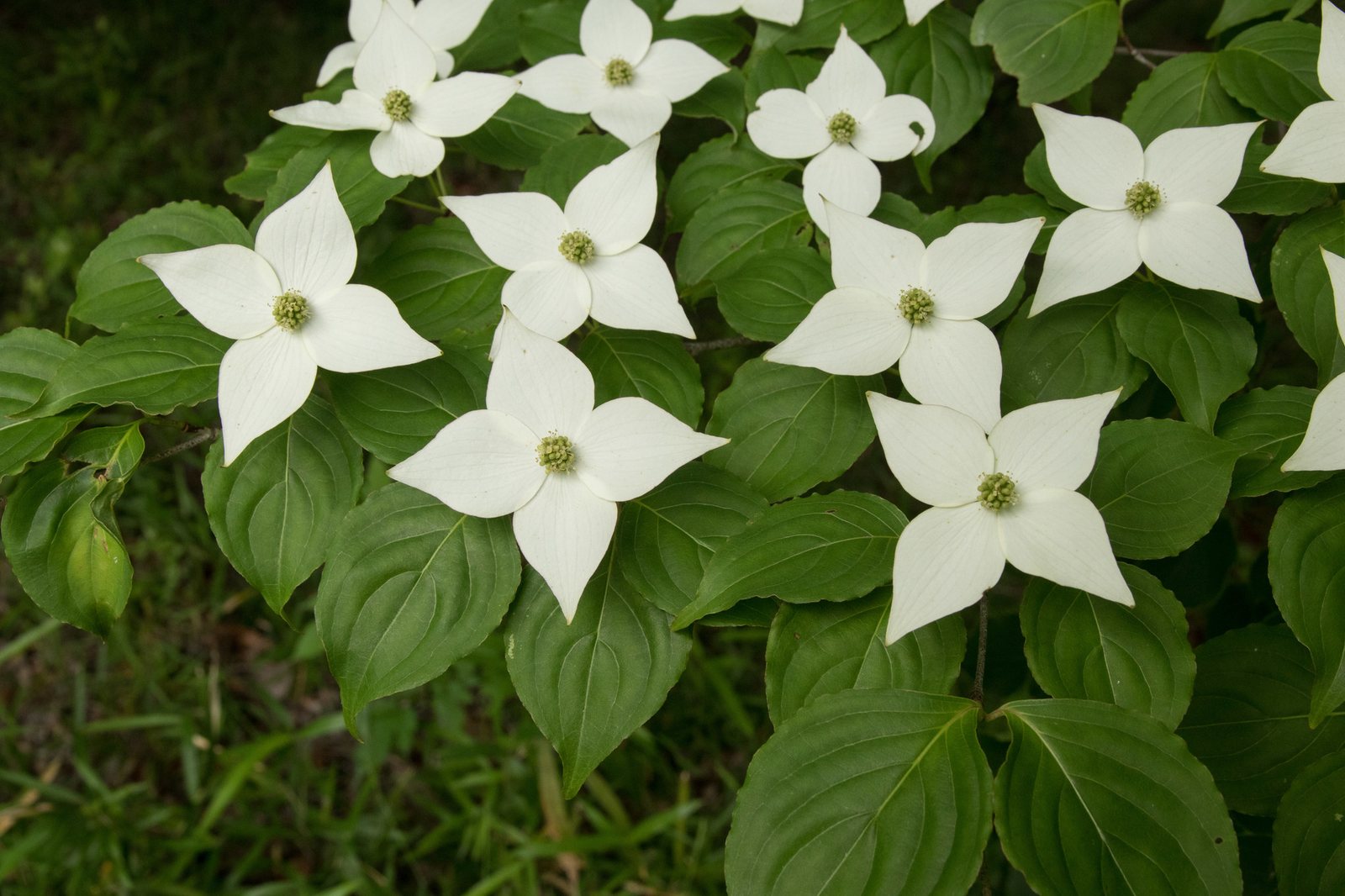
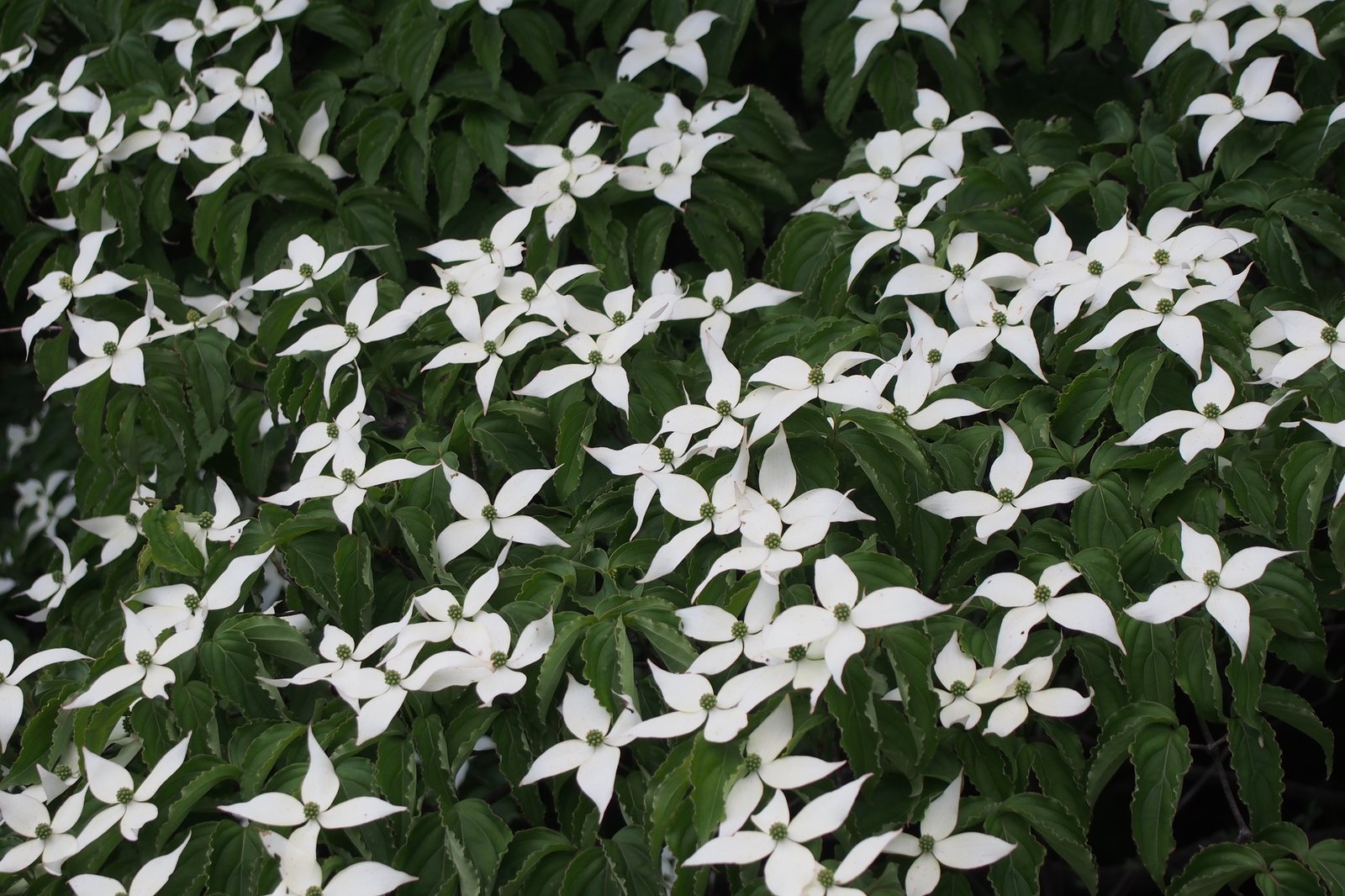
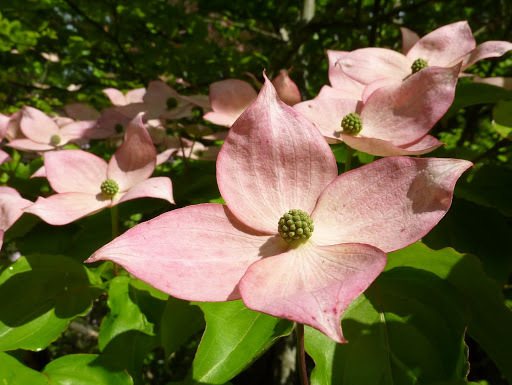
A small deciduous tree grown for pink flower-like bracts in late spring and early summer, followed by strawberry-shaped red fruit and red-purple autumn foliage. It develops spreading, layered branches and attractive mottled bark with age; the pink colouring varies with climate and can be paler in hot conditions.
At a glance
- Sun
- Full sun to partial shade; give afternoon shade in hotter climates and shelter from drying winds.
- Water
- Keep the root zone evenly moist but not waterlogged. Water established trees deeply during prolonged dry spells.
- Soil
- Moist, well-drained, humus-rich soil, preferably acidic to neutral. Avoid chalky soil, standing water and compacted ground.
- Height
- 15-25 ft (4.5-7.5 m)
- Spread
- 15-25 ft (4.5-7.5 m)
- Flowers
- Late spring to early summer, after the leaves open; small greenish-yellow flowers are surrounded by four pink bracts that often deepen in colour as they age.
- Foliage
- Dark green, oval leaves with pointed tips, turning red, purple and sometimes orange in autumn.
- Growth
- Slow to moderate; allow many years for a broad, mature canopy.
- Care needed
- Low
The year at a glance
- Pollinators
- Disease resistant
- Wildlife
- Low allergen
| J | F | M | A | M | J | J | A | S | O | N | D | |
|---|---|---|---|---|---|---|---|---|---|---|---|---|
| Flowers | ||||||||||||
| Fruit | ||||||||||||
| Plant |
Northern hemisphere months. In Australia, shift them by six.
- Difficulty
- Easy
- Toughness
- Fairly tough
Will it suit your garden?
Pick your zone, country, light and whether you have pets.
Full sun is 6 or more hours of direct sun a day, part shade 3 to 6 hours, shade under 3.
How it grows
Planting day
7 ft (2 m)
After 1 year
7 ft (2.2 m)
After 2 years
8 ft (2.3 m)
After 3 years
8 ft (2.5 m)
After 5 years
9 ft (2.8 m)
About 26 years to full size.
From a typical nursery size, at an average rate for this kind of plant. A rule of thumb, not a forecast.
Good to know
- Cats and dogs
- Safe
- Invasive in
- the US
- Growth rate
- Slow
Care
Jobs through the year
- WaterApr–May, Sep–Oct, every 14 days
- Water established trees deeply if soil is drying and rain is insufficient; young trees need more frequent checks.
- WaterJun–Aug, every 7 days
- Water established trees deeply during dry spells; keep young trees evenly moist for their first three summers.
- MulchMar–Apr
- Refresh organic mulch to 5–8 cm deep, keeping the trunk and root flare clear.
- FeedMar–Apr
- Top-dress lightly with compost; use fertilizer only for a demonstrated deficiency.
- PruneFeb
- Remove dead, damaged or crossing branches sparingly; preserve the layered crown.
- Plant with the root flare at soil level, leaving enough room for the mature spreading crown.
- Water deeply during dry weather for the first two or three growing seasons.
- Spread 2-3 in (5-8 cm) of organic mulch over the root zone, keeping it away from the trunk.
- Top-dress with compost in spring; use fertiliser only if growth or a soil test indicates a need.
- Keep lawn equipment away from the trunk and avoid digging beneath the canopy.
Pruning. Prune lightly in late winter while dormant, removing dead, damaged or crossing branches. Preserve the naturally layered crown and avoid topping or routine hard pruning.
Through the year
- Late winter
- Remove dead or crossing branches and check any tree ties for rubbing.
- Spring
- Plant where the soil is workable, water thoroughly and refresh the mulch without covering the root flare.
- Late spring
- Check new leaves for yellowing or spots; investigate drainage and soil pH before applying treatments.
- Summer
- Water deeply during dry spells, especially while the tree is establishing.
- Autumn
- Collect fallen fruit from paths and remove unwanted seedlings.
- Late autumn
- Plant in mild climates where the ground remains workable and winter drainage is good.
In the garden
- Use as a lawn specimen where its spreading branches can develop without repeated pruning.
- Place at a woodland edge above ferns, hostas and other shade-tolerant groundcover.
- Frame a patio or seating area with spring bracts, autumn colour and winter bark.
- Combine with rhododendrons and Japanese maples in a sheltered, acidic-soil border.
Garden styles it suits: Japanese, Woodland, Arts and Crafts, English country, Autumn colour and Pacific Northwest woodland.
Plant it with: Japanese maple, Rhododendron, Japanese forest grass, Hosta, Japanese painted fern and Epimedium.
Wildlife: Birds and some mammals eat the ripe fruit. The small true flowers offer food to visiting insects, while the branches provide cover and nesting sites.
Problems to watch for
- Brown leaf edges or summer leaf scorch: water deeply, maintain mulch and protect from hot afternoon sun and drying winds.
- Yellow leaves with greener veins on alkaline soil: test soil pH; improve the root environment or relocate a young tree rather than repeatedly adding fertiliser.
- Root rot in wet or compacted soil: correct drainage and avoid overwatering; badly affected trees may need replacement in a better site.
- Powdery mildew or leaf spots: improve airflow, avoid wetting foliage when watering and remove fallen diseased leaves; minor damage rarely needs spraying.
Safety
Not known to be toxic to people, cats, dogs or horses. The ripe fruit pulp is edible, but the coarse skin and hard seeds are usually discarded; eating large amounts may cause digestive upset.
Where it spreads. Can self-seed and has escaped cultivation in parts of the eastern United States, including New York and Pennsylvania. It is treated as an emerging invasive concern in some local assessments; check regional guidance before planting near woodland.
Easily confused with
Pink flowering dogwood (Cornus florida)
Usually flowers before or as the leaves emerge, with notched bract tips and clusters of separate red berries; kousa dogwood flowers after leaf emergence and has pointed bracts and rounded, fused fruits.
Pacific dogwood (Cornus nuttallii)
Usually has four to six large white bracts, often six, and clusters of separate red fruits rather than the strawberry-like fruit of kousa dogwood.
Chinese dogwood (Cornus kousa var. chinensis)
Usually has white bracts rather than the pink bracts selected in 'Satomi'; foliage and fruit are very similar, and colour alone may be less decisive when 'Satomi' flowers pale.
The name
Cornus comes from the Latin for horn, referring to the hard wood, while kousa derives from a Japanese name for this tree.
Propagation. Usually propagated by grafting or budding onto seedling rootstock. Softwood cuttings can be attempted but rooting is variable; seedlings will not reliably retain 'Satomi' characteristics.
Checked against open data
- Accepted botanical name
- Cornus kousa
- In the US and Canada
- Introduced in the lower 48 states.
- Native range
- China North-Central, China South-Central, China Southeast, East Himalaya, Inner Mongolia, Japan, Korea, Nansei-shoto and Taiwan.
- Measured
- Average height 690 cm.
Sources: GBIF (CC BY 4.0), USDA PLANTS and Trefle (CC BY 4.0). The care and design notes are LandscapeGPT's own.
See it in your own yard.
Upload a photo of your yard and see it redesigned with plants that suit your climate, each checked against your zone.