Sea buckthorn
Hippophae rhamnoides. Family Elaeagnaceae. Shrub.
Also called Seaberry, Sea berry, Sallow thorn.
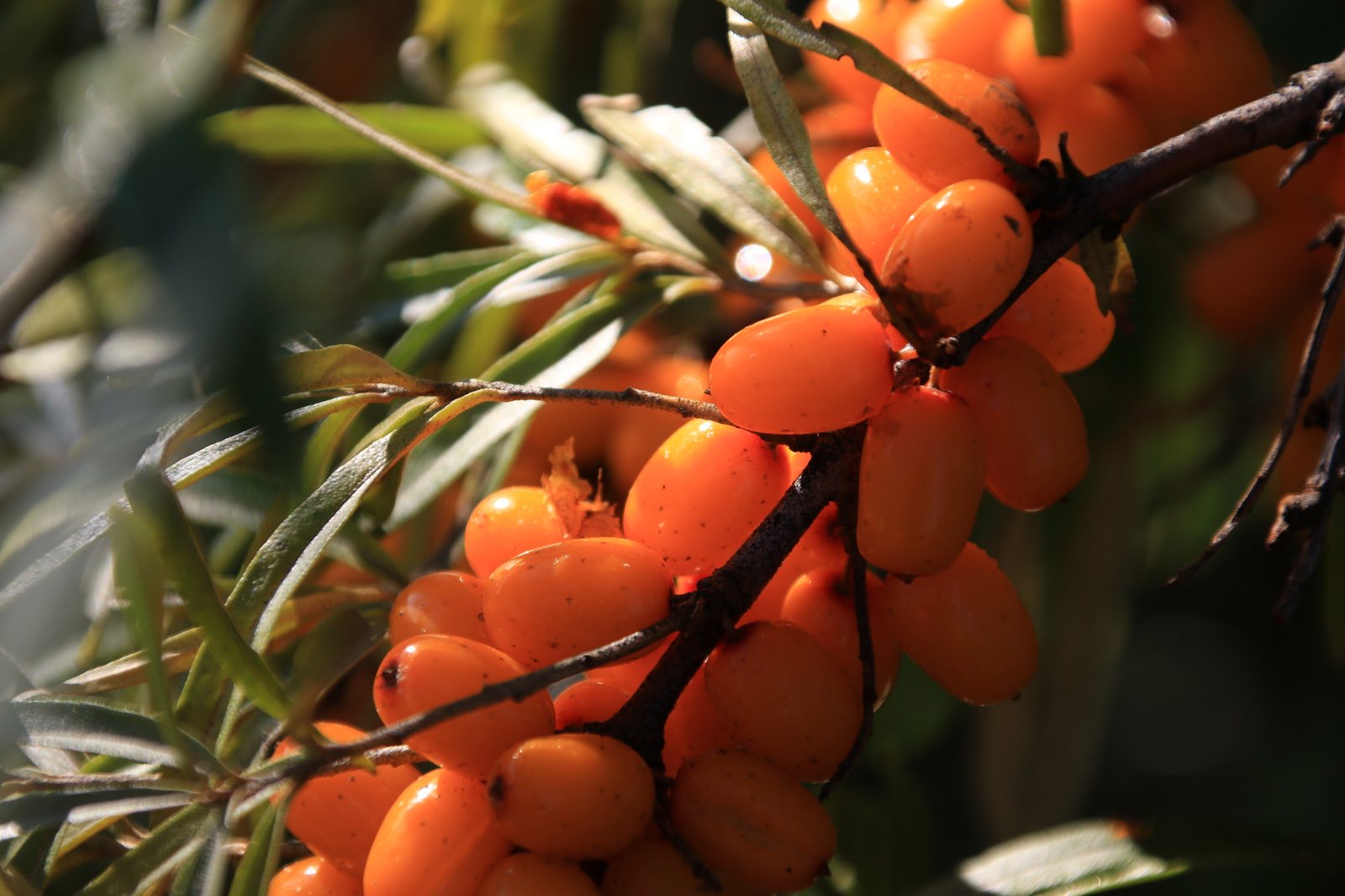
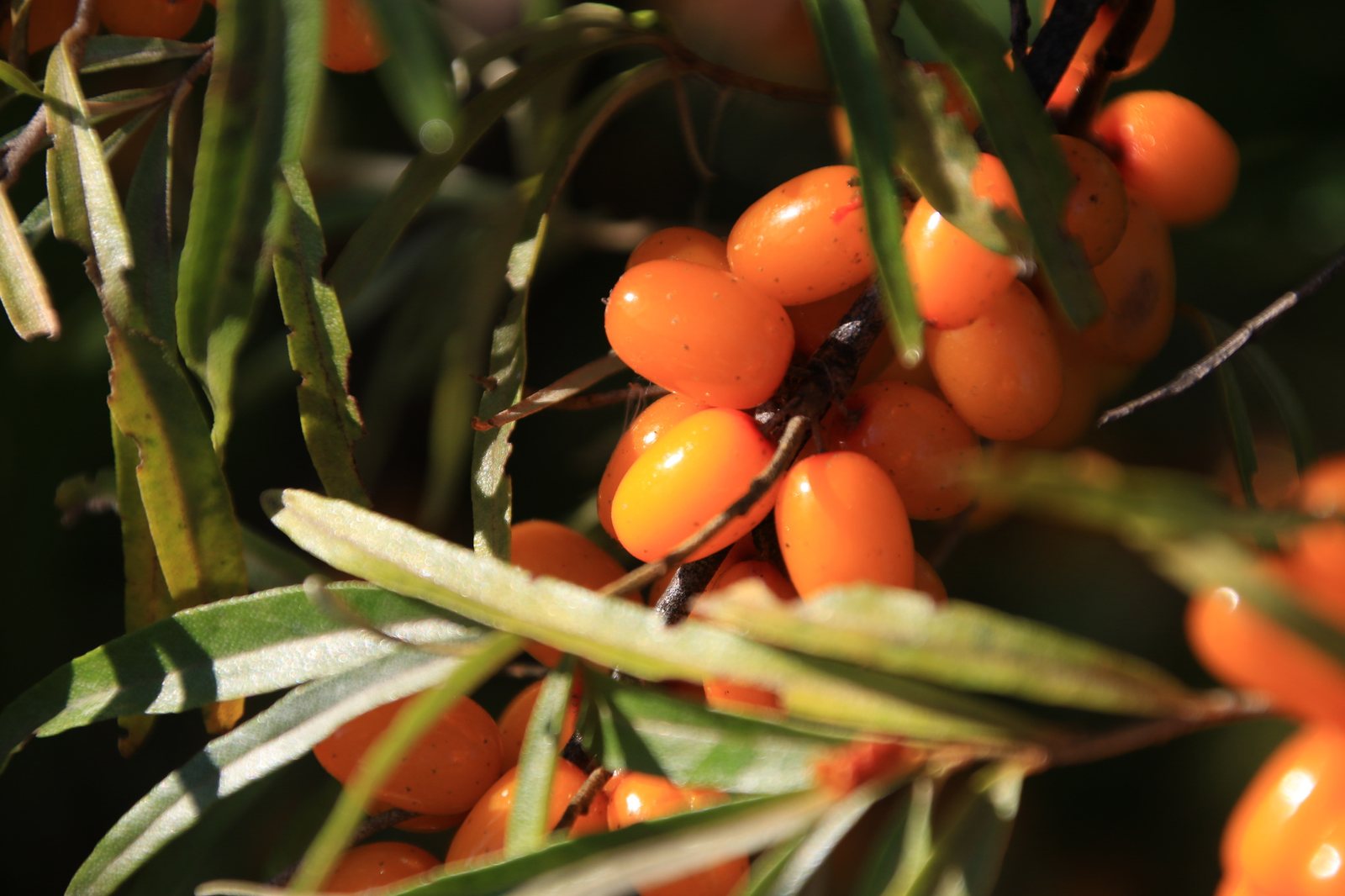
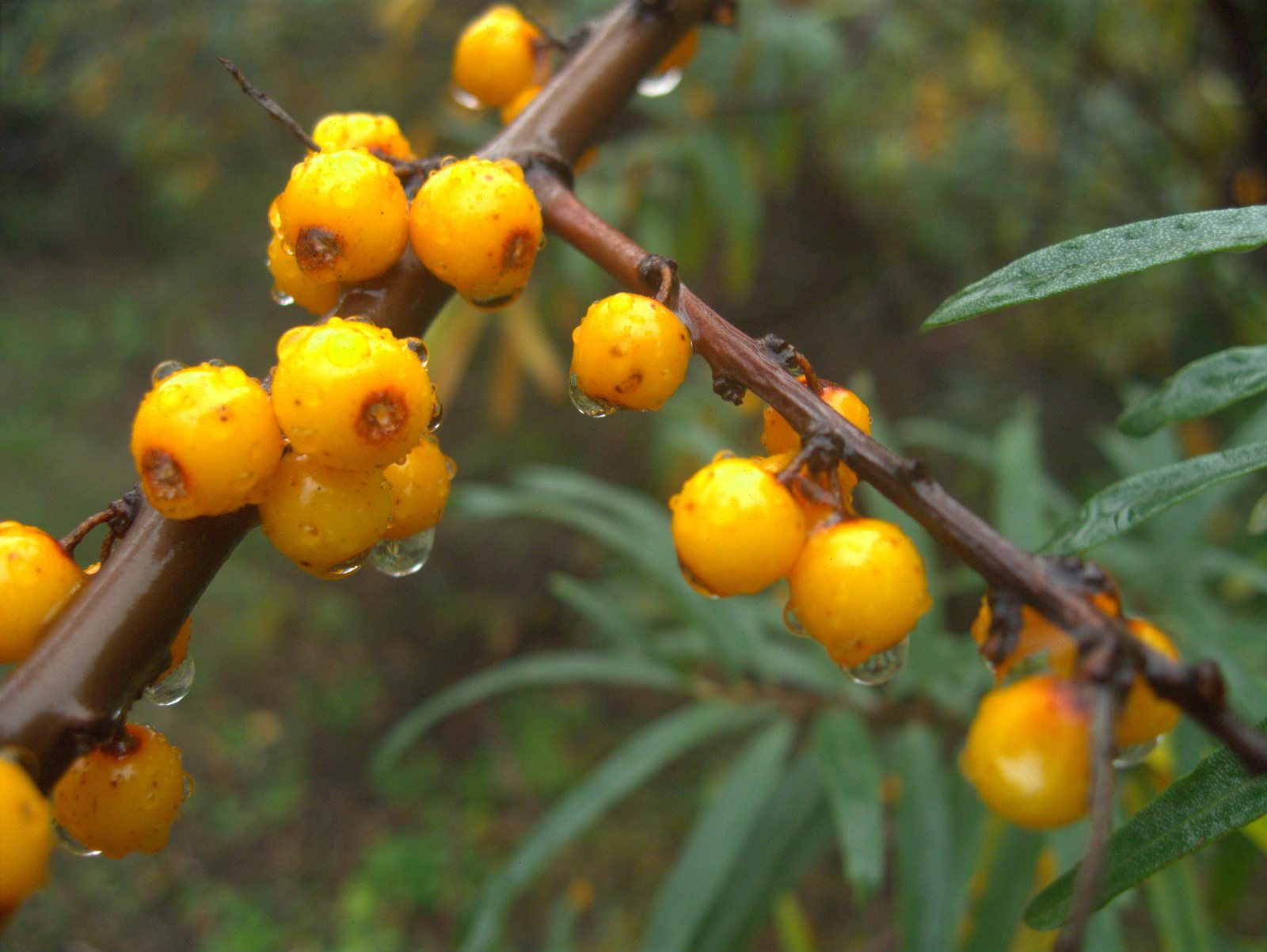
Sea buckthorn is a thorny, deciduous shrub grown for its silvery leaves, tolerance of coastal exposure and bright orange edible berries. It suits sunny, open ground but spreads by suckers and needs room. Most plants are either male or female, so you need both sexes nearby for a reliable fruit crop.
At a glance
- Sun
- Full sun; shade reduces growth and fruiting.
- Water
- Water regularly while establishing; drought-tolerant once rooted. Avoid persistently wet ground.
- Soil
- Well-drained sandy, gravelly or loamy soil, including poor and moderately saline soils. Tolerates a broad pH range, including alkaline soil, but struggles in waterlogged clay.
- Height
- 8-20 ft (2.4-6 m)
- Spread
- 6-15 ft (1.8-4.6 m), eventually wider through suckering
- Flowers
- Small, inconspicuous yellow-green to brownish flowers in early spring, before the leaves; male and female flowers usually occur on separate plants.
- Foliage
- Narrow grey-green leaves with silvery undersides, carried on stiff, thorny branches.
- Growth
- Fast once established
- Care needed
- Medium
The year at a glance
- Drought tolerant
- Cold hardy
- Wildlife
- Edible
| J | F | M | A | M | J | J | A | S | O | N | D | |
|---|---|---|---|---|---|---|---|---|---|---|---|---|
| Flowers | ||||||||||||
| Fruit | ||||||||||||
| Plant |
Northern hemisphere months. In Australia, shift them by six.
- Difficulty
- Moderate
- Toughness
- Very tough
Will it suit your garden?
Pick your zone, country, light and whether you have pets.
Full sun is 6 or more hours of direct sun a day, part shade 3 to 6 hours, shade under 3.
How it grows
Planting day
1.7 ft (0.5 m)
After 1 year
5 ft (1.6 m)
After 2 years
9 ft (2.8 m)
After 3 years
13 ft (3.9 m)
After 5 years
14 ft (4.2 m)
full size
About 3 years to full size.
From a typical nursery size, at an average rate for this kind of plant. A rule of thumb, not a forecast.
Good to know
- Cats and dogs
- Safe
- Native to
- the UK
- Invasive in
- the US and Canada
- In the garden
- Spreads vigorously: plan to contain it.
- Growth rate
- Fast
Care
Jobs through the year
- WaterApr–May, Oct, every 14 days
- Water established shrubs only during prolonged drought; water young plants more often.
- WaterJun–Sep, every 14 days
- Water deeply during prolonged drought while berries develop; young shrubs need more frequent watering.
- MulchMar–Apr
- Apply a light organic mulch, keeping it clear of the stems.
- PruneFeb
- Remove damaged and crossing branches and thin a few old stems without hard clipping.
- PruneApr–Oct, every 30 days
- Remove unwanted suckers at their origin where practical.
- HarvestAug–Oct, every 7 days
- Pick fully coloured, juicy berries carefully, wearing gloves against thorns.
- Water deeply during dry spells for the first two growing seasons; water established fruiting plants during prolonged drought.
- Plant a named male pollinator near female plants; one male commonly serves about six to eight females, with overlapping flowering times.
- Avoid routine nitrogen feeding: root bacteria fix nitrogen, and rich feeding can encourage excessive leafy growth.
- Apply a light organic mulch, keeping it clear of the stems.
- Remove unwanted suckers promptly and keep the shrub away from paths, play areas and property boundaries.
Pruning. In late winter, remove dead, damaged and crossing branches, then thin a few older stems if the shrub is crowded. Avoid hard annual clipping on fruiting plants, because it removes wood that would bear berries.
Harvest
Pick fully coloured orange or yellow-orange berries from late summer into autumn, when they are juicy and have developed their characteristic sharp flavour; exact timing depends on the cultivar and climate. Wear gloves against the thorns and pick carefully, as ripe berries crush easily.
Through the year
- Late winter
- Thin crowded growth, remove damaged wood and cut out unwanted suckers.
- Early spring
- Plant while dormant where soil is workable, and check that male and female plants are present for fruit production.
- Spring
- Mulch lightly and control weeds around young plants without digging deeply among the roots.
- Summer
- Water young plants during dry weather and inspect the surrounding ground for new suckers.
- Late summer
- Begin checking berries for full colour and juiciness; harvest early-ripening selections.
- Autumn
- Harvest later berries and remove seedlings or suckers beyond the intended planting area.
In the garden
- Use as an informal coastal windbreak where salt spray and sandy soil limit other shrubs.
- Plant as a thorny boundary hedge, set well back from paths and access points.
- Combine its silver foliage with sea holly and ornamental grasses in a sunny gravel garden.
- Grow male and female plants in a spacious edible landscape for berries and wildlife cover.
Garden styles it suits: Coastal, Dry gravel garden, Native hedgerow, Wildlife garden, Edible landscape and Homestead.
Plant it with: Sea holly, Sea thrift, Yarrow, Catmint, Russian sage and Feather reed grass.
Wildlife: Berries feed birds, while dense thorny growth provides shelter and nesting cover. Flowers are wind-pollinated and are not a significant nectar source.
Problems to watch for
- Unwanted suckers: remove shoots at their origin where practical and monitor regularly; choose another shrub where spreading roots would cause problems.
- Little or no fruit: provide a compatible male pollinator, full sun and adequate moisture while berries develop; avoid heavy pruning.
- Verticillium wilt: branches wilt or die back, sometimes with stained wood; remove badly affected plants and avoid replanting susceptible shrubs in the same soil.
- Root decline in wet soil: improve drainage before planting or move the plant to a freely draining site; watering less will not correct a permanently waterlogged position.
Safety
The berries are edible for people, though very tart. Sea buckthorn is not known to be toxic to cats, dogs, horses or people, but animal-specific safety information is limited and large amounts of fruit may cause digestive upset. Thorns can cause puncture wounds.
Where it spreads. Spreads aggressively by root suckers and can also spread through bird-carried seed. It has become invasive in some introduced coastal dune sites in western Britain, including Wales and Scotland, where it can displace open-dune vegetation; it is native to parts of eastern Britain's coast. Escapes and aggressive spread also occur locally in the Canadian Prairies and northern United States.
Easily confused with
Common buckthorn (Rhamnus cathartica)
Has broader, finely toothed green leaves and black berries, rather than narrow silver-backed leaves and orange berries. Its fruit is not an edible substitute.
Russian olive (Elaeagnus angustifolia)
Also has silvery leaves and thorny stems, but bears yellowish, olive-shaped, mealy fruit rather than tight clusters of juicy orange berries.
Silver buffaloberry (Shepherdia argentea)
Has opposite leaves and usually red berries; sea buckthorn has alternate leaves and usually orange berries.
The name
The common name refers to its frequent coastal habitat and thorny branches, while rhamnoides means resembling Rhamnus, the buckthorns.
Propagation. Take hardwood cuttings in winter or separate rooted suckers during dormancy. These retain the parent's sex and cultivar characteristics; seedlings vary, and their sex is not apparent until they flower.
Checked against open data
- Accepted botanical name
- Hippophae rhamnoides
- In the US and Canada
- Introduced in Canada.
- Native range
- Afghanistan, Altay, Austria, Baltic States, Belgium, Bulgaria, Buryatiya, China South-Central, Czechoslovakia, Denmark, Finland and France.
- Measured
- Soil pH 6.5 to 8. Average height 155 cm.
Sources: GBIF (CC BY 4.0), USDA PLANTS and Trefle (CC BY 4.0). The care and design notes are LandscapeGPT's own.
See it in your own yard.
Upload a photo of your yard and see it redesigned with plants that suit your climate, each checked against your zone.