Silky eremophila
Eremophila nivea. Family Scrophulariaceae. Shrub.
Also called Silky emu bush.
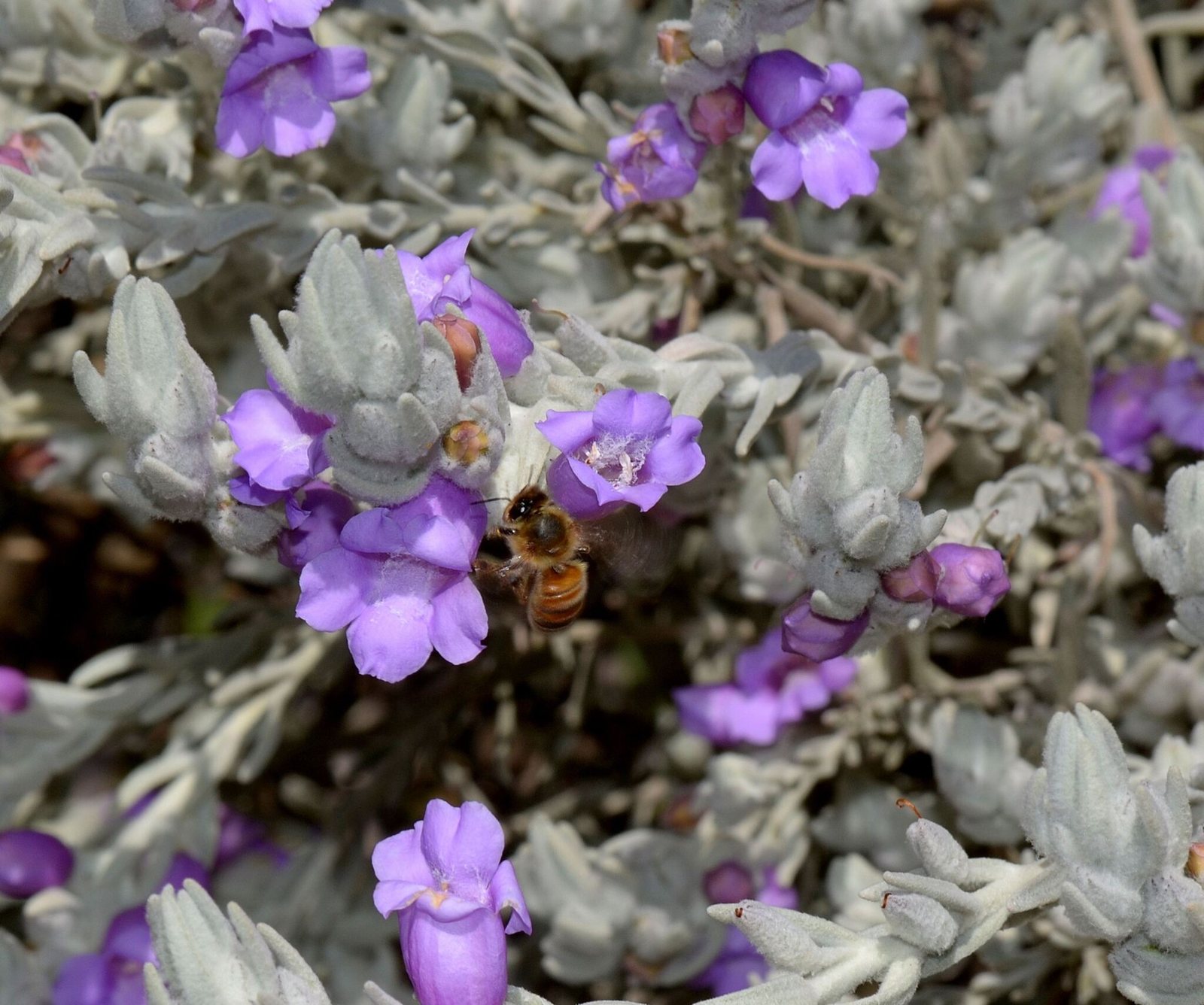
Silky eremophila is an evergreen shrub from Western Australia, grown for its densely silver-haired foliage and purple tubular flowers. It suits sunny, dry gardens with excellent drainage, but struggles with humid summers, prolonged rain and hard frost. In colder parts of the United States, Canada and the United Kingdom, grow it in a container and overwinter it under bright, frost-free cover.
At a glance
- Sun
- Full sun; choose an open position with good air circulation.
- Water
- Water regularly while establishing, allowing the soil to dry between waterings. Once established, water deeply but infrequently during extended dry spells.
- Soil
- Very free-draining sandy or gravelly soil; tolerates poor soil but dislikes wet clay. In containers, use a gritty, free-draining potting mix.
- Height
- 4-6 ft (1.2-1.8 m)
- Spread
- 4-6 ft (1.2-1.8 m)
- Flowers
- Purple to mauve tubular flowers, mainly in spring and early summer, with occasional flowers at other times in mild climates.
- Foliage
- Evergreen. Narrow leaves and young stems covered in dense white hairs, giving the whole shrub a soft, silvery appearance.
- Growth
- Moderate
- Care needed
- Medium
The year at a glance
- Pollinators
- Drought tolerant
- Heat tolerant
- Wildlife
- Low allergen
| J | F | M | A | M | J | J | A | S | O | N | D | |
|---|---|---|---|---|---|---|---|---|---|---|---|---|
| Flowers | ||||||||||||
| Plant |
Northern hemisphere months. In Australia, shift them by six.
- Difficulty
- Hard
- Toughness
- Needs looking after
Will it suit your garden?
Pick your zone, country, light and whether you have pets.
Full sun is 6 or more hours of direct sun a day, part shade 3 to 6 hours, shade under 3.
How it grows
Planting day
1.6 ft (0.5 m)
After 1 year
2.3 ft (0.7 m)
After 2 years
3 ft (0.9 m)
After 3 years
4 ft (1.1 m)
After 5 years
5 ft (1.5 m)
full size
About 5 years to full size.
From a typical nursery size, at an average rate for this kind of plant. A rule of thumb, not a forecast.
Good to know
- Cats and dogs
- Safe
- Native to
- Australia
- Growth rate
- Moderate
Care
Jobs through the year
- WaterApr–May, Sep, every 21 days
- Water established ground plants only when dry; keep foliage dry and check young plants and pots more often.
- WaterJun–Aug, every 21 days
- Water established ground plants deeply only during extended drought; young plants need more frequent watering at soil level.
- FeedMay
- Apply a light low-phosphorus feed if growth is weak or the plant is container-grown.
- MulchMay
- Use a thin gravel mulch, keeping stems and crown uncovered.
- PruneJul
- Lightly trim after the main flowering flush; never cut hard into leafless old wood.
- ProtectJan–Apr, Oct–Dec
- Overwinter under bright frost-free cover with good ventilation; keep barely moist and protect from winter rain.
- Plant on a raised mound or in a container if drainage is doubtful.
- Water at soil level rather than wetting the hairy foliage.
- Feed sparingly in spring with a low-phosphorus fertiliser suitable for Australian native plants.
- Keep mulch clear of the crown and stems; gravel is useful in dry gardens.
- Protect from hard frost and prolonged winter wet; move containers under bright, frost-free cover in cold climates.
Pruning. Lightly trim after the main flowering flush and pinch young shoots to encourage a rounded, bushy shape. Avoid cutting hard into old, leafless wood, which may not regrow reliably.
Through the year
- Spring
- Plant after frost risk has passed, using a sunny position with excellent drainage.
- Spring
- Apply a light dose of low-phosphorus fertiliser if growth is weak or the plant is container-grown.
- Early summer
- Trim lightly after the main flowering flush to keep growth compact.
- Summer
- Check soil moisture during long dry spells; water deeply only when the root zone has dried.
- Autumn
- Reduce watering as temperatures fall and move pots under cover before frost in cold regions.
- Winter
- Keep sheltered plants bright, well ventilated and barely moist; check that outdoor plants are not sitting in wet soil.
In the garden
- Use as a silver focal shrub in a gravel garden, contrasting it with dark-green foliage.
- Plant beside rocks and drought-tolerant Australian shrubs for a dry native garden.
- Repeat along a sunny border with salvias and kangaroo paws for contrasting foliage and flower shapes.
- Grow in a large, well-drained container where the foliage can be seen closely and the plant can be sheltered in winter.
Garden styles it suits: Australian native, Desert / xeriscape, Dry gravel garden, Modern Mediterranean, Sensory garden and Modern courtyard.
Plant it with: Kangaroo paw, Westringia, Grevillea, Blue fescue, Autumn sage and Bulbine.
Wildlife: The flowers provide nectar for insects and nectar-feeding birds, including honeyeaters in Australia.
Problems to watch for
- Root rot in wet soil: improve drainage before planting, avoid waterlogged sites and let container compost dry partly between waterings.
- Fungal dieback in humid or persistently wet weather: provide full sun and generous spacing, avoid overhead watering and remove affected shoots.
- Frost damage: protect young plants during light frosts and overwinter containers under cover where hard frosts occur.
- Sparse, leggy growth: increase sunlight and lightly tip-prune young growth rather than cutting back into bare wood.
Safety
Not known to be toxic to people, cats, dogs or horses, but species-specific safety information is limited. It is not an edible plant; discourage pets and children from eating any part.
Easily confused with
Texas sage (Leucophyllum frutescens)
Also has silver foliage and purple flowers, but its leaves are broader and its flowers are more open and bell-shaped rather than distinctly tubular and two-lipped.
Tar bush (Eremophila glabra)
Some forms have grey foliage, but they usually lack the dense, snowy-white covering of silky hairs. Flowers are commonly red, orange, yellow or green rather than mauve.
The name
Eremophila means 'desert-loving', while nivea means 'snow-white', referring to the dense white hairs on the leaves and stems.
Propagation. Take semi-ripe cuttings in summer, using a very free-draining medium and good ventilation. Cuttings can be difficult to establish; nurseries often graft it onto a more adaptable rootstock, commonly Eremophila maculata. Seed propagation is slow and unreliable.
Checked against open data
- Accepted botanical name
- Eremophila nivea
- Native range
- Western Australia.
Sources: GBIF (CC BY 4.0) and Trefle (CC BY 4.0). The care and design notes are LandscapeGPT's own.
See it in your own yard.
Upload a photo of your yard and see it redesigned with plants that suit your climate, each checked against your zone.