Siskiyou lewisia
Lewisia cotyledon. Family Montiaceae. Perennial.
Also called Cliff maids, Siskiyou bitterroot.
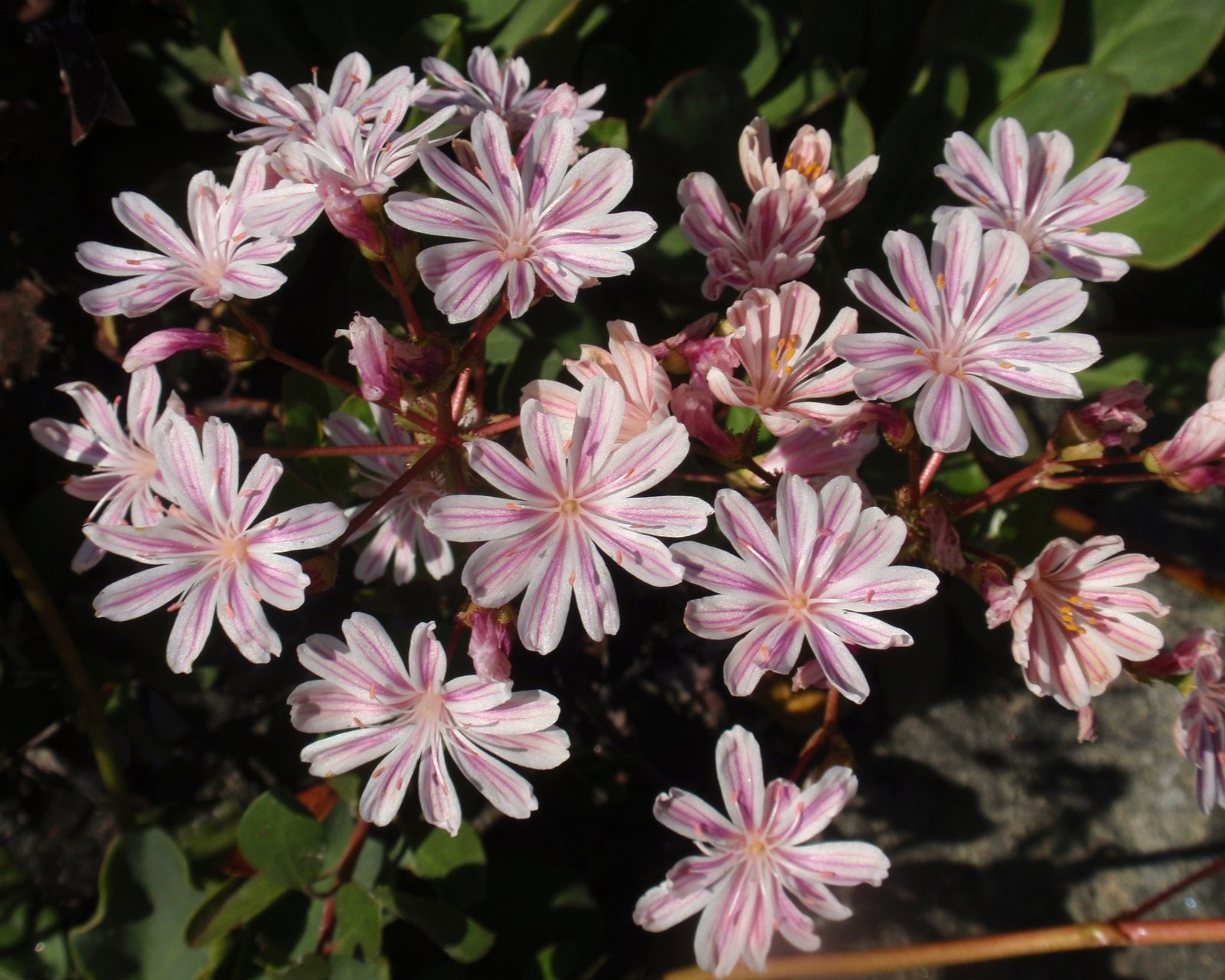
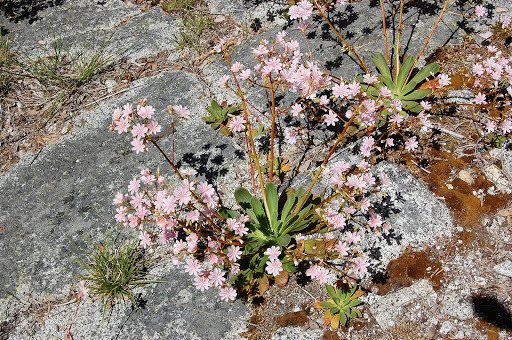
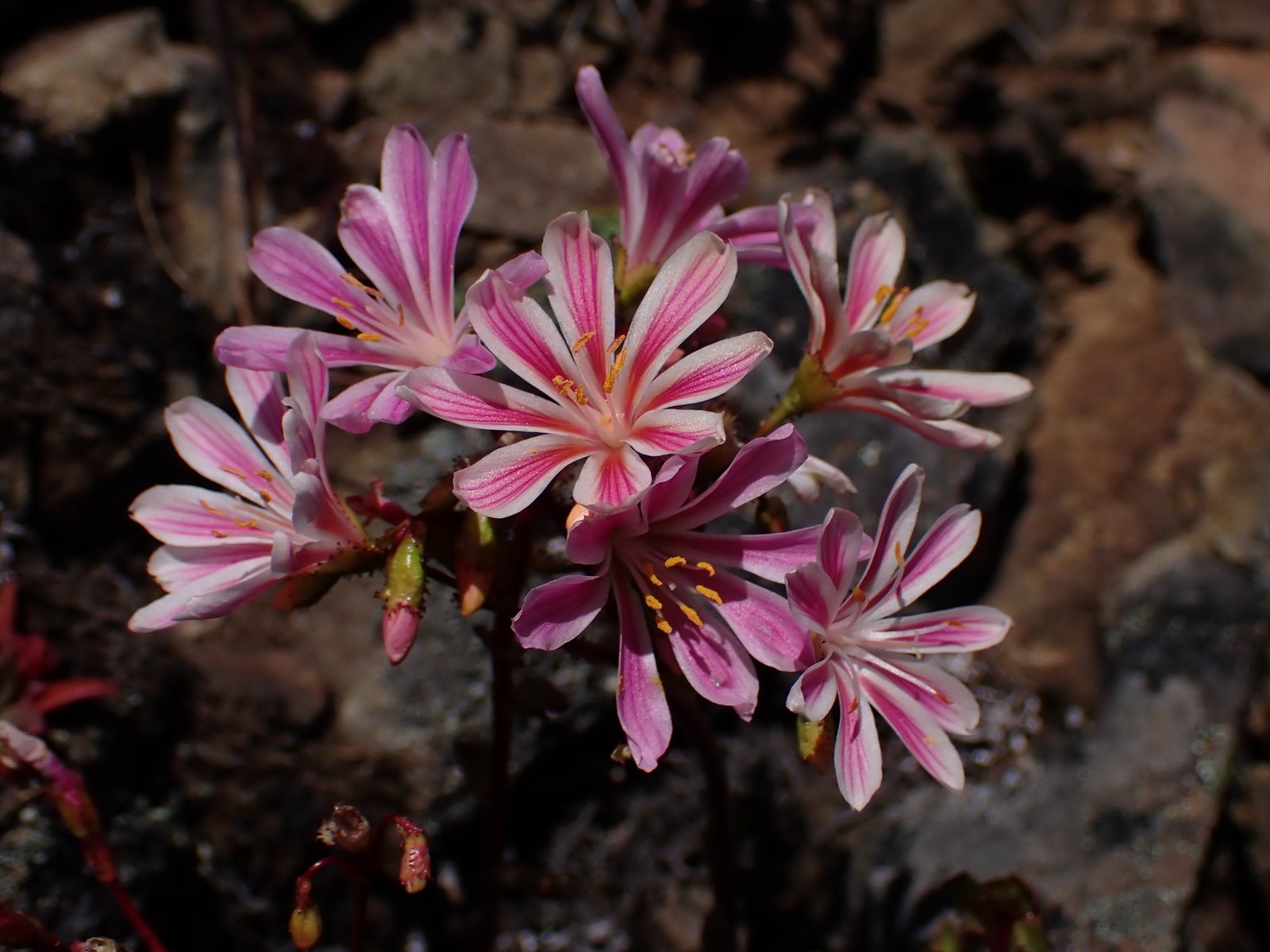
Siskiyou lewisia is a small, evergreen perennial with succulent leaf rosettes, native to rocky slopes in southern Oregon and northern California. Gardeners grow it for its bright flowers in rock gardens, crevices and containers, where its roots can drain freely and its crown stays dry.
At a glance
- Sun
- Full sun in cool climates; morning sun and afternoon shade where summers are hot.
- Water
- Water moderately during active growth, allowing the soil to dry slightly between waterings. Keep much drier in winter; persistent wetness is more dangerous than cold.
- Soil
- Very sharply drained, gritty soil, preferably slightly acidic to neutral. Avoid heavy clay and sites that collect winter water.
- Height
- 0.5-1 ft (0.15-0.3 m), including flower stems
- Spread
- 0.5-1 ft (0.15-0.3 m)
- Flowers
- Spring to early summer, sometimes repeating later; pink, rose, salmon, orange, yellow or white, often with contrasting stripes.
- Foliage
- Evergreen rosettes of thick, smooth, spoon-shaped leaves, sometimes with wavy or toothed edges.
- Growth
- Slow to moderate
- Care needed
- Medium
The year at a glance
- Pollinators
- Low allergen
| J | F | M | A | M | J | J | A | S | O | N | D | |
|---|---|---|---|---|---|---|---|---|---|---|---|---|
| Flowers | ||||||||||||
| Plant |
Northern hemisphere months. In Australia, shift them by six.
- Difficulty
- Moderate
- Toughness
- Needs looking after
Will it suit your garden?
Pick your zone, country, light and whether you have pets.
Full sun is 6 or more hours of direct sun a day, part shade 3 to 6 hours, shade under 3.
How it grows
Planting day
0.7 ft (0.22 m)
full size
About 4 years to full size.
From a typical nursery size, at an average rate for this kind of plant. A rule of thumb, not a forecast.
Good to know
- Cats and dogs
- Safe
- Native to
- the US
- Growth rate
- Slow
Care
Jobs through the year
- WaterMar–May, Sep–Oct, every 14 days
- Water established plants only when the root zone begins drying; keep water off rosettes.
- WaterJun–Aug, every 7 days
- Water if the root zone is drying; young plants need closer checks, but never saturated soil.
- FeedMar–Apr
- Give one light application of dilute balanced fertilizer as growth starts.
- MulchMar
- Refresh a thin grit dressing around the raised crown; avoid organic mulch.
- PruneMar, Oct
- Carefully remove dry dead leaves and debris without damaging the crown.
- DeadheadMay–Aug, every 14 days
- Cut faded flower stems to their base unless saving seed.
- ProtectJun–Aug
- Provide afternoon shade during hot spells.
- ProtectJan–Feb, Oct–Dec
- Shelter crowns from persistent rain while maintaining airflow and sharp drainage.
- Plant the crown slightly above the soil surface, preferably tilted into a slope or rock crevice so water drains away.
- Use a gritty, free-draining compost in a container with unobstructed drainage holes.
- Water the soil rather than the rosette; let excess water drain away completely.
- Apply a light, dilute balanced feed in spring; avoid heavy feeding.
- Top-dress with grit rather than moisture-retaining organic mulch, and shelter containers from prolonged winter rain.
Pruning. Cut spent flower stems back to their base after flowering, unless saving seed. Remove dead leaves carefully when dry, without damaging the crown.
Through the year
- Early spring
- Remove dead leaves and check that grit and drainage holes are not clogged.
- Spring
- Plant or repot into sharply drained soil, keeping the crown above the surrounding surface.
- Spring
- Give a light feed as new growth and flower stems develop.
- Late spring to early summer
- Remove faded flower stems, or leave a few to collect seed.
- Summer
- Water when the root zone begins to dry and provide afternoon shade during hot spells.
- Autumn
- Clear fallen leaves from rosettes and move pots out of persistent rain.
- Winter
- Keep crowns dry and check for rot during mild, wet weather.
In the garden
- Tuck into sloping rock crevices, where flowers rise above the stone and crowns shed rain.
- Plant in an alpine trough with dwarf saxifrages and houseleeks for contrasting rosette shapes.
- Use in small terracotta pots on a sheltered patio, bringing the flowers close enough to inspect.
- Place at the front of a raised gravel bed with low-growing alpine plants, away from vigorous neighbours.
Garden styles it suits: Alpine rock garden, Mountain lodge, Dry gravel garden, Small-space and Pacific Northwest woodland.
Plant it with: Houseleeks, Dwarf saxifrages, Alpine pinks, Creeping thyme and Dwarf stonecrops.
Wildlife: Flowers provide nectar and pollen for visiting bees and other insects, although this small plant offers limited habitat.
Problems to watch for
- Crown and root rot: prevent standing water, keep soil away from the crown and provide winter rain shelter; discard plants with extensively rotted crowns.
- Slugs and snails: inspect around rosettes and pots after dark, remove hiding places and use suitable slug controls if needed.
- Aphids on flower stems: wipe off small colonies or use an insecticidal soap labelled for ornamental plants, avoiding open flowers.
- Heat stress and leaf scorch: provide afternoon shade and keep pots away from heat-reflecting walls in hot climates.
Safety
Not known to be toxic to people, cats, dogs or horses. Species-specific safety information is limited, and no part should be treated as food.
Easily confused with
Bitterroot (Lewisia rediviva)
Has narrow, almost cylindrical leaves that usually die back before its large pink or white flowers open; Siskiyou lewisia retains broad, flat leaf rosettes.
Tweedy's lewisia (Lewisiopsis tweedyi)
Usually has larger, broader, fleshy leaves and fewer, larger cream, peach or pink flowers; Siskiyou lewisia generally carries more flowers in branched clusters.
The name
Lewisia honours the American explorer Meriwether Lewis, while Siskiyou refers to the mountain region where this plant grows.
Propagation. Sow fresh seed in gritty compost and expose it to a cool winter period; germination can be uneven. Detach offsets in spring only when they have their own roots. Seedlings from garden hybrids may differ in flower colour from their parents.
Checked against open data
- Accepted botanical name
- Lewisia cotyledon
- In the US and Canada
- Native in the lower 48 states.
- Native range
- California and Oregon.
Sources: GBIF (CC BY 4.0), USDA PLANTS and Trefle (CC BY 4.0). The care and design notes are LandscapeGPT's own.
See it in your own yard.
Upload a photo of your yard and see it redesigned with plants that suit your climate, each checked against your zone.