Skyrocket juniper
Juniperus scopulorum 'Skyrocket'. Family Cupressaceae. Tree.
Also called Skyrocket Rocky Mountain juniper.
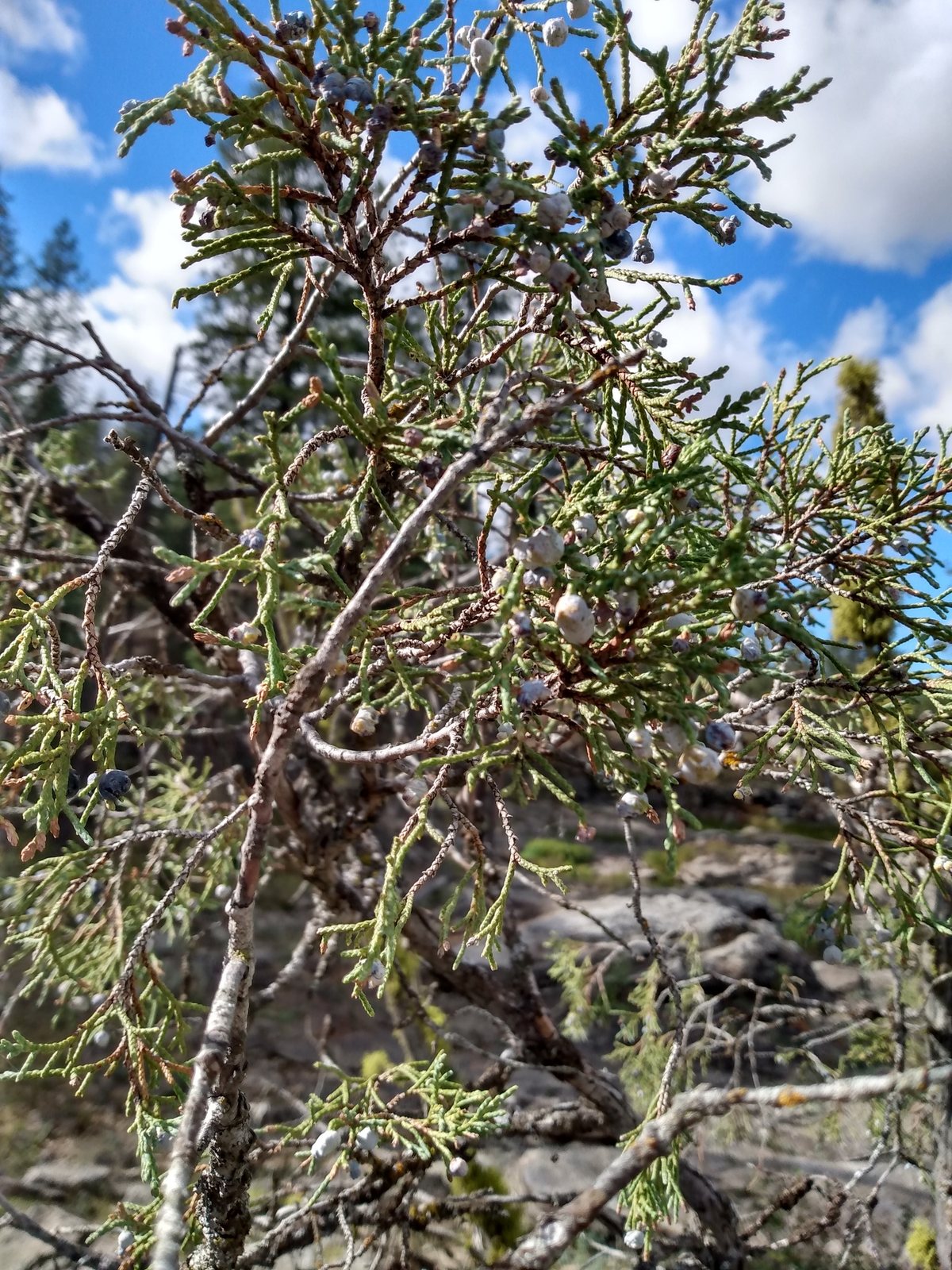
Skyrocket juniper is a very narrow evergreen conifer with upright branches and blue-grey foliage. Gardeners use it for vertical accents, paired planting and slim screens where a broad tree would take too much space. It performs best in full sun with freely draining soil, rather than in humid, poorly ventilated sites.
At a glance
- Sun
- Full sun; shade produces looser growth and poorer foliage colour.
- Water
- Water regularly while establishing; drought tolerant once rooted. Avoid persistently wet soil.
- Soil
- Well-drained sandy, gravelly or loamy soil; tolerates alkaline conditions. Heavy clay is suitable only where drainage is good.
- Height
- 15-20 ft (4.5-6 m), sometimes taller with age
- Spread
- 2-3 ft (0.6-0.9 m), sometimes wider with age
- Foliage
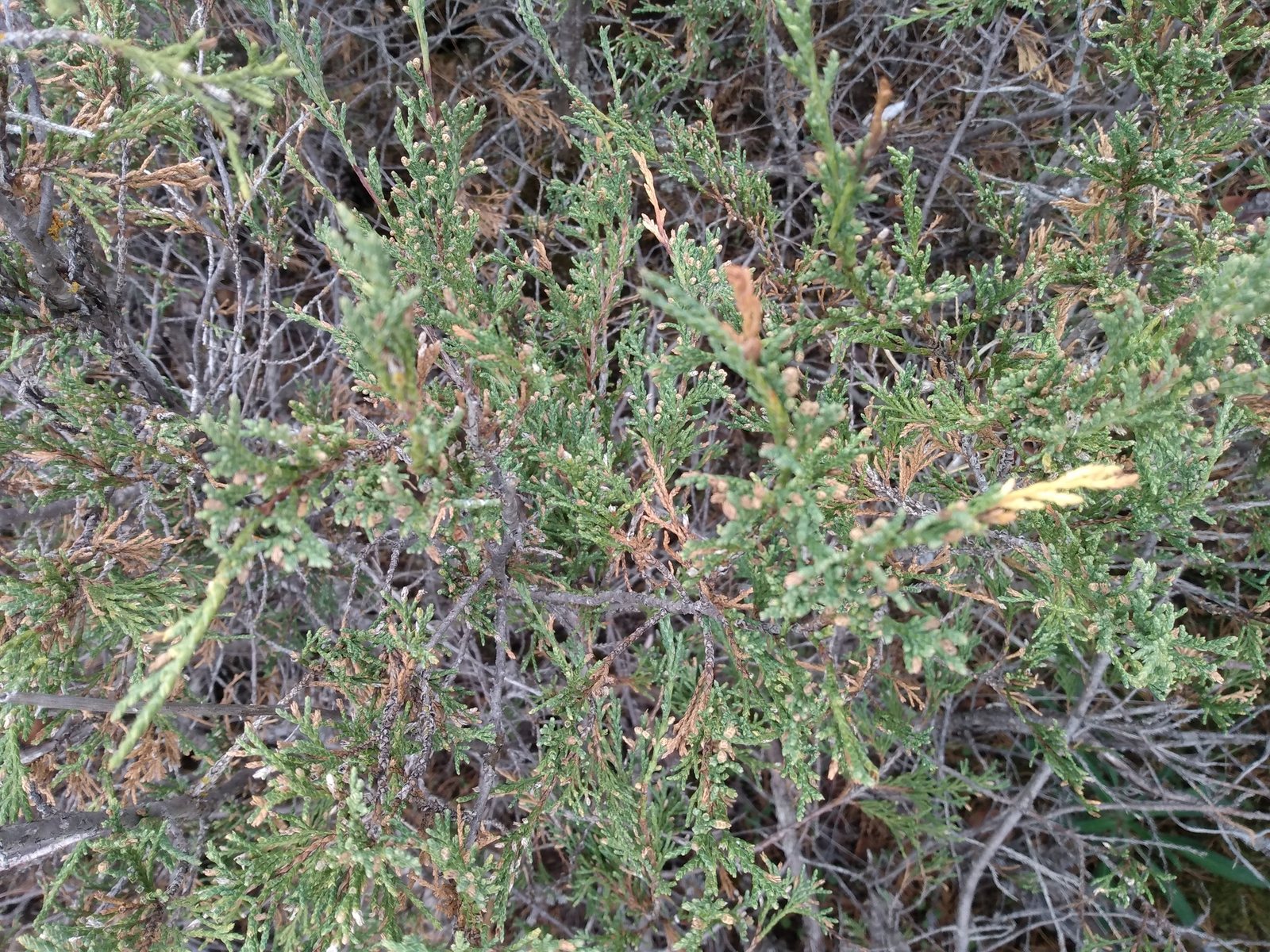
- Evergreen. Dense, blue-grey to silvery-blue foliage, mainly small overlapping scales; young shoots may carry sharper, needle-like leaves.
- Growth
- Moderate, commonly 6-12 in (15-30 cm) a year once established.
- Care needed
- Low
The year at a glance
- Deer resistant
- Drought tolerant
- Cold hardy
- Wildlife
| J | F | M | A | M | J | J | A | S | O | N | D | |
|---|---|---|---|---|---|---|---|---|---|---|---|---|
| Plant |
Northern hemisphere months. In Australia, shift them by six.
- Difficulty
- Easy
- Toughness
- Very tough
Will it suit your garden?
Pick your zone, country, light and whether you have pets.
Full sun is 6 or more hours of direct sun a day, part shade 3 to 6 hours, shade under 3.
How it grows
Planting day
7 ft (2 m)
After 1 year
7 ft (2.2 m)
After 2 years
8 ft (2.3 m)
After 3 years
8 ft (2.5 m)
After 5 years
9 ft (2.8 m)
About 20 years to full size.
From a typical nursery size, at an average rate for this kind of plant. A rule of thumb, not a forecast.
Good to know
- Cats and dogs
- Mildly toxic: may upset a stomach
- Native to
- the US and Canada
- Growth rate
- Moderate
Care
Jobs through the year
- WaterApr–May, Sep–Nov, every 21 days
- For established trees, water deeply only if soil is dry; young trees need more frequent watering.
- WaterJun–Aug, every 14 days
- Water established trees only during prolonged drought; let soil partly dry between soakings.
- MulchMar–Apr
- Maintain 5–8 cm of mulch over roots, keeping the trunk and root flare clear.
- PruneMay–Jun
- Lightly shorten stray green shoots if needed; never cut into bare old wood.
- ProtectJan–Feb, Dec
- Gently brush off loose snow before it freezes; do not pull or strike frozen branches.
- Water deeply during dry spells for the first two growing seasons; let the soil begin to dry between waterings.
- Plant with the root flare at soil level and avoid sites where winter water collects.
- Apply 2-3 in (5-8 cm) of mulch over the root area, keeping it clear of the trunk.
- Do not feed routinely; use a modest spring application of balanced fertiliser only if growth is weak and a nutrient shortage is likely.
- Allow space between plants for air circulation rather than crowding them into an immediately solid screen.
- Gently brush off loose snow before it freezes onto branches; do not strike or pull frozen branches.
Pruning. In late spring or early summer, lightly shorten stray green shoots if needed to preserve the narrow outline. Remove dead or damaged branches promptly, but do not cut back into bare old wood because it rarely regrows.
Through the year
- Late winter
- Inspect for snow or wind damage and remove broken branches during frost-free weather.
- Spring
- Plant when the ground is workable, water thoroughly and mulch without covering the trunk base.
- Late spring
- Check shoot tips for dieback and lightly trim any branches that spoil the outline.
- Summer
- Water young plants during dry spells and check bronzing foliage for spider mites.
- Autumn
- Water before the ground freezes if autumn has been dry, especially for recently planted trees.
In the garden
- Place a matching pair beside a sunny entrance or gateway to create upright markers.
- Repeat along a boundary for a narrow evergreen screen, allowing for the mature spread.
- Use among low grasses, lavender and gravel to contrast slender blue columns with soft, spreading forms.
- Set behind low shrubs in a small sunny border to provide height without a broad canopy.
Garden styles it suits: Architectural minimal, Formal, Contemporary minimal, Dry gravel garden, Desert / xeriscape and Winter interest.
Plant it with: English lavender, Russian sage, Catmint, Blue fescue, Creeping thyme and Stonecrop.
Wildlife: Dense evergreen branches provide shelter and potential nesting cover for small birds. Junipers can also support insects and mites eaten by birds.
Problems to watch for
- Root rot in waterlogged soil: improve drainage before planting; severely affected trees usually need replacing in a better-drained position.
- Juniper tip blight: prune out dead shoot tips in dry weather, clean tools between cuts and avoid overhead watering.
- Spider mites causing fine stippling and bronzing: confirm by tapping a branch over white paper, then wash foliage with water; use a labelled mite treatment if damage continues.
- Branches splaying under wet snow: remove loose snow gently and have badly split stems assessed; preventive, loose seasonal support may help exposed multi-stemmed plants.
Safety
Rocky Mountain juniper is reported to have low-severity toxicity if eaten: foliage and berry-like cones may cause digestive upset in people, and foliage can irritate sensitive skin. Reliable toxicity information specific to this cultivar in cats, dogs and horses is limited; prevent substantial ingestion and seek veterinary advice if an animal develops symptoms. Do not use its cones as culinary juniper berries.
Easily confused with
Blue Arrow juniper (Juniperus scopulorum 'Blue Arrow')
Usually has tighter, more closely held branches and a denser, slimmer outline. Young plants can be difficult to distinguish reliably without a label.
Italian cypress (Cupressus sempervirens)
Upright forms have a similar columnar silhouette but generally darker green foliage and much larger, woody, rounded cones rather than small berry-like juniper cones.
Pencil Point juniper (Juniperus communis 'Compressa')
A much smaller, slower-growing column with prickly needle leaves marked by pale bands, rather than predominantly scale-like blue-grey foliage.
The name
Juniperus is the Latin name for juniper, scopulorum means 'of rocky places', and 'Skyrocket' describes the cultivar's slender, upward-reaching shape.
Propagation. Take semi-ripe cuttings with a small heel in late summer or autumn and root in a freely draining medium under protected conditions. Rooting can be slow; seed will not reliably reproduce the cultivar.
Checked against open data
- Accepted botanical name
- Juniperus scopulorum
- In the US and Canada
- Native in Canada and the lower 48 states.
- Native range
- Alberta, Arizona, British Columbia, Colorado, Idaho, Mexico Northeast, Mexico Northwest, Montana, Nebraska, Nevada, New Mexico and North Dakota.
- Measured
- Soil pH 5 to 8.5. Average height 1200 cm.
Sources: GBIF (CC BY 4.0), USDA PLANTS and Trefle (CC BY 4.0). The care and design notes are LandscapeGPT's own.
See it in your own yard.
Upload a photo of your yard and see it redesigned with plants that suit your climate, each checked against your zone.