Snakebark maple
Acer davidii. Family Sapindaceae. Tree.
Also called Père David's maple, David's maple.
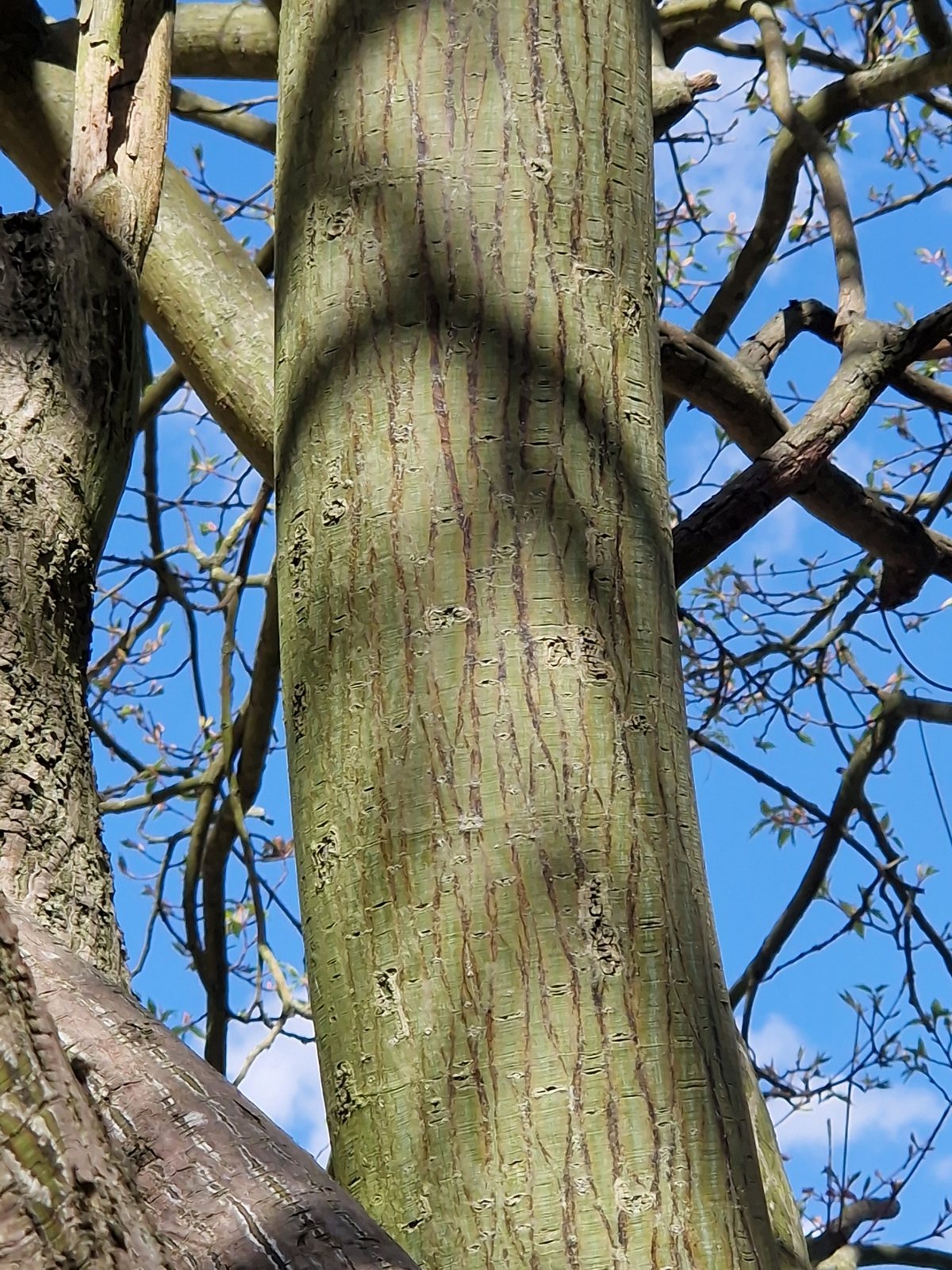
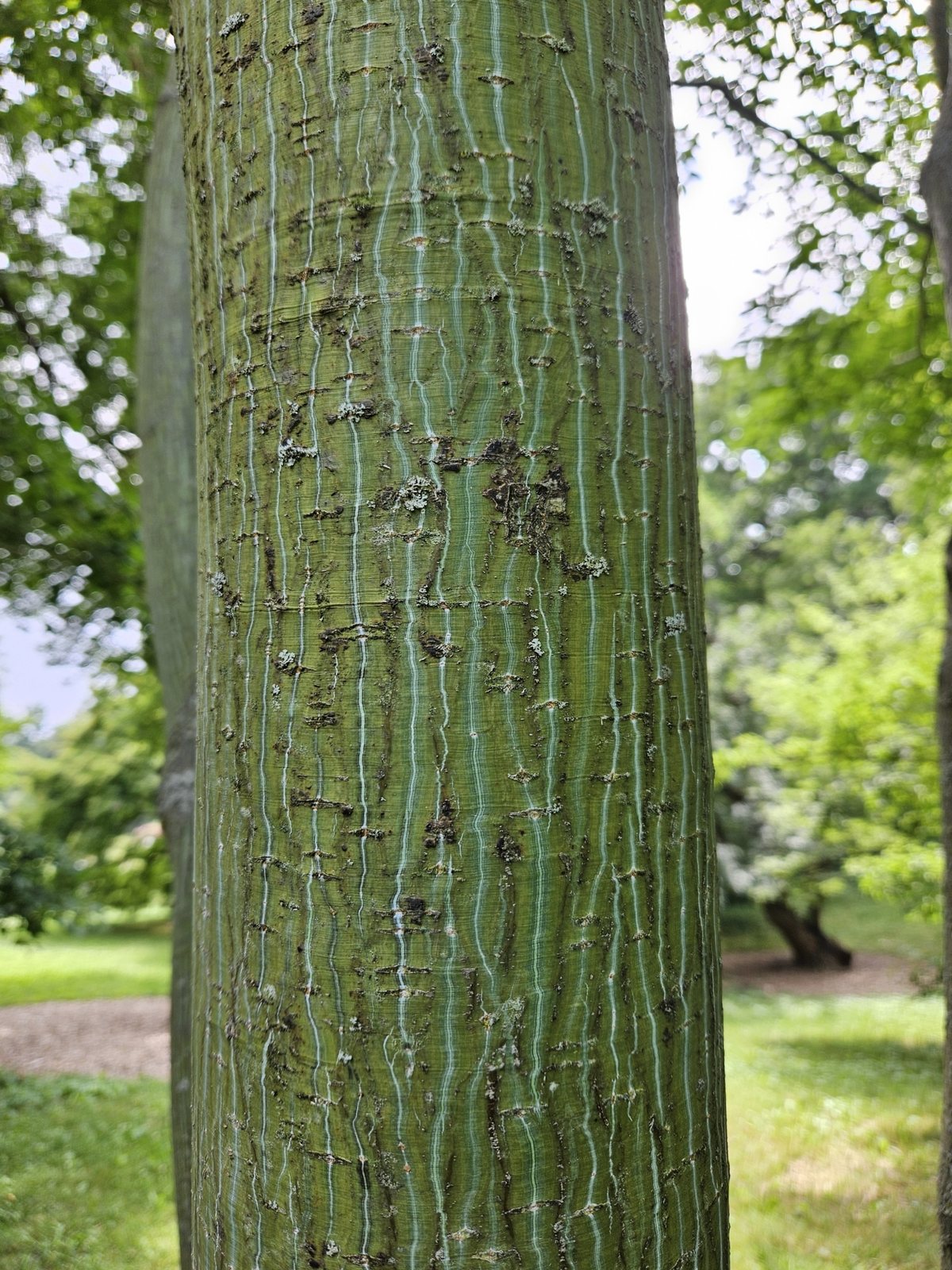
A deciduous Chinese maple grown for its green bark marked with pale vertical stripes, especially noticeable on young trunks and branches. Its arching crown gives light shade, and the leaves turn yellow, orange or red in autumn. It grows best in a sheltered garden with cool, moist soil rather than a hot, dry site.
At a glance
- Sun
- Partial shade or full sun where summers are cool; shelter from strong winds and hot afternoon sun.
- Water
- Moderate; keep the root zone evenly moist but not waterlogged. Water deeply during dry spells, especially while establishing.
- Soil
- Humus-rich, well-drained soil, preferably slightly acidic to neutral. Avoid compacted ground, standing water and shallow, drought-prone soil.
- Height
- 30-50 ft (9-15 m)
- Spread
- 20-35 ft (6-10.5 m)
- Flowers
- Small yellow-green flowers in hanging clusters in spring; not especially showy.
- Foliage
- Opposite, dark green, toothed leaves, usually oval and unlobed or shallowly three-lobed; yellow, orange or red autumn colour varies with the tree and growing conditions.
- Growth
- Moderate
- Care needed
- Low
The year at a glance
- Pollinators
- Wildlife
- Low allergen
| J | F | M | A | M | J | J | A | S | O | N | D | |
|---|---|---|---|---|---|---|---|---|---|---|---|---|
| Flowers | ||||||||||||
| Fruit | ||||||||||||
| Plant |
Northern hemisphere months. In Australia, shift them by six.
- Difficulty
- Easy
- Toughness
- Fairly tough
Will it suit your garden?
Pick your zone, country, light and whether you have pets.
Full sun is 6 or more hours of direct sun a day, part shade 3 to 6 hours, shade under 3.
How it grows
Planting day
7 ft (2 m)
After 1 year
8 ft (2.5 m)
After 2 years
10 ft (3 m)
After 3 years
11 ft (3.5 m)
After 5 years
15 ft (4.5 m)
About 20 years to full size.
From a typical nursery size, at an average rate for this kind of plant. A rule of thumb, not a forecast.
Good to know
- Cats and dogs
- Safe
- Growth rate
- Moderate
Care
Jobs through the year
- WaterApr–May, Sep–Oct, every 14 days
- For established trees, water deeply only if soil is drying; water more often during the first two years.
- WaterJun–Aug, every 7 days
- During dry spells, soak the established root zone; skip when soil remains moist.
- MulchMar–Apr
- Apply 5–8 cm of leaf mould or composted bark, keeping the trunk clear.
- FeedApr
- Feed modestly only if growth is poor and soil fertility is low.
- PruneAug
- Remove damaged or crossing branches sparingly; preserve the natural crown.
- ProtectJan–Feb, Nov–Dec
- Check young trunks for browsing and loosen tight stakes or ties.
- Plant with the root flare at soil level, allowing enough space for the mature crown.
- Water deeply through the first two growing seasons and during prolonged drought thereafter.
- Apply 2-3 in (5-8 cm) of leaf mould or composted bark over the root zone, keeping it clear of the trunk.
- Avoid routine feeding; use a modest spring application of balanced fertiliser only if growth is poor and soil fertility is low.
- Stake only on exposed sites, using flexible ties, and remove the support once the roots anchor the tree.
Pruning. Prune sparingly in late summer, removing damaged, crossing or badly placed branches and retaining the natural outline. Avoid late-winter and spring pruning, when maples can bleed sap heavily.
Through the year
- Autumn
- Plant while the soil is workable and moist; in very cold climates, postpone planting until spring.
- Winter
- Check young trunks for browsing damage and loosen any tight stakes or ties.
- Spring
- Renew mulch and begin regular watering for newly planted trees.
- Summer
- Water deeply during dry weather and check for leaf scorch, especially in exposed positions.
- Late summer
- Remove damaged or crossing branches if necessary; avoid heavy crown thinning.
- Late autumn
- Collect healthy fallen leaves for leaf mould and check that mulch is not touching the trunk.
In the garden
- Use as a specimen beside a path where the striped bark can be seen closely in winter.
- Plant at a woodland edge with ferns and shade-tolerant perennials beneath its light canopy.
- Set against a dark evergreen backdrop to make the pale bark stripes stand out.
- Combine with other restrained autumn-colour plants in a sheltered lawn or spacious courtyard.
Garden styles it suits: Woodland, Japanese, Chinese scholar garden, Winter interest, Autumn colour and Pacific Northwest woodland.
Plant it with: Japanese forest grass, Epimedium, Hellebores, Hardy cyclamen, Japanese painted fern and Camellias.
Wildlife: Spring flowers provide food for visiting insects, and the canopy offers shelter and nesting sites for birds. It is not a native tree in the United States, United Kingdom, Canada or Australia.
Problems to watch for
- Leaf scorch: brown leaf edges usually indicate drought, drying wind or excessive heat. Water deeply, mulch and provide shelter; avoid hot, exposed planting sites.
- Verticillium wilt: sudden branch wilt or dieback can indicate this soil-borne disease. Seek a diagnosis, remove dead wood and avoid replanting susceptible trees in affected soil.
- Aphids: colonies can cause curled growth and sticky honeydew. Tolerate light infestations, encourage predators and wash accessible shoots with water if necessary.
- Poor establishment or root decline: compacted or waterlogged soil can cause sparse growth and dieback. Correct drainage and planting depth rather than adding fertiliser.
Safety
Not known to be toxic to people, cats or dogs, though it is not an edible plant. Horse safety is not well established for this species; because some other maples can cause serious poisoning, keep horses away from its leaves, seeds and seedlings rather than assuming it is safe.
Easily confused with
Striped maple (Acer pensylvanicum)
Also has striped green bark, but its leaves are broad with three large, conspicuous pointed lobes; Père David's maple usually has oval, unlobed or only shallowly lobed leaves.
Redvein maple (Acer rufinerve)
Usually has clearly three-lobed leaves with conspicuous rusty hairs along the main veins underneath. Père David's maple generally has less-lobed leaves with much less hair beneath.
The name
The name davidii honours the French missionary and naturalist Père Armand David, while snakebark refers to the pale stripes on the green bark.
Propagation. Usually grown from seed. Fresh seed sown outdoors in autumn receives natural winter chilling, but germination can be slow and uneven. Named forms are generally propagated by grafting to preserve their characteristics.
Checked against open data
- Accepted botanical name
- Acer davidii
- Native range
- China North-Central, China South-Central, China Southeast, Inner Mongolia and Myanmar.
- Measured
- Average height 1310 cm.
Sources: GBIF (CC BY 4.0) and Trefle (CC BY 4.0). The care and design notes are LandscapeGPT's own.
See it in your own yard.
Upload a photo of your yard and see it redesigned with plants that suit your climate, each checked against your zone.