Snow gum
Eucalyptus pauciflora. Family Myrtaceae. Tree.
Also called White sallee, Cabbage gum.
Snow gum is an evergreen Australian tree grown for its smooth, patchwork bark, grey-green leaves and often twisted, spreading branches. It makes a striking specimen where there is room for its mature crown and roots. Cold tolerance varies with seed origin; ordinary snow gum should not be assumed to match the hardiest alpine subspecies.
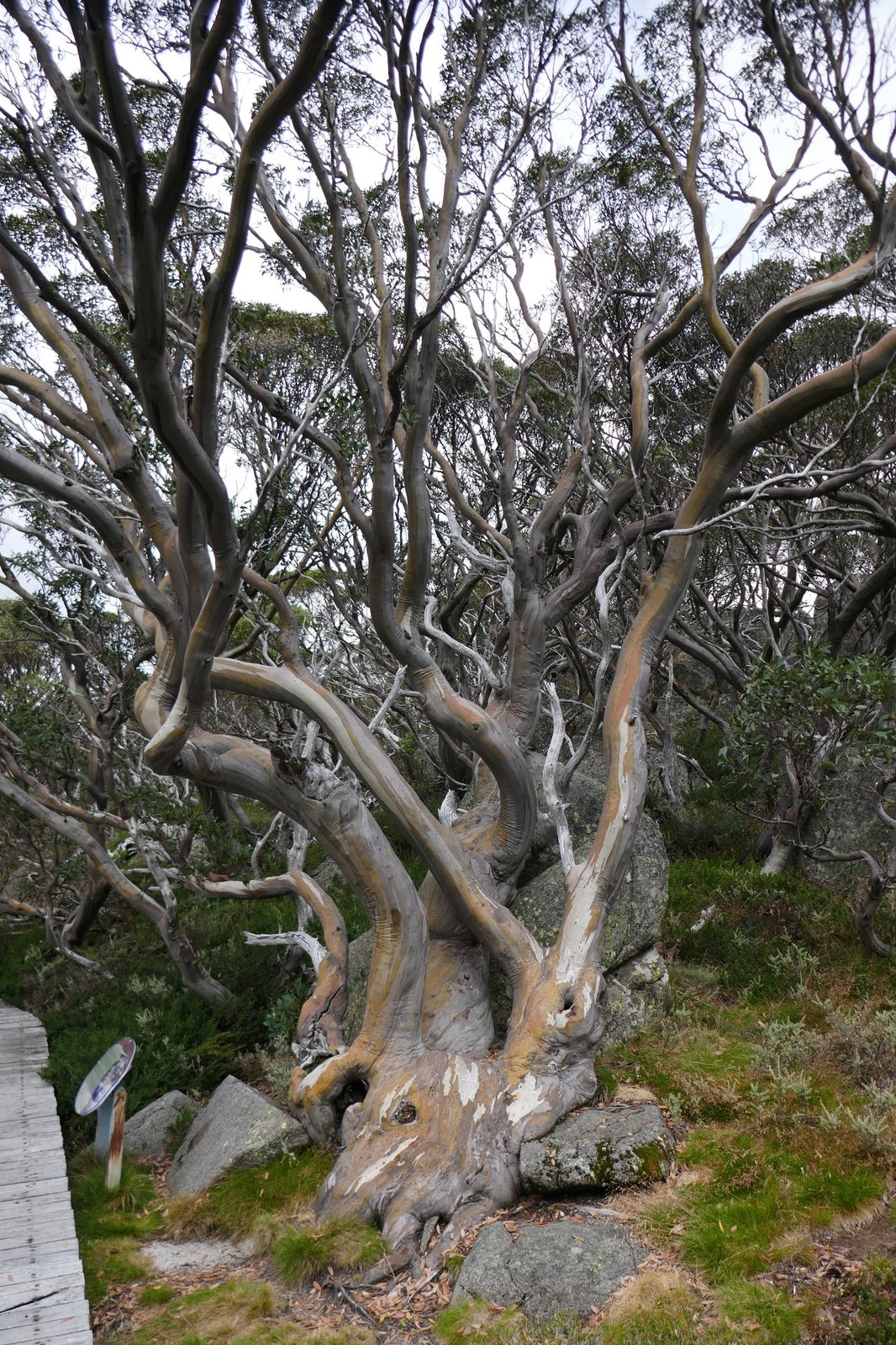
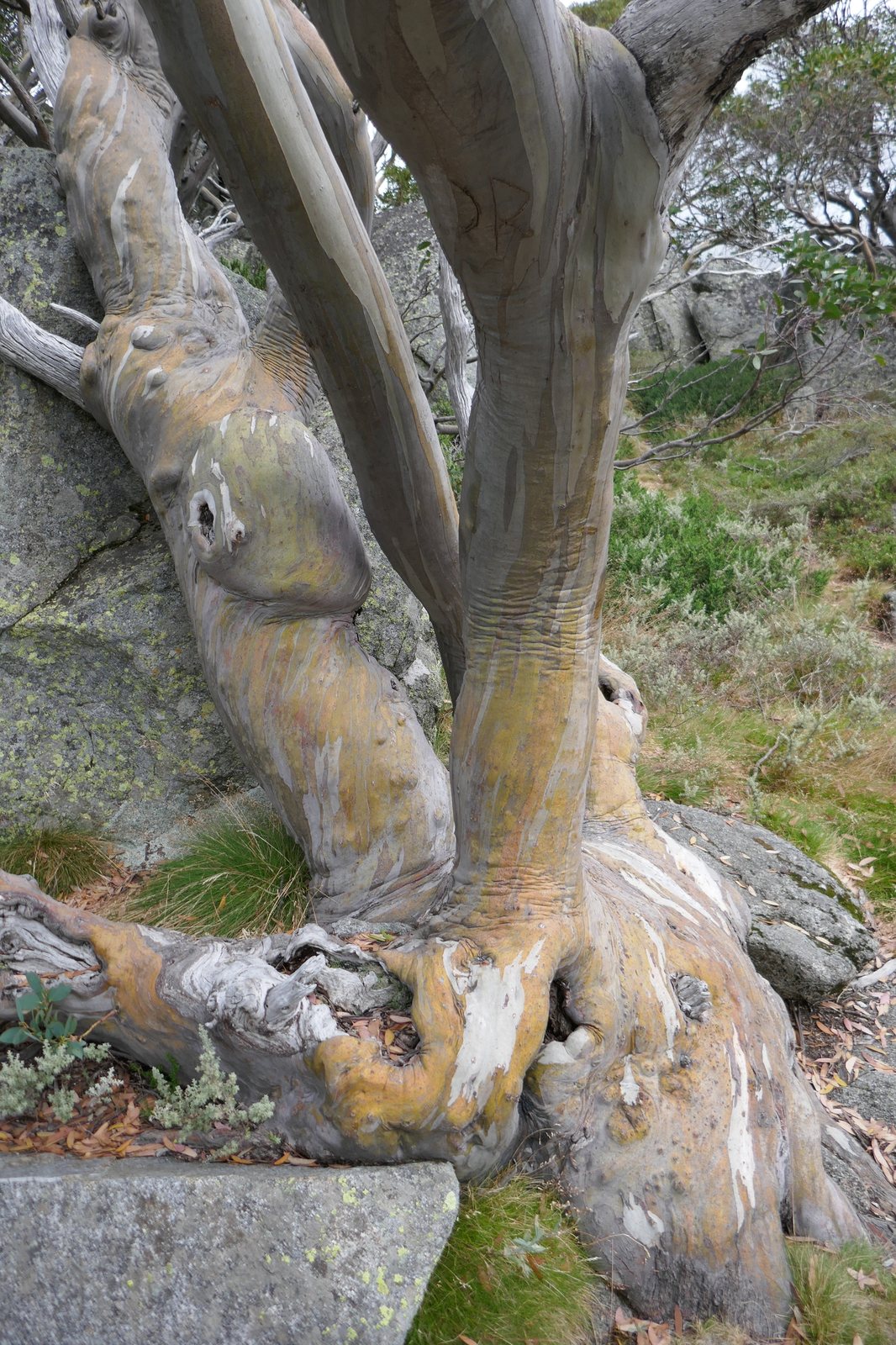
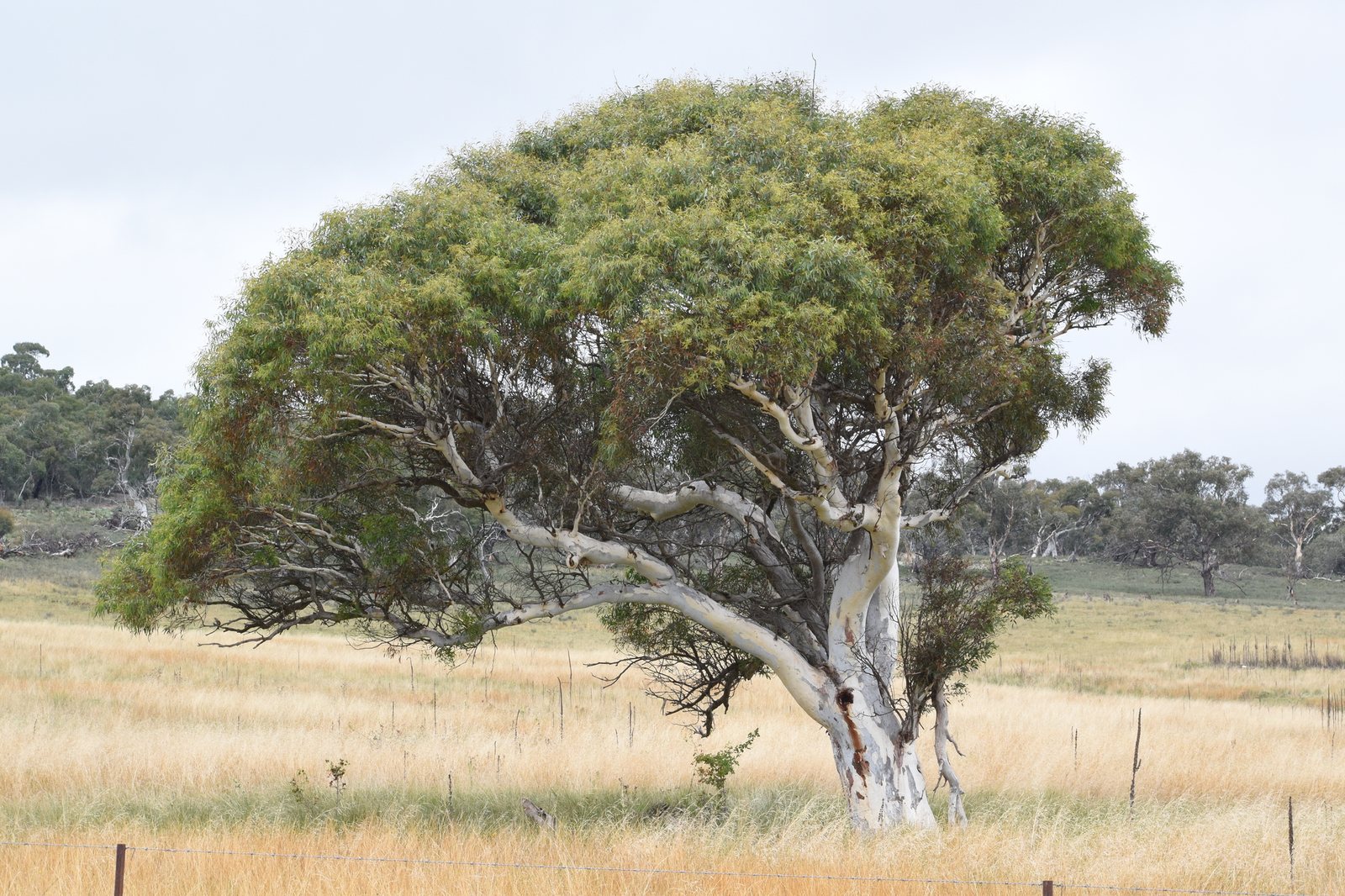
At a glance
- Sun
- Full sun; choose an open position with shelter from severe, drying winds while young.
- Water
- Water regularly while establishing, allowing the surface soil to dry between soakings. Established trees tolerate dry periods but benefit from deep watering during prolonged drought.
- Soil
- Well-drained sandy, loamy or clay soil, preferably slightly acidic to neutral. Avoid persistently waterlogged ground.
- Height
- 30-60 ft (9-18 m), occasionally taller in favourable conditions
- Spread
- 20-40 ft (6-12 m)
- Flowers
- Clusters of small, creamy-white flowers, usually in late spring and summer; timing varies with climate.
- Foliage
- Evergreen, leathery, grey-green to blue-green leaves. Adult leaves are lance-shaped or curved, with several prominent veins running lengthwise.
- Growth
- Moderate to fast when young, depending on moisture, climate and seed origin.
- Care needed
- Medium
The year at a glance
- Pollinators
- Deer resistant
- Drought tolerant
- Wildlife
- Fragrant
| J | F | M | A | M | J | J | A | S | O | N | D | |
|---|---|---|---|---|---|---|---|---|---|---|---|---|
| Flowers | ||||||||||||
| Plant |
Northern hemisphere months. In Australia, shift them by six.
- Difficulty
- Moderate
- Toughness
- Fairly tough
Will it suit your garden?
Pick your zone, country, light and whether you have pets.
Full sun is 6 or more hours of direct sun a day, part shade 3 to 6 hours, shade under 3.
How it grows
Planting day
7 ft (2 m)
After 1 year
9 ft (2.7 m)
After 2 years
11 ft (3.4 m)
After 3 years
14 ft (4.2 m)
After 5 years
18 ft (5.6 m)
About 16 years to full size.
From a typical nursery size, at an average rate for this kind of plant. A rule of thumb, not a forecast.
Good to know
- Cats and dogs
- Toxic
- Native to
- Australia
- Growth rate
- Fast
Care
Jobs through the year
- WaterApr–May, Sep, every 21 days
- Water established trees only in prolonged drought; water young trees whenever the root zone dries.
- WaterJun–Aug, every 14 days
- Deep-water established trees during prolonged drought; check trees in their first two years weekly.
- MulchOct
- Renew a broad organic mulch, keeping it away from the trunk.
- PruneMar–Apr
- After severe frosts, remove damaged or crossing small branches; avoid topping or cutting large limbs.
- ProtectJan–Feb, Nov–Dec
- Shelter young trees from drying winds and severe frost; ordinary outdoor planting is unreliable in zone 6.
- Plant a small, healthy tree in its permanent position; eucalyptus trees resent root disturbance and being kept too long in pots.
- Water deeply through the first two growing seasons, especially during dry weather.
- Apply a broad organic mulch, keeping it clear of the trunk.
- Avoid routine heavy feeding; use a modest amount of slow-release fertiliser only if growth is poor and soil fertility is low.
- Stake only if needed on an exposed site, use flexible ties, and remove the support once the roots hold the tree securely.
- Allow ample room away from buildings, drains and busy seating areas; mature trees shed bark, twigs and sometimes branches.
Pruning. Prune lightly in late winter or early spring after the worst frosts, removing dead, damaged or crossing branches and correcting weak forks while the tree is young. Avoid topping or removing large limbs from a mature tree; use a qualified arborist for substantial work.
Through the year
- Spring
- Plant young trees once severe frost has passed, and water thoroughly.
- Late spring
- Check new shoots for psyllids and sap-sucking insects; avoid unnecessary spraying.
- Summer
- Deep-water young trees during dry spells and check that ties are not cutting into the trunk.
- Autumn
- Renew mulch and clear accumulated bark and dry leaves from paths, gutters and areas near buildings.
- Winter
- Check young trees for wind rocking and make sure water is draining away from their roots.
- Late winter
- After severe frosts, assess branch damage and carry out only necessary formative pruning.
In the garden
- Use as a specimen in a large lawn or open garden where its branching shape can develop freely.
- Set against dark evergreen planting to show off the pale, mottled trunk.
- Combine with grasses and low shrubs in a spacious Australian-native planting.
- Use in a sunny gravel garden with drought-tolerant planting, leaving space around the trunk for maintenance.
Garden styles it suits: Australian native, Architectural minimal, Modern, Dry gravel garden, Winter interest and Wildlife garden.
Plant it with: Lomandra, Wallaby grass, Kangaroo grass, Westringia, Bottlebrush and Rockrose.
Wildlife: Flowers provide nectar and pollen for insects and, in Australia, nectar-feeding birds. Foliage supports native leaf-feeding insects, while older trees can provide nesting and shelter sites.
Problems to watch for
- Frost damage: young growth and poorly adapted seed sources can be injured in hard freezes. Buy locally proven stock and wait until spring growth begins before cutting back damaged shoots.
- Waterlogging and root disease: yellowing, decline or sudden wilting can follow prolonged wet soil. Improve drainage before planting; do not keep watering already saturated ground.
- Psyllids and lerps: sap-sucking insects may cause sticky deposits, leaf spotting or leaf drop. Keep young trees adequately watered and encourage predators; seek local advice if defoliation is severe.
- Poor anchorage: pot-bound roots, prolonged staking or wind rocking can leave trees unstable. Start with sound nursery stock, check ties regularly and have a leaning mature tree assessed by an arborist.
Safety
Leaves and essential oil are toxic if swallowed by cats, dogs, horses or people. Eating foliage can cause digestive upset and other poisoning symptoms; concentrated eucalyptus oil is particularly dangerous and can cause severe, potentially life-threatening poisoning. Keep prunings away from livestock and seek medical or veterinary advice after ingestion.
Easily confused with
Cider gum (Eucalyptus gunnii)
Young cider gum commonly has conspicuous round, opposite, blue-grey leaves. Snow gum develops longer leaves with distinctive lengthwise veins; adult foliage alone can be harder to distinguish.
Spinning gum (Eucalyptus perriniana)
Its rounded juvenile leaf pairs join around the stem, forming discs that may remain attached and spin when dry. Snow gum does not have these stem-encircling leaf discs.
The name
The common name refers to its occurrence in snowy Australian mountain country, while pauciflora means 'few-flowered', despite the tree often flowering freely.
Propagation. Usually grown from seed. Cold stratification can improve germination of seed from alpine populations; follow the supplier's instructions for the particular seed source. Plant seedlings out young before roots become crowded.
Checked against open data
- Accepted botanical name
- Eucalyptus pauciflora
- Native range
- New South Wales, Queensland, Tasmania and Victoria.
- Measured
- Average height 1740 cm.
Sources: GBIF (CC BY 4.0) and Trefle (CC BY 4.0). The care and design notes are LandscapeGPT's own.
See it in your own yard.
Upload a photo of your yard and see it redesigned with plants that suit your climate, each checked against your zone.