Spanish dagger
Yucca gloriosa. Family Asparagaceae. Shrub.
Also called Mound-lily yucca, Roman candle.
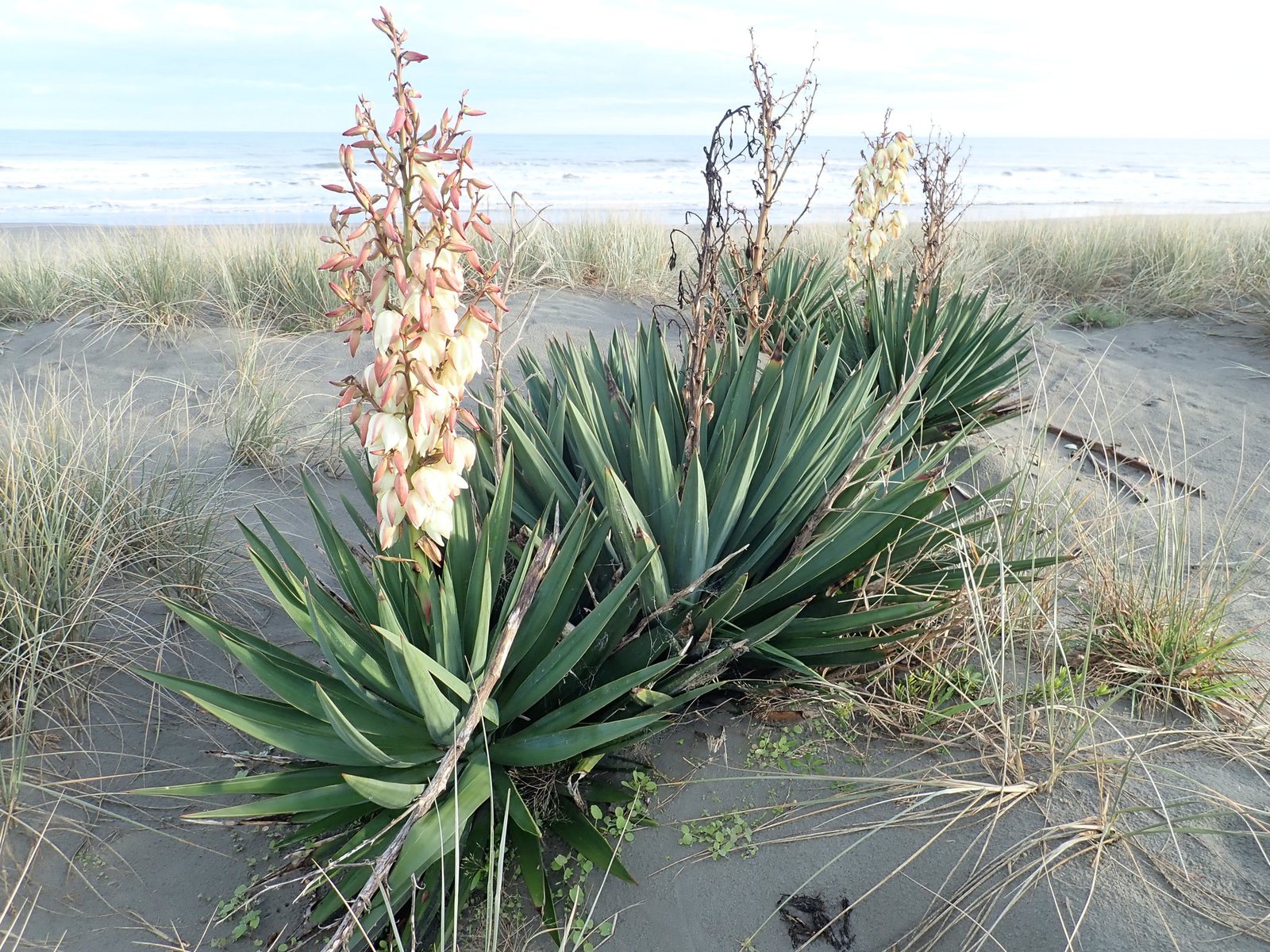
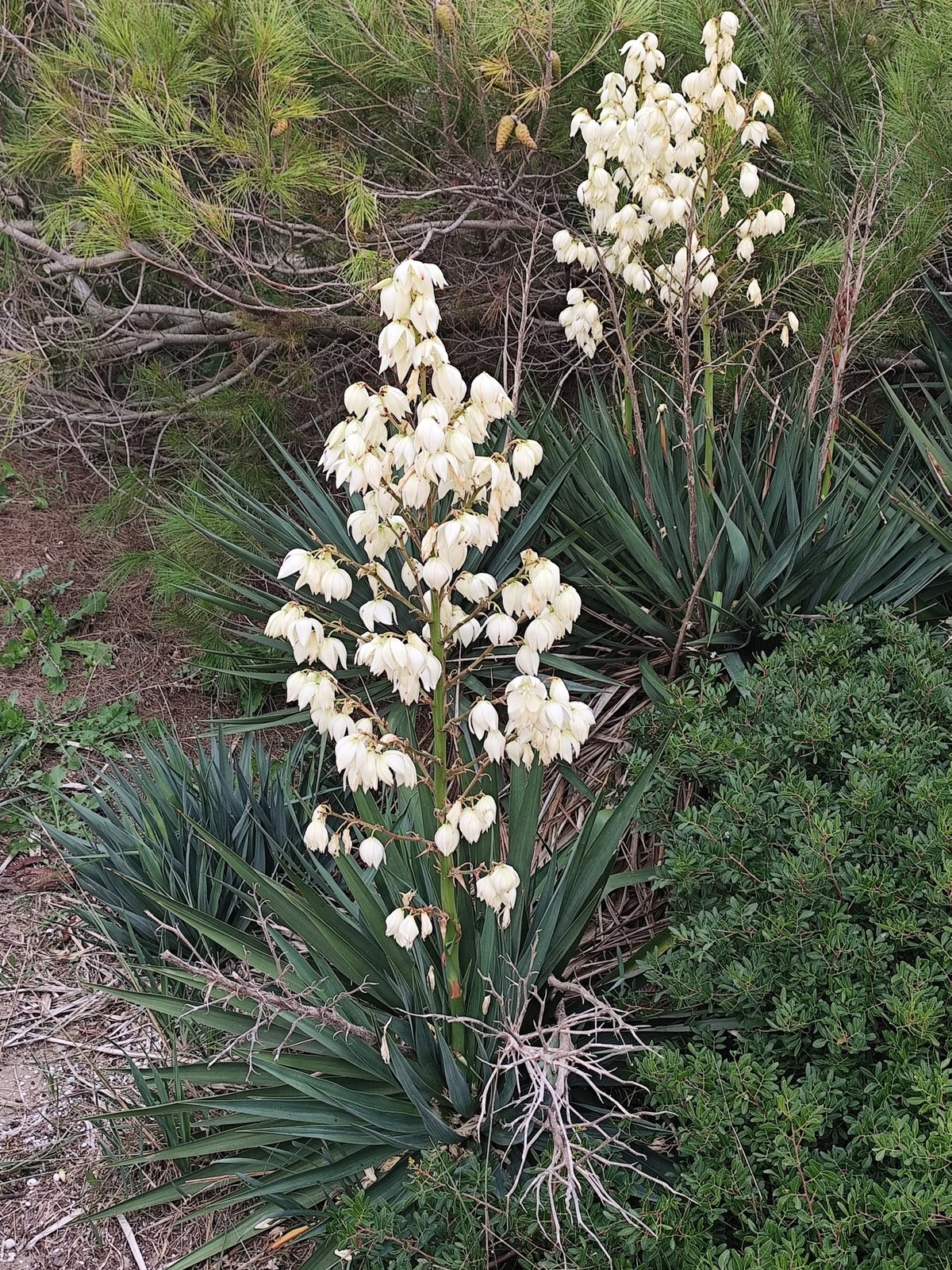
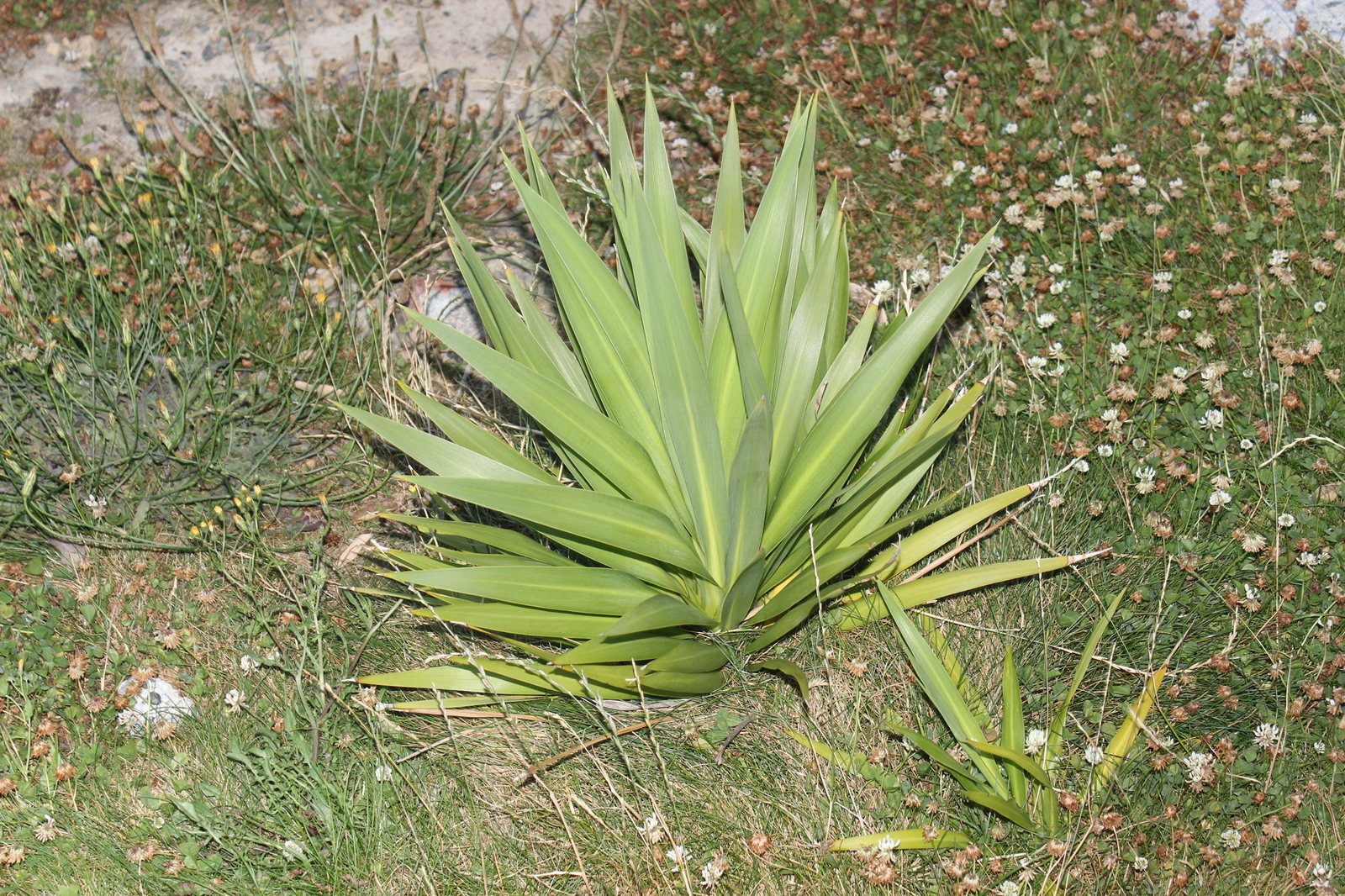
Spanish dagger is a slow-growing evergreen shrub with stiff, sword-shaped leaves, eventually forming a short trunk or a branching clump. Gardeners grow it for its bold outline and tall sprays of creamy-white flowers. It tolerates drought and coastal exposure, but needs excellent drainage and space away from people because its leaf tips are dangerously sharp.
At a glance
- Sun
- Full sun is best; tolerates light shade but may flower less freely.
- Water
- Low once established. Water young plants during dry spells; established plants usually need supplemental water only during prolonged drought.
- Soil
- Well-drained sandy, gravelly or loamy soil; tolerates poor soil and a broad pH range. Avoid waterlogged clay, especially in winter.
- Height
- 4-8 ft (1.2-2.4 m), occasionally taller with age; flower stalks rise above the foliage
- Spread
- 3-5 ft (0.9-1.5 m), eventually wider where offsets form a clump
- Flowers
- Creamy-white, bell-shaped flowers in tall branching sprays, usually in summer or early autumn; flowering time varies with climate and plant maturity.
- Foliage
- Evergreen. Dense rosettes of stiff, blue-green to grey-green sword-shaped leaves with sharp terminal spines.
- Growth
- Slow
- Care needed
- Low
The year at a glance
- Pollinators
- Deer resistant
- Drought tolerant
- Heat tolerant
- Wildlife
- Low allergen
| J | F | M | A | M | J | J | A | S | O | N | D | |
|---|---|---|---|---|---|---|---|---|---|---|---|---|
| Flowers | ||||||||||||
| Plant |
Northern hemisphere months. In Australia, shift them by six.
- Difficulty
- Easy
- Toughness
- Very tough
Will it suit your garden?
Pick your zone, country, light and whether you have pets.
Full sun is 6 or more hours of direct sun a day, part shade 3 to 6 hours, shade under 3.
How it grows
Planting day
1.6 ft (0.5 m)
After 1 year
2.2 ft (0.66 m)
After 2 years
2.7 ft (0.83 m)
After 3 years
3 ft (0.99 m)
After 5 years
4 ft (1.3 m)
About 8 years to full size.
From a typical nursery size, at an average rate for this kind of plant. A rule of thumb, not a forecast.
Good to know
- Cats and dogs
- Toxic
- Native to
- the US
- Growth rate
- Slow
Care
Jobs through the year
- WaterApr–May, Sep, every 28 days
- Established plants usually need no water unless drought persists; water young plants as soil dries.
- WaterJun–Aug, every 21 days
- Water established plants only during prolonged drought, letting soil dry fully between soakings.
- PruneApr–May
- Remove dead lower leaves and unwanted offsets; wear gloves and eye protection.
- PruneAug–Oct
- Once flowering finishes, cut the spent stalk near its base without damaging the rosette.
- ProtectJan–Mar, Nov–Dec
- Clear debris from the crown and shelter from persistent winter wet; zone 6 requires extra cold protection.
- Plant with the crown at soil level in freely draining ground; use a raised mound where drainage is doubtful.
- Water deeply during establishment, then allow the soil to dry between waterings.
- Avoid routine feeding; use a light spring feed only for container plants or visibly poor growth.
- Keep mulch away from the crown and trunk; gravel is suitable around the root area.
- Wear gloves and eye protection when working close to the leaves.
Pruning. After flowering, cut the spent flower stalk down near its base without damaging the leaf rosette. Remove dead lower leaves as needed, and cut unwanted offsets at their attachment point in spring.
Through the year
- Spring
- Plant or transplant once severe frost has passed, choosing a sunny site with excellent drainage.
- Late spring
- Remove unwanted offsets and pot up well-rooted divisions.
- Summer
- Check newly planted specimens during dry spells; water deeply rather than little and often.
- Late summer
- Remove finished flower stalks when flowering is over; leave any stalk still carrying fresh flowers.
- Autumn
- Clear fallen leaves from the crown and check that containers and planting beds drain freely.
- Winter
- Keep container compost on the dry side and shelter pots from prolonged freezing and persistent rain in cold regions.
In the garden
- Use as a sculptural focal point in a sunny gravel garden, paired with low-growing thyme or sedums.
- Repeat widely spaced plants against a plain wall for a strong architectural rhythm.
- Plant in a dry coastal border with lavender and ornamental grasses for contrasting leaf shapes.
- Grow in a large, stable container with free-draining compost, well away from doors, seating and circulation routes.
Garden styles it suits: Architectural minimal, Modern Mediterranean, Dry gravel garden, Coastal, Desert / xeriscape and Winter interest.
Plant it with: Lavender, Rosemary, Santolina, Creeping thyme, Stonecrop and Blue fescue.
Wildlife: In its native southeastern United States, specialist yucca moths pollinate the flowers and their larvae feed on some developing seeds. Seed set may be poor where these moths are absent; the evergreen clump also provides shelter for small animals.
Problems to watch for
- Root or crown rot in wet soil: improve drainage or replant on a raised mound; badly rotted plants may not recover.
- Fungal leaf spots: remove badly affected leaves, avoid overhead watering and improve airflow.
- Scale insects or mealybugs: inspect leaf bases and treat accessible infestations with a suitable horticultural soap or oil, following the label.
- Winter leaf damage: choose a sheltered, well-drained site and remove damaged leaves in spring once new growth is evident.
Safety
Yucca contains saponins and is toxic if eaten by cats, dogs and horses. Leaves and other tissues, particularly roots, can cause vomiting or diarrhoea in pets; horses may develop colic or diarrhoea. Raw plant material can also cause stomach upset in people, so do not treat it as an edible garden plant. The rigid leaf tips can cause serious puncture wounds, especially to eyes.
Easily confused with
Spanish bayonet (Yucca aloifolia)
Usually has narrower, very rigid leaves with more distinctly toothed edges; Spanish dagger generally has broader leaves with smooth or only finely toothed margins.
Adam's needle (Yucca filamentosa)
Usually forms a largely stemless clump and has conspicuous curling white threads along the leaf edges; Spanish dagger develops woody stems and lacks abundant marginal threads.
Spineless yucca (Yucca gigantea)
Has broader, more flexible leaves without the hard, needle-like terminal spine of Spanish dagger, and can become a much larger tree in frost-free climates.
The name
The Latin epithet gloriosa means glorious or splendid, while Spanish dagger refers to the sharply pointed, blade-like leaves.
Propagation. Separate rooted offsets in spring, letting cut surfaces dry briefly before planting in a gritty, free-draining mix. Seed is another option where pollination occurs, but seedlings are slow to mature and may vary.
Checked against open data
- Accepted botanical name
- Yucca gloriosa
- In the US and Canada
- Native in the lower 48 states. Introduced in Puerto Rico.
- Native range
- Alabama, Florida, Georgia, Louisiana, Mississippi, North Carolina and South Carolina.
- Measured
- Average height 399 cm.
Sources: GBIF (CC BY 4.0), USDA PLANTS and Trefle (CC BY 4.0). The care and design notes are LandscapeGPT's own.
See it in your own yard.
Upload a photo of your yard and see it redesigned with plants that suit your climate, each checked against your zone.