Spring starflower
Ipheion uniflorum. Family Amaryllidaceae. Bulb.
Also called Springstar, Spring star flower.
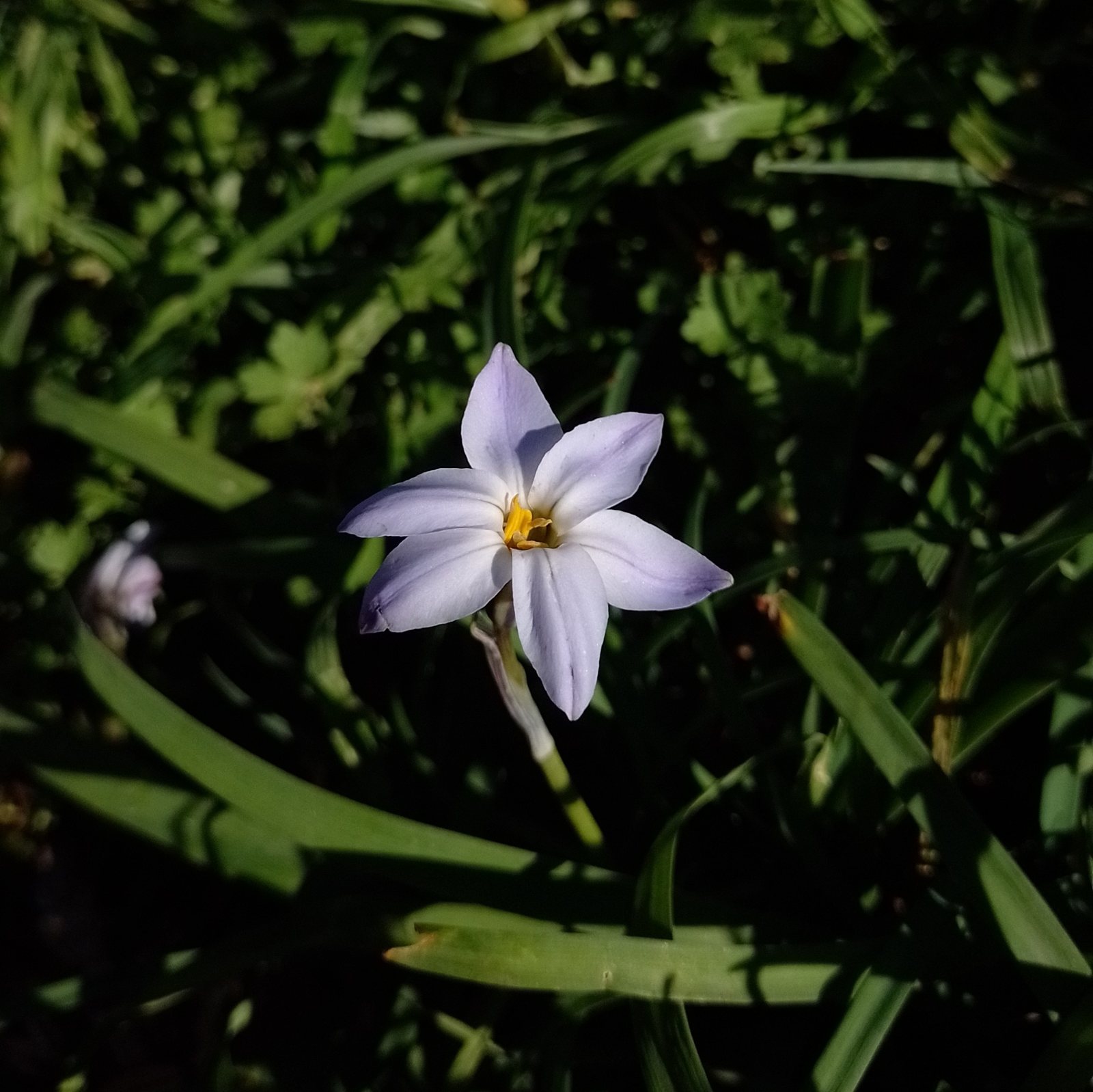
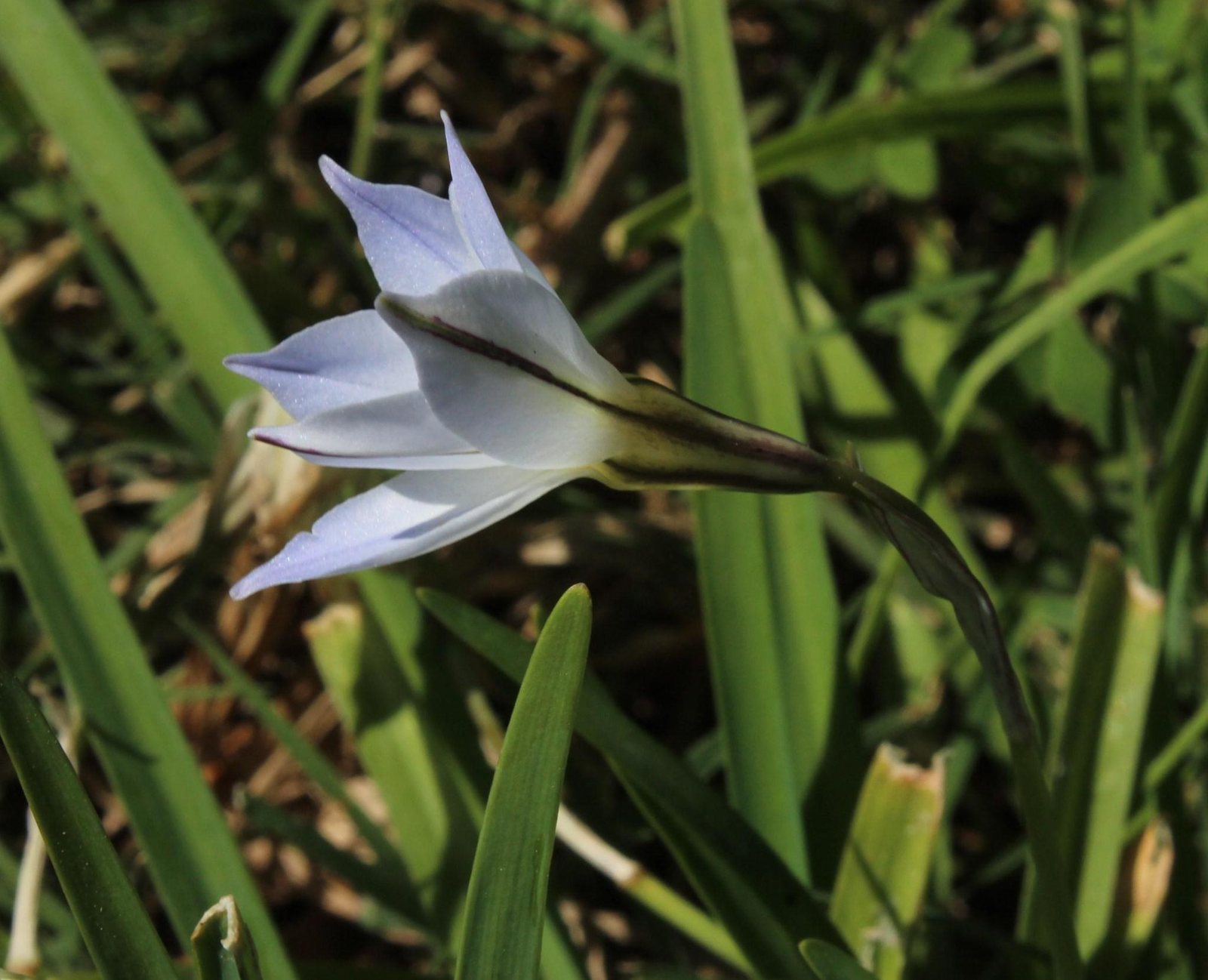
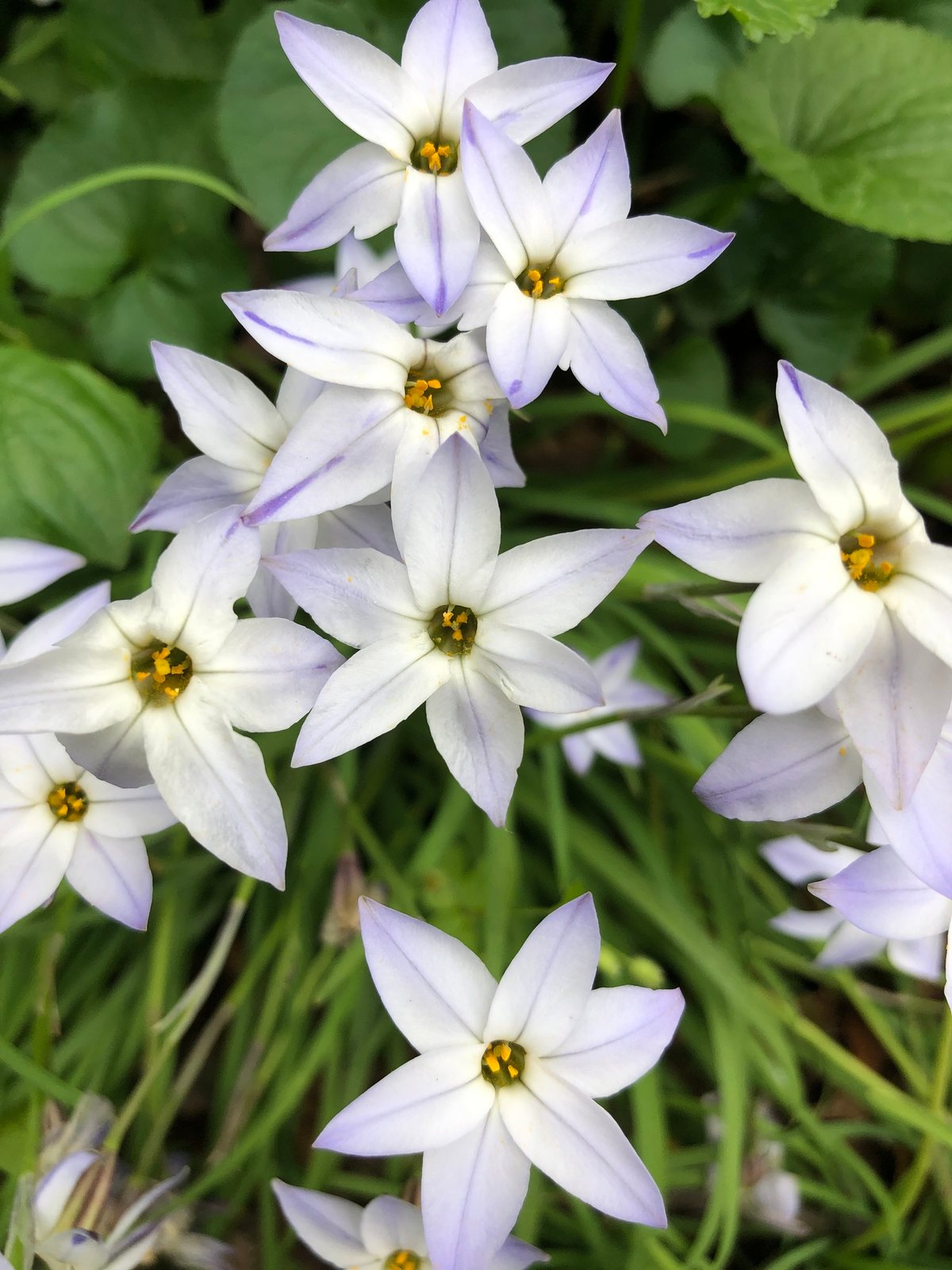
Spring starflower is a small, clump-forming bulb grown for its lightly scented, star-shaped spring flowers. It gradually makes patches beneath deciduous shrubs, along borders and in rock gardens, then disappears underground for summer.
At a glance
- Sun
- Full sun to partial shade; flowers best with plenty of spring sunlight.
- Water
- Moderate moisture during autumn-to-spring growth; relatively dry conditions during summer dormancy.
- Soil
- Well-drained sandy, loamy or gritty soil; tolerates a range of soil pH but dislikes waterlogged ground.
- Height
- 0.25-0.5 ft (0.08-0.15 m)
- Spread
- 0.25-0.5 ft (0.08-0.15 m) per clump, gradually spreading farther through offsets.
- Flowers
- Early to mid-spring; pale blue to lilac-blue or nearly white flowers, usually with a darker stripe along each petal.
- Foliage
- Narrow, grassy green leaves smell of onion when crushed. Leaves often emerge in autumn, remain through mild winters and die back after flowering.
- Growth
- Moderate; builds into colonies over several years.
- Care needed
- Low
The year at a glance
- Pollinators
- Drought tolerant
- Low allergen
- Fragrant
| J | F | M | A | M | J | J | A | S | O | N | D | |
|---|---|---|---|---|---|---|---|---|---|---|---|---|
| Flowers | ||||||||||||
| Fruit | ||||||||||||
| Plant |
Northern hemisphere months. In Australia, shift them by six.
- Difficulty
- Easy
- Toughness
- Very tough
Will it suit your garden?
Pick your zone, country, light and whether you have pets.
Full sun is 6 or more hours of direct sun a day, part shade 3 to 6 hours, shade under 3.
How it grows
Planting day
0.4 ft (0.12 m)
full size
About 1 years to full size.
From a typical nursery size, at an average rate for this kind of plant. A rule of thumb, not a forecast.
Good to know
- Cats and dogs
- Safe
- In the garden
- Spreads vigorously: plan to contain it.
- Growth rate
- Moderate
Care
Jobs through the year
- WaterFeb–May, every 14 days
- Water established bulbs only during prolonged dry spells while growing; leave summer-dormant bulbs relatively dry.
- WaterSep–Nov, every 14 days
- Water if autumn soil is dry; water newly planted bulbs thoroughly at planting.
- MulchOct–Nov
- Add thin compost on poor soil; use a light winter mulch in colder gardens after soil cools.
- DeadheadApr–May
- Remove faded flowers before seed ripens if seedlings are unwanted.
- PruneMay–Jun
- Clear foliage or mow only after leaves have yellowed and withered.
- DivideJun–Jul
- Divide congested clumps after foliage dies back if flowering has declined.
- Plant bulbs in autumn, about 2-3 in (5-8 cm) deep and 2-3 in (5-8 cm) apart.
- Water after planting and during prolonged dry spells while leaves are growing.
- Keep dormant bulbs relatively dry in summer; avoid sites watered heavily for summer bedding.
- On poor soil, apply a light dressing of compost in autumn; avoid heavy feeding.
- In colder gardens, add a light winter mulch after the ground cools.
- Divide congested clumps after the foliage dies back if flowering declines.
Pruning. Remove spent flowers if you want to limit seeding. Leave all green foliage intact, then clear it away once it has yellowed and withered.
Through the year
- Autumn
- Plant bulbs in well-drained ground or containers with drainage holes.
- Winter
- Check that pots drain freely and protect bulbs from persistent waterlogging.
- Early spring
- Water during dry weather while leaves and flower stems are developing.
- Spring
- Remove fading flower heads where unwanted seedlings would be a nuisance.
- Late spring
- Allow leaves to yellow naturally; delay mowing any planted grass until they have died back.
- Summer
- Keep dormant bulbs relatively dry; lift and divide crowded clumps if needed.
In the garden
- Plant in drifts beneath deciduous shrubs, where spring sunlight reaches the ground before the canopy fills out.
- Edge paths and small borders with low patches of blue flowers.
- Tuck between rocks or into gravel gardens with good drainage.
- Combine with small spring bulbs and later-emerging perennials that cover the fading foliage.
Garden styles it suits: Cottage garden, Woodland, Dry gravel garden, Low-maintenance, Blues and silvers and Small-space.
Plant it with: Species crocuses, Dwarf daffodils, Grape hyacinths, Hellebores, Hardy geraniums and Catmint.
Wildlife: Flowers provide pollen and nectar for visiting bees and other early-season insects.
Problems to watch for
- Bulb rot in wet soil: improve drainage or move bulbs to a raised bed; discard soft, rotten bulbs.
- Slugs and snails chewing young growth: inspect during damp weather and use barriers, hand-picking or a locally approved bait.
- Poor flowering in deep shade or crowded clumps: provide more spring sunlight and divide after the foliage dies back.
- Few flowers after early mowing or leaf removal: leave foliage until it yellows so bulbs can replenish their reserves.
Safety
Species-specific toxicity information for people, cats, dogs and horses is limited, so its safety should not be assumed. Do not eat the bulbs, leaves or flowers or allow pets to graze them; an onion-like smell does not establish that a plant is edible. The severity of any poisoning is uncertain.
Where it spreads. Spreads by bulb offsets and sometimes seed. It has escaped cultivation and become naturalised in parts of southern Australia, including Victoria and South Australia; keep it away from bushland and check local weed guidance before planting.
Easily confused with
Star-of-Bethlehem (Ornithogalum umbellatum)
Usually bears clusters of white flowers rather than a single flower per stem. Its leaves typically have a conspicuous white central stripe.
Spring beauty (Tristagma peregrinans)
A close relative often sold under the name Ipheion 'Rolf Fiedler'; it has more rounded, overlapping petals and stronger blue flowers than typical spring starflower.
Glory-of-the-snow (Scilla luciliae)
Has broader leaves without an onion smell and usually several upward-facing blue flowers with sharply defined white centres on each stem.
The name
The name uniflorum means 'one-flowered', referring to the usually solitary flower on each stem, while spring starflower describes its flowering season and shape.
Propagation. Separate bulb offsets once the leaves have died back and replant promptly. Seed can be sown when ripe, but seedlings take several years to flower and may differ from named cultivars.
Checked against open data
- Accepted botanical name
- Ipheion uniflorum
- In the US and Canada
- Introduced in the lower 48 states.
- Native range
- Argentina Northeast and Uruguay.
Sources: GBIF (CC BY 4.0), USDA PLANTS and Trefle (CC BY 4.0). The care and design notes are LandscapeGPT's own.
See it in your own yard.
Upload a photo of your yard and see it redesigned with plants that suit your climate, each checked against your zone.