Staghorn fern
Platycerium bifurcatum. Family Polypodiaceae. Fern.
Also called Elkhorn fern, Common staghorn fern.
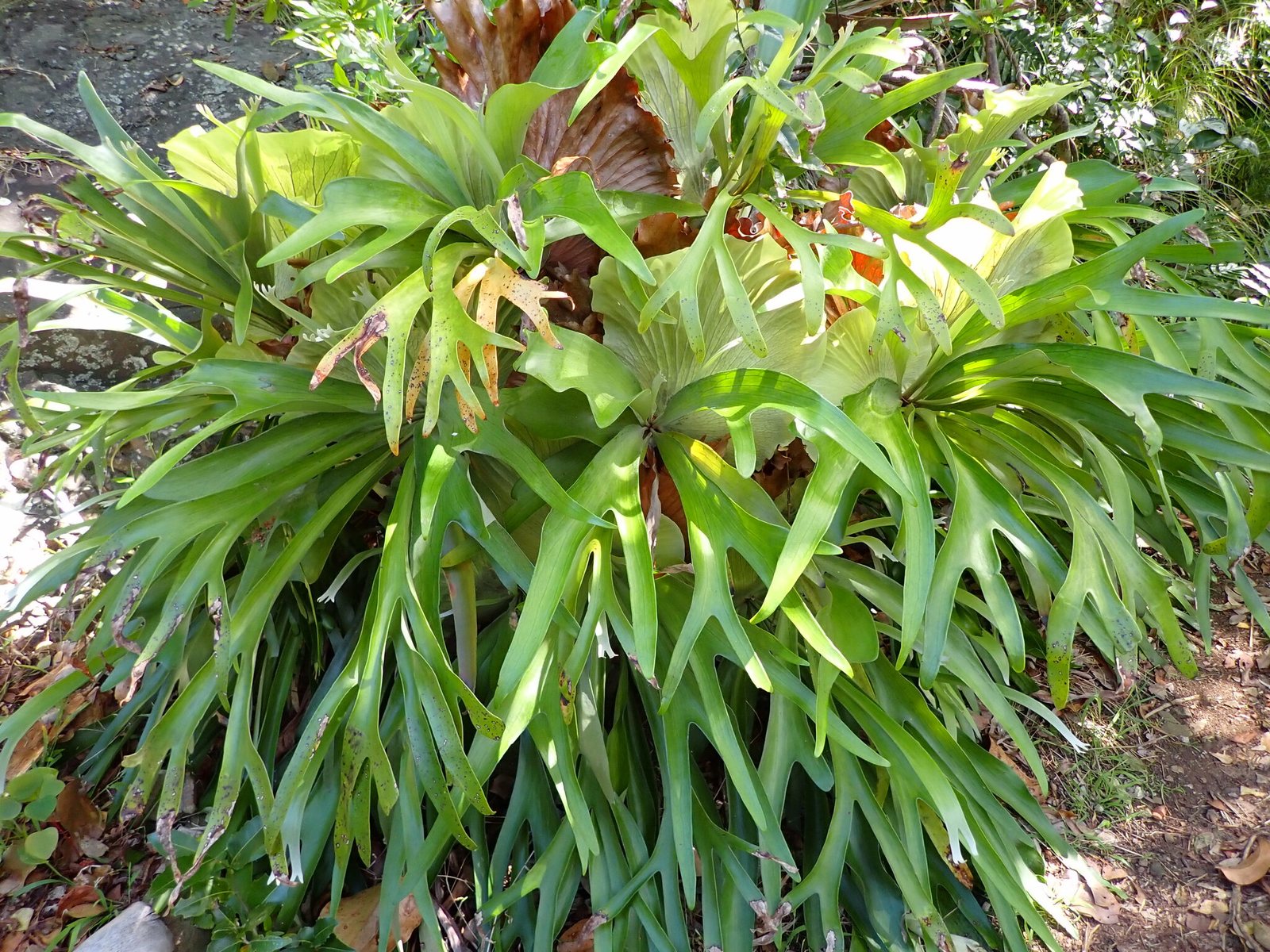
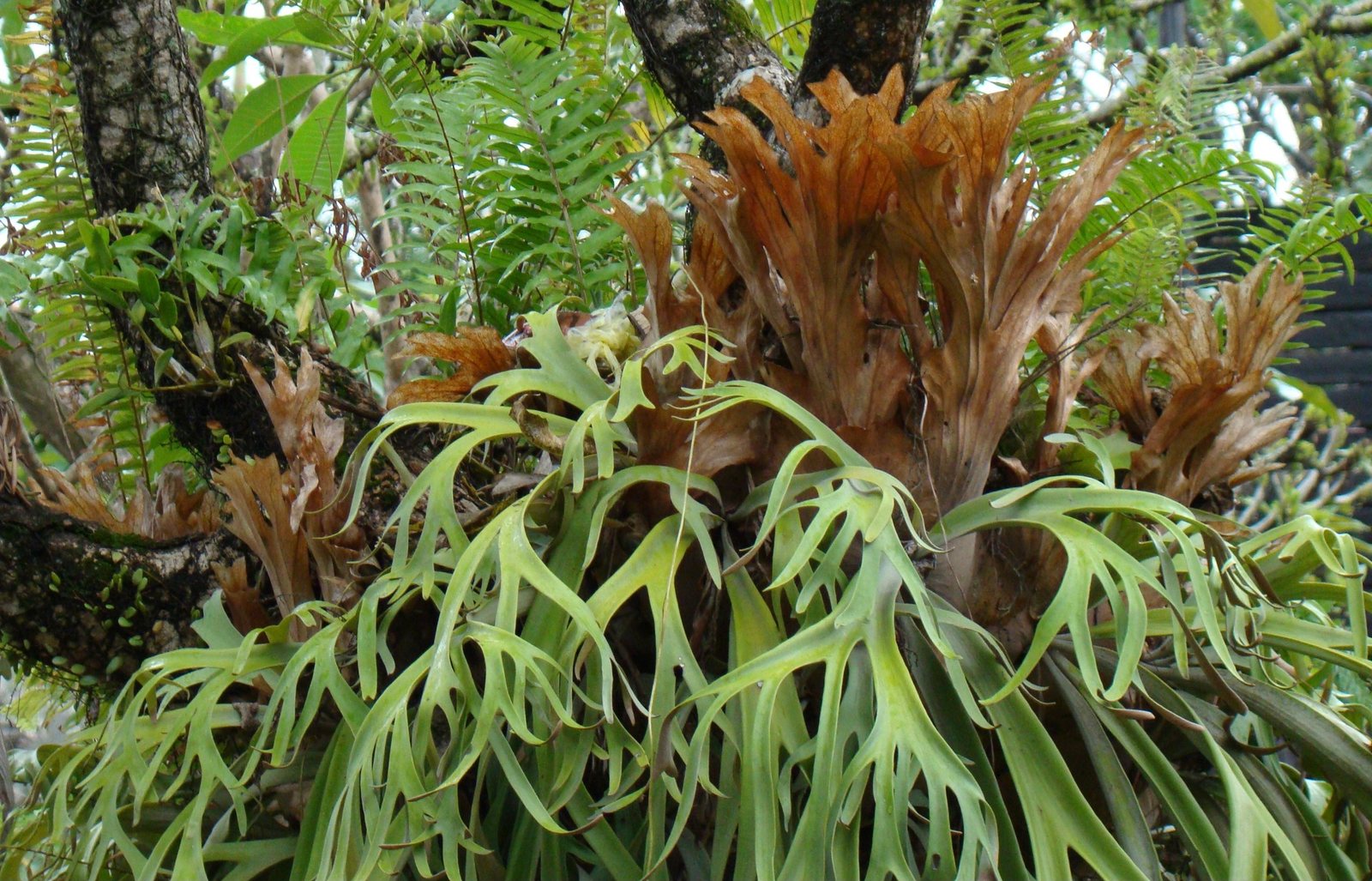
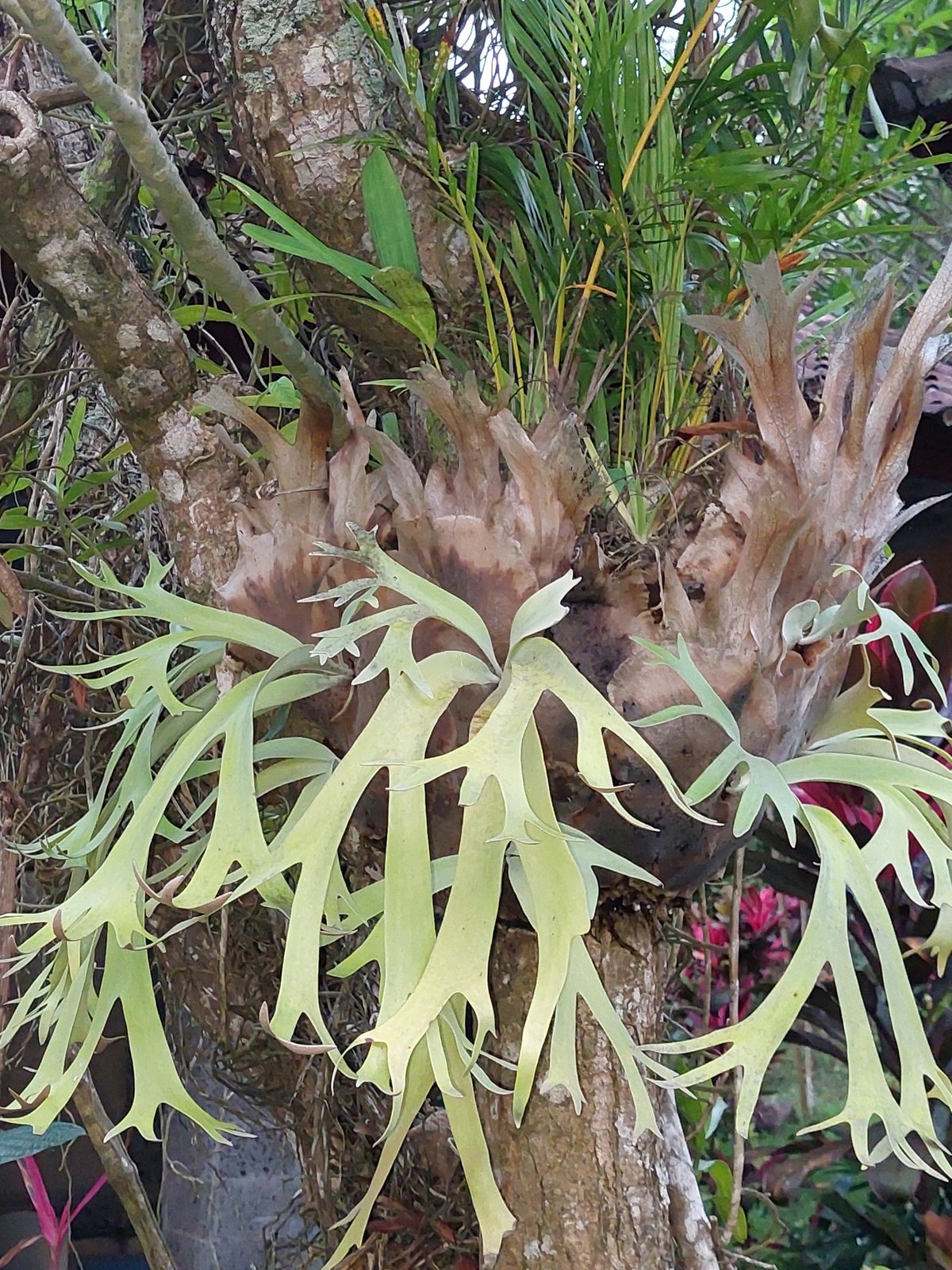
Staghorn fern is an evergreen fern that naturally grows attached to trees rather than rooted in the ground. Gardeners grow it for its forked, antler-like fronds, usually on a wooden mount or in a hanging basket. It suits sheltered, frost-free gardens; in colder parts of the United States, Canada and the United Kingdom, grow it indoors or move it inside for winter.
At a glance
- Sun
- Bright, filtered light or partial shade; protect from strong midday and afternoon sun.
- Water
- Water thoroughly, then let the mounting material become nearly dry before watering again. Reduce watering in cool weather, but do not leave it completely dry for long periods.
- Soil
- No ordinary garden soil is needed. Mount over a small pad of sphagnum moss or grow in a very open orchid-bark mix in a slatted basket.
- Height
- 2-3 ft (0.6-0.9 m)
- Spread
- 2-4 ft (0.6-1.2 m), with old colonies eventually wider
- Foliage
- Evergreen. Grey-green, leathery, forked fertile fronds rise or hang from rounded basal shield fronds. The shields start green and become brown and papery with age; brown spore patches develop beneath mature fertile fronds.
- Growth
- Slow to moderate; faster with warmth, moisture and light feeding.
- Care needed
- Medium
The year at a glance
- Heat tolerant
- Wildlife
| J | F | M | A | M | J | J | A | S | O | N | D | |
|---|---|---|---|---|---|---|---|---|---|---|---|---|
| Plant |
Northern hemisphere months. In Australia, shift them by six.
- Difficulty
- Moderate
- Toughness
- Needs looking after
Will it suit your garden?
Pick your zone, country, light and whether you have pets.
Full sun is 6 or more hours of direct sun a day, part shade 3 to 6 hours, shade under 3.
How it grows
Planting day
1 ft (0.3 m)
After 1 year
1.5 ft (0.45 m)
After 2 years
2 ft (0.6 m)
After 3 years
2.5 ft (0.75 m)
full size
About 3 years to full size.
From a typical nursery size, at an average rate for this kind of plant. A rule of thumb, not a forecast.
Good to know
- Cats and dogs
- Safe
- Native to
- Australia
- Growth rate
- Moderate
Care
Jobs through the year
- WaterMar–May, Sep–Oct, every 7 days
- For mounted or basket plants, soak when mounting material is nearly dry, then drain completely.
- WaterJun–Aug, every 3 days
- Check the moss pad frequently and soak only when nearly dry; small or newly mounted plants dry faster.
- WaterJan–Feb, Nov–Dec, every 14 days
- In winter shelter, check before soaking and let the mount approach dryness without prolonged dehydration.
- FeedApr–Aug, every 30 days
- Apply balanced liquid fertilizer at one-quarter strength during active growth.
- DivideApr–May
- Divide only for propagation, retaining roots and shield fronds on each section; otherwise leave undisturbed.
- ProtectJan–May, Sep–Dec
- Move under cover before cold nights, preferably above 10°C; return outdoors only when nights are consistently mild.
- Soak the moss pad or basket thoroughly when it is nearly dry, then allow excess water to drain completely.
- Feed monthly during active growth with a balanced liquid fertiliser at one-quarter strength; stop feeding during cool, slow growth.
- Keep the brown basal shield fronds intact: they protect the roots and collect moisture and organic debris.
- Provide humidity and gentle air movement, keeping the plant away from heating vents and cold draughts.
- Use rot-resistant mounting wood and strong fixings; mature plants become heavy when wet.
- Bring portable plants under cover before frost, preferably keeping winter temperatures above 50°F (10°C).
Pruning. No routine pruning is needed. Cut off completely dead hanging fronds with clean scissors at any time, but do not peel away brown shield fronds or mistake brown spore patches for damage.
Through the year
- Early spring
- Check mounting boards, hanging wires and wall fixings, and replace anything weakened or corroded.
- Spring
- Begin light feeding as new fronds appear; divide crowded plants only if you want additional specimens.
- Late spring
- Move overwintered plants outdoors once nights are consistently mild, acclimatising them gradually to brighter light.
- Summer
- Check the moss pad frequently during hot weather and soak it when nearly dry; inspect for scale insects and mealybugs.
- Autumn
- Reduce feeding and move plants to frost-free shelter before cold nights arrive.
- Winter
- Keep in bright, indirect light and water less often, allowing the mounting material to approach dryness between soakings.
In the garden
- Mount on a shaded courtyard wall as a sculptural foliage feature.
- Hang in a slatted basket beneath a pergola, allowing the forked fronds to trail freely.
- Attach to a suitable garden tree in a frost-free climate, using supports that will not girdle the trunk.
- Combine with bird's-nest ferns and bromeliads for layered foliage in a sheltered tropical planting.
Garden styles it suits: Architectural minimal, Modern tropical, Tropical, Modern courtyard, Urban city garden and Australian native.
Plant it with: Bird's-nest fern, Rabbit's-foot fern, Bromeliads, Moth orchids and Cast-iron plant.
Wildlife: Mature outdoor clumps can shelter small invertebrates. It has no flowers, nectar or fruit, so it is not a direct food source for pollinators.
Problems to watch for
- Scale insects and mealybugs: inspect frond bases and undersides, remove small infestations by hand, and use a product labelled for ferns if needed; test on a small area first.
- Root or crown rot: persistent wetness causes soft, dark tissue and collapse. Improve drainage and airflow, remove rotten material, and let the mounting pad approach dryness between waterings.
- Sun scorch: bleached or brown patches follow exposure to strong sun. Move into filtered light; damaged tissue will not turn green again.
- Shrivelling or crisp frond tips: check for a dry mounting pad, hot draughts or very dry air. Soak thoroughly when needed and move away from drying heat.
Safety
Not known to be toxic to cats, dogs, horses or people; no part is recognised as poisonous. Eating plant material can still cause mild stomach upset.
Easily confused with
Giant staghorn fern (Platycerium superbum)
Forms a large, usually solitary rosette with tall, upright nest fronds and very long hanging fertile fronds; P. bifurcatum commonly produces offsets and develops into a colony.
Silver elkhorn fern (Platycerium veitchii)
Has more densely silvery, narrow, stiffly upright fertile fronds; P. bifurcatum generally has greener, broader and more arching fronds.
The name
Platycerium comes from Greek words meaning broad horn, while bifurcatum means forked, both referring to the antler-like fronds.
Propagation. Separate offsets in spring or early summer, keeping roots and a growing point with each division, then mount individually and keep warm in filtered light. Spore propagation is possible but slow and requires consistently humid, clean conditions.
Checked against open data
- Accepted botanical name
- Platycerium bifurcatum
- In the US and Canada
- Introduced in Hawaii.
- Native range
- Jawa, Lesser Sunda Is., New Caledonia, New South Wales, Norfolk Is., Queensland and Sulawesi.
Sources: GBIF (CC BY 4.0), USDA PLANTS and Trefle (CC BY 4.0). The care and design notes are LandscapeGPT's own.
See it in your own yard.
Upload a photo of your yard and see it redesigned with plants that suit your climate, each checked against your zone.