Sweet Tea foamy bells
Heucherella 'Sweet Tea'. Family Saxifragaceae. Perennial.
Also called Heucherella 'Sweet Tea', Sweet Tea heucherella.
Sweet Tea foamy bells is a clump-forming perennial grown mainly for its large, deeply lobed leaves in shades of orange, copper and cinnamon, marked with dark reddish-brown veins. A hybrid between coral bells and foamflower, it brings warm foliage colour to partly shaded borders and containers.
At a glance
- Sun
- Partial shade, preferably with morning sun and afternoon shade. More sun is possible in cool climates if the soil stays moist; avoid strong afternoon sun in hot regions.
- Water
- Keep evenly moist but not waterlogged. Water during dry spells, especially in containers and during the first growing season.
- Soil
- Humus-rich, well-drained soil, preferably neutral to slightly acidic. Avoid heavy, wet soil around the crown.
- Height
- 1.5-2 ft (0.45-0.6 m), including flower stems
- Spread
- 2-2.5 ft (0.6-0.75 m)
- Flowers
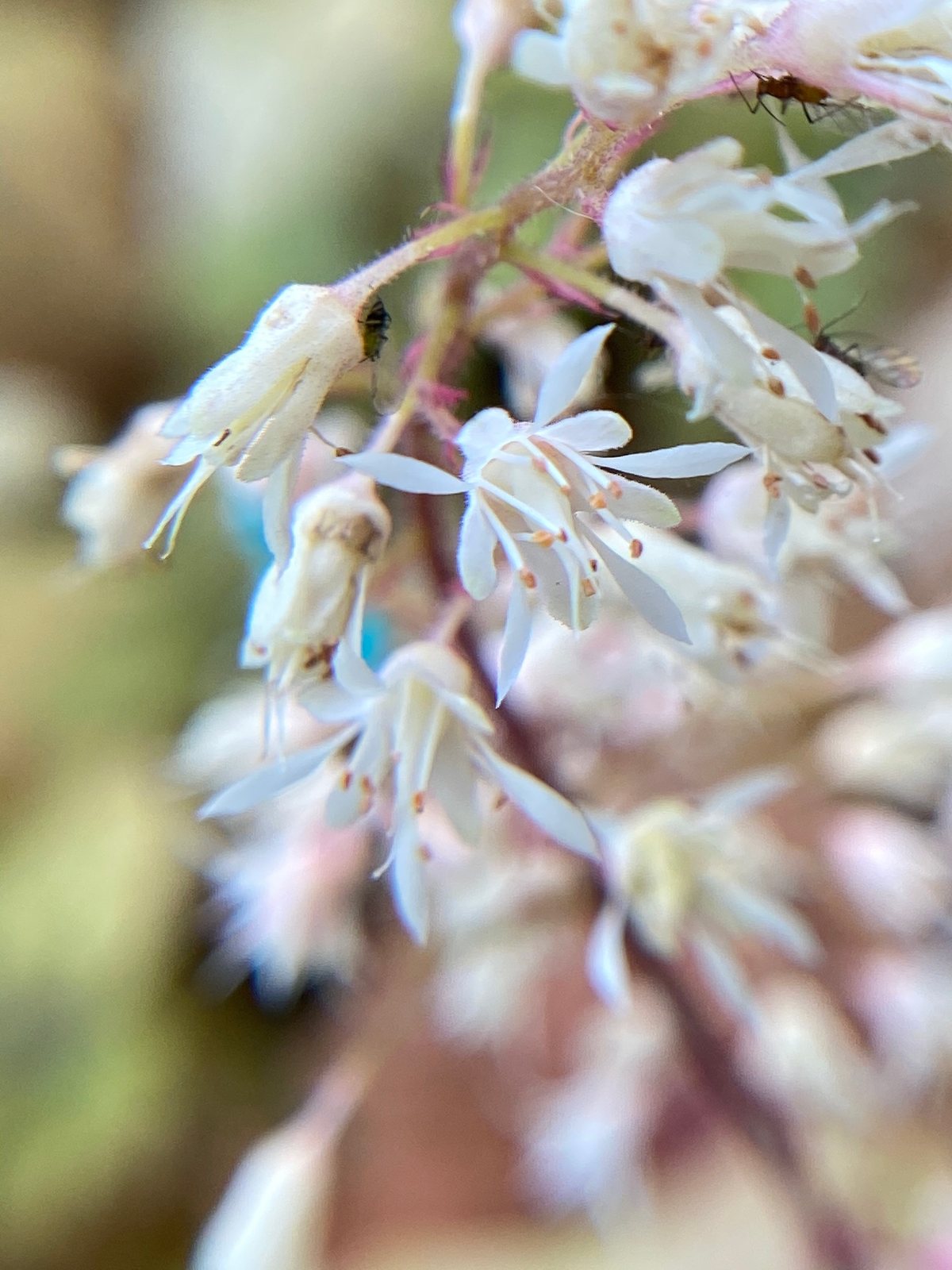
- Small white flowers on slender stems in late spring to early summer.
- Foliage
- Evergreen. Large, rounded, deeply lobed leaves with orange to copper colouring and dark reddish-brown veins. Colour changes with temperature, light and leaf age, often becoming darker in summer and brighter in cooler weather.
- Growth
- Moderate; usually forms a substantial clump within two to three growing seasons.
- Care needed
- Low
The year at a glance
- Pollinators
- Cold hardy
- Low allergen
| J | F | M | A | M | J | J | A | S | O | N | D | |
|---|---|---|---|---|---|---|---|---|---|---|---|---|
| Plant |
Northern hemisphere months. In Australia, shift them by six.
- Difficulty
- Easy
- Toughness
- Fairly tough
Will it suit your garden?
Pick your zone, country, light and whether you have pets.
Full sun is 6 or more hours of direct sun a day, part shade 3 to 6 hours, shade under 3.
How it grows
Planting day
1 ft (0.3 m)
After 1 year
1.2 ft (0.37 m)
After 2 years
1.5 ft (0.45 m)
After 3 years
1.7 ft (0.53 m)
full size
About 3 years to full size.
From a typical nursery size, at an average rate for this kind of plant. A rule of thumb, not a forecast.
Good to know
- Cats and dogs
- Safe
- Growth rate
- Moderate
Care
Jobs through the year
- WaterApr–May, Sep–Oct, every 14 days
- Water established clumps if soil is drying; keep new plants more consistently moist.
- WaterJun–Aug, every 7 days
- Water established clumps during dry weather, keeping soil moist but never waterlogged.
- MulchMar–Apr
- Apply a thin compost mulch around the clump, leaving the crown uncovered.
- PruneMar
- Remove dead or badly damaged leaves without cutting into the crown.
- ProtectFeb–Mar
- Check for frost-heaved crowns and gently firm or replant them at soil level.
- DivideMar–Apr
- Divide only ageing clumps with woody centres or weakened growth.
- DeadheadJun–Jul
- Cut faded flower stems back to their bases.
- Plant with the crown at soil level rather than buried.
- Water at soil level when the surface begins to dry; do not leave pots standing in water.
- Apply a thin layer of compost in spring, keeping it clear of the crown.
- Mulch around the clump to conserve moisture without covering its centre.
- Check for frost-heaved crowns after winter and gently firm or replant them.
- Divide ageing clumps in spring if the centres become woody or growth weakens.
Pruning. In early spring, remove dead or badly damaged leaves without cutting into the crown. Cut spent flower stems back to their bases after flowering.
Through the year
- Early spring
- Remove winter-damaged leaves and check for frost-heaved crowns.
- Spring
- Plant or divide clumps, water thoroughly and add a thin compost mulch.
- Late spring
- Check new growth for slug damage and inspect container plants for vine weevil.
- Summer
- Water during dry spells and remove faded flower stems.
- Autumn
- Remove fallen debris from the crown, but retain healthy foliage.
- Winter
- Keep containers freely drained and shelter them from persistent winter rain.
In the garden
- Edge partly shaded paths with repeated clumps for a continuous band of warm foliage colour.
- Plant beneath deciduous shrubs where it receives spring light and summer shade.
- Contrast its copper leaves with blue-green hostas, fine-textured ferns or dark green hellebores.
- Use in shaded patio containers with sedges and other moisture-loving foliage plants.
Garden styles it suits: Woodland, Cottage garden, Arts and Crafts, Modern courtyard, Small-space and Autumn colour.
Plant it with: Hostas, Japanese painted fern, Hellebores, Siberian bugloss, Japanese forest grass and Japanese sedge.
Wildlife: The small flowers can attract bees and other small pollinating insects. Its main garden value is foliage rather than a long flowering season.
Problems to watch for
- Vine weevil larvae can eat roots and cause sudden wilting or loose crowns, particularly in pots. Inspect roots and use an appropriate biological nematode treatment when soil temperatures suit the product.
- Slugs and snails may chew young leaves. Check after dark, remove pests and use barriers or locally approved controls where needed.
- Crown and root rot can develop in waterlogged soil. Improve drainage, keep mulch away from the crown and discard badly rotted plants.
- Leaf scorch and crispy margins usually follow hot sun or drought. Provide afternoon shade and more consistent moisture.
Safety
Not known to be toxic to cats, dogs, horses or people. No particular part is recognised as poisonous, although specific toxicity data for this cultivar are limited; it is not an edible plant.
Easily confused with
Coral bells (Heuchera spp.)
Many cultivars have similar copper foliage, but their leaves are often less deeply lobed and their flowers more distinctly bell-shaped. Cultivar labels are the safest guide.
Heartleaf foamflower (Tiarella cordifolia)
Usually has green, heart-shaped leaves, sometimes with dark central markings, rather than broad areas of orange-copper colour; its flower spikes have a particularly frothy appearance.
The name
Heucherella combines the names of its parent genera, Heuchera and Tiarella, while foamy bells combines their common names, foamflower and coral bells.
Propagation. Divide healthy clumps in spring, retaining roots and growing points on each section. This hybrid does not reliably produce viable seed, and seed would not preserve the cultivar. Check local plant breeders' rights or patent restrictions before propagating.
Checked against open data
- Accepted botanical name
- Heucherella
Sources: GBIF (CC BY 4.0). The care and design notes are LandscapeGPT's own.
See it in your own yard.
Upload a photo of your yard and see it redesigned with plants that suit your climate, each checked against your zone.