Taylor juniper
Juniperus virginiana 'Taylor'. Family Cupressaceae. Tree.
Also called Taylor eastern red cedar, Taylor redcedar.
Taylor juniper is a very narrow, upright evergreen grown for its dense blue-green foliage and strong vertical shape. It makes a useful screen or accent where there is little room for a spreading tree. The species is widely rated for USDA zones 2–9, but 'Taylor' is more commonly recommended for zones 4–9; choose locally proven stock in colder areas.
At a glance
- Sun
- Full sun; shade makes the growth thinner and less upright.
- Water
- Water regularly while establishing; drought-tolerant once rooted. Avoid persistently wet soil.
- Soil
- Well-drained sandy, loamy or clay soil, including alkaline and relatively poor soils. Not suitable for waterlogged ground.
- Height
- 15-25 ft (4.6-7.6 m), sometimes taller with age
- Spread
- 3-5 ft (0.9-1.5 m)
- Foliage
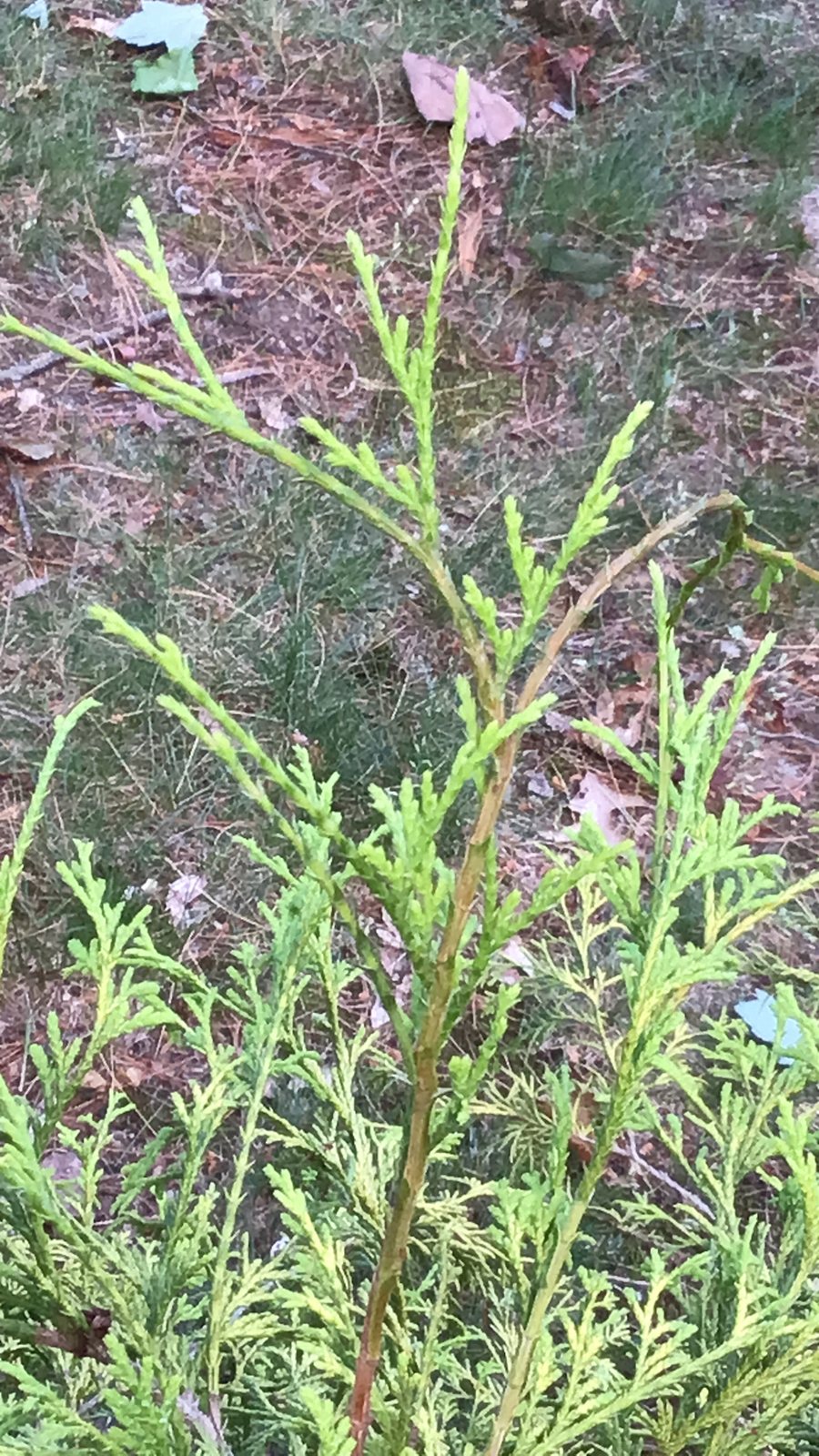
- Evergreen. Dense blue-green, mostly scale-like foliage on tightly upright branches; may turn bronze or purplish in cold weather.
- Growth
- Moderate, often 1-2 ft (0.3-0.6 m) a year when young and well established.
- Care needed
- Low
The year at a glance
- Deer resistant
- Drought tolerant
- Cold hardy
- Heat tolerant
- Wildlife
| J | F | M | A | M | J | J | A | S | O | N | D | |
|---|---|---|---|---|---|---|---|---|---|---|---|---|
| Plant |
Northern hemisphere months. In Australia, shift them by six.
- Difficulty
- Easy
- Toughness
- Very tough
Will it suit your garden?
Pick your zone, country, light and whether you have pets.
Full sun is 6 or more hours of direct sun a day, part shade 3 to 6 hours, shade under 3.
How it grows
Planting day
7 ft (2 m)
After 1 year
7 ft (2.2 m)
After 2 years
8 ft (2.4 m)
After 3 years
9 ft (2.6 m)
After 5 years
10 ft (3 m)
About 20 years to full size.
From a typical nursery size, at an average rate for this kind of plant. A rule of thumb, not a forecast.
Good to know
- Cats and dogs
- Mildly toxic: may upset a stomach
- Native to
- the US and Canada
- Growth rate
- Moderate
Care
Jobs through the year
- WaterApr–May, Sep–Oct, every 21 days
- Deep-water established trees only in prolonged dry weather; water more often for the first two years.
- WaterJun–Aug, every 14 days
- Water deeply during extended drought; young trees generally need weekly watering in dry weather.
- WaterNov
- If autumn has been dry, soak the root zone before freezing weather.
- MulchMar–Apr
- Maintain 5–8 cm of mulch over roots, leaving the trunk base clear.
- PruneFeb–Mar
- Remove dead, damaged or competing leaders; shorten strays only into leafy growth.
- ProtectFeb–Mar
- Hand-pick bagworm cases and remove accessible rust galls before spring spore release.
- ProtectJun–Aug, every 14 days
- Inspect for young bagworms and mites; treat only confirmed infestations.
- Plant with the root flare at soil level, leaving enough space for the mature width.
- Water deeply during dry spells for the first two growing seasons; let the soil begin to dry between waterings.
- Apply 2-3 in (5-8 cm) of mulch over the root area, keeping it clear of the trunk.
- Do not routinely fertilize; feed lightly in spring only if growth is poor and a soil test indicates a deficiency.
- Stake only if the root ball moves in wind, using flexible ties and removing the support once roots hold it firmly.
Pruning. Usually needs little pruning; remove dead, damaged or competing upright stems in late winter or early spring. Shorten stray shoots only into leafy growth, because bare old wood rarely produces new shoots.
Through the year
- Late winter
- Remove broken branches and check for stems pulled apart by snow; do not knock ice from frozen branches.
- Spring
- Plant when the ground is workable, water thoroughly and renew mulch without covering the trunk base.
- Late spring
- Check for orange rust growths and browning shoot tips; remove affected growth during dry weather.
- Summer
- Water young trees during dry spells and inspect for bagworms or fine mite webbing.
- Autumn
- Water thoroughly before the ground freezes if autumn has been dry, especially for recently planted trees.
In the garden
- Plant in a row for a narrow evergreen screen, allowing room for each tree's mature width.
- Use matching specimens to frame an entrance or mark the ends of a path.
- Add vertical structure behind ornamental grasses and sun-loving perennials.
- Use as an evergreen focal point in a gravel garden or small formal border.
Garden styles it suits: Architectural minimal, Formal, Contemporary minimal, Small-space, Low-maintenance and Winter interest.
Plant it with: Little bluestem, Purple coneflower, Black-eyed Susan, Catmint, Russian sage and Stonecrop.
Wildlife: Dense evergreen branches provide shelter and nesting cover for birds. The species supports juniper-feeding insects, and female trees can produce berry-like cones eaten by birds; do not rely on this cultivar for a substantial cone crop.
Problems to watch for
- Cedar-apple rust: swollen twig galls develop orange gelatinous horns in wet spring weather. Remove accessible galls before they release spores; nearby susceptible apples and crabapples may suffer more serious damage.
- Bagworms: caterpillars carry hanging bags made from foliage and can strip branches. Hand-pick bags before eggs hatch, or treat very young larvae with an appropriately labelled product.
- Spider mites: foliage becomes stippled, dull or brown, especially in hot, dusty conditions. Check by tapping a branch over white paper; rinse foliage and use a labelled horticultural oil if needed.
- Root rot and decline in wet soil: improve drainage or move the tree to a better-drained site. Extra watering or fertilizer will not correct oxygen-starved roots.
Safety
Not a culinary juniper. Foliage, berry-like cones and especially concentrated oils can cause digestive upset if swallowed by people, cats or dogs; foliage may also irritate sensitive skin. Horse-specific toxicity information is limited, so prevent browsing and do not put prunings in paddocks.
Where it spreads. The species spreads aggressively into grasslands in parts of the central United States, particularly the Great Plains, including Nebraska, Kansas, Oklahoma and Texas, where fire is excluded. This is native woody encroachment rather than a non-native invasion; seed-producing garden trees can contribute.
Easily confused with
Brodie eastern red cedar (Juniperus virginiana 'Brodie')
Usually forms a broader column with greener foliage. Young plants can be difficult to distinguish reliably without a label.
Skyrocket juniper (Juniperus scopulorum 'Skyrocket')
Also very narrow, but usually has more distinctly silvery-blue foliage. Colour overlaps, so nursery identification is more reliable than shape alone.
Italian cypress (Cupressus sempervirens)
Typically has darker green foliage and rounded, woody cones rather than the small, berry-like cones of junipers; it is also much less cold-hardy.
The name
The cultivar name refers to Taylor, Nebraska, where the original narrow-growing tree was discovered.
Propagation. Propagate by semi-ripe cuttings, usually with rooting hormone under controlled nursery conditions. Seedlings do not reliably retain the narrow form of 'Taylor'.
Checked against open data
- Accepted botanical name
- Juniperus virginiana
- In the US and Canada
- Native in Canada and the lower 48 states.
- Native range
- Alabama, Arkansas, Colorado, Connecticut, Delaware, District of Columbia, Florida, Georgia, Illinois, Indiana, Iowa and Kansas.
- Measured
- Soil pH 4.7 to 8. Average height 820 cm.
Sources: GBIF (CC BY 4.0), USDA PLANTS and Trefle (CC BY 4.0). The care and design notes are LandscapeGPT's own.
See it in your own yard.
Upload a photo of your yard and see it redesigned with plants that suit your climate, each checked against your zone.