Thompson Seedless grape
Vitis vinifera 'Thompson Seedless'. Family Vitaceae. Climber.
Also called Sultana grape, Sultanina grape.
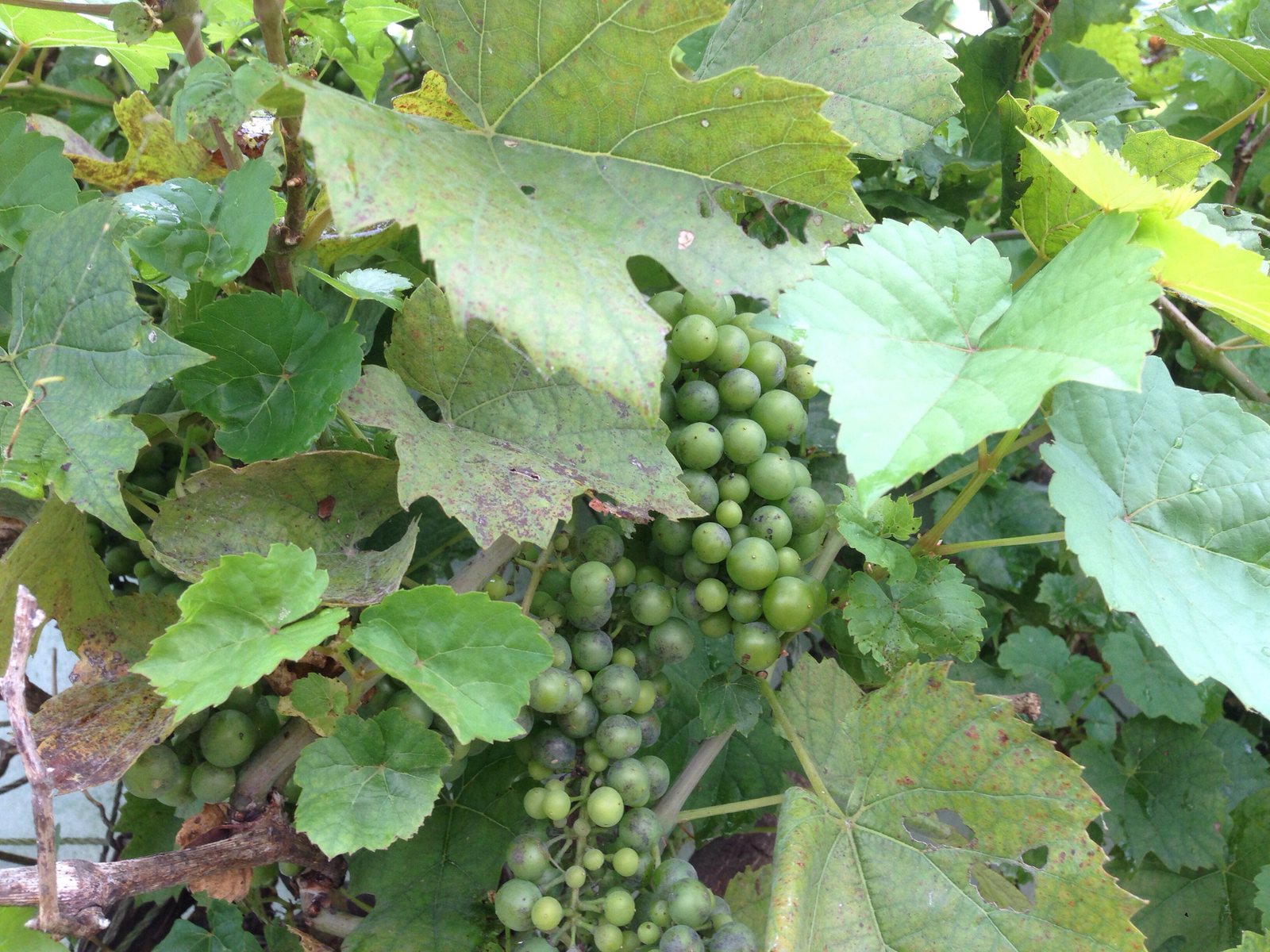
A vigorous, deciduous grapevine grown for sweet, pale green, seedless grapes eaten fresh or dried as raisins. It needs a strong support and a long, warm growing season to ripen well; winter survival alone does not guarantee a crop, particularly in the UK and cooler parts of Canada.
At a glance
- Sun
- Full sun, ideally at least 8 hours daily; choose a warm, sheltered position.
- Water
- Water deeply during establishment and dry spells, particularly from flowering through fruit swelling. Avoid waterlogged soil and frequent shallow watering.
- Soil
- Deep, well-drained loam is ideal; tolerates sandy or gravelly soils if watered appropriately. Avoid poorly drained ground.
- Height
- 10-20 ft (3-6 m) on a support; longer if left unpruned
- Spread
- 10-20 ft (3-6 m), controlled by training and pruning
- Flowers
- Late spring to early summer; tiny greenish flowers in branching clusters.
- Foliage
- Broad, lobed green leaves, often turning yellow in autumn.
- Growth
- Fast once established
- Care needed
- High
The year at a glance
- Heat tolerant
- Wildlife
- Edible
| J | F | M | A | M | J | J | A | S | O | N | D | |
|---|---|---|---|---|---|---|---|---|---|---|---|---|
| Flowers | ||||||||||||
| Fruit | ||||||||||||
| Plant |
Northern hemisphere months. In Australia, shift them by six.
- Difficulty
- Hard
- Toughness
- Fairly tough
Will it suit your garden?
Pick your zone, country, light and whether you have pets.
Full sun is 6 or more hours of direct sun a day, part shade 3 to 6 hours, shade under 3.
How it grows
Planting day
2 ft (0.6 m)
After 1 year
3 ft (1.1 m)
After 2 years
5 ft (1.5 m)
After 3 years
6 ft (1.8 m)
full size
About 3 years to full size.
From a typical nursery size, at an average rate for this kind of plant. A rule of thumb, not a forecast.
Good to know
- Cats and dogs
- Toxic
- Growth rate
- Fast
Care
Jobs through the year
- WaterApr–May, Sep–Oct, every 14 days
- Water established vines deeply during dry spells; young vines need more frequent watering.
- WaterJun–Aug, every 7 days
- Water deeply if dry, especially from flowering through fruit swelling; avoid shallow sprinkling.
- MulchMar–Apr
- Apply compost or organic mulch over the roots, keeping the trunk clear.
- FeedMar–Apr
- Use fertilizer only for weak growth or a confirmed deficiency; avoid excess nitrogen.
- PruneJan–Feb
- Cane-prune before sap flow, retaining one-year canes with 10–15 buds and short renewal spurs.
- PruneMay–Aug, every 21 days
- Thin crowded shoots, tie retained growth to supports and keep enough leaves to shade fruit.
- PruneJun–Jul
- Remove flowers on establishing vines and thin excessive bunches after fruit set.
- ProtectAug–Oct
- Protect ripening bunches with wildlife-safe netting or bunch bags and check regularly.
- HarvestAug–Oct, every 7 days
- Taste several berries and cut whole bunches only when sweet; ripening may fail in cool summers.
- ProtectOct–Nov
- Remove diseased fallen leaves and shrivelled grapes to reduce overwintering disease.
- Install a sturdy wire trellis, pergola or arbor before planting, and tie young shoots loosely to it.
- Water deeply through the first two growing seasons; give established vines extra water during prolonged dry weather.
- Apply compost in spring and use fertilizer only where growth or a soil test indicates a need; excess nitrogen encourages leaves rather than fruit.
- Mulch the root zone, keeping mulch clear of the trunk.
- Remove flowers during establishment and thin heavy crops so the vine can ripen its remaining bunches.
- Use wildlife-safe netting or individual bunch bags as fruit ripens, checking regularly for trapped wildlife.
Pruning. Cane-prune while fully dormant, before spring sap flow: retain well-ripened one-year-old canes with roughly 10-15 buds each, plus short renewal spurs, and remove the old fruiting canes. In summer, thin crowded shoots and shorten excessive growth while retaining enough leaves to shade and feed the fruit.
Harvest
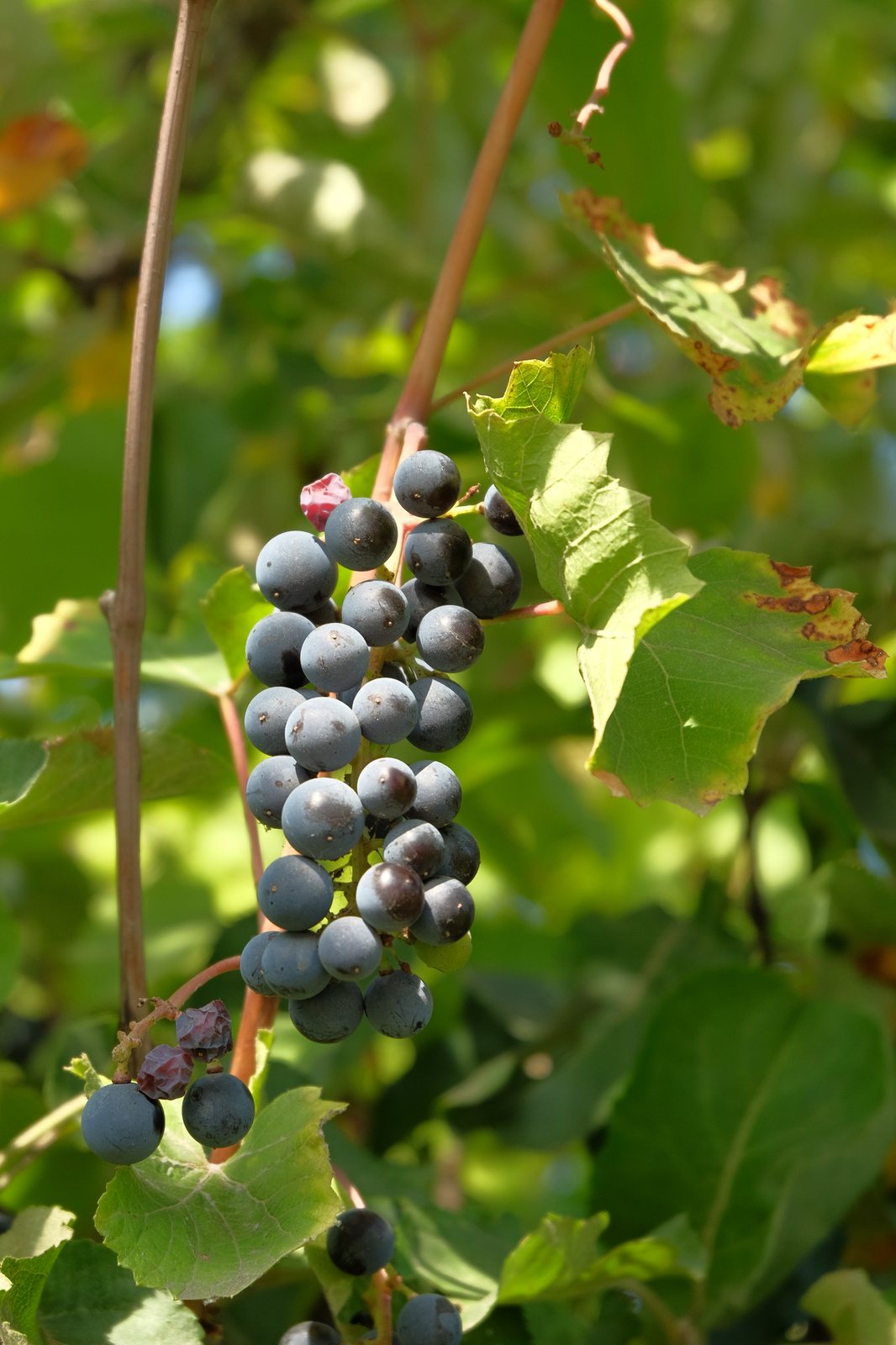
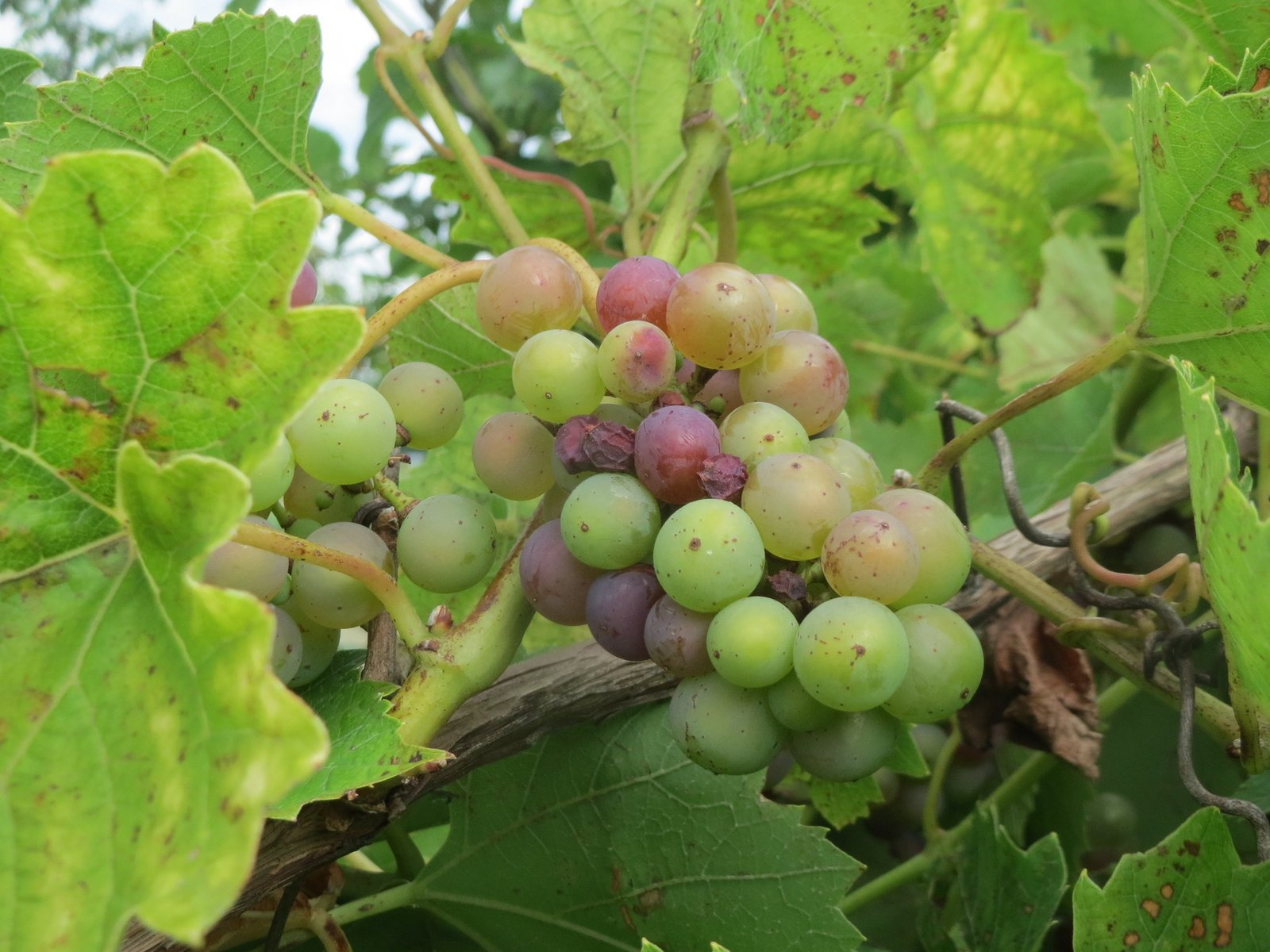
Cut whole bunches in late summer or autumn when berries are sweet throughout the bunch, pale green to golden, and easily detached; grapes do not become sweeter after picking. Taste several berries rather than judging by colour alone. Expect the first substantial crop about 3-4 years after planting, sometimes later in cool conditions.
Through the year
- Winter
- Cane-prune dormant vines and inspect the trellis, wires and ties.
- Early spring
- Plant dormant vines when the soil is workable; renew mulch and apply compost.
- Late spring
- Select and tie in strong shoots, remove surplus shoots, and watch for mildew.
- Early summer
- Thin excessive bunches after fruit set and water during dry spells.
- Late summer
- Protect ripening bunches from birds and wasps, and taste berries to assess ripeness.
- Autumn
- Finish harvesting and remove fallen diseased leaves and shrivelled fruit.
In the garden
- Train over a sturdy pergola for summer shade and hanging fruit, with winter sunlight returning after leaf fall.
- Grow along horizontal wires against a sunny wall to capture warmth in cooler gardens.
- Use as a productive screen on a strong freestanding trellis beside a vegetable garden.
- Train over an arbor at the entrance to an orchard or edible garden.
Garden styles it suits: Mediterranean, Potager (kitchen garden), Edible landscape, Homestead, Modern courtyard and Farmhouse.
Plant it with: Lavender, Thyme, Rosemary and Yarrow.
Wildlife: Birds and mammals eat ripe grapes; wasps and other insects feed on damaged berries. The leafy canopy provides shelter for small garden animals.
Problems to watch for
- Powdery mildew: white powder on leaves and berries can spoil the crop. Thin shoots for airflow and, if needed, use a locally approved grape fungicide according to its label.
- Downy mildew and bunch rot: humid, wet weather encourages leaf damage and rotting fruit. Keep the canopy open, avoid overhead watering and remove infected material.
- Birds and wasps: ripening berries attract feeding damage. Use wildlife-safe netting or bunch bags and remove split or damaged fruit promptly.
- Poor ripening or few grapes: insufficient summer heat, shade, overcropping or pruning every cane back to short spurs can reduce production. Choose the warmest sunny site, cane-prune and reduce the crop load.
Safety
Grapes and raisins can cause life-threatening kidney injury in dogs; keep all fruit, dried fruit and harvest waste out of reach and seek urgent veterinary advice after ingestion. Comparable poisoning is not established in cats or horses, but do not offer them grapes or raisins. Ripe fruit and properly prepared leaves are edible for people.
Easily confused with
Niagara grape (Vitis 'Niagara')
Also produces pale green grapes, but its berries normally contain seeds and have a pronounced musky aroma and slip skins.
Concord grape (Vitis 'Concord')
Has similar climbing growth and lobed leaves, but ripe berries are dark blue-purple, usually seeded, and have thick slip skins.
Virginia creeper (Parthenocissus quinquefolia)
Has leaves divided into five separate leaflets, rather than a grapevine's single lobed leaf, and small blue-black berries that are not edible.
The name
The name commemorates William Thompson, who helped establish this grape in California; Vitis vinifera means wine-bearing vine.
Propagation. Take hardwood cuttings from healthy dormant one-year-old wood, or layer a low-growing cane. Cuttings preserve the cultivar, but in regions with grape phylloxera, buy certified vines grafted onto suitable resistant rootstocks.
Checked against open data
- Accepted botanical name
- Vitis vinifera
- In the US and Canada
- Introduced in the lower 48 states, Pacific Basin and Puerto Rico.
- Native range
- Albania, Austria, Bulgaria, Corse, Cyprus, Czechoslovakia, France, Germany, Greece, Hungary, Iran and Iraq.
- Measured
- Soil pH 7 to 7.5. Average height 2000 cm.
Sources: GBIF (CC BY 4.0), USDA PLANTS and Trefle (CC BY 4.0). The care and design notes are LandscapeGPT's own.
See it in your own yard.
Upload a photo of your yard and see it redesigned with plants that suit your climate, each checked against your zone.