Trailing ice plant
Lampranthus spectabilis. Family Aizoaceae. Succulent.
Also called Trailing mesembryanthemum, Purple ice plant.
Trailing ice plant is a low, spreading South African succulent with evergreen leaves and bright, daisy-like flowers that open in sunshine. Grow it over walls, in containers or on dry banks where winters are mild and drainage is excellent; in colder regions, overwinter it under cover.
At a glance
- Sun
- Full sun; flowering is poor in shade, and flowers close in dull weather.
- Water
- Low once established. Water during prolonged dry spells, allowing the soil to dry between waterings; keep almost dry in winter.
- Soil
- Sharply drained, sandy or gravelly soil. Avoid heavy clay and sites that stay wet in winter.
- Height
- 0.5-1 ft (0.15-0.3 m)
- Spread
- 2-3 ft (0.6-0.9 m)
- Flowers
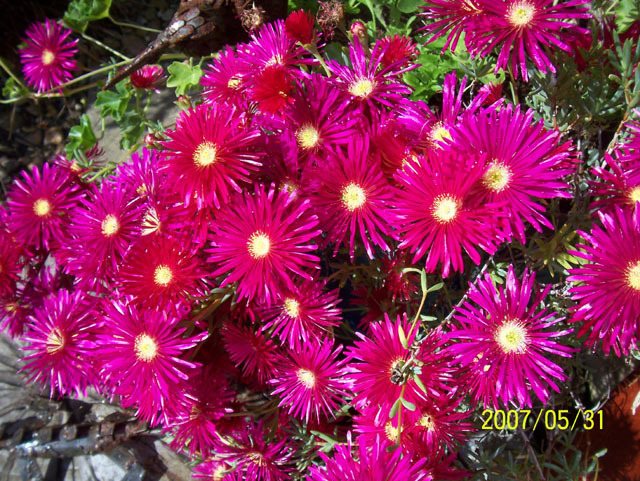
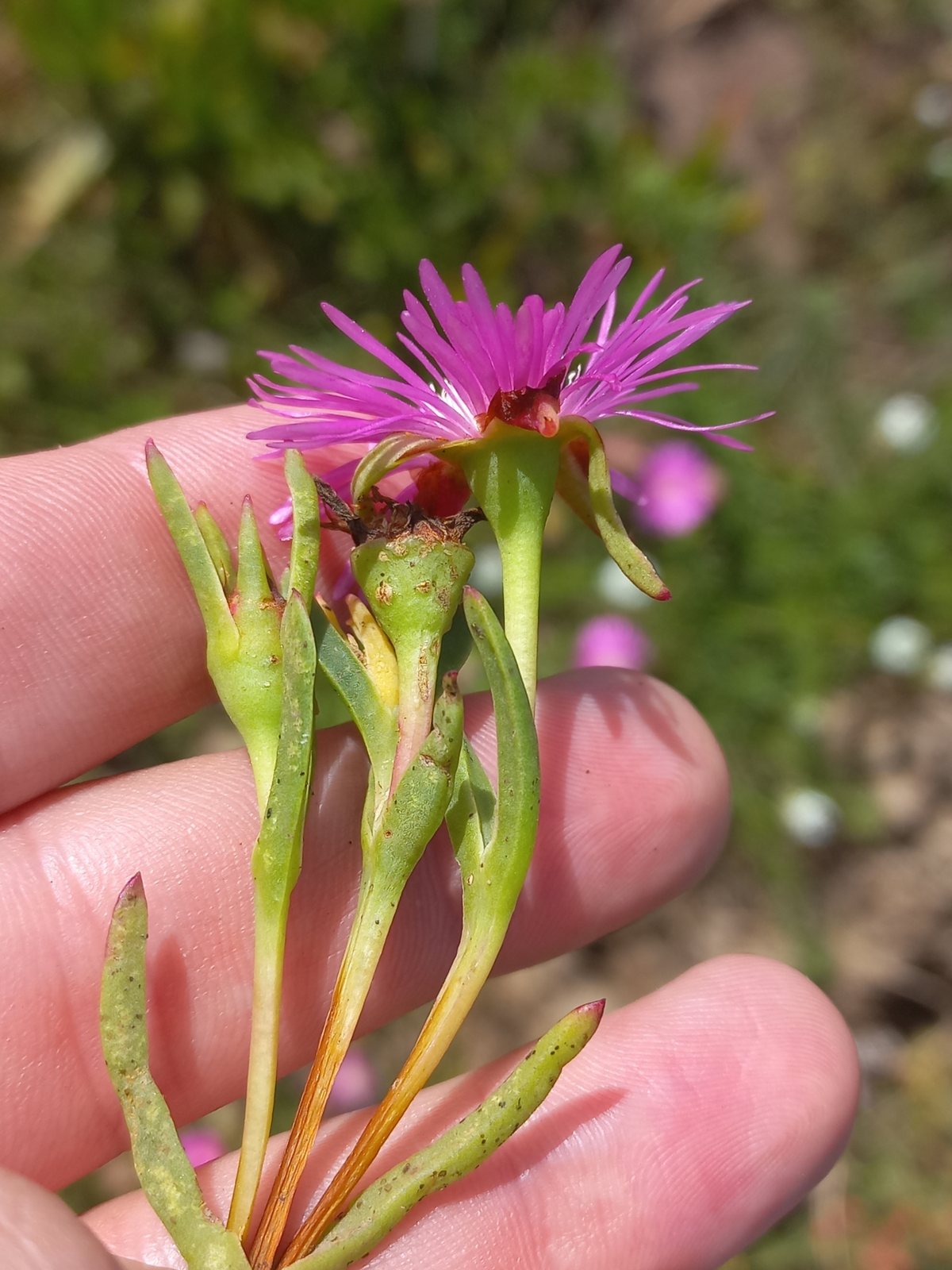
- A main flush in spring to early summer, sometimes followed by scattered flowers; typically magenta or purple-pink.
- Foliage
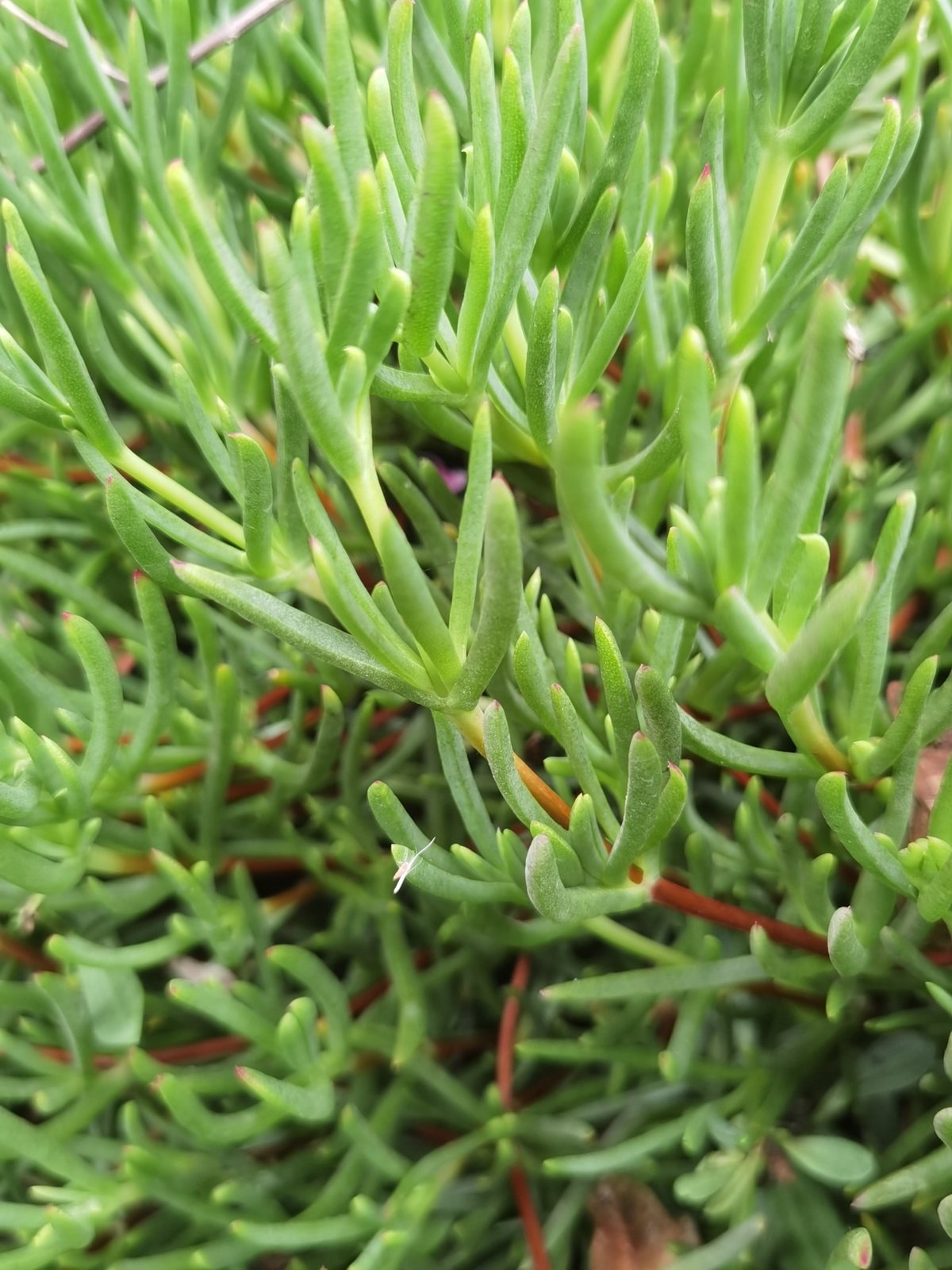
- Evergreen. Fleshy, narrow, grey-green leaves on spreading stems that become woody with age.
- Growth
- Fast in warm weather with suitable drainage.
- Care needed
- Low
The year at a glance
- Pollinators
- Drought tolerant
- Heat tolerant
- Low allergen
| J | F | M | A | M | J | J | A | S | O | N | D | |
|---|---|---|---|---|---|---|---|---|---|---|---|---|
| Flowers | ||||||||||||
| Plant |
Northern hemisphere months. In Australia, shift them by six.
- Difficulty
- Moderate
- Toughness
- Fairly tough
Will it suit your garden?
Pick your zone, country, light and whether you have pets.
Full sun is 6 or more hours of direct sun a day, part shade 3 to 6 hours, shade under 3.
How it grows
Planting day
0.7 ft (0.22 m)
full size
About 4 years to full size.
From a typical nursery size, at an average rate for this kind of plant. A rule of thumb, not a forecast.
Good to know
- Cats and dogs
- Safe
- Invasive in
- Australia
- In the garden
- Spreads vigorously: plan to contain it.
- Growth rate
- Fast
Care
Jobs through the year
- WaterApr–May, Sep, every 21 days
- Water established plants only if thoroughly dry; water new plants more often until rooted.
- WaterJun–Aug, every 14 days
- Water during prolonged dry weather only, letting the soil dry fully between soakings.
- WaterJan–Mar, Oct–Dec, every 30 days
- Check sheltered pots and give minimal water only if needed; keep almost dry.
- MulchMay
- Use a thin gravel dressing around the crown, not moisture-retaining organic mulch.
- PruneApr
- Remove dead or frost-damaged shoots once live growth is evident.
- PruneJun–Jul
- Lightly shorten straggly shoots after flowering; avoid old, leafless wood.
- ProtectJan–May, Sep–Dec
- Not winter-hardy locally: grow in a pot, shelter bright and frost-free, and return outside after frost.
- Plant after frost risk has passed, in a sunny position with excellent drainage.
- Water new plants until rooted, then let the soil dry between thorough waterings.
- Use containers with drainage holes and a gritty cactus or succulent potting mix.
- Avoid rich feeding; container plants need only an occasional weak feed during active growth.
- Use gravel rather than moisture-retaining organic mulch around the crown.
- Move pots into a bright, frost-free shelter before winter in colder climates.
Pruning. After the main flowering flush, lightly shorten straggly shoots and remove dead stems. Avoid cutting hard into old, leafless wood, which may not regrow.
Through the year
- Spring
- Remove frost-damaged or dead shoots once new growth shows which stems are alive.
- Late spring
- Plant outdoors or move overwintered pots outside after frost risk has passed, gradually acclimatising them to direct sun.
- Early summer
- Lightly trim after the main flowering flush to keep plants compact.
- Summer
- Take non-flowering shoot cuttings and root them in a gritty mix.
- Autumn
- Reduce watering as growth slows and move containers under cover before frost.
- Winter
- Keep sheltered plants bright and almost dry; check outdoor plants for standing water around their roots.
In the garden
- Trail it over a sunny retaining wall to soften the edge with foliage and spring flowers.
- Use it as groundcover on a sharply drained bank in a mild climate.
- Plant it in wide containers beside upright succulents for contrasting shapes.
- Combine it with low, drought-tolerant plants in a gravel garden, leaving room for its spreading stems.
Garden styles it suits: Mediterranean, Desert / xeriscape, Coastal, Dry gravel garden, Modern Mediterranean and Low-maintenance.
Plant it with: Lavender, Santolina, Rock rose, Blue fescue, Echeveria and Aloe.
Wildlife: Open flowers provide pollen and nectar for bees and other visiting insects.
Problems to watch for
- Root and stem rot in wet soil: improve drainage, reduce watering and take healthy cuttings if the base begins to collapse.
- Frost damage: protect from freezing temperatures or overwinter containers in a bright, frost-free place.
- Mealybugs on sheltered or container-grown plants: isolate affected pots and treat with a product labelled for mealybugs on succulents.
- Sparse flowers and loose growth in shade: move the plant to full sun and avoid excessive fertiliser.
Safety
Not known to be toxic to people, cats, dogs or horses, but reliable species-specific safety information is limited. No particular part is established as poisonous; do not treat the leaves or flowers as food.
Where it spreads. Can escape cultivation in coastal southern Australia, including Victoria and South Australia. Keep spreading stems and garden waste out of native dunes and coastal scrub.
Easily confused with
Hardy ice plant (Delosperma cooperi)
Usually forms a lower mat with finer, cylindrical leaves covered in tiny glistening bumps. It is considerably more cold-hardy than Lampranthus spectabilis.
Hottentot fig (Carpobrotus edulis)
Has much larger, thick, distinctly three-sided leaves and heavier creeping stems. Its flowers usually open yellow and may fade pink; it forms extensive mats.
The name
Lampranthus comes from Greek words meaning 'bright flower', while spectabilis means 'showy' or 'remarkable' in Latin.
Propagation. Take short, non-flowering stem cuttings in spring or summer. Let the cut ends dry for a day or two, then insert into a gritty propagation mix and water sparingly until rooted.
Checked against open data
- Accepted botanical name
- Lampranthus spectabilis
- Native range
- Cape Provinces.
Sources: GBIF (CC BY 4.0) and Trefle (CC BY 4.0). The care and design notes are LandscapeGPT's own.
See it in your own yard.
Upload a photo of your yard and see it redesigned with plants that suit your climate, each checked against your zone.