Tuberous begonia
Begonia × tuberhybrida. Family Begoniaceae. Perennial.
Also called Hybrid tuberous begonia.
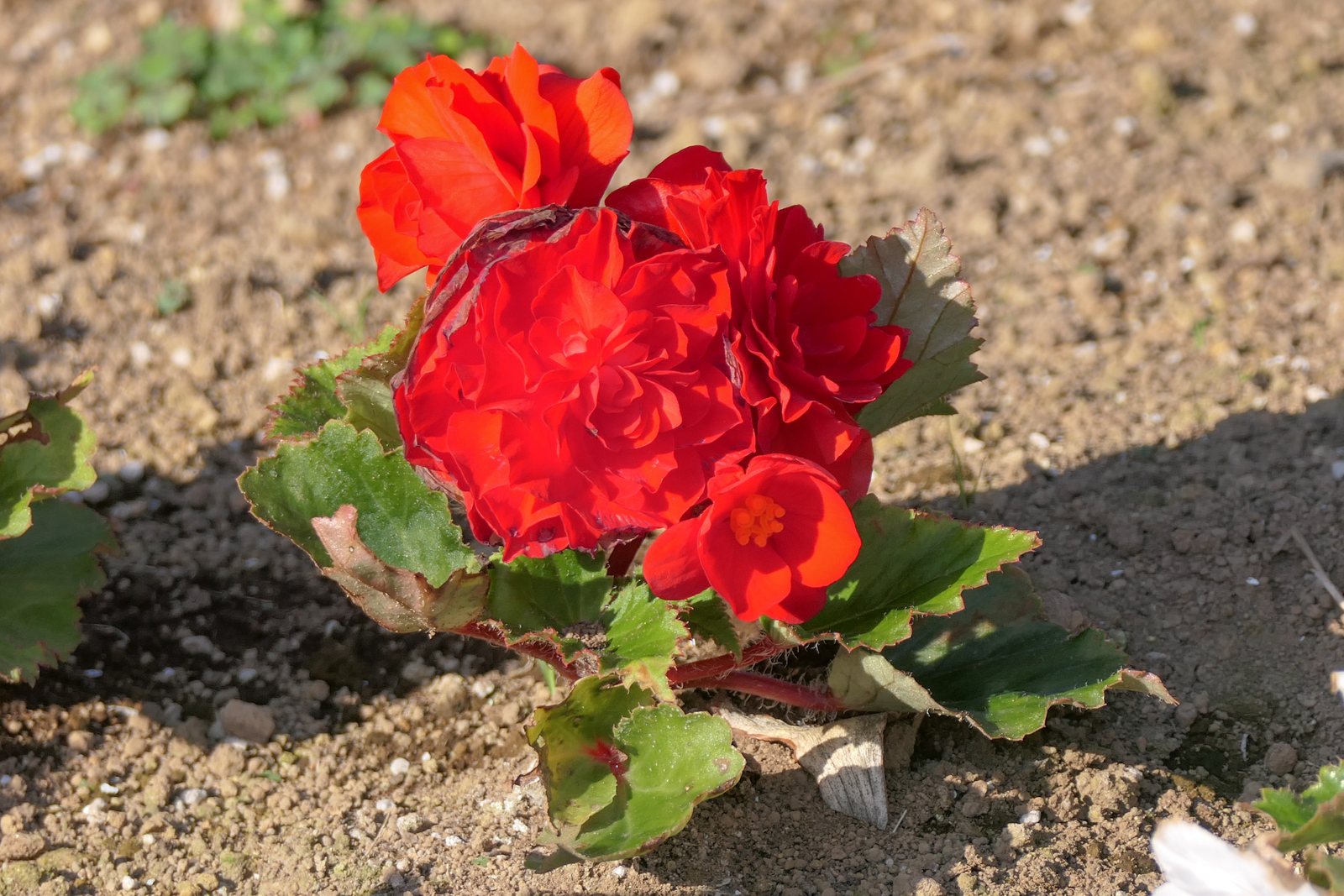
Tuberous begonia is a frost-tender, summer-flowering perennial grown for large, often double flowers in shaded beds, pots and hanging baskets. It is usually grown as an annual in cold climates, although you can lift and store the dormant tubers for replanting. It performs best where summers are mild rather than very hot.
At a glance
- Sun
- Partial shade or bright filtered light; gentle morning sun is suitable, but avoid hot afternoon sun.
- Water
- Keep evenly moist during active growth, allowing the surface to begin drying between waterings. Reduce watering as growth dies back and keep dormant tubers dry.
- Soil
- Humus-rich, freely draining soil or potting mix; slightly acidic to neutral. Avoid heavy, waterlogged ground.
- Height
- 0.5-2 ft (0.15-0.6 m)
- Spread
- 0.5-1.5 ft (0.15-0.45 m)
- Flowers
- Summer to autumn, until frost; white, yellow, orange, pink or red, often with contrasting edges. Flowers may be single, semi-double or double.
- Foliage
- Fleshy, asymmetrical leaves with toothed edges, usually green but sometimes bronze-tinted; foliage dies back for winter dormancy.
- Growth
- Moderate to fast during the growing season
- Care needed
- Medium
The year at a glance
- Deer resistant
- Low allergen
| J | F | M | A | M | J | J | A | S | O | N | D | |
|---|---|---|---|---|---|---|---|---|---|---|---|---|
| Flowers | ||||||||||||
| Plant |
Northern hemisphere months. In Australia, shift them by six.
- Difficulty
- Moderate
- Toughness
- Needs looking after
Will it suit your garden?
Pick your zone, country, light and whether you have pets.
Full sun is 6 or more hours of direct sun a day, part shade 3 to 6 hours, shade under 3.
How it grows
Planting day
1 ft (0.3 m)
After 1 year
1.1 ft (0.33 m)
After 2 years
1.2 ft (0.36 m)
After 3 years
1.2 ft (0.38 m)
full size
About 2 years to full size.
From a typical nursery size, at an average rate for this kind of plant. A rule of thumb, not a forecast.
Good to know
- Cats and dogs
- Toxic
- Growth rate
- Fast
Care
Jobs through the year
- WaterMay–Jun, every 7 days
- Check established plants and water when the surface begins drying; new plants need closer checks.
- WaterJul–Aug, every 4 days
- Keep established plants evenly moist during dry weather without wetting crowns or flowers.
- WaterSep–Oct, every 7 days
- Water only while actively growing; reduce as leaves yellow and keep dormant tubers dry.
- FeedJun–Aug, every 28 days
- In poor soil, apply a balanced liquid feed at the label rate.
- ProtectMay–Jun
- Plant only after frost risk passes and carefully stake heavy-flowered upright plants.
- DeadheadJun–Oct, every 7 days
- Cut off faded flowers and damaged leaves without pulling brittle stems.
- ProtectSep–Oct
- Lift tubers or bring plants under cover before the first frost; allow foliage to die back.
- PruneOct–Nov
- Remove dry stems after foliage has died naturally.
- ProtectJan–Mar, Nov–Dec, every 30 days
- Keep stored tubers dry, cool and frost-free; discard soft or rotten tubers.
- Start tubers hollow side up in shallow trays of compost in a bright, frost-free place; cover lightly once shoots develop.
- Plant outdoors only after frost risk has passed and nights are reliably mild; harden off indoor-grown plants first.
- Water the compost rather than the leaves and flowers, and empty standing water from saucers.
- Feed container plants every two weeks with a balanced liquid fertiliser at the label rate while actively growing.
- Support heavy-flowered upright plants with short stakes inserted carefully away from the tuber.
- Before frost, lift tubers or bring pots under cover; let foliage die back, then store cleaned, dry tubers somewhere cool and frost-free.
Pruning. Remove faded flowers and damaged leaves throughout summer, cutting rather than pulling brittle stems. After the foliage has died back in autumn, remove the dry stems before storing the tubers.
Through the year
- Late winter
- Check stored tubers and discard any that are soft or rotten.
- Early spring
- Start tubers indoors in shallow compost with gentle warmth and bright, indirect light.
- Late spring
- Harden off and plant outside after the last frost, once nights are mild.
- Summer
- Water regularly, feed container plants and support stems carrying heavy flowers.
- Summer to early autumn
- Remove faded flowers and check for mildew, aphids and stem rot.
- Autumn
- Reduce watering as leaves yellow; move plants under cover or lift tubers before frost.
- Winter
- Keep dormant tubers dry, cool and frost-free, checking occasionally for decay.
In the garden
- Use upright forms in pots beside shaded entrances, where their flowers can be seen close up.
- Plant trailing forms in hanging baskets beneath a porch or lightly shaded pergola.
- Add seasonal colour to shaded borders in front of ferns and hostas, using raised or well-drained planting pockets.
- Combine pale pink or white flowers with silver-leaved foliage plants for a restrained courtyard display.
Garden styles it suits: Modern courtyard, Victorian, Cottage garden, Romantic rose garden, Pastel border and Small-space.
Plant it with: Ferns, Hostas, Fuchsias, Coleus, Impatiens and Silver falls dichondra.
Wildlife: Single flowers may attract some insects, but heavily double forms offer little accessible pollen or nectar. It is not a strong choice for a pollinator-focused planting.
Problems to watch for
- Powdery mildew: allow space for air circulation, avoid drought stress and remove badly affected leaves.
- Grey mould and stem or tuber rot: remove decaying flowers promptly, improve drainage and keep water off the crown; discard rotten tubers.
- Vine weevil: larvae can destroy roots and tubers, especially in pots; inspect rootballs and use an appropriate beneficial nematode treatment when soil temperatures suit the product.
- Leaf scorch and bud drop: protect from hot sun, drying winds and extreme heat, and avoid alternating drought with heavy watering.
Safety
Toxic to cats, dogs and horses if eaten, with the highest concentration of harmful soluble oxalates in the tubers and other underground parts. Ingestion can cause salivation, vomiting and more serious illness after substantial amounts; contact a veterinarian promptly. It can also be harmful to people if eaten, particularly the tubers; do not treat it as an edible plant.
Easily confused with
Wax begonia (Begonia Semperflorens Cultorum Group)
Usually has smaller flowers, rounded glossy leaves and a compact, bushy habit; it has fibrous roots rather than a dormant storage tuber.
Rieger begonia (Begonia × hiemalis)
Often sold as a compact flowering houseplant with clusters of smaller, rose-like flowers; it is not normally managed through the same dry tuber dormancy.
Bolivian begonia (Begonia boliviensis)
Typically has narrower leaves and slender, hanging flowers with long, pointed petals rather than the broad, rounded blooms of most tuberous hybrids.
The name
Begonia honours Michel Bégon, a French administrator and patron of botany, while tuberhybrida refers to the group's tuber-forming hybrid origin.
Propagation. Take basal shoot cuttings in spring, keeping them warm and humid but not waterlogged. Experienced growers can divide large tubers in spring, leaving a healthy bud on each section and allowing cut surfaces to dry before planting. Seed-grown plants are slower and may differ from the parent.
Checked against open data
- Accepted botanical name
- Begonia tuberhybrida
Sources: GBIF (CC BY 4.0). The care and design notes are LandscapeGPT's own.
See it in your own yard.
Upload a photo of your yard and see it redesigned with plants that suit your climate, each checked against your zone.